Mann Gulch survivor to speak at anniversary

UPDATE AT 2:55 MT, August 2

We received an email last night from Susan Schroedel who said:

Bob Sallee will NOT be in attendance at the 60th anniversary of the Mann Gulch fire. My husband and I spoke with him two days ago. My husband and many other former jumpers will be in attendance.

————–

From the Independent Record, Helena, MT:

One of the survivors from the 1949 Mann Gulch fire, Bob Sallee, will be at the Meriwether picnic area Aug. 2-5 as part of ceremonies commemorating the 60th anniversary of the deadly blaze.

On Aug. 5, 1949, a wildfire trapped 15 smokejumpers and a fire guard in Mann Gulch, near the Gates of the Mountains on the Missouri River. Before it was controlled, the fire took the lives of 13 men and burned nearly 5,000 acres.

The Helena National Forest, along with the National Smokejumpers Association, will be at the nearby Meriwether picnic area with informal interpretive programs highlighting the Mann Gulch Fire, impacts the Mann Gulch tragedy has had on firefighting techniques and smokejumping and the associated equipment.

Four smokejumpers — Sallee, John McKinnon, Carl Gidland and Roland Anderson — also will be at the Meriwether picnic area to speak to people about Mann Gulch, current and historic fire fighting techniques and much more.

For more information about the event, contact the Helena Ranger District office at 449-5490.
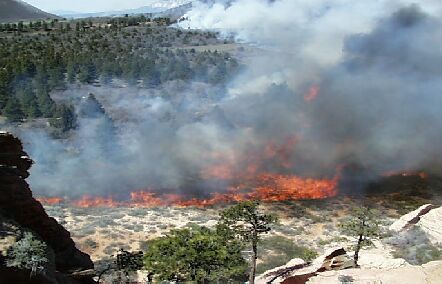
 

Fire in Zion NP closes part of park

hvjournal photo

The Cliff fire in Zion National Park has required that portions of the park be closed, including the Kolob Canyond District and the 5-mile Kolob Canyons Scenic Drive located at Exit 40 on Interstate 15.

Lightning ignited the fire on July 28, and another thunderstrom on July 30 slowed the spread. It has been mapped at 744 acres, with 350 acres being inside the park. It is 20% contained.

Another university conducting Rx fire without PPE

In April of 2008 we told you about Knox College in Galesburg, IL conducting a prescribed fire with the students wearing no person protective equipment. Here is one of the photos from that article.

Student at Knox College

Now it turns out that one of the premier forestry schools in the world, the Yale School of Forestry, also conducts prescribed fires with the participants wearing no PPE except for hard hats. One of the “lecturers”, we’ll give her a small amount of credit, was wearing a Nomex shirt.

They posted a video of their research burn on the web. There is no way to imbed it, but HERE is a link. It is titled F&ES Students with Prof. Cam Fighting Wildfires With Fire.

Here are some screen grabs from the video.

Here is more proof that the policy of very little PPE at Yale is institutionalized, in this photo from the 2002 Yale Forest News which shows a Masters of Forestry student.

Yale Forest News, 2002

It is inconceivable to me how professors at a college or university, TEACHING fire classes, can train their students to conduct prescribed fires without at least Nomex pants and shirts. Or even long-sleeve cotton shirts.

Some of the federal land management agencies are requiring college degrees for the higher-level fire management jobs. Of course the graduates all have to be re-trained.

Elvis douses Oshkosh

“Elvis”, a Sikorsky S-64F Aircrane helitanker operated by Erickson, continues to impress at the Oshkosh air show. This is the first video I have seen of the Aircrane “scooping” water, rather than drafting.

(THE VIDEO IS NO LONGER AVAILABLE)

Thomas Marovich services

Family members, friends and firefighters hold a walking procession from the church to the cemetary at the funeral of Thomas David Marovich Jr. in Hayward, Calif. Photo: Liz Hafalia

From the San Francisco Chronicle:

As a kid, Thomas Marovich Jr. played with toy fire trucks. He channeled his childhood fascination into a firefighting job with the U.S. Forest Service. Whenever he was off duty, he flashed his famous “million-dollar smile” and served as a mentor to young firefighters in training.

That was how Marovich, 20, was remembered today at an emotional Mass in Hayward, where he grew up.

Marovich died July 21 after falling from a helicopter during a training exercise in Humboldt County.

More than 500 relatives, friends and fellow firefighters, their badges wrapped in black mourning bands, gathered at St. Clement Church in Hayward to honor a man described as selfless. Everybody called Marovich “T.J.” for “Tom Jr.”

After the service, mourners walked along Mission Boulevard as an honor guard, motorcycle officers and fire engines escorted Marovich’s casket to nearby Holy Sepulchre Cemetery, where he was buried.

Marovich fell 200 feet from a Bell 212 helicopter at the Backbone Helibase in Willow Creek, authorities said. The same helicopter performed a fly-by at the cemetery.

Marovich was a second-year firefighter apprentice with the Forest Service at the Modoc National Forest. He had been practicing rappelling maneuvers as part of training that is required every two weeks.

Witnesses on board the helicopter reported problems with the harness he had been using, relatives said. His death remains under investigation, Forest Service spokesman John Heil said.

Through tears, Christy Marovich, 21, told those in attendance that she was consumed by nightmares about her brother falling from the helicopter. As firefighters in the audience wept, she said she had images of him simply bouncing back up, as if he were on a trampoline.

She said her brother protected her against people who broke her heart and served as an inspiration to young people who wanted to become firefighters. “You did not become a hero on the day you died,” she said. “You were a hero in the days you lived.”

Fire photos

I love looking at fire photographs.

A helicopter dips water out of a swimming pool while working on a fire near Avila, Spain. Photo: Pedro Armestre
A Dutch East India Company replica of the Prince Willem vessel burned in the historical museum harbor in Den Helder, Netherlands, Thursday. The replica was built in 1985. Photo: Maurice Amoureus
Residents watched a fire burn near Avila, Spain on Thursday. Photo: Pierrephilippe Marcou

Breckenridge, Colo residents reverse fire-safe ordinance

The residents of Breckenridge, Colorado (map) recently convinced the town council to repeal an ordinance passed in June which required homeowners to thin the vegetation around their houses. Ordinances like this are common in California and some other areas, but in the high-scale ski resort community some of the residents gathered 330 signatures on a petition asking the council to repeal the law or put it to a public vote. The council bowed to pressure and opted for the former.

One of the residents said:

People buy lots for the trees and the view. The trees are a valuable asset. Nobody wants to look at Breckenridge with no trees.

Other residents said there was little evidence that the ordinance’s provisions would be effective against a massive blaze.

Perhaps some education would be appropriate in Breckenridge, since making a home fire-safe does not require that every tree be removed. Generally, if you have a 10-15 foot spacing between the crowns of the trees a fire will not spread through the crowns, but will be limited to a ground fire, more easily suppressed. And, there is plenty of evidence that thinning vegetation, coupled with fire-safe building standards, can prevent a structure from burning during a wildfire.

The local fire district, oddly named the “Red, White, and Blue Fire Protection District“, which includes Breckenridge, promoted the ordinance and disputed the argument that creating defensible space is ineffective in fighting wildfires.

“There is plenty of science behind it”, said Capt. Kim Scott, spokeswoman for the fire district.

The Firewise site has plenty of facts about being fire safe.

During the next city council meeting, residents are going to ask the council to adopt resolutions declaring that the earth is flat, and that the 1969 moon landing was filmed in a movie studio in New Mexico. (kidding!)

Here are a couple of photos of homes that did not burn during a major wildfire, because the residents used fire-safe building materials and thinned the vegetation around the structures.

A home left standing after a fire in Clairmont, California.
A fire-safe home surrounded by vegetation that had been thinned. November 14, 2008, Santa Barbara, California. (Robyn Beck photo)

747 Supertanker’s world tour

Evergreen continues their road trip, uh, air trip, with the 20,000-gallon 747 air tanker they call a “Supertanker”. On July 10 they were in Sacramento. Last week they were in France, Germany, and Spain where they made their first ever drop on a real fire during a demonstration in Spain. And on Tuesday they were in Edmonton, Canada and Fairbanks, Alaska.

The company will donate the services of the 747 today, making a drop on the Railbelt Complex of fires, which has burned 340,000 acres 12 miles northwest of Nenana, Alaska. This will be the first drop on a real fire in the United States for the aircraft.

Sam White of Evergreen points out the four nozzles that dispense retardant. Photos by Eric Engman
The pressurized retardant tanks on the 747 Supertanker. The retardant is forced out by compressed air, much like on the MAFF C-130 air tankers.

And speaking of very large air tankers (VLAT), in a cost-saving move, CalFire recently downgraded their exclusive use agreement for one of the DC-10 air tankers (tanker 910) to a Call When Needed (CWN) agreement, meaning they will only pay for the air tanker when and if they use it. They still have CWN agreements for the second DC-10 operated by 10 Tanker Air Carrier, Tanker 911 and the 747 air tanker.

The U.S. Forest Service issued a solicitation for VLAT’s on June 25. We have not heard if they have awarded any contracts through this process.

Lessons learned from the Redrock-Trailer1 fire norovirus incident

Dozens of people became sick at the Redrock and Trailer 1 fires 25 miles north of Reno, Nevada around July 19. Tests on some of them revealed that they had been infected with the Norovirus. The Medical Unit Leaders, Chris Graves and Diana Ludwig (trainee) prepared a lessons learned document, which is now on our Documents page, titled “Redrock-Trailer fires: Norovirus Lessons Learned”.