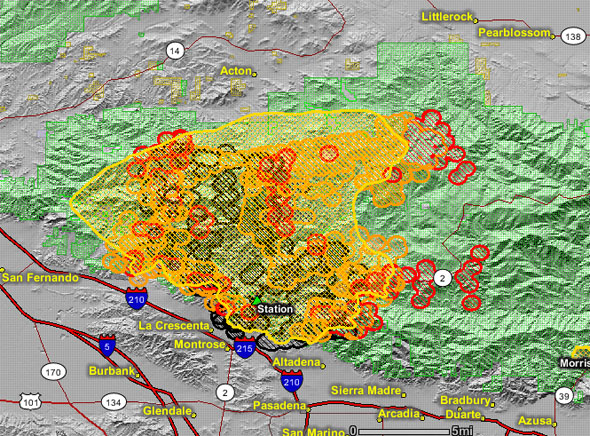
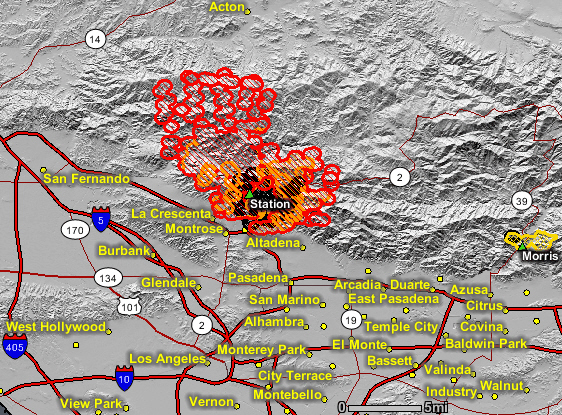
This updated map of the Station fire shows heat detected by satellites at 12:26 p.m. on Monday, August 31. Most of the new fire growth, compared to the map we posted earlier Monday morning, is on the east side, and appears to show spot fires quite a distance out ahead of the main fire.
The red areas show heat that was detected within the previous 12 hours. The yellow area is the fire perimeter as provided by the fire officials. GEOMAC
The size of the fire, as we reported earlier Monday afternoon, is estimated at 105,000 acres.
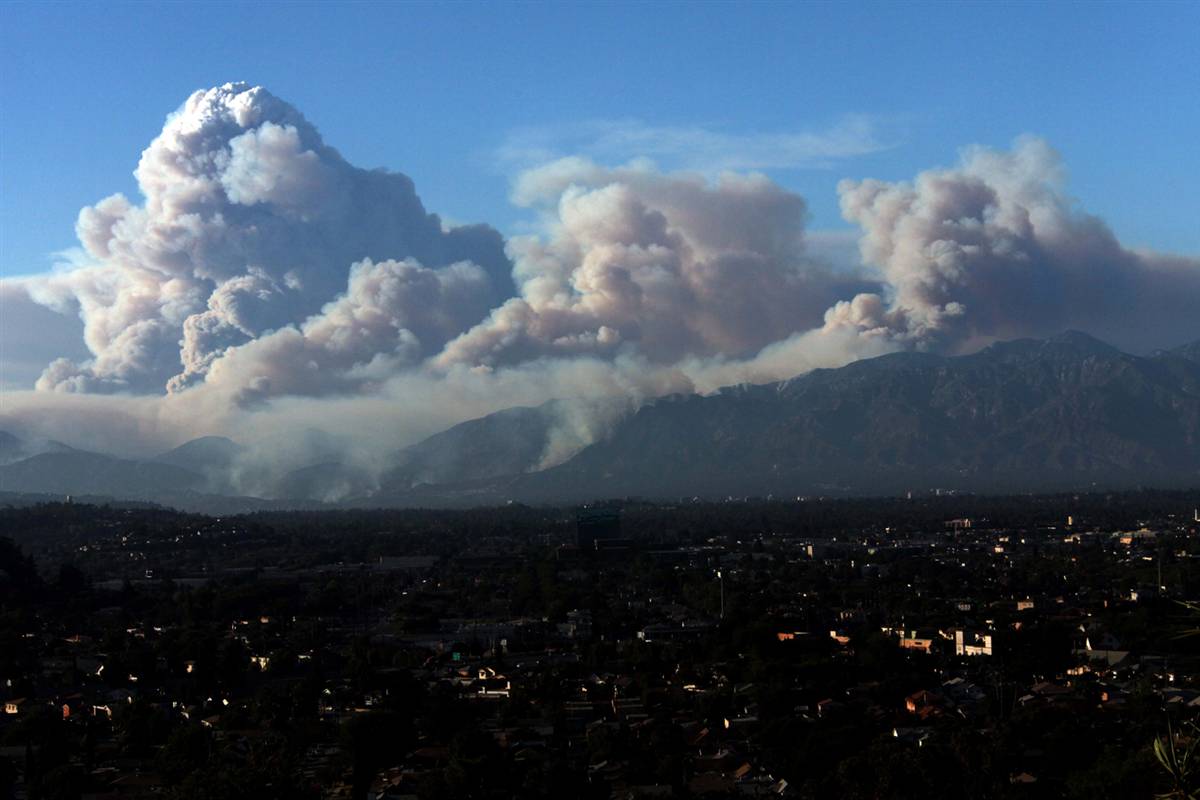
This fire has produced a lot of incredible photos. Here is one that the LA Times distributed via Twitter. We don’t know who the photographer was. We were informed by a commenter that the photographer’s name is Wally Skalij.
The Station fire near Los Angeles doubled in size Sunday night to an estimated 85,760 acres. It is a fatal fire, after two firefighters, Arnaldo Quinones, 35, of Palmdale and Tedmund Hall, 47, of San Bernardino County were killed when they drove off the side of a road south of Acton around 2:30 p.m. on Sunday. The firefighters worked for Los Angeles County Fire Department.
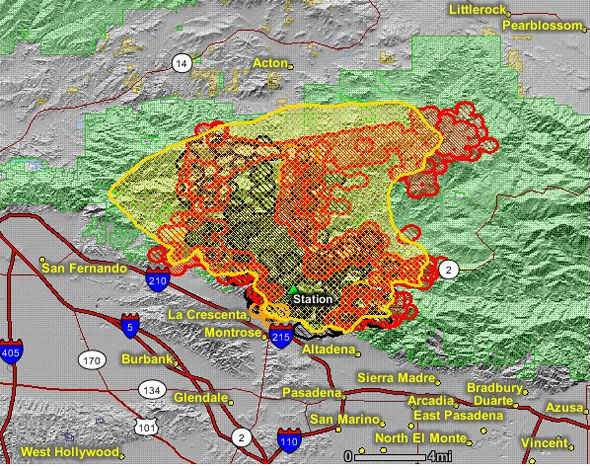
The map of the Station fire shows heat detected by satellites Monday morning at 3:02 a.m. The red areas show heat that was detected in the last 12 hours. The yellow line is the fire perimeter provided by the Incident Management Team.
Only about 5% of the fire is contained, a small section of the fire perimeter near Altadena.
More structures were destroyed south of Acton overnight and Monday morning, adding to the 18 homes that burned in Big Tujunga Canyon earlier. The exact numbers will not be known until firefighters can get back into the burned areas to conduct damage assessments.
More residents were forced to evacuate overnight as the fire spread on three sides, making large advances on the west, north, and east sides. It is still about 2-3 miles from Acton on the north, and has come to within 7-8 miles of Littlerock and Pearblossom on Highway 138 on the northeast side.
At least 6,600 homes were under evacuation orders Sunday night. Residents are being told to call 211 to get the latest evacuation information.
The photo above shows the west flank of the Station fire near La Cresenta Valley, at 8:57 PT Monday morning. The fire is beginning to break through an inversion. From the local Fox TV station.
While most large fires in southern California are driven by Santa Ana winds, this fire, while occasionally influenced by moderate winds, is primarily driven by steep slopes, heavy vegetation or fuel loading, and extreme weather, including high temperatures and very low humidity.
Wildfire Today explored this concept in an August 26 article. During the last 130 years, through 2007, six of the eight “megafires” larger than 123,000 acres (50,000 ha) were pushed by Santa Ana winds during the first one to four days. The other two megafires were influenced by extreme weather, much like we have seen in southern California since Tuesday, August 25.
There is not going to be much relief from the extreme weather during the next two days. In the valley areas near the fire, temperatures will be in the mid to high 90s with relative humidity in the low teens, which is a little better than the last several days. Winds will be moderate, maxing out at 9-10 mph out of the southwest.
A P3 Orion drops on the Station fire Aug. 30 near Acton, California. Photo: Dan Steinberg
This photo is one of the best fire photos I have ever seen. When I first saw it, I thought it was a great photo with plenty going on–the two fire vehicles, massive nearby flames, the house, and the firefighters–and then noticed the air tanker making a drop between the house and the intense flames. Holy Crap! What a photo!
This one is pretty impressive too, of the Station fire near Los Angeles:
The Angeles National Forest is reporting that the Station fire has now burned 42,500 acres. It is 5% contained and is being fought by 2,575 personnel. There have been at least two firefighter fatalities and four injuries.
The fire was extremely active Sunday afternoon. During most of the day smoke conditions made it very difficult and at times impossible for air tankers and helicopters to operate over the fire. Air tankers were able to “paint” some of the area around Mt. Wilson with fire retardant at times when they could navigate through or around the smoke. The fire is now burning close to the peak which houses hundreds of communication sites for the Los Angeles area.
Local residents are being advised to call 211 to get the latest evacuation information.
The weather on Sunday contributed to the rapid fire spread, with the temperature at the nearby Little Tujunga Forest Service station reaching 101 degrees, while the relative humidity bottomed out at 10% at 2 p.m. Similar weather, including an extension of the red flag warning, is expected for Monday.
Mt. Wilson at 8:20 p.m. PT, August 30, 2009. Webcam of UCLA Dept. of Physics and Astronomy
At a press conference on Sunday officials announced that 18 structures have been destroyed by the fire, adding that the number will probably grow as firefighters work their way back into the burned areas and assess the damage.
In a news conference late today officials announced that two firefighters with the Los Angeles County Fire Department (LACFD) died today in a vehicle accident while working on the Station fire near Mt. Gleason in southern California. The accident happened earlier this afternoon, and the families of the fallen firefighters have been notified, they said at the news conference.
Details about the accident were not provided, but television footage showed a truck that had rolled over.
lacfd *Station IC* Report of fire department vehicle over the side 400+ feet with unknown outcome. Copters unable to get in to search. Keep them in our prayers.
Our sincere condolences to the families and co-workers of the firefighters.
We will update this as more information becomes available.
This photo of the Station fire was taken by the automatic web cam on Mt. Wilson near Los Angeles at 2:18 p.m., August 30. The Angeles National Forest said via Twitter 40 minutes before the photo was taken that Mt. Wilson was “not currently threatened”.
The LA Times has the scoop on the fleet of air tankers being used in southern California:
“Despite state and local budget cuts, crews have the air support they need to handle the Station fire, officials said.
The state budget that Gov. Arnold Schwarzenegger signed last month canceled the contract for California’s largest firefighting tool, a DC-10 jet, to save taxpayers about $7 million. It was replaced with a contract for two DC-10s on a pay-as-you-go basis, but at a higher hourly rate. But after several fires hit Northern California earlier this month, authorities reversed that decision and signed a 90-day contract for the plane, which costs taxpayers an average of $43,404 a day.
“The determination was made that it would cost more to have it on an as-needed basis than on an exclusive-use contract,” said Cal Fire aviation chief Bill Payne.
DC-10 drops on the Station fire near Acton, California, August 30, 2009. Photo: Irfan Khan
For many Southern California residents whose homes were threatened by the Station fire, the appearance of the DC-10 Saturday at the Station fire’s northern and southern flanks came as a welcome relief. The plane could be seen making drops of its bright red flame retardant on the hills of the Angeles National Forest, then making sharp banks as it turned around for additional passes.
Before the arrival of the DC-10, officials had been relying on helicopters and some smaller fixed-wing aircraft to drop water and fire retardant on the Station fire.
The U.S. Forest Service contracts a Martin Mars air tanker, sometimes called a “Super Scooper,” which carries a flame retardant foam concentrate. But that plane has had mechanical problems and has not been used to fight the Station fire. In addition, Los Angeles County has a contract for two additional air tankers, which it leases from the government of Quebec. But those planes — which are CL-415s — are not available until Tuesday, said Payne.
Initially, officials thought the county’s planes would not arrive in the area until Thursday. But at a press conference today, officials said the CL-415s would be available starting Monday and that a second DC-10 also had been requested.
The state will have to pay for that second DC-10 on a pay-as-you-go basis. According to its agreement with the contractor, Victorville-based 10 Tanker Air Carrier, Cal Fire guarantees to pay the company a minimum of $66,060 a day for a minimum of five days, Payne said. That amounts to about $330,000.”
==============
The above article from the LA Times refers to the Martin Mars as a “Super Scooper”, but as we were reminded by Kelly Andersson, that term is usually reserved for the Bombardier (formerly Canadair) CL-415 or CL-215. We also corrected the name of the CL-415 in the article, incorrectly referred to as “CL-14”.
Kelly documented some of the history of the SuperScoopers in a 1998 article that appeared in Wildland Firefighter magazine.
Thanks Kelly.
By the way, the difference between the CL-215 and the 415 is that the 415 has turboprop engines, and has an updated cockpit, aerodynamics enhancements and changes to the water-release system as well.
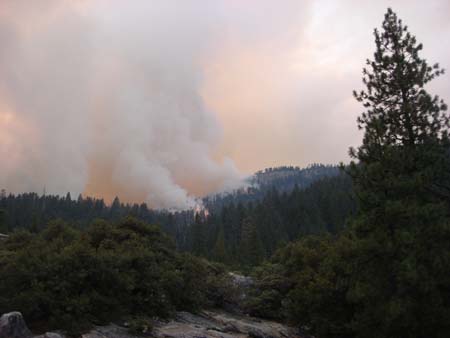
The Big Meadow fire, which was planned to be a 90-acre prescribed fire, has fire lines around about 80% of the perimeter but continues to spread on the north side where it has crossed Big Oak Flat Road and is within one to two miles of Tioga Road. Officially, as of 1:00 p.m. PT, August 30 it has burned 4,382 acres and is 50% contained.
This map of the Big Meadow fire was updated at 6 a.m. this morning.
It is interesting to see the completed dozer line, designated by the xxxxxx. It is unusual to use dozers in National Parks, but I am sure the National Park Service feels a great deal of pressure to put out this escaped prescribed fire and minimize the acres burned outside the park boundary.
Big Meadow fire, August 27. NPS photo
A 10 a.m. news release from the park had this information:
Yesterday, firefighters made good progress improving fire lines east of El Portal. The active portion of the fire is in the north and northwest flanks away from Foresta and El Portal. Today, the highest priority continues to be improving fire lines east of El Portal and structure protection in Foresta. Firefighters are aided by 11 water dropping helicopters and six air tankers. Control difficulties continue to be hot weather, low humidity, and steep terrain.
Eric Spiegelman used a Nikon D5000 still camera to take time lapse photos of the Station fire near Los Angeles, then with Quicktime stitched the images together into this very cool video. I’m not sure what day it was shot, but the video was uploaded on Saturday evening, August 29.
(THE VIDEO IS NO LONGER AVAILABLE)
And HERE is a link to a web cam in Mount Wilson that is threatened by the fire. The peak has a bazillion dollars worth of communications equipment that if put out of commission would cause major problems for TV and radio stations in the Los Angeles area as well as government agencies suppressing the fire.
The updated map of the Station fire near Los Angeles shows major spread of the fire on the north side. The map shows heat detected by satellites at 2:16 a.m. Sunday morning. The red areas are the most recently burned. The Morris fire to the east shows no recent heat.
GEOMACMap of Station fire produced by the incident management team. The correct date should be August 30.
As of early Sunday morning the Station fire had grown to 35,000 acres and had come to within 5 miles of the community of Acton. The southeast wind of Saturday changed to a down-canyon wind overnight, pushing it closer to some residential areas.
Extreme fire behavior caused the fire to spread in all directions on Saturday. Firefighters reported 80-foot flames as the 15-20 foot high brush burned.
The Station fire burns above Altadena, Californiaon August 28. Photo: Michal Czerwonka
On Sunday morning there may be an inversion which could slow the spread, but when it breaks up, extreme fire behavior could be seen again. The area is still under a red flag warning for high temperatures and low relative humidity.
Evacuations are in effect for areas in La Canada-Flintridge, Rockdale, Acton, Pasadena, La Crescenta, Altadena, Glendale, and Big Tujunga Canyon. For official information about evacuations go to the LA County Fire Department site.
Photo: Michal Czerwonka
Three to five homes were destroyed in Big Tujunga Canyon on Saturday where three civilians were flown out by helicopter with burn injuries.
About 1,804 personnel are assigned to the fire and it is 5% contained.