Today we acquired a “username” or “vanity url” for the Wildfire Today Facebook page. And, it’s so easy even I will be able to remember it. Now our web address at Facebook is—
Just type that into the web address bar from anywhere, and you can get there with just one click. You don’t have to be signed in to Facebook to visit the page. In case you were wondering, formerly the address for the page at Facebook was http://www.facebook.com/pages/Wildfire-Today/53544254768. That still works, but I like the shorter one better.
But you don’t need to visit both this web site AND the Facebook page. THIS site has all of the Wildfire Today articles. Most, but not all of them also appear on the Facebook page.
There are, however, some features that are available to Facebook users at the Facebook page that are not available here. Users can write on the “wall” without having to wait for an administrator to approve it. And all of the wall postings and comments are visible right on the main page. At WildfireToday.com, here, you have to click on each individual article in order to read the comments.
And, Facebook users can post videos and photographs on the Wildfire Today Facebook page. Of course you can also submit them here through our Contact page. Call us or send us a message and we’ll give you our email address or snail-mail address. We love to post photos and videos from our readers. (We also like to wear fire T-shirts they send in 🙂 )
So, which ever one floats your boat… Facebook.com/WildfireToday, or WildfireToday.com. Not everybody loves Facebook, but a lot of folks do.
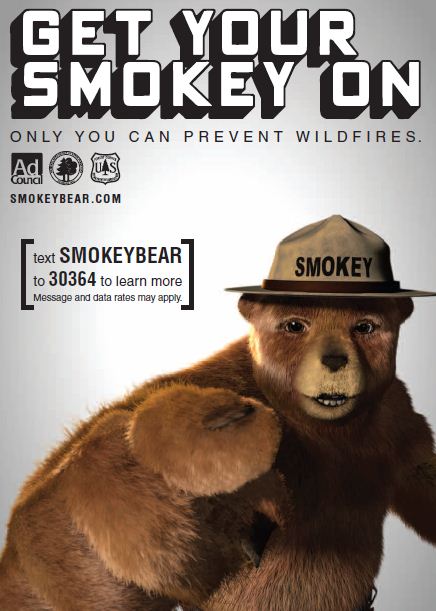
The Advertising Council, the U.S. Forest Service, and the National Association of State Foresters released today a new Smokey Bear advertising campaign. It includes the poster above, the video below, radio PSAs, and an educational DVD. The announcement is a little ahead of the Smokey Bear web site and his Facebook page, which will probably have more details later.
The video is about 8 minutes long. It is animated and is directed at children, educating them about campfire safety.
The video is pretty good, and will probably be effective for the intended audience, young children.Sam Elliott But I was disappointed that the voice of Smokey is no longer Sam Elliott,
who took over the role as Smokey’s voice in June, 2008 when a new series of PSAs was launched. One of Elliott’s first PSAs was cancelled after a controversy about the use of ATVs in the forest, but his voice was used in other videos. Washington D.C. radio station WMAL personality Jackson Weaver served as Smokey’s voice until his death in 1992. The voice was then silent until Elliott resurrected it in 2008.
Awarding air tanker contracts to the lowest bidders may at first sound like good fiscal management, but it means that the only aircraft private operators can afford to supply at those low prices are 40 to 60 year old military aircraft that were determined by one government agency to be no longer practical to operate. And then another agency, The U. S. Forest Service, without thinking, operates them through a contractor, using them on missions for which they were not designed, flying low and slow, into, and usually out of canyons.
A “Blue Ribbon Panel”, chaired by former NTSB Chairman James E. Hall, evaluated the air tanker program following the two crashes in 2002 in which the wings fell off very old military surplus aircraft, killing their crews. The panel issued a report in December, 2002, which said in part:
Air tanker 44, which reportedly lost its brakes when it went off the runway while landing at Rocky Mountain Metropolitan Airport (JeffCo) in Colorado on Friday, was moved off 120th Avenue yesterday. Crews used a crane, a tow truck, and a large flatbed truck to move the P-2 Neptune to a location where it will be examined by the NTSB and the U. S. Forest Service. Thankfully, the pilots walked away from the crash.
Pilot Steve Jensen with the Firewatch Cobra Helicopter. Photo by Rick Hartigan, Fire Information Officer, Arizona Central West Zone Incident Management Team. 8/3/2006
The U.S. Forest Service has two helicopters they call Firewatch Cobras which are retrofitted Bell AH-1 Cobra attack helicopters. The USFS has them outfitted with infrared sensors so that they can be used for close in intelligence support for ground troops, GIS mapping, real time color video, geo-referenced infrared, and infrared downlink. In addition to intelligence gathering, they are also used as a platform for an Air Attack Group Supervisor (ATGS) or a Helicopter Coordinator (HLCO).
The FLIR Turret (Forward Looking Infrared) is equipped with an infrared camera, low light color camera, spotter scope, laser range finder, and a laser pointer. Firewatch Cobra on the Bar Complex Fire. USFS photo
This year one of the ships is based at Redding, California, and the other is just outside of Boise, Idaho at Lucky Peak Helibase. They are owned by the USFS, and staffed by an ATGS, but they are contractor supported and maintained. (Could this be the model for a new fleet of modern, safe, air tankers? Government-owned and contractor supported?)
The helicopter module includes a “Data Van” staffed with a GIS technician who can use the shape files produced on the helicopter to make perimeter maps of the fire. The van is also used for receiving and viewing the downlinked live video feed from the helicopter.
Firewatch Cobra Data Van
Specifications of the Firewatch Cobras (from the Firewatch Cobra web site)
Propulsion
Number of Engines: 1 [a newer version currently being used by the Marines has two engines]
Engine: T53-L-703
Horsepower: 1800
Performance
Range: 362 miles
Cruise Speed: 166 mph
Max Speed: 219 mph
Climb Rate: 1,680 feet per minute
Ceiling: 10,800 feet
N109Z was manufactured in 1969. N107Z was manufactured in 1983.
Michael Jamison has an excellent, very well-written article in the Missoulian, describing the job of a Park Ranger at Glacier National Park and how it has changed — and not changed — over the last 105 years. It is worth reading. Here is an excerpt:
…The biggest change, Johnson said, is with new recruits. Young ranger-hopefuls raised in town on video games want to be cops, he said, not woodsmen and cowboys.
“What we’re losing is the jack-of-all-trades-and-master-of-none,” Johnson said. “And that’s too bad, because that’s always been the best part of the job.”
Well, almost the best part. There’s also the wilderness lake shimmering golden with pine pollen, the sunsets and meteor showers and the barred owl’s hoot just outside the cabin door, the wild edge of keeping the very same office Liebig kept.
Ober, like many of the seasonal rangers, doesn’t even know exactly how much he makes on the job – “but you can’t ask for a better way to spend a summer.”
Longtime seasonal employee Pat Hagan, who has led more tourists on more nature walks than he’d care to count, still shows up eager for the next.
“Mountains, waterfalls, flowers, wolves and grizzlies all right there in your office,” Hagan wrote. “The nearest wall is a glacial arête, and windows seem to open directly onto opportunity.”
It’s Liebig’s opportunity, and Moses’, too, 100 years now of
stiff-brimmed exploits among the peaks.
“There’s really nothing like skiing through here in the winter, or rowing a boat on the North Fork and thinking, ‘Hey, I’m getting paid today,’ ” Blickhan said.
“On those days, especially, it’s the best job in the world.”
Air tanker 44, a P2V-5 Neptune operated by Neptune Aviation in Missoula, MT, experienced a hydraulic failure upon landing, had no brakes, and went off the runway at Rocky Mountain Metropolitan Airport (JeffCo) in Colorado at 12:30 p.m. today (map). Both pilots self-evacuated and were walking around when fire apparatus arrived to put out a fire in one of the engines.
The retardant base at the airport, which had been supporting the Cow Creek fire in Rocky Mountain National Park (photo) and the Round Mountain fire, shut down for the rest of the day.
The air tanker was built in 1954 and had just completed a drop on the Cow Creek fire.
This is the third accident involving Neptune’s P2 air tankers within the last two years, with the other two being fatal for the three-person crews. On September 1, 2008 Tanker 09 crashed while attempting to take off from the Reno airport when an auxiliary jet-assist engine disintegrated. On April 25, 2009 Tanker 42 flew into a mountain near Toole, Utah while ferrying from Missoula to Alamogordo, New Mexico for a fire assignment.
If my math is correct, this reduces the number of large air tankers on exclusive use contracts in the United States from 19 to 18.
These three crashes of aircraft from one company in less than 2-years brings to mind the two crashes of air tankers operated by Hawkins and Powers in 2002 which resulted in all large air tankers being grounded for an extended period of time. Those two crashes were different from the latest P2V-5 crashes, in that they were caused by the wings literally falling off the aircraft.
Almost two years after the Summer 2002 crashes and as a direct result of the ensuing investigations, on May 10, 2004, the Forest Service abruptly terminated the contracts for the entire large tanker fleet. USFS Chief Dale Bosworth stated, “Safety is a core value of the firefighting community, and it is non-negotiable. To continue to use these contract large airtankers when no mechanism exists to guarantee their airworthiness presents an unacceptable level of risk to the aviators, the firefighters on the ground and the communities we serve.” [14] The decision affected tanker contracts issued by both the USFS and BLM.
We are very thankful that THIS TIME there were no fatalities, but how many crashes of 50 to 60-year old air tankers, usually resulting in fatalities, do we have to endure before the five federal agencies shit or get off the pot and bring on a new generation of air tankers that are less likely to crash?
According to a September 2, 1987 story in the New York Times, during the huge lightning bust in northern California when firefighters were battling hundreds of fires that year, they were assisted by 48 air tankers. In 2002 there were 44.
…
The U. S. Forest Service has said that by 2012 the existing 19 large air tankers currently approved for use by the federal agencies will be either too expensive to maintain or no longer airworthy. The average age of the large air tankers is 50 years old.
Discussions about this have been going on since at least 2005 when Congress directed the USFS to come up with a strategic plan for procuring and managing aircraft for fighting wildfires. But that plan has never seen the light of day.
The new Agriculture Deputy Undersecretary Jay Jensen said the agency is working on the plan and it might be released by the end of the year. Senator Lisa Murkowski (R-Alaska) suggests that the plan should be released by September 30 so that it can be considered when preparing the next fiscal year’s budget.
While the U. S. Forest Service and the Department of Interior do nothing, we continue to award lowest bid contracts for 50 to 60 year old aircraft which far too often crash, usually killing the crews. We need a modern, safe, fleet of large air tankers, that are no more than 20 to 25 years old. Preferably new, purpose-built air tankers, like the CL-415, or even the Russian-built Be-200 if it is tested and determined to be suitable for use in the United States.
Apathy about this serious safety issue by the USFS and DOI is not acceptable.
Going back to Chief Bosworth’s statement in 2004 about the air tanker fleet — was it true then, or is it true today?
Safety is a core value of the firefighting community, and it is non-negotiable.
Words are easy. Actions…not so much.
UPDATE: On June 29 we explored in more detail the future of the air tanker fleet, and offered some suggestions on an upgrade path.
Twenty years ago today, six firefighters perished on the Dude fire in Walk Moore Canyon north of Payson, Arizona on a day when the temperature in Phoenix reached 122 degrees, grounding jetliners because there was no reliable data confirming that fully loaded commercial aircraft could operate in that kind of heat.
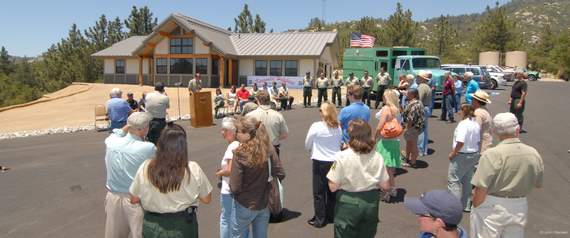
The San Bernardino National Forest held an opening ceremony for their new helibase at Keenwild earlier this month. The seven-member crew works with Helicopter 535, a Bell 407, at these new facilities in southern California near Idyllwild.
Below is an excerpt from an article in the Press Enterprise. The USFS sent us these photos, and we were told that the photo credit should go to John Miller.
Rep. Mary Bono Mack, R-Palm Springs; San Bernardino National Forest Supervisor Jeanne Wade Evans and Idyllwild District Ranger Laurie Rosenthal were among event speakers but they referred to the “gray beards” in the crowd as those who knew the history of the base, which opened in 1963.
Bono Mack credited Norm Walker as the “squeaky wheel” who shared information about the facilities need and answered questions that came up. Walker was the forest’s Idyllwild district fire chief before he retired, and is now interim chief of a community fire district in Idyllwild.
In the beginning, there was a makeshift helicopter landing pad down a single-lane access road near the Keenwild fire station. As Rosenthal told the story, in the 1970s the crew used the dismantled remains of the old Ranger Peak fire lookout to build the 560-square-foot office that was moved uphill in 1974.
Lack of funds forced based closure, but six years later it reopened in 2001 with the showing that the base was a firefighting asset and a spot on a competitive capital projects list.
An initial $600,000 was set aside in 2007, and then Congresswoman Bono Mack assured that the remainder needed was part of an appropriations bill. Bono Mack said her job is “to make sure you have the resources to do your job best.”
The $1,024,000 project by CGO Construction Co. of Rancho Cucamonga began in June 2009. The work included reconstruction of the helipad and access road and the building, which includes an operations center, offices, a kitchen, restrooms and a locker room.
The crew moved back in last month from temporary quarters by the Cranston Ranger Station on Highway 74 east of Hemet.