Bud Moore, former Director of Fire and Aviation in USFS Northern Region

Bud MooreBud Moore, a former Director of Fire and Aviation for the U. S. Forest Service’s Northern Region passed away on Friday at the age of 93. He was one of the founders of the current wilderness fire management policy and in the 1960s and 1970s was a leader in the concept of ecosystem management.

I ran across an excellent article in Smithsonian Magazine written in 2003 that details how he and several others developed the first prescribed natural fire program and saw it implemented in 1972 in Montana. Here is an excerpt.

==============================================

…Not every forester has embraced the idea of fighting every fire. In 1972, in the Wilderness Area of Montana’s Bitterroot National Forest, a handful of Forest Service heretics intentionally let a lightning strike burn—the first time the agency had done that. One of the maverick foresters, Bob Mutch, then a young researcher at the Forest Service Sciences Fire Laboratory, in Missoula, Montana, had had the idea that forest health might actually depend on fire. To be sure, a few foresters had previously argued that forests evolved with fire and were adapted to it, but they had been proverbial voices in the wilderness.

Mutch and the others are now retired, but in the midst of the destructive fire season of 2002—and only six weeks after the Rodeo-Chediski Fire scorched Arizona—they journeyed to the Bitterroot Mountains to assess the experiment they had begun three decades earlier. The Forest Service, whose orthodoxy they once challenged, now wanted their advice on preventing catastrophes from occurring in national forests.

In the Bitterroot Mountains, it’s only a short way from Paradise to Hell’s Half Acre. The ranger outpost at Paradise, where the veterans initially gathered, is a place of deep silence, sparkling water and tall ponderosa pines. The men were eager to look at “the scene of the crime,” as they called it. They hardly looked like rebels. Among them was Bud Moore, in his mid-80s, who had grown up in a family of woodcutters and trappers in these mountains, and was hired as a Forest Service smoke chaser in 1935. There was Bill Worf, just a few years younger, who today is almost blind and last summer hiked the wilderness trail with black glasses and a white cane while someone ahead warned of fallen logs across the path. Orville Daniels, now 68, was the supervisor of the Bitterroot National Forest back in 1970. And there were Bob Mutch and Dave Aldrich, who now looked a bit like members of the Monkey Wrench Gang (as author Edward Abbey called a bunch of radical environmentalists in his 1975 novel of the same name). Aldrich, a muscular 63-year-old, had always looked at fire as the enemy until he joined the group. Mutch, 69, an intellectual and a researcher with a passion for ecology, had once been a smoke jumper, a Forest Service firefighter who parachutes from planes.

The only member of the group still employed at that time by the Forest Service was David Bunnell, 59. He was a firefighter before falling in with the Bitterroot bunch in the 1970s, and he remembers well his first encounter with them. “Renegades! Heretics!” he recalls thinking. “I’m surprised they weren’t all fired.”
Continue reading

Firefighters fired after raising safety concerns

A-T FDFour firefighters with the Adjala-Tosorontio Fire Department near Toronto claim they were fired after they notified their chain of command and the Township Council about safety concerns. The firefighters were offered a total of $23,050 between them if they would waive their right to fight the termination and if they would agree to never to speak publicly about the issue. The four decided not to take the money, and are seeking legal counsel to fight the township’s decision to fire them.

Here is an excerpt from an article at Simcoe.com, listing some of the firefighters safety concerns:

At a structure fire on Dec. 31, 2009, the group alleges one of the chiefs ordered firefighters into a barn on fire without proper respiratory equipment. The chief is also accused of making “disparaging remarks” about ATFD equipment, staff and belittling firefighters over the radio.

At an undated Tosorontio motor vehicle collision, another chief is accused of wearing flip flops and shorts while doing extrication work. The group claims former Chief Paul Wales was told about this, but failed to “act” on the concerns.

At a wildland fire at Sommerville farms in 2009, the group accuses one of the chiefs of heading down into a ravine despite being told not to by the incident commander. The group said the chief required rescue, which took six firefighters to pull him back up the hill using a hose line. The group claims this put the chief’s and the lives of the crew “at risk.”

None of the allegations by the terminated firefighters has been proven in court or at a hearing.

Thanks Dick

Georgia’s Arabia Bay fire contained

Arabia Bay fire
Arabia Bay fire

The Arabia Bay fire that has been burning in south Georgia since November 9 has been 100% contained, according to the Georgia Forestry Commission in today’s update:

– Current situation of the fire is 2710 acres and 100% contained.

– Heavy smoke from the fire and shifting winds still periodically reduce visibility on highways throughout the area, with some road closures still occurring

– Today’s winds will be out of the east at 10 mph to 14 mph, this will carry the smoke to the west of the fire area. The winds are expected be from the south on Tuesday, pushing the smoke towards the north. There is a 40-50% chance of rain on Monday and Tuesday.

– Plans are to continue to monitor and patrol the exterior control lines.

– Fire activity continues to be minimal, with smoke being the major concern at this point.

Arabia Bay fire
Arabia Bay fire

The photos are from the Georgia Forestry Commission’s Facebook page.

Montana thunderstorm

If you saw this, what would you do?

Montana thunderstorm
A supercell thunderstorm in Montana. Photo by Sean Heavey

From National Geographic

Ideas for Christmas presents for firefighters

Here are some ideas for Christmas presents for that firefighter in your life.

Wildland Firefighter Foundation–The first thing to consider would be something from the Wildland Firefighter Foundation. The WFF does great work supporting injured wildland firefighters and the families of fallen firefighters. From their site, you could select a WFF shirt, membership in their 52 Club, auto magnet, or a wrist band.

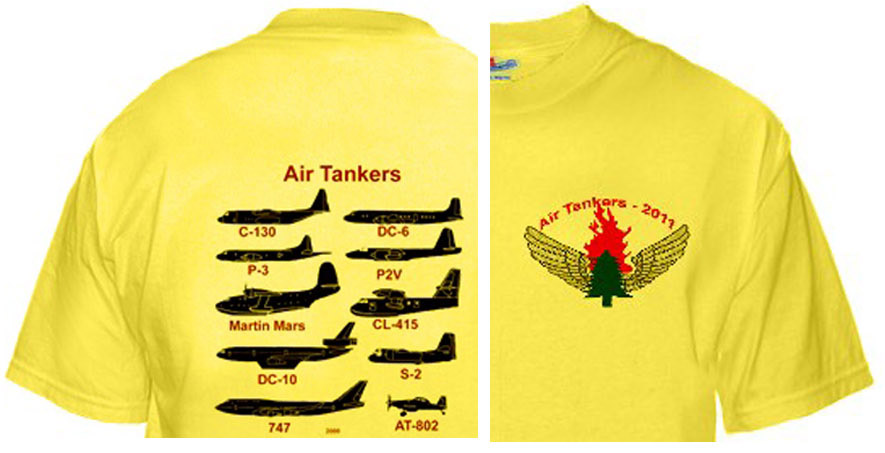
Air Tanker items at CafePress– You can get many different items, including shirts with the new 2011 Air Tanker logo on the front, and silhouettes of 10 different air tankers on the back. The images can be found on t-shirts, mugs, sweatshirts, hoodies, caps, Sigg bottles, iPhone cases, Thermos bottles, and men’s and women’s underwear.

air tanker shirt

Wildfire Today items at CafePress– Help support Wildfire Today by getting something with the Wildfire Today logo. It is available on shirts, sweatshirts, mugs, teddy bears, dog t-shirts, Sigg water bottles, travel mugs, kids clothes, iPhone cases, Thermos bottles, and men’s and women’s underwear. The shirts start at $9.69 and the mugs at $11.99.

Wildfire Today mug, thermos, bottle

Items at Amazon.com specially selected for wildland firefighters–You can choose from wildland fire books, electronics (GPS receivers, SPOT Personal Tracker, Kindle), weather instruments, and headlamps. Everything purchased from Amazon through these pages is exactly the same price that you normally pay at Amazon.

Wildfire News, November 28, 2010

Prescribed fire in South Carolina’s state forests

ATV prescribed burning SC State Forest
James Douglas uses an ignition device on an ATV during a prescribed fire. Photo: R. Darren Price / The Item

TheItem.com has an article about prescribed fire in the state forests of South Carolina. Here is an excerpt:

…Right now, [Forest director Harvey] Belser said the foresters are in the process of burning grasslands to plant longleaf pine, a tree native to the Carolinas, to replace slash pine, a Gulf Coast species susceptible to disease, wind and ice breakage. And, according to state Department of Natural Resources, longleaf pine thrives in a fresh-burned forest floor.

The trees planted will one day be chopped down and sold – but Belser said it was an important step nonetheless. “It’s critical these plants are planted to the correct depth,” Belser said.

So, [Charlie] Scruggs and the other firefighters got to work getting things ready.

Controlled burns are more science than pyrotechnics, said [James] Douglas. After spraying an area with herbicide six weeks before the burn, the forest has to get a fire permit and wait for a day when the wind and humidity are not too high. Then the group figures out what type of fire they plan to light based on the plants and brush in a burn area, which they call “fuel.” For a grassland like the one burned Nov. 19, they light a fire at one end of the tract and let a light breeze blow the fire to the other end. For that kind of burn, Douglas said the entire area will be completely burned after just a few hours, and they can start planting as soon as the ground cools off.

“We’ll probably plant this field in the next couple of weeks,” he said of the singed grassland.

Volunteer firefighters

CBS News “Sunday Morning” had a very good segment about volunteer firefighters. The video is below, and here is a transcript. It’s worth viewing and reading.

WUI meeting in Washington, DC

The West Yellowstone News has an article about the National Wildland/Urban Interface Council’s fall meeting in DC. They interviewed Hebgen Basin Fire District Chief Scott Walron about the meeting and how their fire district west of Yellowstone National Park is dealing with the WUI.

Canada gets new air tankers.

Manitoba just received the first of four new CL-415 air tankers. (Wow. A government agency using brand new, purpose-built air tankers, instead of 60-year-old aircraft previously thrown away by the millitary. What a concept!)

More details about the fatal crash of the firefighters’ crew carrier

Corinna Craddock has a well-written article about the crash of the inmate crew carrier in which one firefighter, Julio Sanchez, and the driver of a second vehicle were killed. Here is an excerpt:

…The fact that [Julio] Sanchez and the rest of his crew were serving a court-ordered sentence at the time Sanchez was killed is a fact with little relevance. The reality is that when men go to camp where they are trained to fight wildfires, this is what they become. Sanchez was a firefighter.

Men who sleep on the side of a mountain in order to continue battling the blaze of a wildfire when they awake once again are men who know that there is no such thing as being an “almost firefighter” any more than it is possible for a woman to be “almost pregnant.” It is just one of the all-or-nothing things in life. This is why inmates who are trained to fight fires must undergo the same feats of endurance, strength, and perseverance that every American firefighter is trained for.

Firefighting is not for weak Americans. There is the kind of stress on a firefighter’s heart that is something akin to being in combat when a team of firefighters tackle such a threat to life. What some of these men will take away once the fire dies is the image of wild rabbits running ablaze. This is the sight that broke my own father’s heart more than once as he explained to me how he had no other choice but to hit an animal with his shovel hard enough to put it out of its misery rather than watch it suffer as it died. Anyone who knows a cat-lover, such as my dad was, might be able to imagine how a six-foot-four man could be hurt watching a tiny creature suffer.

Norman Paraiso, in a comment on our article about the accident, provided more information:

Thank you to all our family and friends who send their love, thoughts, and prayers in our most recent loss. Fernando Julio Sanchez, youngest child of Ramon “Chunky” Sanchez, lost his life on 11-23-10 in a Tragic car accident while serving as a Firefighter for Cal Fire.

Services will be held on Wednesday (12/1) at 2200 Highland Ave in National City at California Cremation and Burial between 3pm-9pm.

Funeral will begin at 11:00 am on Thursday (12/2) at California Cremation and Burial. funeral will take place at Holy Cross Cemetary followed with a Celebration of Life at the Centro Cultural de la Raza, 2004 Park Blvd.

Donations can be mailed to: Ramon Sanchez 6367 Radio Dr, San Diego, Ca 92114.

Book about the Fourmile fire will help rebuild fire station

The proceeds from a new book about the Fourmile fire, which was near Boulder, Colorado last September, will go toward rebuilding a fire station that burned during the fire.

Thanks Norman and Dick

Accountability and the Davis escaped prescribed fire report

The Helena Independent Record has an excellent editorial about the report that was released on Monday on the prescribed fire that escaped on August 26, 2010 and burned over 2,000 acres of private and U.S. Forest Service land 28 miles northwest of Helena, Montana. The report, and the reaction to it from Kevin Riordan, the Helena National Forest Supervisor, indicates that the U. S. Forest Service is not fully aware of, or at least will not publicly admit, the impacts of the serious mistakes and errors in judgement that were made. Accountability did not seem to enter the minds of the 5-person review panel or the Helena National Forest.

Read the entire editorial, but here is an excerpt.

…Our disappointment with the Forest Service’s lack of accountability to accept responsibility is threefold:

First, the Forest Service’s top fire officials should have known the weather, fuels conditions and tree types. That’s what they’re paid and trained to do. The wildfire wouldn’t have ignited had the fire boss used common sense and called off the prescribed burn out of precautionary measures. If there is any blame to be had, it’s there. Right there.

Second, if this was a Regular Joe who didn’t put out a campfire which boomed into a $3 million firefighting effort, they’d be in jail, or at least facing stiff criminal charges. Instead, the Forest Service gets a free pass to “Go.”

Third, we expect more from our governmental leaders. If they goof, which happens, we expect them to own up to it and admit their mistakes. It’s OK to learn from those mistakes; that’s how we all grow to be better people and better citizens. But to blatantly disregard those mistakes is unacceptable.

Ultimately, the forest will grow back, and Forest Service officials will continue to rightfully use prescribed burns as an important forest-health mechanism. Ultimately, they might even learn a lesson or two from this debacle.

But it’s the public trust that has been burned the worst, and that is going to be hard to redeem.

The mistakes and errors in judgement before this prescribed fire was even lit are mind-boggling. Some Forest Supervisors, if their heads were not in the sand, would consider firing those responsible.

We have previously covered good and bad examples of accountability and accepting responsibility. We’ll make a mental note to add this incident to the bad example list.

Thanks Dick.

Weather Channel program on Big Sur fire

The Weather Channel is going to run a 30-minute “Storm Stories” program on the “Big Sur Fire”. Their description is a little over the top:

Storm Stories: “Big Sur Fire” – [Friday, Nov. 26] 5:30 p.m. ET;  The worst wildfire event in California’s history blazes across the breathtaking Big Sur region, terrorizing its 1,000 residents and leveling nearly every structure in its path. Also in the line of fire are eight endangered California Condors trapped in a pen on the side of a mountain.

I am guessing that the fire they are referring to is the Basin Complex fire of June and July, 2008 that burned over 162,000 acres, mostly in the Los Padres National Forest, east of Big Sur, California. It destroyed 26 residences and 32 other structures and cost $77 million to  suppress before it was contained on July 27, 2008.

Here is a map of the Basin Complex, from July 22, 2008. Click on it to see a larger version.

Basin_map_7-22-2008

But who knows. The Weather Channel may be referring to another fire. Any guesses?

Fires caused by North Korea’s artillery attack burn 70% of island

Korea wildfire
A wildfire triggered by North Korea's artillery attack continues to burn on Yeonpyeong Island on the night of Nov. 24.

The artillery attack launched by North Korea on Yeonpyeong Island killed two marines and destroyed scores of houses, but it also started wildfires that have burned 70 percent of the forests and fields on the island. At least 20 fire trucks and 80 firefighters were deployed to the island to suppress the fires. I hope they are receiving hazard duty pay.

California inmate crew carrier involved in head-on crash

California inmate fire crew truck crashNews media in southern California are reporting that a crew carrier transporting a California inmate fire crew was involved in a head-on crash with another vehicle on Highway 138 in Gorman this afternoon. The Los Angeles Times and ABC7 report that prisoners were ejected from the vehicle. One inmate was killed and 12 were injured. Three of the injured are in critical condition. The elderly driver of the other vehicle was also killed. The supervisor of the crew, a firefighter with the Los Angeles County Fire Department, was not killed, according to ABC7.

A California Highway Patrol investigator said a Subaru Forester crossed the center line and crashed into the crew carrier.

The crash occurred at 2:18 p.m. today on Highway 138 just east of Interstate 5.

The AP reports:

The crew was one of four based at a camp near the crash site in San Francisquito Canyon in Saugus, [Los Angeles County fire inspector Matt] Levesque said. The county and the California Department of Corrections work together to maintain 10 such camps throughout LA county.

Los Angeles County supervises California state inmates at five camps in the county. The crew was one of the four crews stationed at Camp 14 near Santa Clarita, CA.

Our sincere condolences go out to the families and coworkers.

Thanks Brian