

NTSB issues recommendations to USFS, following the investigation into the fatal helicopter crash on the Iron Complex fire
On Monday the National Transportation Safety Board issued a number of recommendations to the U.S. Forest Service following the NTSB’s investigation into the fatal Carson helicopter crash on the Iron Complex fire in 2008 in northern California which killed nine firefighters and helicopter crew members.
On November 29, 2010, the USFS sent a briefing paper to the NTSB outlining some changes they had already made to their fire aviation program in response to the crash.
Here is a summary of the new NTSB recommendations. The complete memo that the NTSB issued to the USFS is below the summary.
Develop mission-specific operating standards for firefighter transport operations that include procedures for completing load calculations and verifying that actual aircraft performance matches predicted performance, require adherence to aircraft operating limitations, and detail the specific 14 Code of Federal Regulations Part 135 regulations that are to be complied with by its contractors. (A-10-159)
Require its contractors to conduct firefighter transport operations in accordance with the mission-specific operating standards specified in Safety Recommendation A-10-159. (A-10-160)
Create an oversight program that can reliably monitor and ensure that contractors comply with the mission-specific operating requirements specified in Safety Recommendation A-10-159. (A-10-161)
Provide specific training to inspector pilots on performance calculations and operating procedures for the types of aircraft in which they give evaluations. (A-10-162)
Require a hover-out-of-ground-effect power check to be performed before every takeoff carrying passengers from helispots in confined areas, pinnacles, and ridgelines. (A-10-163)
Review and revise policies regarding the type and use of gloves by firefighting personnel during transport operations, including but not limited to, compatibility with passenger restraints and opening emergency exits. (A-10-164)
Review and revise your contract requirements for passenger transport by aircraft so that the requirement to install shoulder harnesses on passenger seats provides improved occupant crashworthiness protection consistent with the seat design. (A-10-165)
Require that helispots have basic weather instrumentation that has the capability to measure wind speed and direction, temperature, and pressure and provide training to helitack personnel in the proper use of this instrumentation. (A-10-166)
Modify your standard manifest form to provide a place to record basic weather information and require that this information be recorded for each flight. (A-10-167)
Require all contracted transport-category helicopters to be equipped with a cockpit voice recorder and a flight data recorder or a cockpit image recorder with the capability of recording cockpit audio, crew communications, and aircraft parametric data. (A-10-168)

The NTSB also issued some recommendations to the Federal Aviation Administration.
The NTSB’s memo to the USFS is below. (Click the “+” or Fullscreen to see larger versions.)
New Oklahoma State Forester
 Oklahoma Department of Agriculture, Food and Forestry recently chose George Geissler to serve as the Oklahoma State Forester and Director of Forestry Services.
Prior to his selection, Geissler served as Staff Forester with Oklahoma Forestry Services and in this position he coordinated statewide forest management programs.
His selection follows the retirement of State Forester, John Burwell. “I have no doubt the division will be in good hands for many years to come,” said Burwell. “George has exhibited strong leadership skills that will serve him well.”
Geissler has been a professional forester for 22 years. A native of New Orleans, La., he has a Bachelor of Science Degree in Forestry from Louisiana State University, a Master of Business from Harvard University and is a Society of American Foresters Certified Forester.
Before joining Oklahoma Forestry Services, Geissler owned a natural resource consulting firm based in New Mexico with clients located in 18 western states specializing in forest management and wildland fire preparedness. This company was sold in 2002.
Geissler was also the Corporate Forester for Central and Southwest Services, an electric utility holding company with operations in Texas, Louisiana, Arkansas, Oklahoma, Wyoming, Montana, Great Britain and Brazil. He has also held positions as a wildland firefighter for the US Forest Service and a procurement/land management forester for a major forest products company.
Thanks Dick
Florida man dies after trash fire escapes

From the Orlando Sentinel:
A man burning trash in east Orange County lost control of the fire and was consumed by flames as he tried to battle the blaze, deputies said.
Deputies received calls about 1:25 p.m. Tuesday indicating a home on Hancock Lane in the Waterford Lakes area of east Orange County was on fire and a man was inside.
Fire crews were dispatched and fought back a brush fire threatening several homes, fire officials said.
Fire Rescue spokesman John Mullhall said one team of firefighters attacked the blaze from Magnolia Creek Circle, while another was working on nearby Thanhall Way. Crews reported the fire was brought under control in less than an hour from when they arrived on scene.
Witnesses told investigators an elderly man, whose name was not released Tuesday evening, was trying to burn trash at the home on Hancock Lane when “the fire got away from him,” a sheriff’s spokesman said.
As he tried to put out the fire, “the male victim was overwhelmed by the flames and died,” spokesman Jeff Williamson said.
Florida firefighters fight wildfire with 9,000-acre burnout

Firefighters in Florida are aggressively trying to contain a 4,000-acre wildfire with a 9,000-acre burnout. Cliff Frazier, spokesman for the Florida Division of Forestry, said if the burnout, which is 85% complete this morning, is not conducted, smoke from the Three Forks fire would impact the area for a week. Earlier, the fire forced the closure of a 17-mile section of Interstate 95 in Indian River County, but it reopened at 8:40 Wednesday morning.
The fire is burning on land administered by St. John Water Management District, about seven miles west of Palm Bay.
East County Magazine’s best and worst newsmakers of 2010
A San Diego publication, East County Magazine, has a list of the “Best and Worst Newsmakers of 2010”. Two items on the list involve wildland fire.
The number one “Naughty Newsmaker” on the list is San Diego Gas and Electric:
1. SDG&E: The utility paid $14 million to settle claims that its lines caused the Rice and Witch Creek fires, then got regulators to approve a rate hike. SDG&E claimed it couldn’t afford to pay hiked up insurance premiums imposed due to the fires that it caused. Yet SDG&E had ample funds to wine and dine influential individuals at its posh resort in Mexico. The utility also ired many with plans to erect Sunrise Powerlink through scenic and high fire risk areas. Adding insult to injury, SDG&E now wants to shut off power in the backcountry to limit its liability the next time a wildfire seems likely to occur. Definitely NOT nice!
The number one “Nice Newsmakers”:
1. San Diego Sheriff’s Deputies Gary Kneeshaw and Scott Blight risked their lives to save two rock climbers trapped on the face of El Capitan mountain during the Monte Fire in Lakeside. With sparks flying into the cockpit, Deputy Kneeshaw helped a hiker into the helicopter, then leaped onto the skid rails, riding unsecured on the outside of the chopper as it descended through blinding smoke. The Board of Supervisors commended the pair for their daring heroism “above and beyond the call of duty” which “without a doubt, saved the lives” of rock climbers André Doria and Meg Rippy.
Great Smoky Mountains wildlife biologist reflects on his career

After 32 years of trapping wild hogs, darting nuisance bears and chasing wandering elk, Kim Delozier, the Great Smoky Mountains National Park Chief Wildlife Biologist, is retiring. Knoxnews.com has an article, describing some of his more interesting memories. Here is an excerpt.
…In the early 1990s, the Smokies and the U.S. Fish and Wildlife Service tried unsuccessfully to reintroduce red wolves in the park. None of the wolf pups born in the park survived, and after 10 years, the project came to a halt.
“We couldn’t release enough wolves to out-compete the coyotes in the park,” Delozier said. “You just can’t take a captive animal, open the cage and expect it to make it in the wild.”
In 2001, the park launched an ambitious program to bring elk – a species that hadn’t roamed the mountains since the late 1700s – back to Cataloochee Valley in North Carolina. Delozier said what he remembers most about this successful campaign was the tremendous support from partners like the Rocky Mountain Elk Foundation, the Friends of the Smokies and the public at large.
“Unlike the wolf reintroduction, bringing elk back to the park was something people genuinely wanted to see happen,” he said.
Delozier’s favorite memory from his three decades on the job? That would be a late afternoon in Cataloochee Valley when he was greeted with the sight of 15 or 20 elk grazing just hours after their release.
And his worst memory? Delozier said that by far it would be May 21, 2000, the day Glenda Ann Bradley, a 50-year-old elementary school teacher from Cosby, was mauled to death by a 112-pound black bear while hiking in the Elkmont section of the park.
In his office, Delozier keeps Bradley’s funeral announcement on the wall. Delozier said even though the bear had no prior record of aggressive behavior, he still felt guilty.
“I feel responsible for all the bears in the park, nomatter what they do, whether they’re good or bad,” he said. “Part of the reason I’m ready to retire is this feeling of responsibility for every pig, elk and bear in the Smokies. You just know when it’s time.”
Top wildland fire stories of 2010 – with poll
Vote on the most significant wildland fire stories of 2010
As we documented earlier this month, the 2010 wildland fire season, when measured by the acres burned in the 49 states outside Alaska, was the slowest since 2004. But in spite of that, there has been significant news about wildland fire. In fact, we posted over 670 articles this year.
In 2009 we listed some of the top stories and invited you to vote on the ones that you considered to be the most significant.
Continuing that tradition, below we have listed the top stories of 2010. The line of duty fatalities are not listed unless there was an unusual spin-off story associated with the fatality. Below the list, there is a poll where YOU can let us know which stories you feel are the most significant of 2010.
Top wildfire stories of 2010
Jan. 8: The National Park Service released the report on the August, 2009 Big Meadow escaped prescribed fire in Yosemite National Park. The fire blackened 7,425 acres before being controlled by 1,300 firefighters at a cost over $15 million. It became the eighth largest fire in California in 2009.
Jan. 11: One of the five Type 1 Incident Management Teams in California was disbanded. Bill Molumby, who had been the team’s Incident Commander for several years, retired in November, 2009 and apparently they were not able to replace him.
Jan. 21: Federal wildland firefighter bill introduced in Congress. The “National Infrastructure Improvement and Cost Containment Act” would affect the pay, retirement age, and fireline liability of federal wildland firefighters.
Feb. 1: Fire contractor sentenced to 10 months in prison for forging wildfire training certificates and task books.
Apr. 23: NIOSH to study long-term health effects of working as structural firefighter, but not as a wildland firefighter. In a follow-up a few days later, Brian Sharkey of the USFS’ Missoula Technology and Development Center downplays lung cancer risks for firefighters. NWCG later responds to our article.
Apr. 30: The International Association of Fire Chiefs, an organization that concentrates on structural fire, received at least $13.2 million from the U.S. Forest Service and DHS-FEMA over a seven-year period, reportedly for wildfire-related purposes. The IAFC became furious at Wildfire Today for exposing the information.
Jul. 5: Montana Congressman Denny Rehberg, one of the wealthiest members of Congress, sues the Billings Fire Department over the loss of “trees and ground cover” on his property during an 1,100-acre fire in 2008.
Aug. 2: Hundreds of wildfires in Russia claimed more than 50 lives, left more than 3,500 people homeless, and caused massive air quality issues in Moscow and other areas.
Aug. 2: A BAe-146 jet airliner was converted to an air tanker and was tested in Missoula. The Interagency Air Tanker Board failed to certify it due to inadequate ground coverage of retardant.
Aug. 24: The 100th anniversary of the fires of 1910 and Ranger Pulaski’s incident are commemorated at several events in Washington, Idaho, and Montana.
Aug. 26: In spite of weather forecasts that would have alarmed most fire managers, the Helena National Forest in Montana ignited the Davis prescribed fire during a near record heat wave. The fire escaped and burned 2,800 acres. The report was released in November. The Forest Supervisor said the report did not point out “something clearly that we did wrong, done incorrectly or that we’re going to make big changes on”.
Sep. 6: The Fourmile Canyon fire burned 6,200 acres and 169 homes a few miles west of Boulder, Colorado. The fire was devastating to local fire districts within the burned perimeter in several ways, including the facts that a firefighter’s burn pile escaped and started the fire, the homes of 12 firefighters burned, and one fire station and an engine inside it burned.
Sep. 21: The Commander of the Utah Army National Guard assumed responsibility and apologized for the Machine Gun fire that burned 4,346 acres and three homes near Herriman, Utah. The fire started during target practice with a machine gun at a National Guard base.
Sep. 24: The Australian state of Victoria tested the U.S.-built DC-10 very large air tanker and concluded that it did not perform adequately and would not be suitable for use in their wildland-urban interface areas.
Oct. 13: The US Forest Service’s response to the 2009 Station fire is criticized, and Congress holds hearing in Pasadena, CA about the management of the fire, which burned 160,000 acres near Los Angeles.
Oct. 26: “Dirty Jobs” TV show features prescribed burning in a Florida wildlife refuge. Video footage captures some activities that are criticized by some viewers.
Dec. 2: A fire in Israel kills 43 prison guards and firefighters. Air tankers from the United States respond.
Dec. 7: NTSB holds a meeting about the helicopter crash on the Iron Complex fire in northern California in which nine firefighters and crew members died. Much of the blame was attributed to falsified helicopter performance documents supplied by Carson Helicopters when they applied for a contract with the U.S. Forest Service. Carson and the surviving co-pilot dispute that conclusion.
===================
Honorable mention stories (not exactly top stories, but interesting; they are not part of the poll).
Feb. 24: Wood piles were burned on frozen Lake Pactola in South Dakota.
Mar. 29: Washington D.C. Metro train drives through wildfire, and stops in the middle of it. And on July 25 we posted a very impressive video that was shot from a Greyhound bus that drove past a large bushfire during the night in Queensland, Australia.
May 11: NWCG outlaws the use of some terms, including “appropriate management response” and “wildland fire use”.
Jun. 20: It was not a wildland fire, but every firefighter can relate to some of the problems encountered when a kinked fire hose and improper procedures delayed the rescue of IndyCar driver Simona de Silvestro from her burning race car which crashed at Texas Motor Speedway.
====================
POLL
[poll id=”4″]
Feel free to leave a comment (or “response”) explaining your choices, or to discuss other news items that did not make the list.
Hong Kong firefighting helicopter ditches in lake
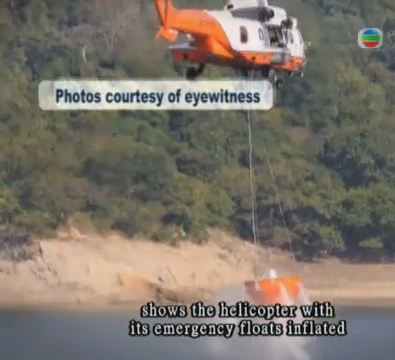
A Hong Kong Government Flying Services helicopter lost power in one of its engines while dipping water out of a reservoir in northern Hong Kong on Monday. The 3-person crew of the Eurocopter AS332 L2, or Super Puma, activated the pop-out floats and the helicopter settled into the water, remaining upright. The crew escaped unharmed and swam to shore wearing inflatable personal flotation devices.
The helicopter was engaged in a water dropping operation, helping to suppress a vegetation fire near the Shing Mun reservoir when the accident occurred.
Here are three screen grabs from the video, which follows:


If you watch the video to the very end, you will see a photo of the aftermath of a helicopter vs. bus accident, something you don’t see every day.
On September 22, 2010, we ran a story about a helicopter operated by the New York Police Department that ditched into Jamaica Bay in Brooklyn, New York. The crew also activated their pop-out floats, preventing the helicopter from sinking.
Brush fire near Atmore, Florida

From the Atmore Advance:
December has been a busy month for personnel with the Atmore (Florida) Fire Department.
Numerous fires have been reported to the department keeping firefighters on their toes throughout the holiday season.
Monday afternoon, firemen worked to contain a brush fire in an open field off Presley Street near the Florida state line, which bordered Briar Lake subdivision and Tom Byrne Park. Despite windy conditions, firefighters were able to quickly contain the fire, which was reported just after 1 p.m., not allowing it to spread to nearby houses with assistance from the Poarch Creek Fire Department, the Walnut Hill Volunteer Fire Department and the Alabama Division of Forestry.