Let’s adopt a Texas fire department

A Texas fire department

Firefighters in Texas are having a really tough year. It’s their worst wildland fire season in decades and there is no relief from the weather in sight. They have had some fatalities and several very serious injuries on fires. We have pointed out some examples of Texas firefighters working on fires wearing little or no personal protective equipment. Sometimes, but not always, this is due to inadequate tax revenue from their citizens, who expect free fire suppression services. In a perfect world, local residents would enact a tax system that would supply their fire departments with enough funds to serve their populations with sufficient equipment and adequate levels of training. However, in some jurisdictions that may not happen in our lifetime.

A Texas fire department
One example of a fire department in Texas. Photo: Stephen Michaels.

Let’s adopt a fire department.

ChuckW led us to good idea in his comment in another post. We, the writer and the readers here, should adopt a fire department and send them help.

I will accept nominations of a fire department in Texas that has a significant wildland fire workload, and (1) needs help in the form of wildland personal protective equipment and firefighting equipment, and (2) would wear and use the equipment if they received it. We will select one department and then “beat the drum” among the loyal readers here at Wildfire Today and try to get them some much needed help. Many of us have slightly used, but serviceable, equipment that we would be glad to send to our brother and sister firefighters. I am thinking that we could send them Nomex shirts, Nomex pants, Nomex brush coats, hard hats, safety glasses, hose, nozzles, fireline gear, etc. Maybe we could even arrange for instructors to put on some wildland fire training, pro bono.

We can’t help every fire department, but if we can help just one, we can make a difference.

Nominations should include:

  1. Name, shipping address, phone number, and web site (if it exists) of the fire department;
  2. Name, phone number, and email address of the chief;
  3. The number of wildland fires they worked on between 1-1-2010 and 5-31-2011;
  4. The number of firefighters in the department;
  5. Description of what they need and why;
  6. What size hose do they use and what type of threads? For example, 1″ hose with NPSH threads, 1.5″ hose with NH threads; and size and thread type of your wildland nozzles.
  7. If the department receives personal protective equipment, will the firefighters wear it?
  8. If someone wants to send a check, how should it be made out, and to what address should it be sent?

The equipment and donations will be sent directly to the fire department. Wildfire Today will not filter or take any portion of them. We will post the contact information of the selected department so that potential donors can ask questions if necessary. The email address will be posted similar to this,” joechief (at) gmail.com”, to reduce the chance of autobots scraping off the address and using it to send spam.

The nominations can be sent to us via the Contact Us page. If we receive enough nominations, the last day for us to receive them will be June 20, 2011.


Fighting fire in Texas

Stonewall County VFD firefighter Chad Hayes 4-8-2011

Updated, 2:36 p.m. MT, May 31, 2011

Lake Tanglewood firefighters
A Lake Tanglewood Fire Department fire apparatus, at a fire near Tangle Aire in Amarillo, Texas on May 29, 2011. Photo: Joe Gamm

I have seen too many photos like this, of firefighters in Texas standing, sitting, or kneeling on the back of a fire truck fighting fire. In addition to the obvious hazard of the effects of the fire itself on an exposed firefighter, there is also the risk of the overloaded and top-heavy truck rolling and injuring or killing the firefighter riding on the back.

According to the Lake Tanglewood Fire Department’s web site, Grass 1 pictured here, is a 1992 Ford F-350, with a 500-gallon water tank. The payload this truck is carrying is probably at least 5,000 pounds, pretty close to if not over the GVWR.

Here are a couple of photos taken April 8, 2011, by Victor Cristales, showing the Stonewall County Volunteer Fire Department fighting fire in Texas.


Stonewall County VFD firefighter Justin Myers 4-8-2011
Stonewall County VFD firefighter Justin Myers, 4-8-2011


Stonewall County VFD firefighter Chad Hayes 4-8-2011
Stonewall County VFD firefighter Chad Hayes, 4-8-2011

These firefighters deserve credit for helping their communities, and I know that many rural fire departments in Texas receive little or no tax revenue from citizens who expect free fire protection, but there is no excuse for this.

UPDATE: ChuckW’s comment below led us to a good idea. We are going to accept nominations for a Texas fire department that needs help in the form of donated fire equipment, or even cash.

Teenage wildland firefighters, missing on a fire in Mexico, found

A rather bizarre story comes to us out of Mexico. Three teenage volunteer firefighters who were reported missing on May 25 while working on a wildfire in the southeastern Mexican state of Quintana Roo were located on Monday, May 30. The boys, who are 17, 16, and 14 years old, were found by their fathers and neighbors who followed their tracks into the jungle and “located them with the help of a cell phone”. More than 200 people were involved in the land and air search for the missing boys, who were found about 6 miles from the nearest road.

At the last report, searchers were trying to find a clearing where a helicopter could land in order to evacuate the boys to a hospital.

More information.

Nine year old girl wins Smokey Bear poster contest

2011 Smokey Bear poster contest winner
On May 27, Vaibhavi Patankar of Woodland Hills, Calif., was named the winner in the 2011 Smokey Bear & Woodsy Owl Poster Contest. USFS photo

On May 27, Vaibhavi Patankar, 9, of Woodland Hills, Calif., was named the top winner in the 2011 Smokey Bear & Woodsy Owl Poster Contest. The fourth-grader received a trip to Washington, D.C., with her family to collect her trophy and a framed copy of her poster from the Forest Service during a special ceremony at the National Garden Clubs Inc. annual meeting.

Poster contest winner Vaibhavi Patankar of Woodland Hills Calif
Vaibhavi Patankar. USFS photo

The contest is open to students in the 1st through 5th grades. The other grade-level winners in this year’s contest are Ciana Main, Fairbanks, Alaska, first grade; Jacob Lucero, Fresno, Calif., second grade; Emma Fockele, Gainsville, GA, third grade; and Ana Alvarez, Marsing, Idaho, fifth grade.

Wildfire news, May 27, 2011

San Diego Co firefighters

Updated at 10:15 a.m. May 27, 2011

Listening session about fire retardant held at Missoula, MT

On Thursday a “listening session” was held in Missoula to gather comments about the draft environmental impact statement for the use of fire retardant. One of the alternatives includes new rules for mapping areas, primarily around water courses, that should be avoided due to the possible adverse effects on sensitive species. If this alternative is chosen as written, about 3.5 million acres of Montana’s 16.8 million acres of national forest land would be excluded from retardant use because of waterway buffer zones. The Missoulian has more details about yesterdays’ meeting. Wildfire Today has information about the draft retardant EIS here.

San Diego police and firefighters dispatched to fire in New Mexico

San Diego Co firefighters
Eight of the nine members of the county's Regional Emergency Response Team are photographed prior to leaving for New Mexico Thursday. Photo: County of San Diego

A mixed group of nine firefighters and police officers from San Diego County left Thursday to work on the 86,000-acre Miller fire on the Gila National Forest in New Mexico. From the article at Signon San Diego it appears that they are members of the county’s new all-hazards incident management team which was formed last year. Here is an excerpt from the article:

…Officers from the El Cajon and San Diego police departments deployed as well as firefighters from the San Diego, Heartland, Chula Vista, Carlsbad, Escondido, Coronado and San Miguel fire departments, said Yvette Urrea Moe, a spokeswoman for the county’s Office of Emergency Services.

The goal is to train the team in joint emergency response for when a large-scale incident occurs here, Moe said. Firefighters and police have little opportunity to train together unless there there are disasters, she said, like the county experienced with the wildfires in 2003 and 2007.

“It’s an opportunity to learn to manage on some of these large scale incidents and not have to wait for something to happen here,” said San Diego police Sgt. Scott Wahl, one of the officers going to New Mexico.

San Diego fire Capt. Dave Gerboth, who also is headed to the fire, said getting to cross train and work with law enforcement “lays the foundation for a regional response,” when one happens locally.

The county’s all-hazards incident management team was formed last year. It has 36 members from police and fire agencies as well as emergency medical services, public works and public health.

Experts ponder environmental fallout from burned homes in Slave Lake fire

An article in The Canadian Press covers the possible environmental effects from the 400 lots that burned in the Slave Lake wildfire two weeks ago.  An excerpt:

The flames have been beaten back from Slave Lake in northern Alberta.

But as residents slowly return to their fire-scarred town, scientists are wondering about the environmental legacy of a blaze that consumed hundreds of homes and businesses — and everything in them.

“If there’s a really heavy fire and you burn up plastic … you’ll end up with some of that residual, partially burnt plastic in the soil,” said Anne Naeth, a biologist and expert in land reclamation at the University of Alberta.

Studies have been done on what happens when materials such as vinyl siding are burned, but there’s little research on what’s left behind from large-scale conflagrations. And large-scale certainly describes what happened in Slave Lake.

More than 400 lots were either levelled or badly damaged. Entire neighbourhoods were burned to their foundations. Dozens of vehicles were reduced to metal skeletons. Gas stations exploded.

“I would expect all sorts of nasty toxins, both inorganic and organic,” said David Schindler, an ecologist at the University of Alberta.

Bears are attracted to the rotting food following the Slave Lake fire

The residents that are returning to Slave Lake are encountering bears that are attracted to the food that is rotting in refrigerators and freezers that were without power for more than a week.

When our incident management team was dealing with the response and recovery from Hurricane Andrew in the four south Florida national parks in 1992, we had a version of that problem. Rotting food in National Park Service facilities, but thankfully no bears; just every kind of insect you can imagine — and an odor that you can’t. Some of the researchers had been fond of the practice of saving the carcasses of road killed animals in freezers. After careful analysis, we decided that our best option was to call in a HazMat team to haul away and dispose of all of the refrigerators, freezers, and their contents.

Wildfire burns thousands of acres on Spanish island of Ibiza

Ibiza fire

The largest fire in recorded history on the Spanish island of Ibiza (map) has burned 3,700 acres of pine forest and forced the evacuation of 80 homes and a school.

Texas firefighter suffers burns

From OA online:

A Kermit firefighter was reported in stable condition after he was airlifted to the University Medical Center Burn Center in Lubbock Tuesday after he suffered injuries battling one of the three fires that sprung up in the Permian Basin Tuesday evening.

A family member at the burn unit identified the firefighter as Hunter Hardaway and would not comment on more than his condition.

Hunter was battling the YT Ranch fire, one of three that sprung up Tuesday. Starting near Highway 115, the fire burned towards the Caprock before it was finally extinguished. The Texas Forest Service estimated the fire at 2,800 acres.

Bennie Cope, the Goldsmith Volunteer Fire Chief, said the fire wasn’t fully put out until 7 a.m. Wednesday morning.


Wildfire news, May 26, 2011

Backfire on Palo Duro Canyon fire

Updated at 3:47 p.m. MT, May 26

Backfire on Palo Duro Canyon fire
USFS Task Force 36 sets backfire Wednesday on the Palo Duro Canyon fire in Texas. (Does anyone see an interesting shape in the flames?) Photo: Joe Gamm

Jumpers from lower 48 dispatched to Alaska

The @BLMNIFC Twitter account sent this message Thursday afternoon:

Boise BLM jump base sent 16 smokejumpers to Alaska today due to the increased fire weather conditions. Alaska currently has 3 large fires.

Wildfire contractor voluntarily provides crew to assist with tornado recovery

A company that usually provides contract firefighting crews to government agencies to suppress wildfires, is voluntarily providing a crew to help assist with search and rescue following the devastating tornado that struck Joplin, Missouri. Chloeta Fire, headquartered in Oklahoma City, dispatched a crew on May 24.

Need identified to implement national wildfire strategy in Canada

Following the Slave Lake fire in northern Alberta, there has been a push to implement the national wildfire strategy that was developed but not funded in 2005. Here is an excerpt from an article in the Canadian Press:

While it may have been impossible to save Slave Lake, Stocks said more funding for the national strategy could lead to fireproofing of buildings being improved, firewalls being built around communities, and public education campaigns.

Money must also be found for new firefighting equipment and hiring and training new fire personnel to replace the hundreds who retire every year, said Stocks. Declining to name a figure, the amount should be decided by the country’s forestry ministers, he said.

But convincing governments to spend money on fighting forest fires when their priorities are focused on health care, education or regional issues may be a tough sell, he said.

A spokesman for Natural Resources Canada said the strategy was created as a framework to guide decision making and jurisdiction-specific investment decisions, noting the provinces and territories are responsible for wildfire management.

Residents of Slave Lake are told 374 lots burned in the wildfire

Some of the residents are being allowed back into the town after one-third of it burned on May 15. From the Canadian Press:

Residents of fire-ravaged northern Alberta communities in and near Slave Lake are finally learning if their homes were engulfed by flames.

The town has released a detailed photographic map which shows 374 lots were destroyed by the wildfires that swept through the area Sunday evening. Another 52 lots were damaged. There is also a map of homes in the nearby Municipal District of Lesser Slave River which shows 59 lots were destroyed and 32 were damaged.

Flames forced roughly 7,000 people to flee from their homes.

The mayor of Slave Lake, Karina Pillay-Kinnee answered questions about the recovery from the fire on Wednesday.

Pilot identified that was killed in helicopter crash

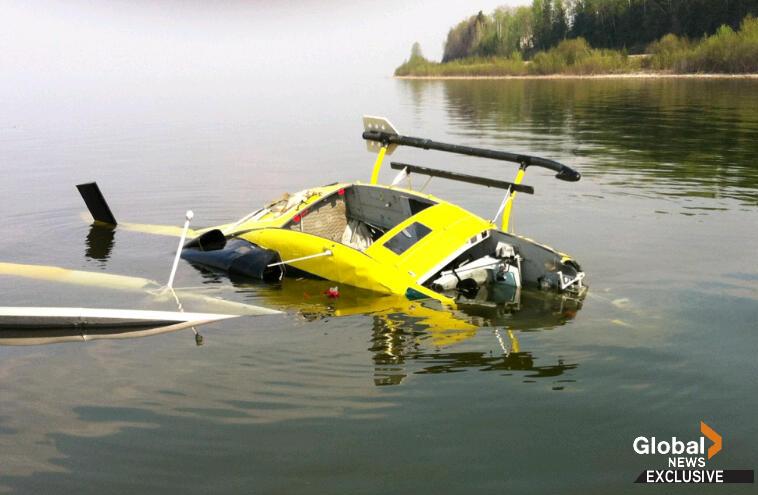
Slave Lake helicopter crash
A firefighting helicopter crashed in Lesser Slave Lake. Photo Credit: Supplied, Global News

Jean-Luc Deba, 54, has been named as the pilot that died in the helicopter crash last week while working on the Slave Lake fire in northern Alberta. Mr. Deba was an employee of Campbell Helicopters out of Abbotsford, B.C. The helicopter crashed into Lesser Slave Lake, but the cause has not been released.

In tree felling accident, a laceration was caused by a hard hat

A facilitated learning analysis has been released for a tree felling accident on the Huron-Manistee National Forest in Michigan. A sawyer was struck on the head by a falling tree, but the only injury, a nasty laceration, was caused by the hard hat. Here is an excerpt from the  Lessons Learned section:

5. The injury was caused by the hard hat. While the team looked at the incident the recent Tech Tip “Alternate Head Protection Available” draft released in March 2011 by MTDC came to our attention. In the Tech Tip it states, “Although Bullard Hard Hats meet safety standards a limited number of users now find the hard hats to be uncomfortable. The redesigned suspension system provides less space between the hard hat and users head and may allow sharp corners to cause pressure points.” There was discussion among the team that we could not identify which part of the hardhat had actually caused the injury (there was no blood or hair found on the hard hat after the incident). However, we can easily see how one of the corners of the rear suspension system 8 bracket could have caused the injury upon impact of the tree to the hardhat.

Hard hat injury, tree felling accidetn
From the FLA, USFS

Firefighters make progress on Pains Bay fire

Map Pains Bay fire 5-24-2011


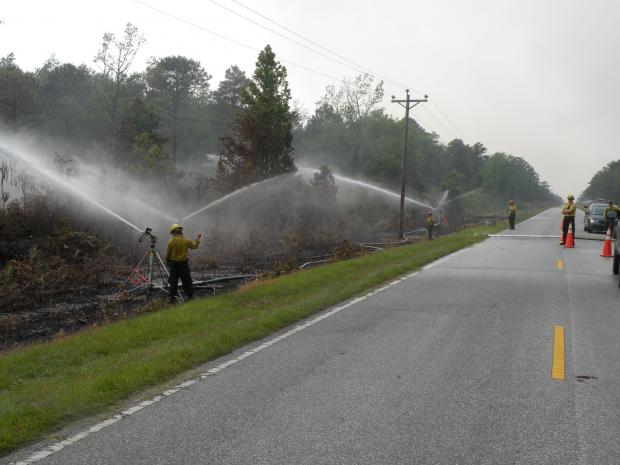
Firefighters install sprinklers on the Pains Bay fire. Photo: Bonnie Strawser, USFWS

Due to weather that has been more favorable for firefighters, the Pains Bay fire on the North Carolina coast has been relatively quiet the last two days. Here is an update from the Incident Management Team that was released Wednesday night at 8 p.m.:

  • Light winds and some overnight rainfall helped firefighters today.  Fire intensity dropped and good progress was made today establishing and widening control lines on the north portion of the fire.  Aircraft were more effective with less smoke and better visibility.
  • Current size of the fire is 28,860 acres.
  • US 264 will re-open Thursday, May 26.  Pilot car escorted travel on US 264 will begin at 10:00 AM, Thursday morning.   Initially, travel will be limited to 10:00AM- 7:00PM daily.  Fire officials plan to extend the hours of travel in coming days as smoke along the roadway subsides.  Drivers should expect up to 30 minutes wait at check points.  Delays due to heavy smoke or fire suppression activities should be anticipated.
  • A threat still exists to the Stumpy Point community.  Conditions are being monitored and the need for evacuation is being assessed on a continuous basis.
  • Smoke was lighter on the vicinity of the fire today, but heavy smoke will continue to affect nearby communities in days to come.
  • Containment is now estimated at 65 percent due to the escape.

In map of the Pains Bay fire below, the red area represents the current location of the fire.

Map Pains Bay fire 5-24-2011


NTSB releases causes of New Mexico police helicopter crash, and makes recommendations

New Mexico helicopter crash
The crash site of the Agusta S.p.A. A-109E helicopter. NTSB photo.

Today the National Transportation Safety Board released a report on the crash of a police helicopter in New Mexico in 2009 that killed two people (map). There may be some factors about the crash that are familiar to wildland firefighters and fire aviation crews.

Here is a brief summary of two of the causes of the crash, as determined by the NTSB:

The National Transportation Safety Board (NTSB) today determined that a New Mexico State Police (NMSP) helicopter pilot’s decision to take off from a remote landing site, without conducting a thorough assessment of the weather and night time conditions, was the primary cause of the 2009 fatal crash. Contributing to the accident was an organizational culture within the New Mexico State Police that emphasized mission completion over safety, as well pilot fatigue, stress, and the pilot’s self-induced pressure to complete the rescue mission.

Another aspect of the crash, not covered in detail by the NTSB report, is the lost hiker who had just been found and picked up by the helicopter. There were many technological glitches related to the 911 call the hiker, Megumi Yamamoto, made that hampered her timely rescue. Unfortunately she was killed in the crash, along with the pilot, Andy Tingwall. The spotter, although injured, walked until he found rescuers and was then hoisted in a basket below a helicopter before being flown to a hospital.

Here are some excerpts from the NTSB report. Their site has more details, including conclusions and recommendations.

=====================

EXECUTIVE SUMMARY

On June 9, 2009, about 2135 mountain daylight time, an Agusta S.p.A. A-109E helicopter, N606SP, impacted terrain following visual flight rules flight into instrument meteorological conditions near Santa Fe, New Mexico. The commercial pilot and one passenger were fatally injured; a highway patrol officer who was acting as a spotter during the accident flight was seriously injured. The entire aircraft was substantially damaged. The helicopter was registered to the New Mexico Department of Public Safety and operated by the New Mexico State Police (NMSP) on a public search and rescue mission under the provisions of 14 Code of Federal Regulations Part 91 without a flight plan. The helicopter departed its home base at Santa Fe Municipal Airport, Santa Fe, New Mexico, about 1850 in visual meteorological conditions; instrument meteorological conditions prevailed when the helicopter departed the remote landing site about 2132.

PROBABLE CAUSE

The National Transportation Safety Board determines that the probable cause of this accident was the pilot’s decision to take off from a remote, mountainous landing site in dark (moonless) night, windy, instrument meteorological conditions. Contributing to the accident were an organizational culture that prioritized mission execution over aviation safety and the pilot’s fatigue, self-imposed pressure to conduct the flight, and situational stress. Also contributing to the accident were deficiencies in the NMSP aviation section’s safety-related policies, including lack of a requirement for a risk assessment at any point during the mission; inadequate pilot staffing; lack of an effective fatigue management program for pilots; and inadequate procedures and equipment to ensure effective communication between airborne and ground personnel during search and rescue missions.

Pains Bay fire spots across control lines

Aerial photo escaped fire at 6pm on May 23 (Donnie Harris, USFWS)

Updated at 2:56 p.m. ET, May 24, 2011


Map Pains Bay fire 1230 5-24-2011
Map of the Pains Bay fire, showing the fire perimeter as last mapped by the incident management team (the red line), and heat detected by satellites (the squares) at 12:30 p.m. MT 5-24-2011

The map of the Pains Bay fire above shows where the fire spotted across the control lines on Monday, indicated by the red squares, which represent heat detected by satellites.

Map Pains Bay fire hand drawn 5-23-2011
Hand drawn map of the additional spread of the Pains Bay fire, 5-23-2011. Credit: USFWS

Here is an update on the fire sent out by the incident management team at 11:00 a.m. ET, May 24:

=======================

Firefighters Working Today to Contain Escaped Fire

Firefighters today have begun the process of establishing new containment lines around escaped fire on the north side of the Pains Bay Fire.  The fire, which escaped Monday afternoon, burned uncontrolled into the night pushed by winds gusting to 30 mph.  By daybreak, the fire had burned approximately 3 miles and crossed two roads.   The fire has not crossed U.S. Hwy. 264.  Current fire size is estimated at 29,000 acres.

Lack of roads, fast spreading fire, and intense burning of the fire have forced firefighters to establish new control lines far in front of the advancing fire.  Helicopters will be used today to drop water in an effort to slow the spread of the fire.  Firefighters positioned along new control lines will be preparing for burnouts to remove fuel in front of the advancing fire.

Fire managers, Dare County Emergency Services, and Dare County Sheriffs Department continue to monitor conditions and assess the need for evacuation of the Stumpy Point community.  A community meeting is scheduled at Stumpy Point at 6:30 PM today for residents to ask questions about the fire situation and evacuation plans.

Heavy smoke was seen yesterday in Manteo and other communities to the north of the fire.  Heavy smoke will continue to affect nearby communities for the foreseeable future.  U.S. Hwy. 264 has been closed from U.S. 64 to Stomper Rd. near the Dare-Hyde County line.  Only local Stumpy Point residents will be allowed access.

======================


Pains Bay fire crosses Navy Shell Road
Fire crosses Navy Shell Road after breaking containment on May 23. Click to enlarge. Donnie Harris, USFWS
Aerial photo escaped fire at 6pm on May 23  (Donnie Harris, USFWS)
Aerial photo escaped fire at 6pm on May 23 (Donnie Harris, USFWS)
Pains Bay fire, preparing to set backfire Navy Shell Road at 5pm on May 23  (Chris Carlson, NCDFR)
Preparing to set backfire Navy Shell Road at 5pm on May 23 (Chris Carlson, NCDFR)

More information is at Inciweb.


Congressional hearing topics: air tankers, and USFS reduces workforce

Updated at 5:34 p.m. MT, May 23, 2011

On May 19, 2011 the Senate Committee on Appropriations, Subcommittee on Interior, Environment, and Related Agencies, held a hearing about the U. S. Forest Service Budget. Sitting at the witness table was the Chief of the Forest Service, Tom Tidwell. Two topics related to wildfire management were discussed during the hearing, a major budget cut and the future of the large air tanker fleet.

Reduction in the number of USFS employees:

The budget proposal that the administration has submitted will require the agency to reduce the number of employees by 1,819 permanent full-time positions. It is not clear which programs will be affected by this, in spite of a direct question by Senator Jon Tester, D-Montana. Here is an excerpt from that portion of the hearing’s transcript:

TESTER: OK. Wildland fire management, $400 million — almost $400 million. Fires are a fact of life. But we all know we need to handle them in a way, because there’s a lot of people that live out there, there’s a lot of forest communities.

Can you tell me how that budget’s going to impact firefighting, and in particular if it’s going to have any impact on protecting our forest communities?

TIDWELL: Our proposed budget will provide the same level of preparedness that we’ve had for the last few years, the same number of firefighters, the — the same number of aviation resources.

TESTER: OK.

So where’d the $400 million come from?

TIDWELL: Well, part of it, close to $100 million of those funds, were — are part of the integrated resource restoration budget line item.

TESTER: Which does what?

TIDWELL: Well, part of — that’s for — some of the hazardous fuels funding was moved into IRR.

TESTER: OK. So let’s — let’s just stop there for — for a second. It — it was moved into other accounts, so it’s still going to be funded or it’s not going to be done?

TIDWELL: It’s — majority (inaudible) was moved. There was a $9 million reduction. And that hazardous fuels work that we do outside of the wildland urban interface.

(CROSSTALK)

TESTER: Right. Because if there’s more hazardous fuels, it sounds to me — and correct me if I’m wrong — there’s more potential for fire; and you might have the same number of firemen, but you may have more fires.

TIDWELL: That’s — it’s a combination of our approach to be addressing the hazardous fuels, but at the same time providing that level of preparedness. And it — you know, we felt it was essential to maintain almost the same level of fuels work.

TESTER: OK, 1,819 employees will be terminated or not replaced if they retire, however you’re going to do it. And I’m all about making folks lean and mean and — and all that. Can you give me an indication on where those people are going to come from?

TIDWELL: Well, we did project that it’ll be — with this budget proposal, there’s a — will be a loss of about 1,800 permanent full- time positions. That’s about what we — our attrition rate is each year.

So we believe that for this budget proposal, with what we normally see with the number of people that retire or leave the agency, that we’ll be able to — to handle this level of reduction without having to take any actions with any of our employees.

The challenge will be is to — to match up the — you know, the — where we’ve lost the funding in these programs with our existing workforce. But we have — we’ve done a very good job to manage our workforce, I mean, to the point, we have a stable, flat workforce since about 1995.

And we’ve continued to do more and more work through contracting so that we are, I believe, well positioned, because our conservative approach to our workforce over the years, to be able to handle this.

TESTER: Just one last, if I may, Mr. Chairman?

You touched on something that drives me crazy in government, and that we reduce the workforce on one hand and we replace it with contract labor on the other hand. The cost is more than the workforce that existed before. That’s not going to happen here?

TIDWELL: No. No, I — I believe we’ll probably be doing less contract work in 2012 to be able to, you know, maintain our existing workforce. TESTER: OK. Thank you very much.

Large air tankers

The USFS has been studying the issue of replacing the fleet of large air tankers since the “Blue Ribbon Panel”, chaired by former NTSB Chairman James E. Hall, evaluated the air tanker program following the two crashes in 2002 in which the wings fell off very old military surplus aircraft, killing five people. Those crashes resulted in the permanent grounding of about 60 percent of the large air tankers, from 44 in 2002 to the 18 or so we have today.

Now there is still another study going on, this time by the Rand Corporation. It was due in January, 2011, but even Senator Dianne Feinstein, D-California, has had difficulty finding out anything about it. Last week, according to a newspaper article, Tom Vilsack, the Secretary of Agriculture, responding three months after her inquiry, said the report would not be completed until August. Will this report simply sit on a shelf next to the last one, or will the USFS actually do something this time?

Referring to the air tanker fleet with an average age of 50 years, in 2009 the USFS said that after 2012 “air tankers currently approved for use by the federal agencies will be either too expensive to maintain or no longer airworthy”.

Below is a discussion during Thursday’s hearing between Senator Lisa Murkowski, R-Alaska, Ranking Member, and Tom Tidwell, Chief of the U. S. Forest Service:
Continue reading