Remember the huge battles to get the bill passed to provide health care for the firefighters that were suffering from medical issues after working in the debris from the towers that fell during the 9/11 attacks? Most of us felt a huge relief when the “S. 1334: James Zadroga 9/11 Health and Compensation Act of 2009“ was finally passed. We wrote about it several times, with the latest being HERE.
It turns out that the bill, or at least the way the provisions are being interpreted, does not cover the treatment of cancer for the firefighters that worked on the debris pile. Cancer — you would think this would be close to the number one condition covered for the people that worked in that toxic environment.
John Howard, the World Trade Center Health Program administrator, said in a statement that cancer would not be covered because there is not adequate “published scientific and medical findings” that a causal link exists between September 11 exposures and the occurrence of cancer in responders and survivors. So if we wait, and study the link for another, what, 20 or 30 years we can prove it then?
This is a disgrace.
Jon Stewart of the Daily Show, in a piece named “I Thought We Already Took Care of This S@#t”, expresses his opinion on the issue. The clip has profanity, but it is bleeped out.
NorthJersey.com has more details about this development.
Meanwhile, the Canadian government has a vastly different approach. For years the provinces of Alberta and Manitoba have had presumptive coverage for a list of conditions for firefighters. If they are diagnosed with one of the cancers on the list, it is considered an occupational disease and they may be eligible for workers compensation benefits. In fact, Alberta expanded their list in May to include prostate, breast, skin and multiple myeloma, bringing the total to 14 types covered under the Workers Compensation Board. Their government acknowledges that firefighters are at a greater risk of contracting cancer than the general public, and it can be difficult or impossible to prove that a particular case of cancer was caused by a specific incident or exposure, on or off the job.
P-3 Orion, making a low drop on a fire near Cedar City, Utah, in 2006. From zionhelitack.blogspot.com
The U. S. Forest Service has cancelled their contract for six large air tankers. Due to Aero Union “failing to meet its contractual obligations” their P-3 air tankers are no longer available for wildfires. In April, 2011 the company had eight P-3 air tankers that were grounded for a few days because of “issues found during aircraft inspection on one of the P-3s”. Since then it appears that two of their eight P-3’s were removed from the contract, leaving the six that today’s announcement said are now off contract as well. The air tankers that are now out of service are T-17, T-21, T-22, T-23, T-27 and T-00.
This leaves 11 large air tankers remaining on exclusive use contracts, all P2V’s. With all of the eggs now in the same basket, if a problem is found that grounds all P2V’s, we are down to zero air tankers under federal exclusive use contracts. Contrast that with the 44 that were on contract in 2002. Nine of the eleven remaining P2V’s are operated by Neptune out of Missoula, MT. Minden Air out of Minden, NV has two P2V’s under contract.
The USFS has refused to put the very large air tankers (VLAT) under exclusive use contracts, and only offered call when needed (CWN) contracts, with no minimum hour or day guarantee, for the DC-10’s and the 747, operated by 10 Tanker Air Carrier and Evergreen. 10 Tanker reluctantly signed the CWN contract with the USFS, but Evergreen did not. As we wrote only yesterday, both companies have told Wildfire Today that they will have difficulty continuing to operate their very large air tankers if they are only occasionally used on fires. They are large, complex, single-purpose aircraft and can’t be diverted like helicopters can, to other uses such as law enforcement or news. CalFire’s CWN contract for the DC-10’s specifies a 5-day minimum.
To summarize, the USFS now has only 11 large air tankers under exclusive use contracts, 33 fewer than we had in 2002. The two DC-10’s are under a CWN contract.
We have ranted on several occasions about the sad state of the aging air tanker fleet. It has been nine years since two very old military surplus air tankers literally fell apart in mid air in 2002, killing five crew members, prompting the permanent grounding of about 57% of the ancient large air tankers. You would think that the US Forest Service and the other federal land management agencies would have immediately taken steps to reconstitute the large air tanker fleet. Well they did take steps, but not enough to lead to any action other than commissioning study after study. The issue has been studied to death. It is long past time to make a damn decision and do something. SOMETHING!
The last study that was commissioned was due in January, 2011, but the Rand Corporation did not deliver it on time. Now it is expected in August, and we’ll see if it spurs action, or if like the others, it collects dust on a shelf.
Most firefighters, and especially higher level fire managers, are genetically programmed to evaluate facts and to be decisive. This appalling situation leads me to believe that firefighters are not a significant part of this decision making process.
Analysis Paralysis is the total inability to reach a decision. Found often in the business and corporate setting. Usually a condition caused by nit picking managers and owners. The primary source is management/owner requests for more information, reports, studies, statistics, evaluations, opinion, and research on a subject. All of this requested research and study is accompanied by endless, mindless, discussions in multiple meetings regarding the subject and the compiled information. The end result is no decision is made because the efforts placed to garner information and hold endless meetings and discussions are viewed as progress on the subject matter.
Hey did management ever decide if we were going to get extra donuts on donut day? Are you kidding me? They spent $2,000 on a cost analysis, accounting is still crunching cost figures and they have been discussing it for 9 months. It is in the company’s usual state of total analysis paralysis.
At the Aerial Firefighting Conference held in Washington, DC last May, Frank Gladics, professional staff member with the U.S. Senate energy and natural resources committee, addressed the report that some in the USFS would like to replace the aging fleet of large air tankers with 20 to 30 C-130Js at a cost of $80 to $85 million each. Gladics said funding is not available for such a massive purchase, and…
We need a more diverse fleet. . . . Go back and look at alternate aircraft, including water-scooping aircraft. Our forests, the resources and communities can’t wait another 10 years while you wait for the existing fleet to become inoperable in hopes Congress will be forced to buy you that Ferrari you want.
US Forest Service Cancels Airtanker Contract with Aero Union
California company did not meet agency’s safety standards
WASHINGTON, July 29, 2011–The U.S. Forest Service announced today that it has terminated its contract with Aero Union of Sacramento, Calif., because the company failed to meet its contractual obligations. The company was providing six airtankers under exclusive-use contracts to the Forest Service.
“Our main priority is protecting and saving lives, and we can’t in good conscience maintain an aviation contract where we feel lives may be put at risk due to inadequate safety practices” said Tom Harbour, director of the Forest Service’s Fire and Aviation Management program. “This contract termination notwithstanding, we possess the aircraft support needed for this year’s fire season.”
The Forest Service has access to additional aviation assets to meet operational needs. Two other private companies provide 11 large airtankers under exclusive-use contracts. In addition, there are two very large airtankers available through a “call when needed” contract, as well as eight military firefighting aircraft.
The five-year contract the Forest Service signed with Aero Union in 2008 required participation in a continued airworthiness program, which included a Fatigue and Damage Tolerance Evaluation and structural inspection program. In April 2011, Aero Union informed the Forest Service that the Federal Aviation Administration found the company was not in compliance with its mandated structural inspection program requirements.
More information about the aging air tanker fleet on Wildfire Today:
Wildfires may redistribute radioactive fallout debris
The NuclearCRIMES.org web site has posted a document that contains information about how radioactive fallout debris from nuclear bomb testing and the meltdown of the Chernobyl nuclear power plant can be transported initially to remote locations, and years later be re-suspended into the air during a wildfire.
Here is an excerpt from the site:
Over the past two weeks, a Chernobyl Reloaded has been in the making, thanks to wildfires that are breaking out in parts of Russia that received some of the greatest deposition levels from Chernobyl fallout. Long-lived radioactive isotopes, such as Cesium-137 and Strontium-90, which are deposited from fallout events such as nuclear weapons tests and large-scale radiological accidents, tend to reside in the top few inches of the soil and also become lodged in vegetation and dead biomass. Hot burning wildfires – such as a record-breaking, large wildfire in 2007 that lifted legacy fallout radiation north of Milford, Utah – can suspend back into the air up to 100% of this lingering radioactivity where winds can carry these carcinogens.
Followup on the lead plane photos
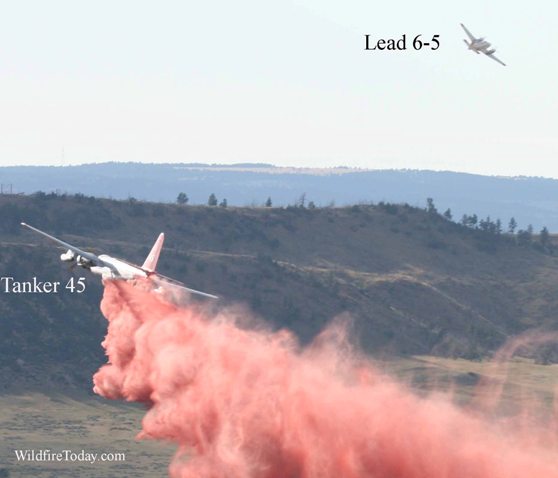
After we posted photos of lead plane 6-5 on July 19 and July 26, we received a message from Jonas Doherty, who provided some interesting details about the photos. Here is an excerpt:
I was the pilot flying the lead plane when you took those pictures. What makes it better is the fact that that actual mission was my final evaluation flight in order to become fully qualified for the lead plane mission. I have been training for the past 1.5 years, the final checkride consisted of 9 seperate missions over the course of a week, the whoopup being the last. It means so much to me to have the article that you wrote as a memory of that day. Your pictures are incredible, and I would love to see more if you would be gracious enough to share them with me.
Just a couple things to clarify regarding the article (as though they matter.) We were actually dispatched out of Silver City, NM. Also, the 5 aircraft that the BLM operates have smoke, but none of the 14 USFS aircraft have it…yet, that is.
Lead 6-5 and Tanker 45 on the WhoopUp fire near Newcastle, WY, July 18, 2011. Photo by Bill Gabbert
We also heard from Chuck Greenwood, the owner of the Greenwood Group, who told us that his company has the contract to supply the lead planes for the U.S. Forest Service. The pilots are USFS employees.
Eagle fire: activity “minimal”
The Eagle fire burning between Warner Springs and Borrego Springs in southern California, has slowed. At the end of the day on Wednesday, CalFire called fire activity on the fire “minimal”. As of Thursday morning it has burned 14,100 acres and has 20 helicopters and over 2,000 personnel assigned. Fire investigators determined that the cause of the fire was arson.
DC-10 worked the Eagle fire on Wednesday
CalFire activated one of the DC-10 air tankers for the Eagle fire in southern California yesterday. Air Tanker 910 flew 5 sorties and dropped 58,000 gallons of retardant on Wednesday.
Rick Hatton, the CEO and President of the company that operates the DC-10’s, 10 Tanker Air Carrier, told Wildfire Today that the aircraft was activated by CalFire on a 5-day Call When Needed (CWN) contract which specifies that any activation will be for a 5-day minimum. The USFS would not allow any minimum number of hours or days in their CWN contract with the company, so the agency apparently expects to use it for one drop, or more, and then shut it down. Mr. Hatton said it will be difficult to continue to operate their two DC-10 air tankers if they are only occasionally used on fires. They are single-purpose aircraft and can’t be diverted like helicopters can to other uses such as law enforcement or news.
Mr. Hatton said that yesterday tanker 910 refilled at Victorville airport, even though CalFire removed all of their property from the reload base on June 30. What remained was the actual reloading equipment, the tanks, mixing equipment, piping, and hoses, which belong to Phos-Chek. Personnel were dispatched to operate it, and they reloaded the tanker five times on Wednesday, each time with 11,600 gallons of Phos-Chek.
File photo of air tankers 910 and 911. Photo: 10 Tanker Air Carrier
CalFire reportedly likes to use the DC-10’s on fires, but the state’s budget problems required that they make $34 million worth of reductions in their fire program this year, including:
730 fewer seasonal firefighters
Reducing the staffing on engines from four to three
Cancellation of the exclusive use contract for the DC-10 air tanker
Norton Point fire along Frontier Creek. Photo: InciWeb
The Norton Point fire 19 miles north of Dubois, Wyoming has been burning vigorously over the last 48 hours or so, but in some areas it has moved into the high country of the Washakie Wilderness, where vegetation, or fuel, may become a limiting factor. The fire ranges from about 8,000 feet in elevation up to 10,000 feet, above which, the fuel, like the air, starts to become thin, which in some areas may slow down or even stop the spread. It is being managed at something less than a full suppression strategy. The IMTeam wrote on Inciweb:
The team is planning for a fire that may burn until snowfall.
Yesterday it was listed at 3,500 acres but an infrared mapping flight at 2:03 a.m. MT today revealed that it had grown to 9,320 acres. And judging from a heat detection map I saw this afternoon, that number is obsolete. Smoke from the fire is visible on weather satellite photos Wednesday afternoon .
Click to enlarge. Norton Point 3-D map of the perimeter at 2:03 a.m. MT, July 27, 2011. (The terrain elevation is exaggerated to make it more visible.) Google Earth/USFS
A “short” version of Rocky Mountain Type 2 Incident Management Team A assumed command of the fire Tuesday morning but they hit the ground running, at least as far as providing information to the public. In less than 36 hours they have already created an InciWeb site, posted a detailed map of the perimeter on InciWeb, uploaded the perimeter file so that it can be viewed by anyone with Google Earth, and provided some photos. Cudos to Information Officer Sarah Gallup! This far exceeds what we have seen from many other incident management teams, Type 1 and Type 2, over the last few months. Todd Richardson’s IMTeam is setting the standard to which other teams should aspire.
The nearest automatic weather station to the fire is the Elkhorn RAWS station, about 8 miles south and 2,000 feet lower than the fire.
We received an inquiry from a resident of Dubois, Wyoming, south of the fire, asking:
Is there any way to predict which way the smoke will likely blow, ie toward dubois? I understand we are talking about six weeks of fire– obviously some of the time it will be in Dubois.
The IMTeam may have more detailed information, but we looked up some historic wind records, and found a “wind rose” that may shed some light on that question. The historic data closest to Dubois that we could find that summarized wind direction records was for Lander, WY (66 miles southeast of Dubois), provided by the Natural Resources Conservation service and WeatherUnderground.
The wind rose below, shows that approximately 86% of the time during the month of August in 1961, the wind was NOT generally out of the north, which would push smoke toward Dubois. In other words, approximately 14% of the time the wind was out of the NNW, N, or NNE.
I have had some requests to see more of the photos of the WhoopUp fire that I took southeast of Newcastle, Wyoming on July 18, 2011…. so, I put a bunch of them in a slide show.
An infrared mapping flight last night revealed that the Norton Point fire has burned 9,310 9,320 acres — almost triple the last reported acreage. As we said yesterday, you will probably be hearing a lot more about this fire over the next few weeks and months. It could be at least six to nine weeks before a weather-related season ending event stops the spread of this “resource benefit” fire.
================
July 26, 2011
The Norton Point fire that started on July 22 on the Shoshone National Forest in western Wyoming is expected to burn through the summer. Lightning ignited the fire, which has now blackened 3,500 acres 19 miles north of Dubois and 41 miles east of Grand Teton National Park. Apparently a fire strategy of something less than full suppression has been chosen.
A “short” version of Rocky Mountain Incident Management Team A assumed command of the fire Tuesday morning, bringing the total number of personnel on the fire up to 12, with 60 expected by the end of the day.
Here is an excerpt from a news release by the Incident Management Team today:
The Norton Point Fire requires more full-time attention than the Wind River Ranger District can provide and still attend to local needs. The District brought in Rocky Mountain Interagency Incident Management Team A, with specialized expertise in long-duration fires.
Incident Commander Todd Richardson leads a dozen experienced managers from Wyoming and Colorado. While managing the fire day-to-day, the Team also will plan responses to likely fire growth for the rest of the summer. Working under the District’s direction, the Team took responsibility for the fire at 6 a.m. today [Tuesday].
Map of the Norton Point fire, showing heat detected by satellites on July 26, 2011
You may be hearing more about this fire in the coming weeks and months.
Arnica fire in Yellowstone National Park, September 24, 2009
A group of five researchers studying climate change in the Greater Yellowstone ecosystem (GYE) have concluded that higher temperatures will lead to more frequent fires, changing the fire return interval from 100-300 years to less than 30 years. This would prevent the current suite of conifer species from regenerating and result in them being replaced with nonforest vegetation. This is expected to occur by mid-century.
Our findings suggest a shift to novel fire–climate–vegetation relationships in Greater Yellowstone by midcentury because fire frequency and extent would be inconsistent with persistence of the current suite of conifer species.
Holy crap! By the time you or your children are applying for Medicare, there may be very few trees left in Yellowstone National Park.
Here are their findings:
Conclusions
Continued warming could completely transform GYE fire regimes by the mid-21st century, with profound consequences for many species and for ecosystem services including aesthetics, hydrology, and carbon storage. The conditions associated with extreme fire seasons are expected to become much more frequent, with fire occurrence and area burned exceeding that observed in the historical record or reconstructed from paleoproxy records for the past 10,000 y. Even in years without extreme fire events, average annual area burned is projected to increase, and years with no large fires—common until recently—are projected to become increasingly rare. The timing and spatial location of such changes varied somewhat among the three GCMs used in this study, but the models converged by the latter part of the century. The magnitude of predicted increases in fire occurrence and area burned suggests that there is a real likelihood of Yellowstone’s forests being converted to nonforest vegetation during the mid-21st century because reduced fire intervals would likely preclude postfire tree regeneration. A change in dominant vegetation would also cause the GYE to shift from a climate- to a fuellimited fire regime (24). We suggest that the climate–fire system is a tipping element that may qualitatively change the flora, fauna, and ecosystem processes in this landscape and could be indicative of similar changes in other subalpine or boreal forests.
The paper can be found at PNAS.org and was written by Anthony L. Westerling, Monica G. Turner, Erica A. H. Smithwick, William H. Romme, and Michael G. Ryan. The title is Continued warming could transform Greater Yellowstone fire regimes by mid-21st century.
In August, 2009 we wrote an article that criticized the U.S. Government for funding research, but publishing the results in privately owned publications which charge substantial fees for access to the government-bought research findings. We are very pleased to report that the paper described above is published as an “open access article” so that, as far as we know, anyone with an internet connection can read it.
Sunday morning, July 24, a firefighter that had been missing on the Diamond fire near Whiteriver, Arizona (map) was found dead after a search by firefighters and law enforcement authorities. Here is the “24-hour” report submitted by the Bureau of Indian Affairs, Fort Apache Agency, Whiteriver, Arizona:
LOCATION: Diamond Fire, Whiteriver, AZ
DATE OF OCCURRENCE: July 24, 2011
TIME OF OCCURRENCE: Approximately 0600 hours (Arizona Time)
ACTIVITY: Wildland Fire Suppression
NUMBER & TYPE OF INJURY: 1, Fatality
NARRATIVE:
The lightning caused Diamond Fire was reported to Show Low Dispatch on Saturday, July 23rd, 2011 at approximately 1200 hours Arizona time. The location of the fire was confirmed by a helicopter to be north of the Black River on Fort Apache, approximately 2.5 miles northeast of Ten of Diamonds Ranch.
The Fort Apache Helitack and Fort Apache Hotshots were dispatched as Initial Attack resources and were flown to a helispot located on a ridge top on Patty Butte near the fire start. Terrain in the area is steep and rocky with a dense woodlands fuel type. Following completion of a handline around the approximately 35 acre fire all resources hiked back up to the helispot (spike camp). As resources returned to helispot, the Incident Commander determined that one firefighter was not accounted for and initiated a search to locate the missing firefighter. The firefighter was in possession of a handheld radio and attempts to contact him throughout the evening were not successful. After several sweeps of the area, law enforcement from local, county and state agencies were requested to assist with the search efforts. Search efforts continued throughout the night until the missing firefighter was found deceased at 6:18 am.
A Critical Incident Stress Management and a Serious Accident Investigation Team have been ordered.
SUBMITTED BY: Lynn Polacca, BIA, Fort Apache Agency, Deputy Superintendent
Our sincere condolences go out to the firefighter’s family and co-workers.
The Eagle fire on the Los Coyotes Indian Reservation and the Anza Borrego Desert State Park in northern San Diego County has grown to 11,000 acres. The fire grew by only a few hundred acres today due in part to overcast skies and a relative humidity between 51% and 60%, recorded at the Ranchita RAWS weather station 3.5 miles south of the fire.
National Guard helicopters are assisting with crew shuttles, inserting over 100 firefighters into the remote area west of Borrego Springs, California. Assigned to the fire are 1,120 personnel, 63 engines, 74 hand crews, 19 helicopters, and 8 dozers. Sunday evening the fire was 40% contained.
Map showing heat detected by satellites on the Eagle fire at 3:06 p.m. PT, July 24, 2011. MODIS
A Borrego Springs resident posted a few photos of the fire.
Something for your trivia file: the 600,000-acre Anza Borrego Desert State Park is the largest state park in California; and after New York’s Adirondack Park it’s the second largest state park in the contiguous 48 states.
Injured hiker starts signal fire
A 35-year old man hiking near Buckeye, Arizona injured his leg, and becoming dehydrated, set a signal fire hoping someone would find him. Here is an excerpt from KPHO:
The man’s fire was initially spotted by a local farmer who called for help. When deputies arrived they heard the injured hiker calling for help. Firefighters were able to get the man out by foot and to a waiting helicopter that took him to a nearby hospital in Goodyear.
The Buckeye Valley Fire Department was able to put out the brush fire, quickly keeping it to a small area. However, because of the remote area they are keeping an eye on it to make sure it is completely out.
Firefighters said they never recommend starting a fire, but in this case it worked out for the best.
“You got to take what he had. If he did not have a phone or any other way to make contact with anybody and he got to the point where he could not make it out of here himself, yes I would say he did the right thing we found him and got him out,” said Preston Hundley, of the Buckeye Valley Fire Dept.
Single engine air tankers in Arkansas
A Single Engine Air Tanker is reloaded with water at the Hot Springs Municipal Airport on July 23, 2011. Credit: Arkansas Forestry Commission
The Arkansas Forestry Commission is bringing on two single engine air tankers a week earlier than previously planned due to the heat and a recent drought.
“Arkansas is in drought conditions and fuels are dry, especially across the south half of the state,” said Don McBride, Assistant State Forester-Protection. “Areas in the state have not received any significant rainfall for a couple of months. With the dry conditions and 100 degree temperatures, conditions are very dangerous for our firefighters. We need to do anything possible to slow these wildfires and cool them down to help suppression crews.”
Firefighters discover historic cabin
Historic cabin found on the Lion fire
Firefighters on the Lion fire in California’s Sequoia National Forest discovered an historic cabin Saturday. Here is a news release from the USFS:
Historic Cabin Discovered on Lion Wildfire
SEQUOIA NATIONAL FOREST Helicopter crew members spotted an old cabin in the forest’s wilderness while completing aerial ignitions yesterday.
Crew members halted ignitions and ensured that the cabin was protected from the fire. This cabin was undocumented by forest officials, so this is a special find for the forest.
“It’s exciting to have discovered an historic structure that we were unaware of in this fire response,” said Priscilla Summers, Western Divide District Ranger. “Efforts are underway by forest staff to determine how this cabin fits into the historical story of the area. The forest thanks the firefighters who saw this cabin and made the efforts to protect it from the fire.”
Please visit http://inciweb.org/incident/2400/ for information about the Lion Wildfire.
WhoopUp fire 100% contained
The 10,675-acre WhoopUp fire straddling the Wyoming/South Dakota border is 100% contained as of 7:00 p.m. July 24. Transfer of command to a local Type III organization will take place Monday, July 25th at 7:00 pm.
“I am extremely proud of the work done on the Whoopup Fire,” said Deputy Incident Commander Jay Esperance. “To get to 100 percent containment without injuries or structural loss is due to the hard work achieved by all incident personnel.” An account of an epic rescue
If you have ever wondered what it’s like to be struck by lighting, check out an article at trib.com about how numerous people were struck by lightning last year on a mountain in Grand Teton National Park in Wyoming. Three groups of climbers, for a total of 17 people, had to be rescued when an unexpected storm moved in. The article is very interesting; here is an excerpt: Continue reading
The Federal Emergency Management Agency has issued a news release which includes a statement saying:
Many Texans have lost their lives during severe wildfire seasons because a wildfire overtook them in their vehicles.
The release goes on to advise motorists that they should never drive into dense smoke or they could become a fire fatality. Makes sense, of course, and it’s always good advise.
We are aware of smoke-caused fatalities occurring on highways in other places, including Florida in 2008 and also during the Cedar fire in San Diego County in 2003 when residents were killed while trying to evacuate from the Wildcat Canyon Road area.
File photo of the wreckage from the January 9, 2008 crash on Interstate 4 in Florida caused by smoke from a prescribed fire. The Ledger.