Tanker 00 drops on the Last Chance fire; photo by Joel Arnwine
A 29-year-old man faces up to six months in jail after he pleaded guilty to a misdemeanor charge of leaving a fire unattended in the Lincoln National Forest in New Mexico in April. Rodrigo Ulloa-Esquivel of El Paso admitted that he lit toilet paper on fire after relieving himself. He explained that he did not want to leave litter behind. The Last Chance fire burned 53,342 acres.
Fires started by campers burning toilet paper is not as uncommon as you may think. I recall one or possibly two fires that were started this way by volunteers in Anza Borrego Desert State Park in California during the annual Bighorn Sheep Count.
Pagami Creek fire September 11, 2011. Photo: Superior National Forest
The latest update on the Pagami Creek fire which has burned over 92,000 acres in Minnesota’s Boundary Waters Canoe Area Wilderness was on October 22. At that time it was described as 93 percent contained and unstaffed. The federal government has spent $22.3 million dollars on suppression as of October 22.
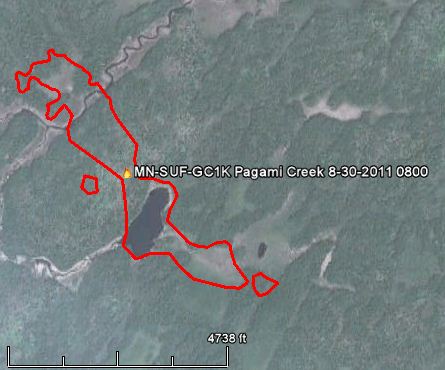
Map of the Pagami Creek fire at 8:00 a.m. CT, August 30, 2011. Credit: Superior National Forest and Google Earth
When lightning ignited the fire on August 18, the Superior National Forest made a decision to not suppress it, but to herd it around as necessary to keep it within a reasonable maximum management area while allowing natural processes to do their thing. After 12 days it had only grown to approximately 130 acres, and fire management officials may have thought things were going well — until September 12 when everything went to hell. Strong winds gusting up to 35 mph spread the fire 16 miles to the east. HERE are some of the posts on Wildfire Today that mention the Pagami fire.
The StarTribune has a probing article written by Tony Kennedy that explores some of the decisions that were made during the early stages of the fire. It’s worth a read. Here is an excerpt:
Records show the federal agency repeatedly underestimated the fire’s strength and volatility.
ELY, MINN. — A series of internal reports show that the U.S. Forest Service repeatedly underestimated the explosiveness of the Pagami Creek Fire during a critical 18-day stretch of late August and early September, allowing a half-acre burn to grow into a massive firestorm that left eight people fighting for their lives inside the Boundary Waters Canoe Area Wilderness.
[…]
“We felt like we were being very proactive,” said Mark Van Every, head of the Kawishiwi Ranger District in Ely, where the fire command is based. “It just happened faster and further than we expected.”
In the future, he said, the Forest Service might order faster and wider evacuations. “I will make those closure areas broader if I feel there is any potential at all that the fire could get there,” Van Every said. He said officials will also recalibrate the tools used to judge how fast a BWCA fire can move.
Meanwhile, two public reviews are underway. One is focused on an incident that endangered six crew members trapped by fire on Lake Insula. Two female crew members were forced to abandon their canoe while paddling in a lake channel that became choked by fire, Van Every said. Four others beached their canoes on an island and took cover under life-saving gear and later rescued their freezing crewmates from a nearby shore.
[…]
The half-acre burn didn’t budge much for seven days. The U.S. Drought Monitor, produced by the National Weather Service, showed the area to be in the first stage of drought, known as “abnormally dry.” But Van Every and Tim Sexton, a forest ranger based in Cook, Minn., said other indicators didn’t suggest rapid rates of spread. The fire’s early behavior supported that thesis, they said.
Then, on Aug. 26, with Sexton covering for a vacationing Van Every, the humidity level dipped abnormally to 18 percent and winds blew from the northwest. What had been a slow-creeping fire with flames 6 inches high in the morning picked up and ran in a narrow band to the southeast.
[…]
Strategic burn
The Sept. 4 decision reflected firefighters’ growing concern about dry forest conditions. “Weather forecasts indicate that September will experience dry, windy weather with occasional frosts (which will cause leaf fall and add to the hazardous fuel loading),” the WFDSS report said. In addition, drought conditions would worsen to the “severe” level by Sept. 6.
Above: Firefighter on the Shep Canyon fire in South Dakota, September 6, 2011. Photo: Bill Gabbert/Wildfire Today.
After reading our excerpt and later the full document from the the Serious Accident Investigation Factual Report for the hyperthermia fatality on the CR 337 fire in Texas, we heard from Dr. Brent Ruby, who has completed studies on this exact issue, even having studied wildland firefighters while they were working on fires. In one of his studies he was monitoring a wildland firefighter outfitted with a core temperature monitor, an ambient temperature sensor, and a special Camelback hydration system that monitored his water intake. This firefighter experienced a heat-related illness, heat exhaustion, and had to be evacuated off the fireline by a helicopter. That was a terrible thing to happen to a firefighter, and I’m sure the researchers thought the same thing, but it was probably a once in a lifetime cornucopia of incredibly useful data. Dr. Ruby sent us this message, reprinted here with his permission:
I was bothered by the findings of the CR337 fatality report from the investigation team. There are issues within this case that are very similar to a published heat exhaustion case study we published recently (Wilderness and Environmental Medicine 22, 122-125, 2011, http://www.ncbi.nlm.nih.gov/pubmed/21664560). In this report, we document drinking behavior, activity patterns, skin and core temperatures in a subject that suffered heat exhaustion and required evacuation. The lessons learned from this research clearly indicate that the best protection against a heat injury is reducing work rate. [*the abstract from the study is below]
Aggressive hydration strategies are over-preached and may provide a false sense of protection. It should be emphasized that the autopsy report as described in the fatality report indicated no signs of dehydration or electrolyte imbalance. I have tried to push these concepts to crews and safety officers when I get a chance to speak to them at meetings. I was bothered by this fatality knowing that it is seemingly directly linked to some of our research findings. I have tried to emphasize this to anyone that will listen in the world of wildfire.
You can certainly review our website to gain a better understanding of the publications we have done from research with the WLFF http://www.umt.edu/wpem. We have a great deal of physiological data, hydration, energy demands of the job, importance of supplemental feedings, etc. from all our work over the years. This peer reviewed research provides objective, scientific evidence that can be used to to change or influence policy to enhance safety on the line.
Let me know if you have any questions.
Regards, Brent Ruby
Brent C. Ruby, Ph.D., FACSM
Director, Montana Center for Work Physiology and Exercise Metabolism, The University of Montana
High work output combined with high ambient temperatures caused heat exhaustion in a wildland firefighter despite high fluid intake.
Cuddy JS, Ruby BC.
Montana Center for Work Physiology and Exercise Metabolism, The University of Montana, Missoula, MT 59812-1825, USA.
The purpose of this case study is to examine the physiological/behavioral factors leading up to heat exhaustion in a male wildland firefighter during wildland fire suppression. The participant (24 years old, 173 cm, 70 kg, and 3 years firefighting experience) experienced heat exhaustion following 7 hours of high ambient temperatures and arduous work on the fire line during the month of August. At the time of the heat-related incident (HRI), core temperature was 40.1 °C (104.2 °F) and skin temperature was 34.4 °C (93.9 °F). His work output averaged 1067 counts·min(-1) (arbitrary units for measuring activity) for the 7 hours prior to the HRI, a very high rate of work over an extended time period during wildfire suppression.
In the 2.5 hours leading up to the heat incident, he was exposed to a mean ambient temperature of 44.6 °C (112.3 °F), with a maximum temperature of 59.7 °C (139.5 °F). He consumed an average of 840 mL·h(-1) in the 7 hours leading up to the incident and took an average of 24 ± 11 drinks·h(-1) (total of 170 drinks). The combined effects of a high work rate and high ambient temperatures resulted in an elevated core temperature and a higher volume and frequency of drinking than typically seen in this population, ultimately ending in heat exhaustion and removal from the fire line.
The data demonstrate that heat-related incidents can occur even with aggressive fluid intake during wildland fire suppression.
Unfortunately, even though Dr. Ruby’s research is funded by taxpayers through the National Institutes of Health, the National Science Foundation, and the Department of Defense, taxpayers are blocked from seeing the full results unless they pay a fee to the privately owned company that published the paper. We have written before about the results of taxpayer-funded wildfire-related research being held hostage by private companies. Dr. Ruby told Wildfire Today that he will send a copy of his paper to individuals that write to him at brent dot ruby at mso dot umt dot edu
The combined information about the fatality of Caleb Hamm on the CR 337 fire and Dr. Ruby’s study on wildland firefighters, is shocking. From the abstract, again:
The data demonstrate that heat-related incidents can occur even with aggressive fluid intake during wildland fire suppression.
Working on a wildfire on a hot day can lead to heat exhaustion and hyperthermia, and can be fatal EVEN IF a person drinks plenty of water and is not dehydrated.
Symptoms and prevention
We asked Dr. Ruby for more information:
Exertional hyperthermia occurs when the metabolic heat production from hard work overwhelms the bodies ability to off load it to the environment. This unloading can be blocked by clothing and/or slowed due to high radiant heat from the sun or an adjacent fire.
The basic symptoms of heat exhaustion are commonplace and can include profuse sweating, weakness, nausea, sometimes vomiting, lightheadedness, headache and sometimes mild muscle cramps.
The best approach [to prevent heat exhaustion and hyperthermia] is to know thyself and thy physical limits. Establishing a pace schedule that allows temperature to come back down in between periods of work that result in a rise in temperature. The factors of importance are pace, fitness level for the task at hand, hydration behaviors and simultaneously electrolyte concentrations in the blood.
It is important for wildland firefighters to drink plenty of water, but this will not, by itself, totally eliminate all chances of heat-related illness.
Be careful out there.
===============
UPDATE October 27, 2011:
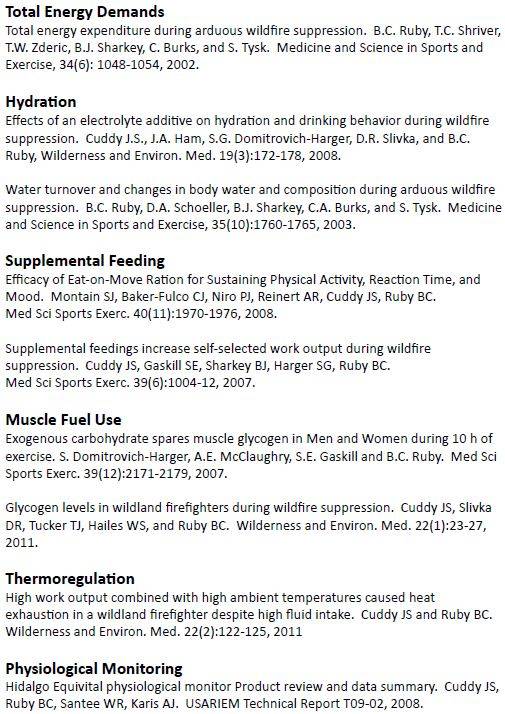
Dr. Ruby sent us the following list of other publications on similar topics that are in peer reviewed journals. I assume that most of them are not available to the public (don’t get me started on that again!) unless you pay the ransom fees at the private companies, or send a message to Dr. Ruby: brent dot ruby at mso dot umt dot edu
====================
UPDATE October 28, 2011:
The U.S. National Library of Medicine has an excellent article about heatstroke, which can follow heat cramps and heat exhaustion and is life-threatening. The article includes causes, symptoms, first aid, what not to do, when to call 911, and prevention (including “avoid exercise or strenuous physical activity outside during hot or humid weather”. Good luck with that one, firefighters.)
The sculptures in the above photos are made of tens of thousands of Crayola crayons that artist Herb Williams made to represent flames, intended to draw attention to the wildfires that have devastated some areas in Texas. The sculptures are supposed to melt under the hot Texas sun, changing their shapes at their installation at the National Ranching Heritage Center in Lubbock, Texas. More photos are at their Facebook page (which was the source for these photos).
HughesNet sics bill collector on victim of Texas fire whose home burned in a wildfire. HughesNet insisted that the dish, the cable, and the modem be returned.
Michael Anthony Penn, 22, will be arraigned on Thursday for setting the Beaver Creek fire that burned about 60 acres near the U.S. Air Force Academy in the Pike National Forest in Colorado on August 19.
Five years ago today five U.S. Forest Service wildland firefighters were entrapped and died on the Esperanza fire near Cabazon, California. Killed were engine Capt. Mark Loutzenhiser, 44, of Idyllwild; engine operator Jess McLean, 27, of Beaumont; assistant engine operator Jason McKay, 27, of Phelan; and firefighter Daniel Hoover-Najera, 20, of San Jacinto. A fifth firefighter Pablo Cerda, 23, of Fountain Valley, who was injured along with the other four, passed away on October 31. More articles about the Esperanza fire on Wildfire Today can be found HERE.
The International Association of Wildland Fire is reporting the deaths of two pilots in separate wildfire aviation accidents in Spain. One was a single engine air tanker that crashed on October 2, and the other was a mid-air collision of two helicopters on September 30. There was one fatality in each incident.
Status: Contractor to the Airborne Firefighting Service of the Galician Regional Government (INFOCAM) (INFOGA)
Years of Service: Very experienced pilot and had flown the last four fire seasons in Galicia (Galice) Spain. He was a master of the Aeroclub of Biscay, and wrote a very popular manual for obtaining a private pilot’s license.
Date of Incident: 2 October 2011
Time of Incident: approximately 1715 hours local time
Date of Death: 2 October 2011
Company: Martínez Ridao Company
Fire Department: Airborne Firefighting Service of the Galician Regional Government (INFOCAM)
Incident Description: Pilot Zubiaga, was helping to extinguish a large fire in the Serra da Meda, Galicia near the town of Arcucelos (Laza). The plane he was piloting, an Air Tractor AT802, crashed for reasons still unknown but the pilot had time to radio his base that something was wrong with the aircraft. Nearby observers saw the “aircraft was on a strange maneuver before plunging to the ground.” Firefighters from Verín started an immediate search and when they found the aircraft the Zubiaga was not inside. He died of unknown causes and was found about 150 meters from the crashed aircraft in an area of rough terrain. His body was discovered about 1900 hours local time and was taken to the Hospital Complex of Ourense. An autopsy was to be performed to determine cause of death. The Regional Ministry of Rural Affairs announced an inquiry would take place concerning the incident.
Incident Location: Autonomous Community of Galicia, Ourense-Xunta de Galicia province, in Serrra da Meda, between Laza and Verín to 42.008999,-7.482033. Galicia (Galice) is in northwest Spain and is bordered by Portugal to the south, the Atlantic Ocean to the west and the Bay of Biscay to the north.
INCIDENT #2
Name: Leo Jenssen (from Denmark)
Rank: Pilot
Age: unknown
Gender: Male
Status: Contractor to the Airborne Firefighting Service of Castilla La Mancha Regional Government (Incendios Forestales Castilla La Mancha, INFOCAM)
Years of Service: More than 10700 flight hours and eight fire seasons in Spain
Date of Incident: 30 September 2011
Time of Incident: 1340 hours local time
Date of Death: 30 September 2011
Company: Grupo INAER
Company Address: Oficinas Centrales (INAER Helicópteros), Aeródromo de Mutxamel, Partida La Almaina, 92, 03110 Mutxamel, Alicante, SPAIN
Fire Department: Airborne Firefighting Service of the Castilla La Mancha Regional Government (Incendios Forestales Castilla La Mancha, INFOCAM)
Helicopter Contractor: Grupo INAER
Incident Description: Two helicopter Bell B212’s touched and crashed during aerial maneuvering to refill with water at the Bienservida reservoir. Pilot Jennsen (flying helicopter MSN 30775, CC-CIS) was the only one of the two pilots who died during the incident. The other pilot, Manuel Fuertes, with 13 years’ experience, (flying helicopter EC-GIC), survived with minor injuries and burns but walked away from the crash and was taken to the hospital in Ciudad Real. Pilot Jennsen was unconscious and with a pulse when extracted from the water and CPR was administered. Pilot Jennsen was pronounced dead at the hospital and reportedly died from drowning. He was working for INAER, for the Castilla La Mancha fire agency. The fire reported at 1245 hours local time was extinguished at only 6 ha. The Accident Investigation Commission and Civil Aviation Incidents (CIAIAC) of the Ministry of Development is responsible for the investigation. The helicopter had last undergone and passed a review on 22 September. At this time the cause of the accident is unknown.
Incident Location: Area known as Los Castellares in the Alcaraz Sierra, Autonomous Community of Castilla-La Mancha, Albacete province, at the Bienservida reservoir, 38.519429,-2.61137. Spain.
The U.S. Forest Service has released a facilitated learning analysis for a series of events that occurred on the Mother Lode fire on the Mount Hood National Forest in Oregon September 4 through 7, 2011.
If you are a regular reader of Wildfire Today and think the Mother Lode fire sounds familiar, it’s because we featured a photo from it on September 18, which showed a Class A faller (qualified to fall trees smaller than 8 inches in diameter) cutting a very large tree which is barber-chairing, a very dangerous condition.
The entire FLA is HERE (7 MB), but we will include an excerpt of it below. The narrative picks up on September 7. Previously, on September 6, at least 90 firefighters engaged in line construction had to abandon their assignments due to fire activity and utilize escape routes. They spent the night on the fire at a couple of different locations but met at H2 the next day. On the morning of September 7, 85 firefighters were extracted from H2 by helicopters. Left at H2 were 5 people, rappellers and helitack personnel.
Here is an excerpt from the FLA, which reads like a novel with the names removed:
The Rappellers and Helitack continued to build loads of non essential gear while they waited for the sling missions to continue. They noticed some indicators of increasing fire behavior; scattered group torching and an increase in the main column. The fire edge closest to H2 was relatively calm, and was being checked by the Type 1 helicopter. When Air Attack had to leave the fire, the Lead Crewman from the Helitack Crew established communication with the Type 1 helicopter to act as lookout for H2. Shortly thereafter, the Type 1 helicopter had to leave the fire. Without the bucket support fire activity near H2 increased significantly.
At approximately 1500 Ship 1 returned for sling work but could not complete the mission because of smoke covering H2. He informed Air Attack on air to air. Ship 3 had just refueled at Helibase and was enroute to pick up the Rappellers. The Rappel Manager copied traffic on air to air in flight. As he approached the fire area for the first time he established communication with Rappeller 1 and could tell they were breathing hard. Ship 3 circled while Rappel Manager scanned the main ridge assuming that H2 was toward the top of the ridge. The fire activity the rappel manager saw along the ridge made him very uncomfortable. He estimated 200’ flame lengths off of sustained crown runs. He said “This isn’t good.”
The Rappellers and Helitack left H2 when fire behavior adjacent to the helispot increased. They headed for the East side of the East Lake (Figure 4). The foot travel was slow through the thick rhododendron. It took them approximately 12 minutes to get there. As they reached the lake they looked back at H2 and could see that it was now burning.
Recognizing that the Rappel manager could not establish their position, Rappeller 2 waded into the lake to signal their location to the helicopter. The Manager spotted Rappeller 2 and immediately felt a sense of relief. He began looking for places to land nearby. He hovered over the area he thought was the best location for an extraction site and Rappeller 2 acknowledged he saw the location. The Rappel Manager then called Air Attack to inform him they intend to let down 2 saws to cut H3. Rappeller 2 and 3 headed up the ridge to their South to begin looking for H3 . Rappeller 1 stayed to communicate the plan with the Helitack Crew.
At about 1530 the ICT3 tells the Forest Agency Administrator that he needs to order a Type 2 team and stated that if they wanted to continue managing this at the 3 level, they will need to find a new Type 3 IC.
At approximately 1545 Ship 1 flew back to helibase to reconfigure for crew extract. Ship 3 also started back to helibase to reconfigure for cargo let down. Enroute they chose to land in a dry creek bed. On the way out the Rappel Manager noticed two spots southeast of the main fire edge. Minutes later on the way back to H3 the spots were approximately 50 acres. They arrived at H3 and letdown the chainsaws. Ship 1 and Ship 3 orbited the fire waiting for H3 to be completed. During this time Ship 2 provided bucket support trying to cool the edge nearest H3.
Rappeller 2 and 3 began falling trees. Rappeller 1 positioned herself at a vantage to keep eyes on the fire. The Helitack Crew came up from the lake to help move material and there was a highly coordinated and tightly coupled effort to get the helispot done quickly. Rappeller 2 and 3 used close to a tank of saw gas each in approximately 40 minutes. When the Helispot was near completion the Helitack Crew called Ship 1 in to approve. Ship 1 decided H3 needed two more snags cut. As soon as they were felled the ship came in to load the Helitack Crew. Immediately behind them Ship 3 picked up the rappellers.
The Suwannee Democrat is reporting that a crop duster plane clipped three high-voltage power lines near McAlpin, Florida early Monday afternoon, starting a brush fire. Suwannee County Fire Chief Charlie Conner said the pilot landed the plane safely at a local airport.
Tanker 07, a P2, on the Whoopup fire, July 18, 2011. Photo by Bill Gabbert
The Missoulian has an article about the current and future state of the air tanker fleet. Here is an excerpt:
Fighting fire from the air will remain a major tactic for the U.S. Forest Service, and the skies could start to get crowded soon.
“We want to have more than 11, but probably less than 44 large air tankers,” U.S. Forest Service national fire director Tom Harbour said in a recent interview with the Missoulian. “I think ultimately we’ll have between two and three dozen large air tankers.”
Eleven multi-engine retardant bombers remain under contract with the Forest Service, down from a fleet of 44 in 2004. Missoula-based Neptune Aviation has nine of those tankers, while Minden Air of Arizona has the other two.
“We’re looking all around to see what aircraft there are out there,” Harbour said. “We’re not doing any research in particular aircraft (within the Forest Service), but we’re interested in all designs. There are lots out there: old, new, big and little. And there are dozens of folks who have a particular platform they want to try. Neptune’s just been the first to take our criteria and put a plane in service.”
That would be Neptune’s new BAe-146 jet tanker, which won a short-term firefighting contract in September. The plane is the *first new model in nearly three decades to be certified for forest fire work. It is currently fighting fires in Texas.
Assuming the BAe passes additional field testing during the interim contract period, Neptune officials said they plan to phase in as many as 11 more jets as market conditions dictate.
Neptune CEO Kristen Nicholarsen said she’s heard of three or four companies developing retardant-dropping planes in pursuit of Forest Service contracts.
*Actually, the DC-10 and the 747 are aircraft models that are new to the air tanker fleet that have been certified by the Interagency Air Tanker Board in recent years.
Scott Steen, the CEO of American Forests, has written an editorial for The Hill, in which his focus is on how the United States should invest in forest health and in strategies to decrease the risk of future fires. Here is an excerpt:
…”First, Congress must approve the recommended $413 million for funding of the Federal Land Assistance, Management and Enhancement (FLAME) Act. This act sets aside specific funds for directly fighting fires — from the wages of the firefighters to the cost of planes and equipment. Every year since 2000, firefighting expenses have exceeded $1 billion a year, so FLAME’s budget is essential to protecting our homes and communities. Even the best fire prevention plans are not going to make wildfires go away overnight.
Next, $110 million is needed for State Fire Assistance, which is partially funded through the Forest Service’s wildfire accounts and partially through their cooperative programs with states. This federal program helps communities prepare Community Wildfire Protection Plans (CWPPs) to reduce hazardous fuels and other wildfire threats in their local communities. Removing hazardous fuels is a key component of fire prevention. The greater the fuel load, the more intense the fire. Through CWPPs, communities are able to identify sites and methods for fuel reduction to protect their most at-risk areas, expediting federal aid to these areas. Federal support of CWPPs ensures consistency across county lines and within forests. By funding fire prevention, the budgetary needs for firefighting will decrease in the coming years, saving Americans millions of dollars.
Science has proven that fires can be a normal, healthy part of forest ecosystems — returning nutrients to the soil and removing disease-ridden plants and harmful insects. But too many years of suppression and hands-off management have made our public lands overgrown, leading to hotter, larger and more destructive fires.
Wildfires cost lives, as well as hundreds of millions of dollars of damage to property, crops and livestock, not to mention the destruction of wildlife and ecosystems. We can no longer simply react to the problem, but must work harder to prevent it. And to do that, Congress needs to monetarily support both firefighting and fire prevention efforts.”
There has been a new development in the lawsuit that U.S. Representative Denny Rehberg is bringing against the Billings Montana Fire Department. Rehberg and his wife have been attempting to obtain money from the fire department to compensate them for a 2008 fire that burned some undeveloped land that they own. In the lawsuit that was filed July 2, 2010, he accused the fire department of not having firefighters on the fire long enough, which allowed the fire to flare up again and burn additional acres.
The Billings Gazette is reporting that Rehberg and his wife have offered to settle the lawsuit “without monetary compensation” if the city will adopt “specific wildland firefighting standards” that may prevent future property loss or damage, according to a letter provided to The Billings Gazette by Jan Rehberg. Ms. Rehberg was quoted as saying:
It’s not about the money. It’s about recognizing wildland fires can cause significant damage, and that’s why we’re interested in making sure it doesn’t happen again.
In a written response to the seven-page letter that Rehberg’s attorney sent to Michele Braukmann, the city’s attorney, in which the settlement offer with the demands was made, Braukmann wrote in part:
..Suffice it to say, I will not waste my client and the taxpayer’s resources by responding to the letter’s many inaccurate, self-serving, and unsubstantiated assertions. I likewise will not respond in kind to the public comments you made in last week’s Billings Gazette article, in essence calling me a “liar”. I do not now, nor will I ever in my practice, litigate by name-calling or making disparaging comments about or to opposing parties and attorneys.
The trial for the lawsuit is scheduled for December 3, 2012, one month after the election in which Denny Rehberg is a candidate for the Senatorial seat occupied by Jon Tester. Representative Rehberg is giving up his seat to challenge Tester. A pending trial against the fire department might adversely affect Rehberg’s chances in the election.
Fire-management-policy-by-lawsuit is never a pleasant thought.