3 firefighters injured while fighting grass fire in Tennessee

Three firefighters from the Braden fire department in Tennessee were injured while fighting a grass fire in the median of Interstate 40 in Fayette County on Monday. At about 5:10 p.m. a pickup pulling a trailer veered into the median and struck the rear of their fire engine, injuring the three firefighters. Two of the firefighters were listed in serious condition at the Regional Medical Center in Memphis while the third firefighter was treated and released from a hospital.

The driver of the pickup was killed and his passenger was transported to a hospital.

Here is an excerpt from the Braden FD’s Facebook page that was updated late Monday night:

=====================================================

“This afternoon Braden responded on a grass fire on I-40 at the 40 mile marker in the median. Many times if in a pumper we will use the deck gun to quickly hit the fire to limit our exposure on the interstate. That is what they did today. While putting flaps back and shifting out the pump, Engine 2 was rear ended by a truck and trailer. Three of our brother firefighters were injured and taken to hospitals. Two were flown to the Med and one was taken to Somerville were he was treated and released. The two at the Med are in serious condition.

Our apparatus is Lime Green, we wear yellow turnouts and also wear ANSI vest. All this just to be better seen on the Interstate. We have been very lucky in the past, but the Interstate is just a dangerous place to work.

I want to thank everyone involved in this incident tonight whatever part you played. A ton of people stepped up and offered help. I also want you to think outside of this tragic event that happend to Braden Fire Department tonight and include those who lost their father and husband in this accident.

We will try to keep you posted on Mack & Josh’s condition and request you keep them and their families in your prayers.”

Google launches Public Alerts

Google Public Alerts

Google has launched a service that displays emergency alerts on a map. According to Google, if you go to Google Maps and search, for example, for “Flood Indiana”, it will display icons at locations that have flood warnings or advisories. Or, you can go directly to the Google Public Alerts page and see the alerts that have been posted. Zooming in sometimes causes more alerts to be displayed.

Google’s announcement about the service that was posted on January 25 does not mention if wildfires or evacuations would be part of this system, but they do say that “public safety” will be one of their objectives.

Here is an excerpt from Google’s announcement:
Continue reading

Fire channelling — a danger to firefighters

Fire Channelling

The rapid escalation of a small fire due to fire channelling can result in a catastrophic decay in both firefighter and community safety that is counterintuitive.

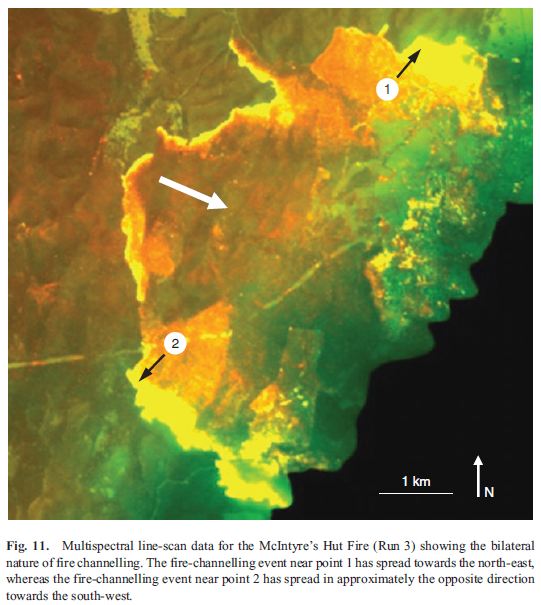
That is how the authors of a paper wrapped up their findings about a weather phenomenon that can cause a wildfire to spread in unexpected directions. “Fire channelling” can force a fire on the lee side of a ridge to spread 90-degrees from the general wind direction. For example, if a west wind pushes a fire across a north-south ridge, on the lee or east side of the ridge the fire could spread to both the north and the south, counterintuitively.

Fire Channeling fig 11
The white arrow shows the general wind direction. The black area was not imaged by the line-scanner on this run. From the Sharples, McRae, and Wilkes paper funded by the Australian government.

Generally a strong wind has the most effect on the direction of spread of a fire — more so than topography or fuel. If a fire is spreading with a strong west wind, the rate of spread on the flanks, the north and south sides, will be much less than the head of the fire on the east side. Unless — fire channelling is occurring.

Firefighters usually face less risk when they attack a fire on the heel or flanks of a fire. In most cases it can be impossible to safely attack the head of a fast-moving fire in heavy fuels. But this fire channelling phenomenon has the potential to present firefighters with unexpected fire behavior, putting them in a dangerous situation on what they expected to be the flanks of a fire that suddenly converted to heads of the fire.

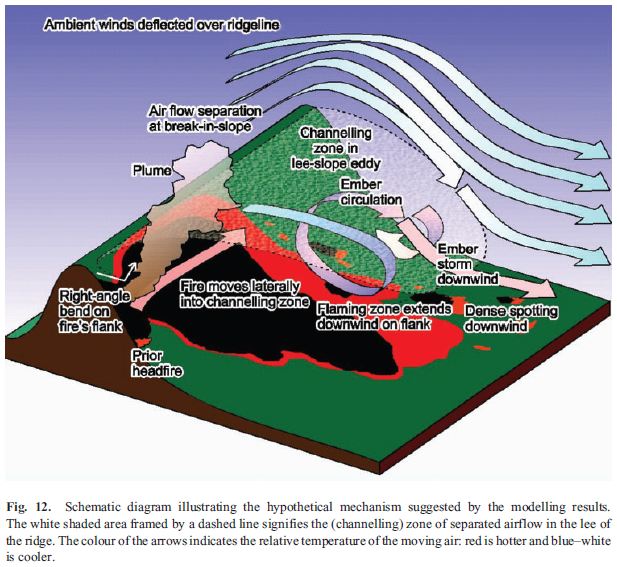
Fire Channelling
Fire channelling caused by wind-terrain-fire interactions. From the Sharples, McRae, and Wilkes paper funded by the Australian govermnent.

The authors of the paper, which is titled Wind–terrain effects on the propagation of wildfires in rugged terrain: fire channelling, considered several causes of fire channelling, including thermally induced winds, pressure-driven channelling, forced channelling, and downward momentum transport, but they settled on wind–terrain–fire interactions as the most likely mechanism driving the atypical spread. Here is an excerpt providing some details about wind–terrain–fire interactions:

…If a fire happened to spread into a region affected by a separation eddy, then the hot gas from the fire could be entrained within the eddy, with the strong wind shear at the top of the eddy impeding mixing between the synoptic and separated flows. Hence, supposing a fire enters a region of separated flow at the north end of a slope or valley, and treating the air within the eddy as a quasi-isolated system (i.e. a system that involves only limited mixing with the surrounding environment; cf. Byron-Scott 1990), the air within the northern part of the eddy will be at a higher temperature and pressure than the air within the southern part of the eddy. As a consequence, the air within the eddy will tend to move towards the south in response to the thermally induced pressure gradient or simply owing to thermal expansion of the air within the eddy. Based on the available evidence, such an interaction constitutes the most likely mechanism driving the atypical spread.

Access to the research

If you want to read the paper you will have to pay CSIRO Publishing $25, in spite of the fact that the authors appear to be funded by the Australian government. It was written by Jason J. Sharples, Richard H. D. McRae, and Stephen R. Wilkes who are associated with three organizations in Australia, the University of New South Wales at the Australian Defence Force Academy, the Bushfire Cooperative Research Centre, and the ACT Emergency Services Agency.

This is another example of government funded research that taxpayers have to pay for twice. Once when the government-paid employees conduct the research and write the paper, and a second time if a person wants to read it. We have written about this lack of Open Access numerous times before. However, this example is a little murky, in that the government sponsored research was published by CSIRO, a governmental body. But many U.S. wildfire researchers who are government employees publish their papers in the same CSIRO publication, the International Journal of Wildland Fire, behind a pay wall.

Sign the petition

At the U.S. White House web site you can sign a petition to make government funded research available at no additional charge to the public. Let President Obama know that you oppose HR3699, the Research Works Act, which is an attempt to put federally funded scientific information behind pay-walls and confer the ownership of the information to a private entity. You will need to register at the site, giving them a name and a real email address.

Fog and wildfire smoke cause crashes in Florida, 9 dead

(updated at 8:04 p.m. MT, January 29, 2012)

A mixture of fog and smoke from a vegetation fire caused multiple vehicle crashes and 11 deaths on I-75 in north Florida early Sunday morning. Authorities said all lanes of the Interstate were closed and at least 18 people were being treated at hospitals.

The Florida Highway Patrol had closed the highway briefly overnight because of a mixture of fog and smoke from a marsh fire in the nearby Paynes Prairie Preserve State Park south of Gainesville. Troopers checked the visibility and when it cleared they opened the highway. At 3:45 a.m. the crashes occurred, involving at least seven large commercial vehicles and about twelve passenger vehicles. Three of the vehicles caught fire. The Gainesville Sun has some photos of the incident.

This brings to mind the horrific 70-vehicle pileup on January 9, 2008 on I-4 in Florida in which five people were killed. That one was caused by a mixture of fog and smoke from an escaped prescribed fire.

Air tankers on contract for 2012 and beyond

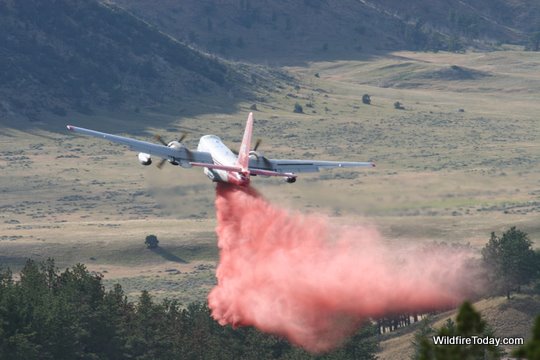
Air Tanker 45 on the Whoopup fire July 18, 2011
Air Tanker 45 on the Whoopup fire July 18, 2011. Photo: Bill Gabbert

The U.S. Forest Service is still struggling to issue a Request for Proposals (RFP) for “next generation” air tankers. As we reported on December 1, 2011, the agency issued a RFP on November 30 for turbine-powered air tankers that can carry 3,000 to 5,000 gallons of retardant and cruise at 300 knots. At that time the required response date was January 10, 2012 and the award date was January 31. Since then there have been three amendments to the RFP, 80 questions from potential bidders have been formally submitted, and the RFP has been re-issued with a new response date of February 15. The revised award date is “to be determined”.

The RFP still indicates that the USFS “intends to award” contracts for seven next-gen air tankers, three in 2012 and four in 2013, with the option to add more. And they retain the option to contract for no next-gen air tankers at all.

All of this uncertainty is not very confidence-inspiring for current and potential vendors who are required to invest millions, or tens of millions, in a venture that may or may not come to fruition, turn a profit, or last more than five years, if that.

This RFP is in addition to the 11 large fully certified “legacy” air tankers that are currently on exclusive use multi-year contracts.  Here is the text from the RFP:

It is the intent of this solicitation to secure a Firm Fixed Price Multi-Year contract(s) not to exceed 10-years (5 year base with 5 one year options) for the daily availability rate. The U.S. Forest Service intends to award seven (7) line items for next generation turbine powered airtankers. Line items 1-3 will begin service in calendar year 2012 and will have a base period of five (5) years with five (5) one year options. Line items 4-7 will begin service in calendar year 2013 and will have a base period of five (5) years with four (4) one year options. For each line item awarded the Government will have the option to add an additional four (4) airtankers (two (2) in year two and two (2) in year 3) to the contract for a total potential of 5 airtankers starting in year three of the base contract period.

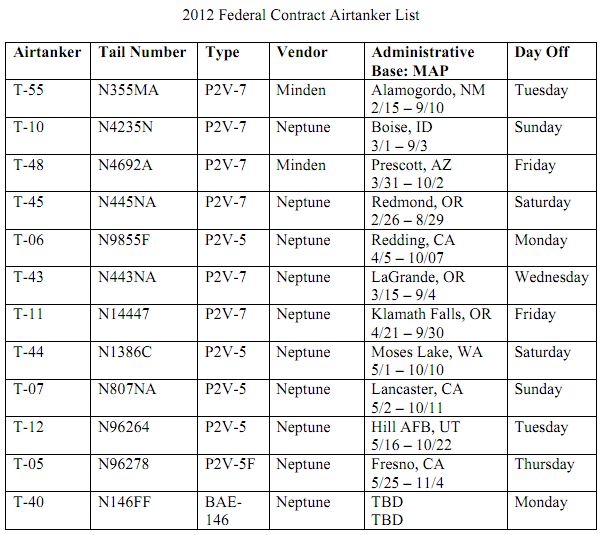
The web site Random Ramblings: Aerial Wildland Firefighting has an article about the large air tankers that are on U.S. Forest Service contract for 2012. Here is the new list that is posted at the NIFC web site:

Air tanker contract list 2012

It’s a rather pitiful looking list, when compared to those from previous years that had 19 to 44 air tankers.

Tanker 40, the BAe-146 that Neptune is leasing from Tronos, arrived at the Tronos facility on Prince Edward Island December 24 to begin a major scheduled maintenance, a C-check, which is required every 5,000 cycles or every 2.5 years. The C-check for a BAe-146 usually takes about 21 work days and the aircraft has not returned to Missoula yet. Last fall the Interagency Air Tanker Board gave “interim approval” to Tanker 40 which will be valid until December, 2012.

Wildfire highlights from the USDA blog

1945 smokejumpers

The U.S. Department of Agriculture has a very active blog where they frequently post articles about activities within the department. The U.S. Forest Service, of course, is in the USDA and we found quite a few stories on the site about wildfire. Here are four examples that have appeared on the blog over the last six months, with excerpts from the articles:

January 19, 2012: US Forest Service Trains Fire Brigades in the Brazilian Amazon

Brazil Bombeiros

“…Recently, representatives from the Payette National Forest trained over 80 community and fire brigade members [in Brazil]. As a result, the landholders and tribes in Mato Grosso are better prepared to control, manage and prevent fires from destroying farms, ranches, and the remaining tropical Amazon forests in the region. The work preserves livelihoods and conserves biodiversity and tropical forests.”

December 5, 2011: French firefighters learn from California visit

French firefighters

“…The U.S. Forest Service’s Pacific Southwest Region recently welcomed French fire officials Captain Philippe DelQuie and Major Pierre Bisone. The visit was part of a very successful seven year educational collaboration between France and the U.S. through the Forest Service Fire and Aviation Management’s International Fire office.

They hail from the Bouches-du-Rhone (Aix-En-Provence) Fire Department, a provincial fire agency in the south of France.

At home, their duties include wildland fire management in a Mediterranean climate similar to that found on national forestlands in southern California.

Their 12-day tour included stops at several national forests, national parks and local fire agencies.”
Continue reading

Simulation of a P-3 air tanker

I don’t know if we will ever see another Aero Union P-3 air tanker flying over a fire in the United States, but to refresh your memory, check out this simulation of two P-3s working a fire near Aguanga, California.

South Dakota state Fire Chief retires

Joe Lowe at gallery
2000 Jasper fire
The Jasper fire, about 2 hours after it started on August 25, 2000. Photo by Bill Gabbert

Joe Lowe, the Director (or Fire Chief) of the South Dakota Division of Wildland Fire Suppression retired on Monday. Joe was the first and so far the only Director of the agency that was formed in 2001. Before accepting that position, he worked in wildland fire suppression in southern California.

During most of the decade of the 1990s, there were few large fires in South Dakota. That began changing in August of 2000 when the Flagpole and Jasper fires burned 7,000 and 83,000 acres respectively in the Black Hills. Then-Governor Bill Janklow, who died of brain cancer on January 12, became extremely interested in wildfire suppression at that time.

I was the Incident Commander on the Flagpole fire for the first two days and received two late night phone calls from the Governor telling me he was sending resources to the fire, including 17 dozers and dozens of fire engines from across the state that later just showed up on the fireline. This was outside of the ordering system and the Incident Command System, and created havoc and safety issues on the fire. The Governor also directed that National Guard dozers take independent action on the Jasper fire, and threatened to start backfires without coordinating with the Type 1 Incident Management Team running the fire. The Incident Commander placed a resource order for U.S. Marshals who stood by at the Incident Command Post ready to put a halt to any actions that put firefighters in danger.

The next year, the Governor created the Division of Wildland Fire Suppression and put Joe in charge. Joe’s experience, management skills, and the fact that the Governor trusted him established a buffer between the Governor and the other wildfire organizations in the state — and we heard a collective sigh of relief. Joe brought additional professionalism and the concept of initially attacking fires with “overwhelming force” to the Division.

During his 10 years as the state Fire Chief, Joe, working with his interagency partners, helped establish the Northern Great Plains Interagency Dispatch Center, the Great Plains Interstate Compact, the State Handcrew Program, the State Aerial Firefighting Program, and the Rocky Mountain Type 2 Incident Management Team C.

Steve Hasenohrl, Assistant Chief for Administration, is the Acting Director until Joe’s replacement is named.

I tried to get in touch with Joe today, calling his gallery, Reflections of South Dakota, but he was out doing a television interview and setting up the gallery’s booth at the Black Hills Stock Show and Rodeo which begins January 27. Joe has been an avid photographer for years, and opened the gallery with his wife Wendy in May of 2007.

His plans are to remain in the Rapid City area and to be available for assignments on large fires.

Joe Lowe at gallery
Joe Lowe at the opening of his Gallery in Rapid City, May 4, 2007. Photo by Bill Gabbert

Neptune gears up for early deployment of their air tankers

Neptune Aviation and Minden Air Corp have been asked by the U.S. Forest Service to have their air tankers available three to four weeks earlier than last year. We first reported on this here and here.

Below is an excerpt from a news release about how it affects Neptune.

==================================================

Neptune Aviation Accelerates Air Tanker Readiness For Predicted Early 2012 Wildland Fire Season

Neptune Aviation, the largest US private operator of fixed wing aerial tankers, is gearing up for the 2012 fire season through an accelerated maintenance and training program, given predictions of earlier than normal wildland fire out-breaks–particularly in portions of the US Southwest.

Washington, DC (PRWEB) January 26, 2012

“The US Forest Service approached us last fall, and asked that we have our aircraft available early,” said Dan Snyder, President of the Missoula-based company. “To meet our customer’s requirement, we commenced our fleet maintenance about a month early in preparation for the fire season. To do that, we leased additional hangar space at Missoula International Airport, and increased our contract maintenance staff to 30–up from the 10-15 we have employed in prior years. The contract staff supplements the 70 mechanics we employ full-time.”

Snyder noted that in a typical year, the contract maintenance staff, which includes airframe mechanics, electricians and sheet metal technicians, is on site from November through March, with the total cadre in place by January. “But, this year, we ramped up to a full staff of 30 in October, and we expect that they will be here through April, so we’re taking on more people for a longer time period,” he said.

The contract maintenance staff will focus exclusively on the company’s nine active P2V Neptune tankers. As Snyder explained, Neptune Aviation is also deploying a single BAE 146 regional jet, modified for aerial tanker duty. The aircraft has operated since October 2011, under Interagency Airtanker Board interim approval. Given the capacity constraints generated by the accelerated preparation schedule, maintenance on the BAE 146 has being outsourced to Tronos, the company which partnered with Neptune on the tanker modification.

Pilot recurrent training has also been moved up by a month, starting January 1st. Neptune currently has 25 pilots, of which five are qualified on the BAE 146.

The earlier resumption of maintenance activity, and pilot training, reported Snyder, will enable Neptune Aviation to make the first aircraft mission-ready by February 26, with the last ones available no later than May 25.

“In 2011, availability of the first aircraft, by contract with the Forest Service, was March 18, with the last one ready for dispatch by June 25,” he pointed out, adding that the longer availability time-frame will mean more time in the field for pilots, mechanics, and support vehicle drivers. Because of this, the company plans to hire additional staff in order to assure those on the line their regular periods of time off.

“Neptune Aviation was well-prepared to meet the Forest Service’s request for early aircraft availability because of changes made in our operations over the past three years,” Snyder said. “We were positioned to respond to our customers’ requests in a timely fashion, and we are on track to do that.”
Thanks go out to Dick