You may have heard about the effort to allow seasonal wildland firefighters working for the federal government the opportunity to purchase health insurance. We covered it initially on May 24, and hopefully you signed the online petition like the other 120,000 have so far.
The issue is gaining more traction and wider coverage. The latest news organization to cover it was NBC News on Friday, as you can see in the video below which was filmed in South Dakota:
As shown in the piece, the U.S. Forest Service is not showing any leadership on the issue:
Here’s an idea. The U.S. Forest Service, NPS, BLM, USF&WS, and BIA could address the issue and at least issue a position paper saying that YES, seasonal firefighters should be allowed to purchase health insurance. The administration frequently asks Congress to introduce and pass bills. This is a good time to do it again.
Court rules company must pay $18 million for 2002 Copper fire
A federal appeals court ruled Friday that a company must pay $18 million for “Intangible environmental damages” caused by the Copper fire that burned 20,000 acres in 2002, most of it within the Angeles National Forest in southern California. The company had not contested a previous jury award of $7.6 million for fire suppression costs, but they balked at the “intangible” damage.
USFS Director of Fire has an opinion about resource orders placed by Incident Commanders
The authors of an Associated Press article interviewed Tom Harbour, the U.S. Forest Service’s Director of Fire and Aviation Management, who talked about Incident Commanders not always receiving the type of resources they say they need. Here is an excerpt from the article:
…Despite some criticism, Harbour said the U.S. Forest Service has been working to position resources where they’re needed most.
There’s a difference between what incident commanders want and what they need to fight a fire effectively, he said. For example, a commander’s order for 10 hot shot crews — among the most elite firefighters — might be filled instead with a mix of hot shots and initial attack crews, which can be just as formidable but with less experience.
This is insulting to Incident Commanders who are out on the ground in the heat, smoke, and dust after having qualified for their position through 15 to 20 years of wildland fire experience. For someone in Washington or Boise who stares at a computer screen all day to decide what Incident Commanders out in the field REALLY need, is absurd.
Report: U.S. company buys 10 Russian air tankers
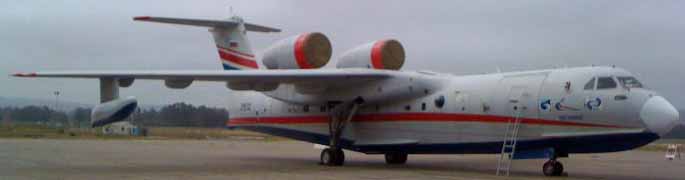
There is a flurry of chatter that a company in the United States has purchased 10 Russian-built air tankers. This is not exactly true. David Baskett, President of TTE International Inc., has said for years his plan is to purchase 10 BE-200 amphibious air tankers and then lease them to operators in the United States.
Mr. Baskett told Wildfire Today Friday that he “signed a contract to buy 10 planes to be delivered over a few years”. He did not specify if any money has actually changed hands, but until the FAA approves the aircraft to be used in this country, which may or may not happen any time soon, and until he has a contract from the U.S. Forest Service or another agency, which may or may not happen at all, it would be foolish to spend $300 to $400 million on Russian-built air tankers.
BE-200 air tanker at Santa Maria, California, April, 2010. Photo courtesy of Michael Lynn.
But we have to give Mr. Baskett credit for pursuing his dream with vigor. He arranged for the expenses to be paid for two USFS employees to travel to Taganro, Russia the home base of the Beriev company, the manufacturer of the aircraft, to conduct the first phase of an air tanker evaluation using specs of the Interagency Air Tanker Board. Reportedly the result of that evaluation was mostly positive in relation to performing as a scooper air tanker, but not as a conventional retardant-carrying air tanker. The IATB requirements are very different for the two types. In the future it may also be qualified for retardant.
Mr. Baskett is in discussions with the USFS and the Bureau of Land Management about using the aircraft in this country, and is attempting to set up a test of the air tanker in the U.S. to compare its performance to other aircraft, including the military MAFFS C-130.
In April, 2010, Mr. Baskett brought a BE-200 to the United States to attempt to drum up some interest in the aircraft. It was on display at Santa Maria, California for a couple of days and made some demonstration drops.
The BE-200 can carry 3,000 gallons of retardant loaded at an airport, or water it scoops from a lake.
A question from a reader: can wildfires cause higher temperatures down stream?
Susan sent us this question:
Wow–great website. Very impressive!
That there’s a causal connection between hot, dry weather and wildfires is clear to me. What I am wondering about right now, though, is whether or not the reverse can be true. Colorado has several large fires going at once, right now, and coincidentally we have also had several days of record-breaking, 100+ degree days, including two in a row of 105 degrees in the Denver area. Is it possible that 800 degrees, spread out over a large area, could raise the ambient temperature by a degree or more?
I could not say either way, definitively, so I asked someone who is actually smart (unlike myself) — Janice Coen, Ph.D., a Project Scientist at the National Center for Atmospheric Research who conducts wildfire-related weather studies, among other topics. Here is her answer:
No, the fires are just too small compared to all that air. However, a big fire may affect the air temperature by the plume shading the ground from sun for hundreds of miles downstream. And affecting the cloud particles to reflect more sun.
I don’t know who took these photos of the President’s visit to the Waldo Canyon fire on June 29, but they are on the same flickr site where Kari Greer posts her fire photos. The photographer was not identified at the site.
It never occurred to me that after being briefed about the fire and then inspecting some of the destroyed houses, that he would have to stand there and sign autographs for firefighters. I suppose it’s a friendly gesture on his part.
We just talked with Brian Scott, a spokesperson for the fire, who told us that a thunderstorm dumped a small amount of rain on the fire in mid-afternoon, but far too little to have any long term effect. The fire was still active at 6:30 p.m., but with the higher humidity following the rain, not as active as it was early in the afternoon.
I checked the data at the Red Canyon weather station near the fire and it only recorded 0.03 inch of rain at around 3 p.m.
=============================
UPDATE at 4:12 p.m. MT, June 30, 2012:
A Type 2 Incident Management Team, with Bob Fry as Incident Commander, will be reassigned from the Dakota fire near Sheridan Lake, to the White Draw fire
==============================
UPDATE at 2:49 p.m., MT, June 30, 2012:
Brian Scott, a spokesperson for the fire, told us that the fire is very active this afternoon, and in the morning exhibited fire behavior that you would expect to see in mid-afternoon, when the humidity is lower and the temperature is higher. They have not had a chance to accurately map the fire perimeter from an aircraft, but he said they estimate the size at about 2,000 acres.
Two military MAFFS C-130 air tankers are working on the fire. Since the U.S. Forest Service Air Tanker base has not been approved for handling MAFFS C-130s, the two aircraft are flying to Billings, Montana, 290 miles away, to reload with retardant. Rapid City would have been a 57-mile hop.
Gordon Schaefer, the new Base Manager who just transferred into the position a few weeks ago, told Wildfire Today that until yesterday the Rapid City Air Tanker Base had not been inspected for MAFFS compatibility. The Air Force Lt. Col. who conducted the inspection said the physical layout and the ramp strength appeared to meet the specifications, but they require a written copy of the ramp specs which was not immediately available. Mr. Schaefer said that next week he hopes to supply the required paperwork to the Air Force, and then MAFFS air tankers should be able to reload at Rapid City.
====================
12:05 p.m MT, June 30, 2012
We talked with Cindy Super, an Information Officer for the Dakota fire, another fire in the Black Hills, who told us that a ball park estimate for the size of the White Draw fire is 1,000 acres, but they intend to fly the fire and map it to get a more accurate number. As of now, the aircraft working the fire will be about the same as yesterday, one single engine air tanker, four helicopters, and no large air tankers.
The Incident Commander of the fire is Jared Hohm. Ms. Super was not certain if a Type 3 Incident Management Team will be assigned to the fire, or if her Type 2 IMTeam, with Bob Fry as Incident Commander, will be reassigned to the White Draw fire. Fry’s team is already loaning some of their members to the White Draw fire.
The map above shows heat detected by a satellite at 12:19 p.m. MT, June 30, 2012. (MODIS/Google)
The White Draw fire started at about 4 p.m. Friday afternoon northeast of Edgemont, South Dakota after a motor home driving up the grade on Highway 18 toward Hot Springs caught on fire. I cruised out there and shot some photos. Here’s one, and I’ll post more over the next few days.
There were quite a few engines working on the fire from the local communities, as well as the U.S. Forest Service, the State of South Dakota, and the National Park Service. There were no large air tankers on the fire at any time as far as I know, but there was one Single Engine Air Tanker, plus two Type 3 Helicopters and a Blackhawk. When I left the fire at about 9:45 p.m. I could not see the entire fire, but I’m guessing it had burned hundreds of acres.
The video is a five day time-lapse of the Waldo Canyon fire that spread into Colorado Springs, burning at least 348 homes and killing two people. It was shot by Steve Moraco, who suggests that you watch it in full screen and in HD if at all possible. To do that, start the video then click on the little red YouTube icon at the bottom-right, then choose your resolution (the little gear symbol) and full-screen.
If you don’t have time to watch the entire 16-minute video, at least check out Tuesday (which starts at about 6:30), the day all hell broke loose when a thunderstorm cell a few miles away created 65-mph winds that pushed the fire into the city.
Mr. Moraco says it was made from 20,000 8MP Jpeg images on a Canon 7D with the EF-S 18-135mm f/3.5-5.6 lens. Then the still images were converted into a video on a Mac using Adobe’s Lightroom and Premiere in full 24fps 1080p.
And, Mr. Moraco also wrote:
Thanks to my family for carefully avoiding bumping the tripod that has been on our deck for the last week, and especially mom who has been incredibly helpful in reminding me to check the camera battery.
The map shows the distribution of wildfire smoke at 4:18 a.m. MT, June 30, 2012. This map gives a good indication of not just WHERE the fires are, but how active they are. The purple and yellow areas have the highest concentrations of smoke.
The White Draw fire started at about 4 p.m. Friday afternoon northeast of Edgemont, South Dakota after a motor home driving up the grade on Highway 18 toward Hot Springs caught on fire. I cruised out there and shot some photos. Here’s one, and I’ll post more over the next few days.
There were quite a few engines working on the fire from the local communities, as well as the U.S. Forest Service, the State of South Dakota, and the National Park Service. There were no large air tankers on the fire at any time as far as I know, but there was one Single Engine Air Tanker, plus two Type 3 Helicopters and a Blackhawk. When I left the fire at about 9:45 p.m. I could not see the entire fire, but I’m guessing it had burned hundreds of acres.
President’s Arrival at Colorado Springs, 12:13 MT, June 29, 2012
President Obama arrived at Colorado Springs at 12:13 p.m. MT Friday, 3 hours and 20 minutes later than the White House’s schedule, then he toured the Waldo Canyon fire area and received a briefing from incident personnel. The schedule called for him to be in Colorado Springs for 2 hours and 50 minutes.
The original plans were for Air Force One to park at Peterson Air Force base on the northeast side of the Colorado Springs Airport, but instead it went to the opposite side, perhaps to avoid interfering with operations of the four military MAFFS air tankers at Peterson. The President, accompanied by Colorado Governor John Hickenlooper and several other politicians departed the airport in an SUV, rather than a helicopter.
President’s statement at Waldo Canyon fire, 1:38 p.m. MT, June 29, 2012. CNN
After he looked at some of the burned areas he received a briefing about the status of the fire. Then he made a short statement, speaking contemporaneously, without notes or a teleprompter. Here are some excerpts that I transcribed from the television coverage on CNN:
…Some lessons are being learned about how we can mitigate some of these fires in the future and I know that the Mayor and the Governor and other local officials are already in those conversations. It means that hopefully out of this tragedy some long-term planning occurs and it may be that we can curb some of the damage that happens the next time even though it is obvious that we can’t fully control fires that are starting up in these mountains.
[…]
The last point I want to make, is that we can provide all the resources. We can make sure they are well coordinated. But as I just told these firefighters what we can’t do is to provide them with the courage and the determination and the professionalism, the heart that they show when they are out there battling these fires.
When we had a chance on site to see some guys who had just saved three homes in a community that had been devastated, for those families, the work and the sacrifices of those firefighters means the world to them and they are genuine heroes. So we just want to say thank you to all the folks that have been involved in this, we’re proud of you, we appreciate what you do each and every day, and for folks all around the country I hope you are reminded how important our fire departments are, our Forest Service is. Sometimes they don’t get the credit that they deserve until your house is burning down or your community is being threatened. You have to understand that they are putting their lives at risk to save us and to help us. We’ve got to make sure we remember that 365 days a year, not just when tragedies like this strike.
Below is a video clip from Friday morning’s Today Show. It provides an update on the fire including a few seconds from the cockpit of a MAFFS C-130 air tanker..
MAFFS air tanker dropping on Waldo Canyon Fire June 28, 2012. Photo by Staff Sgt Stephany Richards USAF
The U.S. Forest Service has activated an additional four Modular Airborne FireFighting System (MAFFS) air tankers. These military C-130s should be operational by 6 p.m. Saturday and are from the North Carolina Air National Guard and the California Air National Guard. They will be working out of Peterson Air Force base in Colorado Springs, Colorado along with the other four MAFFS air tankers that were activated June 24.
This brings the number of large air tankers on active duty right now to 22, plus one very large air tanker:
Airtankers
9 on Exclusive Use contracts (8 P2Vs and 1 BAe-146)
5 CV-580s borrowed temporarily through agreements with the State of Alaska and the Canadian Interagency Forest Fire Centre
8 MAFFS
Very Large Airtankers
1 DC 10 on a call when needed contract
Since June 25 the four MAFFS aircraft operating out of Colorado Springs have conducted 62 sorties, made 53 air drops, and dropped 138,400 gallons of retardant on fires in the area, most of them on the Waldo Canyon fire which has burned 348 homes and killed at least one person.
Jennifer Jones, a spokesperson for the USFS, said today that there are still an additional three CV-580 air tankers available that they could borrow from the Canadian Interagency Forest Fire Centre.
747 air tanker dropping during a test in Arizona. Evergreen photo.
Evergreen International Aviation, the company that built the 20,000-gallon air tanker, or “Supertanker” as they call it, has released a statement that attempts to answer some of the many questions they have received asking why the U.S. Forest Service refuses to use the 747 air tanker, which carries about 10 times more than a P2V. The company says they have never received an explanation from the USFS, but speculates that contracting requirements favoring small businesses may be the reason.
The USFS only offered the two companies with Very Large Air Tankers call when needed contracts, not exclusive use contracts. Without any guaranteed income, Evergreen turned the offer down, while 10 Tanker Air Carrier is struggling to remain in business after accepting a CWN contract for one of their two DC-10 air tankers, which is used only rarely by the USFS.
Evergreen International Aviation Statement Concerning the Supertanker
We felt compelled to release this statement due to the overwhelming amount of calls we have received concerning the availability of the Evergreen Supertanker. We at Evergreen are saddened by the fire devastation now taking place in many Western US states. For over 60 years, we have supported the US Forest Service in its important mission to battle and control fires, and it is our desire to continue this rich history of service. While our helicopters continue to work fires for the State of Alaska under State contracts, unfortunately, our Boeing 747 Supertanker Very Large Air Tanker (VLAT) aircraft awaits activation with the US Forest Service.
We have never been told why we have not been activated by the US Forest Service, so we can only speculate as to why we face this outcome:
1. We were offered a Call-When-Needed (CWN) contract a few years ago by the US ForestService (proving our technical viability), but we were never called into action resulting in a multi-million dollar loss to our company as we were required to maintain and have flight crew available should we be called. The only contact that will sustain a VLAT program is an Exclusive-Use contract, which provides an income stream to sustain the program even if the asset is not utilized. We invested over $50M to develop this asset in the firm belief that we could better control fires as we proved in Israel and Mexico under CWN contracts that we could afford to offer at the time.
2. There have been recent changes to the US Forest Service procurement policies. Today,only small businesses are eligible for contract awards concerning airtanker assets; Evergreen is not a small business and, therefore, is excluded from consideration for any award.
3. The US Forest Service’s specification for Next Generation Air Tanker aircraft limits tanksize to 5,000 gallons. The Supertanker’s tanks hold about 20,000 gallons, which is considered outside the USFS specification. The USFS just awarded contracts to four small businesses with aircraft equipped with these smaller tanks, and excluded the Evergreen Supertanker. Since World War II, tank capacities have been in the 3,000 to 5,000 gallon range, yet continue to face the growing threat from mega fires today. We believe the Supertanker represents an overwhelming response to this growing threat.
Please contact your state representatives in Washington DC to demand an examination of their current procurement policies concerning VLAT aircraft. The US Forest Service says it best: “Only YOU can prevent forest fires.”
Evergreen International Aviation, Inc., Tel: 503.472.9361