The Dallas Canyon Fire, about 50 miles west of Salt Lake City, was mapped today at 43,610 acres. Ignited by lightning on July 27, the fire’s burning in the Cedar Mountain Wilderness Area southwest of the community of Delle. According to the Salt Lake Tribune, the fire area includes sensitive habitat for sage grouse, pronghorn antelope, and wild burros — along with raptor nesting grounds.
Resources on the fire include about 360 firefighters, and Erik Haberstick’s team put the fire at 60 percent containment this morning.
Another wilderness fire, the Rapid Creek Fire in the Bob Marshall, took off yesterday. The Great Falls Tribune reported that the fire is 27 miles west of Augusta.
The fire was reported at about noon on Sunday by two different lookouts. It was estimated at 3,000 acres late yesterday, burning in heavy timber and mountain pine beetle kill, and it grew to over 5,000 acres by this morning.
Dave Cunningham with the Lewis and Clark National Forest said an incident management team and air resources have been ordered; fire behavior has included sustained crown runs. The Rapid Creek Fire yesterday burned over the Continental Divide and into the Triple Divide Fire, then into the Elbow Pass Fire. Sheriff’s deputies and USFS personnel contacted cabin owners and others in the area and warned them that the fire could move toward the Benchmark Corridor.
The 700-acre Elbow Pass Fire in the Scapegoat started on July 12 southwest of Augusta, and the Triple Divide fire west of Augusta is at about 7 acres. The complex is being managed as a suppression fire.
CL-215 and CL-415 air tankers scoop water from Snowbank Lake while working on the 2011 Pagami Creek fire in the Boundary Waters Canoe Area in Minnesota. Photo by Kristi Marshall for the Superior National Forest
The RAND Corporation has released their long-delayed report that that U.S. Forest Service commissioned on air tankers. The company completed the study in August, 2010, but the USFS refused to release it even after receiving a Freedom of Information Act Request, saying “…the report is proprietary and confidential Rand business information and must be withheld in entirety under FOIA Exemption 4″. Their refusal letter went on to say: “The data, analysis, and conclusion in this report are not accurate or complete” and that the USFS wanted “to protect against public confusion that might result from premature disclosure.”
In April we compiled a history of the $840,000 RAND report. This was the fifth study on air tankers since 1996. A sixth one is underway now, commissioned, again, by the USFS, but paid for, again, by the U.S. taxpayers.
But RAND released the study today, which includes a heavy emphasis on scooper air tankers which can fill their tanks with water while skimming over a lake. RAND recommends “15 to 30 scoopers to be used in conjunction with two to six air tankers and a comparable number of 2,700-gallon helicopters”.
A summary of the report is below. The entire report can be found on their web site.
U.S. FOREST SERVICE SHOULD CONSIDER A DIFFERENT MIX OF AIRCRAFT TO FIGHT WILDFIRES, RAND STUDY CONCLUDES
The U.S. Forest Service should upgrade its large airborne firefighting fleet to include more amphibious scooper aircraft, with air tankers and helicopters in a supporting role during the initial attack of fires before they become large, according to a new study from the RAND Corporation. Continue reading
Average size of wildfires, 1961-2011. Source: NIFC and Wildfire Today (click to enlarge)
The media frequently reports on wildfire-related events that are exciting, such as big flames, hundreds of burned homes, and thousands of evacuated residents. but an under-reported aspect of wildfire management is the effects of reductions in funding. Every time Congress passes and the President signs a bill that reduces funding for fire suppression, fuel management, and fire prevention, there are proportional effects that ripple throughout the federal land management agencies. It appears that the chickens have come home to roost as we have fewer federal wildland firefighters, fewer staffed engines, and an air tanker fleet that has been reduced from 44 in 2002 to the 9 exclusive use large air tankers that are currently working under contract.
As we lose the ability to aggressively attack new fires with overwhelming force, more fires become mega-expensive conflagrations that cost tens of millions of taxpayer dollars to attempt to put out. A relatively small upfront expense for ground and air resources arriving within the first 30 minutes can be very cost effective when the fire is put out and everyone one goes back to the fire station to prepare for the next one.
…A strategic review in 2009 warned the government to step up its fire fighting capabilities to deal with an escalating rise in wildfires, covering up to 12m acres of terrain each year. “The current budget environment for federal and partner fire management is at best uncertain and difficult,” the review said.
It noted government agencies had already over-shot their budgets five years in a row, because of escalating wildfires.
But the economic downturn and a Congress dominated by Republicans who want to shrink the role of government make it extremely complicated to divert more funds to forest fighting.
Instead, funding for preventing and putting out wildfires has fallen by $512m, or about 15%, since 2010.
Campaigners say that leaves the federal government agencies responsible for preventing and putting out wildfires under-funded – especially given projections suggesting a rise in wildfires over the next 20 years.
They also worry the government agencies responsible for fire protection are putting capital projects on hold – such as updating its fleet of air tankers.
A firefighter from CAL FIRE is recuperating after being struck by a car while he was operating at a wildfire near Murphys, California on Wednesday. A sports car going through heavy smoke hit Nathan Fyock, 39, and then collided with a fire engine. Mr. Fyock was seriously injured and is recovering from surgery.
Politicians vote against sustaining regulations protecting the public from wildfire
On July 25 the House of Representatives voted down an amendment to HR 4078 that would have sustained regulations “protecting the public from extreme weather, including drought, flooding and catastrophic wildfire …” The amendment would have modified the Regulatory Freeze for Jobs Act of 2012 which prohibits any federal agency from taking any significant regulatory action until the Secretary of Labor reports that the Bureau of Labor Statistics average of monthly unemployment rates for any quarter after the enactment of this Act is 6% or less.
Falling debris from new airliner starts grass fire
Boeing 787, file photo.
Debris that fell from a new Boeing 787 Dreamliner started a grass fire at the Charleston, South Carolina airport Saturday. Two flights had to be diverted while firefighters put out the fire and crews inspected the runway for other debris. The aircraft had just been assembled at the Boeing facility in North Charleston, South Carolina.
Boeing spokeswoman Candy Eslinger says the aircraft was undergoing preflight runway testing when the incident occurred.
Guest writer for Wildfire Today
I am pleased to announce that beginning Tuesday, Kelly Andersson will be assisting with the writing duties here for the next week or so while I take on a special project that will occupy much of my time. Kelly has done this for us previously (very well, I might add) and has a long history of wildfire-related writing and editing. Thanks Kelly!
The Myrtle Fire at 4:12 p.m. MT, July 19, 2012, looking north across Wind Cave National Park. Photo by Bill Gabbert
Since the Myrtle fire burned over 10,000 acres and racked up $4,000,000 in suppression costs, land managers in the Black Hills of South Dakota have become more proactive and aggressive in organizing to fight wildfires. The agencies have been attacking new fires with enough resources to stop the spread within the first burning period. And it has not been easy in all cases. While dozens of lightning-caused fires have burned less than two acres, a few fires have burned several hundred acres but were stopped the same day.
In addition — they have beefed up the number of ground resources available for initial and extended attack of new fires; have increased the number of helicopters available at Custer; on most days there have been a couple of heavy air tankers available at Rapid City; and today they announced that fire managers from the Black Hills National Forest, the National Park Service, and the South Dakota Division of Wildland Fire Suppression entered into an agreement to order a Type 2 Incident Management Team to operate a Command and Mobilization Center. The Team will be assisting with initial attack of fires that grow beyond the capabilities of local resources; assisting the local units by tracking and handling the administrative processes of incoming personnel, crews and equipment; and ordering and resupplying the tools, equipment and other items to ensure that firefighters are ready to go to the next fire.
These are all welcome improvements, and the land managers should be commended for their success in dealing with the many new fires over the last eight days.
This was not necessarily the case when the Myrtle fire started at 1:30 p.m. MT on July 19. From the radio traffic I heard, the first large air tankers were requested at approximately 3:40 p.m. and I saw the first one arrive over the fire at 7:14 p.m. By that time, the Type 1 Incident Management Team, which is used for managing the largest and most complex fires, had already been ordered. I don’t know if a squadron of air tankers over the fire in the first 30 minutes would have made a big difference, but for whatever reason, the fixed wing aerial resources were not available to assist the firefighters on the ground.
As we frequently say, air tankers don’t put out fires, boots on the ground do. But air tankers and helicopters can greatly enhance their effectiveness. An investment in flight time and retardant within the first 30 minutes can, in some cases, save the taxpayers millions of dollars and reduce the loss of lives and property. Having only nine large air tankers available on long term contracts for the entire country makes this objective difficult to achieve. Ten years ago we had 53.
Dr. Gabbert’s prescription for keeping new fires from becoming megafires: Rapid initial attack with overwhelming force using both ground and air resources, arriving within the first 10 to 30 minutes when possible…
What is left of the Myrtle Fire Incident Command Post at Custer High School, July 26, 2012. The fire is contained and has been turned over to a smaller Incident Management Team, a Type 3 team. Photo by Bill Gabbert (click to enlarge)
When the Myrtle fire, which is now contained, was threatening structures between Pringle and Hot Springs, South Dakota, many firefighters were assigned to structure protection. Most homeowners who evacuate have little understanding of what will happen around their house while they are hunkering down in a motel or school gym. Firefighters, when time permits, will do far more than spray water on the structure, as Lynn and Gardner Gray discovered when they visited their home near Pringle the day after they evacuated.
Jim Kent, a columnist for the Rapid City Journal wrote about the Gray’s experience in today’s edition. Here is an excerpt:
…During a return visit the following day, Lynn encountered four firefighters taking what she considered extraordinary steps to fully protect her property.
Once the Myrtle Fire moved out of range and the couple were back in their house, Lynn insisted I tour the property so she could point out the care and attention given by complete strangers.
From removing the propane tank on the Grays’ outdoor grill, to fully sealing their garage door and saturating 6 cords of wood stacked against the side of their home, the firefighters left no combustion hazard to chance.
They even took down a flammable decorative flag and repositioned a wood-handle rake before digging a protective trench around the property. In fact, the list of what the firefighters actually did is too long to include here.
And speaking of public relations, Craig Bobzien, the Forest Supervisor of the Black Hills National Forest in South Dakota, met with a group of citizens from the Edgemont area who had concerns about how the White Draw fire was fought. Mr. Bobzien explained in a Rapid City Journal article attributed to him that he had heard about some complaints in the media and wanted to hear them first hand.
White Draw Fire, June 29, 2012 Photo by Bill Gabbert
Those citizens from the Edgemont have been generating a lot of publicity about how some of them thought the firefighters could have stopped the 9,000-acre rapidly spreading timber fire in late June if only they had paid more attention to the locals. Previously, on July 6 South Dakota Senator John Thune traveled to Edgemont with reporters and photographers in tow to also meet with those citizens. This was the fire on which a military C-130 MAFFS air tanker crashed, killing four members of the crew and injuring two others.
Three U.S. Senators have introduced a bill that would transfer 14 surplus C-27J Spartan aircraft from the Department of Defense to the U.S. Forest Service to be used as air tankers. Senators John McCain (R-AZ), Senator Bill Nelson (D-FL), and Senator Diane Feinstein (D-CA) introduced legislation on Wednesday known as the Wildfire Suppression Aircraft Transfer Act of 2012 (S. 3441) “to help replenish the agency’s aging airtanker fleet”.
A news release from Senator McCain said:
The Forest Service says the C-27J Spartan would become a vital component of its overall airtanker modernization strategy. These aircraft would provide a modern, flexible, and extremely efficient Type 2 platform specifically designed to operate in challenging conditions.
“The Forest Service needs to modernize its entire airtanker fleet,” said Senator John McCain. “We have an opportunity to take the C-27J, an aircraft the Pentagon no longer wants, and give it to the Forest Service to enhance aircraft safety and lower existing maintenance costs. The C-27J should be kept in the service of the American people to help our brave fire crews, rather than sit in an airplane boneyard.”
The U.S. Air Force has ceased operating the aircraft in Afghanistan and plans to retire its fleet of 21 C-27-Js no later than fiscal year 2013 which begins in October. The only operator of the C-27J inside the United States is the Air National Guard.
The C-27J looks like a baby brother of the C-130J and uses two of the same turboprop engines that are used on the larger four-engine aircraft.
If converted to an air tanker, at only four years old they would be by far the youngest large air tankers being used in the United States. The P2Vs that currently comprise 8 of the 9 large air tankers active on exclusive use contracts today are over 50 years old. Even Tanker 40, the newish jet-powered BAe-146 operated by Neptune, is 26 years old.
In 2007 the Department of Defense awarded a contract for the acquisition of 78 new C-27J Spartan aircraft at a cost of about $26 million each, but according to one report only 52 have been built. It has sold to other buyers, new, for as much as $53 million. The United States received its first C-27J on September 25, 2008. The aircraft cruises at 362 mph, has a service ceiling of 30,000 feet, and a minimum control speed of 121 mph.
If it were converted to an air tanker, airworthiness compliance and adding a tank could cost around $2 million. The C-27J can carry a 25,353-pound payload, which could translate to a retardant capacity of 2,000 to 2,500 gallons; perhaps more if the interior was stripped. This would not meet the preferred USFS target of 3,000 gallons for a next-generation air tanker, but could be a valuable addition to the firefighter’s tool box. However, it would carry about twice as much as the S-2Ts being used extensively, and successfully, by CAL FIRE.
We have written previously about the possibilities of this aircraft serving as an air tanker, HERE and HERE.
There is one little dark cloud hovering over this announcement. It was just 11 days ago that the entire U.S. fleet of C-27Js was grounded following a mechanical failure of one aircraft’s flight control system. Few details were disclosed by the Air Force, who characterized the grounding as a “precautionary measure” that is under investigation by the Air Force and the C-27J manufacturer, Alenia Aermacchi. Groundings like this for aircraft are not uncommon and are frequently resolved in a matter of weeks.
Should we do this?
I have reluctantly come to the conclusion that the 55-year experiment of contractor-owned, contractor-operated air tankers should come to an end. We need to move to a government-owned, contractor-operated system. Well over 100 air tanker pilots have lost their lives during that period flying aircraft that have been discarded by the military decades before. Their age leads to frequent engine, air frame, and other mechanical problems that contribute to crashes, deaths, and down time for these aircraft which should be seen in museums and air shows, not diving into steep canyons, low and slow. The new next generation contracts will be bringing us converted passenger airliners that have been retired by their owners. While this may be better than 50-year old maritime patrol P2Vs, it is not a great solution, but is what the contractor-owned system is producing. Contractors can’t afford to purchase new C-130Js, C-27Js, or CL-415s at $25 to $90 million each.
A federal agency that has the experience and knowledge of managing aircraft should manage these C-27Js after they are acquired from the military, and they should acquire additional new or nearly new aircraft that have the design and performance criteria necessary for the very demanding task of delivering retardant in the wildfire environment. Then develop specifications for operating these aircraft to include extensive, regular, professional-level training for pilots and mechanics. Contractors would then maintain and operate them, seven days a week, using relief crews to provide days off and enough back home family time to reduce the currently unacceptable turnover rates among these crews.
So the bottom line is, yes, Congress should pass the Wildfire Suppression Aircraft Transfer Act of 2012 (S. 3441). While a 3,000, 5,000, or 20,000 gallon air tanker would look great flying over and supporting firefighters on the ground, an addition of 14 C-27Js would be a great shot in the arm of the atrophied fleet of air tankers that has declined through neglect and mismanagement from the 44 we had in 2002 to the 9 we have today.
In addition, the bill currently being considered by Congress should appropriate funds to convert the aircraft to air tankers, which could cost more than $30 million. Otherwise, the C-27Js may continue to sit in a boneyard.
We congratulate the three senators, McCain, Nelson, and Feinstein, for showing some leadership toward resolving the air tanker crisis…leadership that has been sorely lacking in the federal land management agencies’ aviation program over the last 10 years. Thanks go out to Jerome and Ken
Nebraska National Guard fire vehicle on the Region 24 Complex in Nebraska. Photo: NIFC
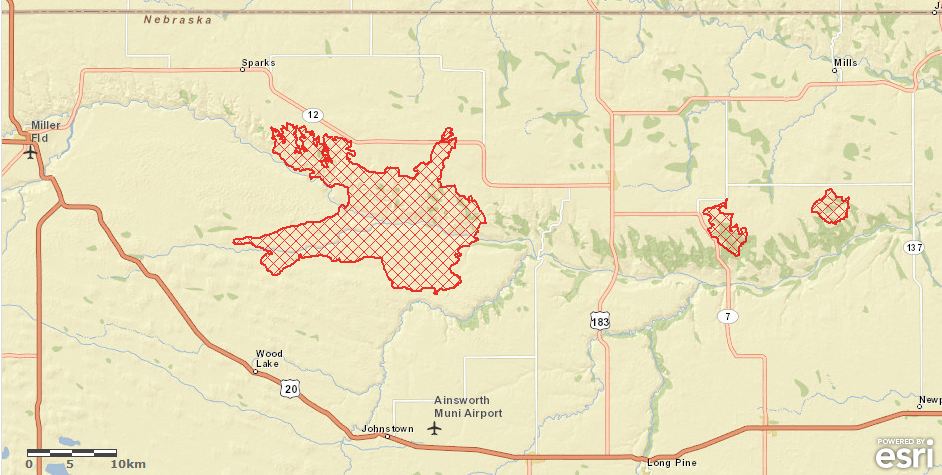
Three fires in northern Nebraska are now being managed by one Type 2 Incident Management Team. The Fairfield Creek, Wentworth and Hall Fires, which we told you about yesterday, are now called the Region 24 Complex of fires. A catchy name, don’t you think?
Map Region 24 fire, July 26, 2012. (Click to enlarge)
The fires range from 15 to 56 miles east of Valentine, Nebraska. On the map above the town of Valentine is on the west side of the map near the “Miller Fld” airport.
Below is some information about the fies from InciWeb:
The lightning caused fires started Friday, July 20, 2012. Within the complex, the Fairfield Fire has grown to 66,745 acres, Wentworth Fire 3,278 acres and Hall Fire 2,382.
Ten homes were destroyed and over 100 hundred residences and livestock have been threatened. The Team is working cooperatively with several local Volunteer Fire Departments and the Red Cross is assisting local residents.
Crews made steady progress throughout the day by using helicopters to drop water. Existing fireline was strengthened and new line constructed.
Doug Fox, Region 24 Emergency Management Director, stated, “We currently have sufficient resources on the incident. If additional resources are needed local Fire Chiefs will put out a call for assistance.”
Map of fires in northern Nebraska and southern South Dakota, July 25, 2012. MODIS/Google. (Click to enlarge.)
With the dozens of fires in the Black Hills of South Dakota over the last week, all within 50 miles of my home, it has been hard to concentrate on other fires, but today we’re focusing to the east and south, since three Type 2 Incident Management Teams are committed to fires in that area. We’ll start with the largest, and the only one in this group that is in South Dakota.
Long Horn Complex: west of Rosebud, SD, Type 2 IMTeam, Joe Lowe, Incident Commander; 44,530 acres and 70% contained. Four outbuildings have been destroyed. The Longhorn Complex includes the Iron Shell Fire (39,780 acres), the South Crazy Horse Fire (3,100 acres), and the Longhorn Fire (1,650 acres). The Longhorn fire is now 100% contained and will be turned back to the local agency to monitor and patrol as necessary. Tuesday night firefighting efforts focused on burnout operations on the South Crazy Horse fire and patrol of the existing containment lines on all fires within the Longhorn Complex.
Fairfield Creek: 10 miles west of Springview, Nebraska, Type 2 IMTeam assigned, Todd Pechota, Incident Commander, 62,580 acres and 25% contained. Structures destroyed: 10 primary and 10 outbuildings. The IMTeam is providing support to the Wentworth and Hall Fires. On Tuesday crews were successful in burnout operations on the Fairfield Creek Fire and on the Wentworth Fire. Observed Fire Behavior: Alignment of winds and slope along the Niobrara River are contributing to rapid ROS, crown runs and group tree torching, with moderate to long-range spotting.
Wentworth: 6 miles southeast of Springview, Nebraska and 2 miles north of the Niobrara River; 2,595 acres.
Hall: 4 miles east of the Wentworth fire, 14 miles east of Springview, Nebraska, and 2 miles north of the Niobrara River. 1,425 acres.
Sikorsky Skycrane dropping on the Draw fire south of Argyle Road, northwest of Hot Springs, SD, July 24, 2012. Photo by Bill Gabbert
The 10,000-acre Myrtle Fire is nearing full containment, but firefighters in the Black Hills of South Dakota are not getting a break. With hundreds of lightning strikes almost every day, fires are breaking out by the dozens. Prompt, aggressive initial attack with both ground and air resources is keeping most of the new fires very small, but occasionally one escapes.
Below, from Great Plains Fire Information, is a list of 15 fires that were discovered on Tuesday, July 24, plus the Mossagate fire which was reported on July 21. There are approximately 7 others that started late in the day on Tuesday that didn’t make this version of the list.
Fire Crews Respond to New Lightning Ignited Fires in the Black Hills
Rapid City, SD – Thunderstorms rolled over the Black Hills again today and federal, state, and local VFD firefighters responded to another 15 new fires. Most of the new fires were small and were contained at less than ½ an acre. However, because of the hot, dry, and windy conditions, several of the new fires required numerous air tanker retardant drops and the use of helicopters to drop water; allowing firefighters to build fire line to contain the spread of the fires.
Fire resources on the Myrtle Fire, which is nearing containment, assisted with initial attack of several new fires in the southern Black Hills. Five Interagency Hotshot crews, responded to three nearby fires. Aviation resources, including helicopters and air tankers assisted with initial attack on eight new fires.
With fire activity remaining high throughout the region, fire resources are being reassigned to other incidents after they are released from their currently assigned fire.
Falls Fire
The Falls Fire started between Falls Canyon and Lindsley Canyon, six miles southwest of Hot Springs. The fire threatens powerlines to the northwest and is burning in steep and rugged terrain. No structures are threatened at this time. A Type III Incident Commander has ordered additional crews and engines.
Size: 150 acres
Cause: Lightning
Containment: Unknown
Placerville Fire
Location: Just north of the Pactola Work Center, in the Mystic Ranger District