The accident report on the fatal crash of the military C-130 MAFFS air tanker which was released yesterday illustrated one very important difference between accident investigations conducted by the military and the U.S. Forest Service. A notice on page two of the report points out that the findings of military aviation accident investigations are regulated by law, 10 U.S.C. 2254(d), which states:
Use of Information in Civil Proceedings.—For purposes of any civil or criminal proceeding arising from an aircraft accident, any opinion of the accident investigators as to the cause of, or the factors contributing to, the accident set forth in the accident investigation report may not be considered as evidence in such proceeding, nor may such information be considered an admission of liability by the United States or by any person referred to in those conclusions or statements.
C-130 MAFFS air tanker crash, July 1, 2012. US Air Force photo
For fatal wildfire burnovers or entrapments of U.S. Forest Service employees, a law provides for just the opposite, thanks to a bill that was sponsored by Senator Maria Cantwell and U.S. Representative Doc Hastings, which became Public Law 107-203 in 2002:
In the case of each fatality of an officer or employee of the Forest Service that occurs due to wildfire entrapment or burnover, the Inspector General of the Department of Agriculture shall conduct an investigation of the fatality. The investigation shall not rely on, and shall be completely independent of, any investigation of the fatality that is conducted by the Forest Service.
The Cantwell-Hastings bill that was signed into law in 2002 was a knee-jerk reaction to the fatalities on the Thirtymile fire the previous year. The Department of Agriculture’s Inspector General’s office had no experience or training in the suppression or investigation of wildland fires. They are much more likely to be investigating violations at a chicken ranch than evaluating fire behavior and tactical decisions at a wildfire. The goal of the Inspector General investigation would be to determine if any crimes were committed, so that a firefighter could be charged and possibly sent to prison.
After the trainee wildland fire investigator for the OIG finished looking at the Thirtymile fire, on January 30, 2007 the crew boss of the four firefighters that died was charged with 11 felonies, including four counts of manslaughter. The charges were later reduced to two counts of making false statements to which the crew boss pleaded guilty on August 20, 2008. He was sentenced to three years of probation and 90 days of work release.
The criminal charges brought against the firefighter who may or may not have made some mistakes on the fire had a serious, chilling effect on wildland firefighters. Not only does it make them reluctant to speak to anyone about what happened on an accident, some even had second thoughts about their willingness to continue working in a professional they loved because potential criminal charges or convictions could ruin their lives and the livelihood of their families.
In addition, firefighters lawyering-up after an accident makes it difficult to discover the causes of an accident and to learn lessons which could save lives by preventing similar fatalities.
The four-fatality MAFFS accident was a complex chain of events involving many individuals and firefighting resources. But in spite of the complexity, the report was released to the public only four months after the accident, making it possible for lessons to be learned while reducing the chances of a similar accident taking more lives.
This short turnaround is unheard of in the wildland fire agencies in part due to the potential civil and criminal implications down the road.
This is literally a life and death issue — Senator Maria Cantwell’s and Representative Doc Hastings’ hastily conceived Public Law 107-203 must be repealed and replaced by one similar to 10 U.S.C. 2254(d), which serves the military very well. The Cantwell-Hastings law serves no useful purpose. Accidents are investigated, with or without the ridiculous law. It had unintended consequences and needs to be fixed.
OK, so it’s not officially winter yet, but often this time of the year the Palmer area of Alaska (map) about 40 miles northeast of Anchorage has snow on the ground. Not this year.
On Thursday a truck pulling a trailer crashed and burned on the Palmer-Fishhook Road near the Glenn Highway. Strong winds gusting to 50 mph pushed the fire through 200 acres of brush and grass and into nearby neighborhoods.
Firefighters and state troopers evacuated homes in the area and city officials established an evacuation center at the Palmer Senior Center.
More than 16 fire units responded, including trucks from Palmer, Anchorage, Butte, and Chugiak.
No homes burned, but one shed was consumed along with some propane tanks stored inside, causing what one nearby resident described as explosions, according to the Anchorage Daily News.
It takes a while to digest the 49-page report on the July 1 crash of MAFFS #7, the military C-130 air tanker, in which four crew members were killed. Earlier we posted a summary of the report, but here are some additional thoughts.
MAFFS crash, radar at 1733, five minutes before the crash.
The radar image above, 5 minutes before MAFFS #7 impacted the ground at 1738 local time, recorded a very large thunderstorm cell southwest of the crash site. The middle of the concentric circles is the location of the crash. The circles indicate 5, 10, and 15 nautical miles from the impact site. The light green areas may have been virga, rain that was not reaching the ground. The red, light brown, dark green, and possibly the yellow areas were most likely rain, accompanied by strong winds. The longest east-west line is the South Dakota/Nebraska state line. The longest north-south line is the boundary between Wyoming and the states of South Dakota and Nebraska.
In addition to the C-130 working on the fire, there was also a Bureau of Land Management Air Supervision Module aircraft which was flown by a lead plane pilot and also carried an Air Tactical Group Supervisor. It was acting as the lead plane at the time of the accident.
The ASM/Lead experienced a severe downdraft while approaching the intended retardant drop zone with the C130 in trail. This is being investigated by the US Forest Service as a separate Incident With Potential.
The third fixed wing aircraft to arrive at the White Draw fire that was mentioned in the report served as Air Attack. It was piloted from the left seat by Air Attack 3 (AA3 in the report), and in the right seat was the Air Tactical Group Supervisor. Both were employed by the State of South Dakota.
Before the crash, the air attack aircraft encountered sudden updrafts and downdrafts with airspeed fluctuations between 20 to 40 knots, which forced the aircraft into bank angles of approximately 90 degrees.
Here are some interesting passages from the report that discuss the weather conditions:
At 17:38:18L, MP1 ordered an e-dump of the retardant, which was immediately conducted. At the same time, Firefighter 1 (FF1) a ground firefighter, was located approximately 1.5 miles west-southwest of the future mishap site. FF1 witnessed the MA [mishap aircraft] jettison their retardant load, at which time she experienced variable surface winds with estimated gusts up to 50 miles per hour. At the same time, in Air Attack, ATGS observed the smoke lying down and “sheeting” of the fire, indicating to him “hellacious” surface winds. ATGS and AA3 lost altitude, experienced updrafts and downdrafts with airspeed fluctuations of 20 to 40 KIAS and severe turbulence. Air Attack lost an estimated 1,000 ft due to the weather conditions. ATGS did not see the MA jettison the retardant load.
Between 1730L and 1745L, Incident Commander 1 (IC1), a member of the Army National Guard, was traveling on a motorcycle, southbound on Highway 18 approximately seven miles north of Edgemont attempting to get to an 1800L meeting at the White Draw Fire incident command center in Edgemont, South Dakota. While heading towards Edgemont, IC1 witnessed the MA flying to his right, approximately one mile away, making a bank as the MA prepared for their approach to the drop area. IC1 lost sight of the MA while going down the hill towards Edgemont, at that same instant, IC1 was “hit with this extreme, fierce wind”. IC1 described it as side wind because it “pushed me over to the other side of the highway”.
The MAFFS crew received a briefing on the weather for the Arapahoe fire they dropped on earlier in Wyoming, but they did not have any specific weather information on the weather for the White Draw fire in southwest South Dakota and no update was requested when they were diverted to that fire.
From the report:
On 1 July 2012 at 1650L, the National Weather Service issued a severe thunderstorm watch for northeast Wyoming and western South Dakota encompassing the area surrounding Edgemont, South Dakota and the White Draw Fire. The severe thunderstorm watch, valid from 1650L to 2300L, was issued for potential hail up to two inches in diameter and wind gusts up to 70 miles per hour. However, there was no evidence the MC requested or received forecast weather information for South Dakota or the White Draw Fire area at any time on 1 July 2012.
After dropping on the Arapahoe fire in Wyoming, the MAFFS was dispatched to the Highlands fire west of Custer, South Dakota. But en route they were diverted to the White Draw Fire which was 24 miles southeast of the Highlands Fire.
At that time I was taking photos at the Highlands Fire and the Oil Creek Fire, the latter being farther west across the state line near Newcastle, Wyoming. Between 1730 and 1830 I remember seeing massive, very dark thunderstorm clouds to my southeast. The photo below taken at 1715 is looking south toward the Highlands Fire. In the background the dark clouds farther south can be seen.
Highlands Fire, 1715 MT, July 1, 2012. Photo by Bill Gabbert
From 1630 until 1645 a Canadian “Bird Dog” and a CV-540 were over the Highlands fire. They were asked to drop, but refused, saying there were too many people on the ground in the intended drop area. It would be interesting to know where they went after being released from that fire, or if the weather affected the decision about their destination.
CV-540, T44, over Highlands Fire, at 1708 MT, July 1, 2012. Photo by Bill Gabbert
The MAFFS has a capacity of 3,000 gallons, but each time MAFFS #7 reloaded that day they refilled with less retardant. At the White Draw fire it was only carrying 2,346 gallons which it split into two drops on the fire.
Crew rest or fatigue were not issues, according to the report.
Regarding the radio transmissions from the lead plane pilot saying “I got to go around” after encountering the downdraft and coming within 10 feet of the ground, and a few seconds later calmly advising the MAFFS to “drop your load when you can”, (meaning an emergency release of retardant to lighten the load, enabling the aircraft to more easily maneuver) the report said:
MAFFS aircrew members attested that a call for a go around is most commonly heard regarding misalignments for drops rather than urgent situations. It is possible that [the lead plane’s] call for a go around while meant to abort the mishap drop, was not interpreted by the [MAFFS Crew] as significantly urgent, based on their prior experience.
According to the report the overall flying experience of the MAFFS crew was high.
However [the pilot, the aircraft commander] had limited experience as a MAFFS aircraft commander and [the navigator] was participating in his first MAFFS mission. [The pilot] was a current and qualified Senior Pilot with over 1,900 total C-130 hours, however prior to the day of the mishap he had accomplished only seven drops as a MAFFS copilot and zero drops as a MAFFS aircraft commander.
The second pilot was more experienced with MAFFS and served as a MAFFS instructor pilot for this sortie.
The emergency locator transmitter (ELT) failed to activate when the C-130 crashed. One of the survivors called 911 on his cell phone and reported the crash but he said he didn’t know where he was.
The flight data recorder for the C-130 was found and shipped to the Air Force Safety Center for data retrieval and analysis. The report said the last 12.8 hours of data on the device were corrupt and unusable for investigation purposes.
There was no evidence that aircraft weight or the MAFFS unit in the cargo hold were factors in the crash. “Prior to the mishap, the MAFFS unit was operating at 100 percent capability and an emergency dump was successfully completed.”
About 34 minutes after the crash, firefighting helicopter crews assigned to the fire that were on the ground at the nearby Edgemont Municipal Airport were notified about the crash. But they were unable to fly at that time due to heavy rain, gusty winds, and a low ceiling. While waiting, an EMT loaded medical equipment on N935CH, call sign 5CH.
At the time of the crash the air attack ship was at 1,500 feet above the ground and following the MAFFS aircraft, observing the drop. On that pass the air attack ship had their hands full, experiencing extreme turbulence which resulted in bank angles of approximately 90 degrees. After the crash it had to leave the area due to the strong turbulence and the approaching thunderstorm. It loitered at a safe distance for about 30 minutes before it was able to access the area again, after which it led one of the fire’s helicopters, H-535, to the site.
During the last pass, the lead plane over-temped (or “smoked”) the aircraft engines while attempting to recover from being pushed down to within 10 feet of the ground and had to go to the Rapid City Airport.
When the weather improved, the two helicopters, N911FS, call sign H-535 (from the San Bernardino National Forest in southern California), and 5CH, departed and proceeded toward the mishap site. When they landed at the site at approximately 1850, the EMT on 5CH met the survivor who was still talking to the 911 operator on his cell phone. The EMT assessed and began treating him while the other helicopter crewmembers searched for other survivors, eventually finding the second survivor “wandering near the mishap site”. Helicopter 5CH transported both survivors to the Custer Airport, about 10 minutes away. One of them was then flown by an emergency medical helicopter to Rapid City while the other went by ground ambulance to a hospital.
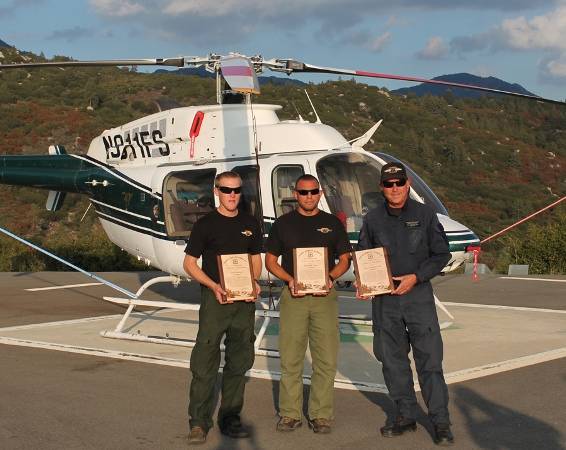
As Wildfire Today reported on September 17, the pilot and at least two crewmembers of H-535 were given awards for their actions related to the crash. It is possible that others involved in the emergency response to the incident also received awards.
Firefighters Daniel Diaz (center), Kevin Walters (left), and pilot Chuck MacFarland (right) receive their awards for their actions following the crash of MAFFS 7. Photo credit: San Bernardino National Forestx
Today the US Air Force released the full report on the July 1, 2012 crash of MAFFS #7, a military C-130 operating as an air tanker on the White Draw Fire in South Dakota.
More details are at FireAviation.com HERE and HERE.
Today the US Air Force released the full report on the crash of MAFFS #7, the C-130 air tanker operated by the North Carolina National Guard. The accident occurred July 1, 2012 as the aircraft was attempting to drop retardant on the White Draw Fire near Edgemont, South Dakota. There were four fatalities. The two crewmen in the rear of the aircraft were seriously injured but survived. Those two were operating the Modular Airborne FireFighting System (MAFFS) in the cargo hold which enables the C-130 to function as an air tanker, capable of dropping up to 3,000 gallons of fire retardant.
The investigation was led by Brigadier General Randall C. Guthrie, USAFR. Also participating were the following board members: Legal Advisor, Medical Member, Pilot Member, Maintenance Member, Flight Engineer Member, Weather Member, Loadmaster Member, Recorder and two Court Reporters.
The report does not list who the investigation board may have interviewed. Most likely they talked with the crews of the lead plane and air attack and probably other personnel assigned to the fire in various positions, but it would seem to be important to have someone on the board who lives and breathes aerial firefighting. Maybe the “Pilot Member” was MAFFS qualified at least.
We will be writing more about this report in the coming days, but for now, here is the “Opinion Summary” from the report:
I find by clear and convincing evidence the cause of the mishap was Mishap Pilot 1 (MP1), Mishap Pilot 2 (MP2), Mishap Navigator (MN) and Mishap Flight Engineer’s (ME) inadequate assessment of operational conditions, resulting in the MA impacting the ground after flying into a microburst. Additionally, I find by the preponderance of evidence, the failure of the White Draw Fire Lead Plane aircrew and Air Attack aircrew to communicate critical operational information; and conflicting operational guidance concerning thunderstorm avoidance, substantially contributed to the mishap.
On 1 July 2012, at approximately 1738 Local time (L), a C-130H3, T/N 93-1458, assigned to the 145th Airlift Wing, North Carolina Air National Guard, Charlotte Douglas International Airport (KCLT), Charlotte, North Carolina, crashed on public land controlled by the United States Forest Service (USFS), while conducting wildland firefighting operations near Edgemont, South Dakota.
At the time of the mishap all members of the Mishap Crew (MC) were assigned or attached to the 156th Airlift Squadron, based at KCLT. The MC consisted of MP1, MP2, MN, ME, Mishap Loadmaster 1 (ML1) and Mishap Loadmaster 2 (ML2). For the mishap sortie, MP1 was the aircraft commander and pilot flying in the left seat. MP2 was in the right seat as the instructor pilot. MN occupied the navigator station on the right side of the flight deck behind MP2. ME was seated in the flight engineer seat located between MP1 and MP2, immediately aft of the center flight console. ML1 and ML2 were seated on the MAFFS unit, near the right paratroop door. ML1 occupied the aft Modular Airborne Fire Fighting System (MAFFS) control station seat and ML2 occupied the forward MAFFS observer station seat.
After three uneventful sorties, the Mishap Aircraft (MA) entered the White Draw Fire Traffic Area (FTA) in South Dakota. The lead plane for the MA was Lead B-5. Lead planes are responsible for the safe, effective and efficient use of air tanker operations within an FTA. A lead plane is also responsible for leading air tankers to a low-level, where fire retardant can be safely dispensed. Air Tactical Pilot (ATP) piloted Lead B-5 from the left seat and Air Tactical Supervisor (ATS) occupied the right seat. ATS initially acted as the airspace manager for the White Draw FTA. However, prior to conducting the retardant drops a third aircraft, Air Attack, entered the White Draw FTA and took over airspace management duties. Air Attack 3 (AA3) piloted Air Attack from the left seat and Air Tactical Group Supervisor (ATGS) was in the right seat.
Upon entering the FTA, the MC noticed a thunderstorm and witnessed lightning between 10 and 20 nautical miles away. ATP determined two retardant drops were needed. Lead B-5 and the MA performed the first drop precisely on target, but the MA’s airspeed was 10 knots slower than planned. As the MA positioned for the second drop, ME and MN noticed an increase in fire activity and surface winds changing in both velocity and direction. Lead B-5 then experienced a rapid “sinker” and ATP stated, “I got to go around.” ATP struggled to keep Lead B-5 under control. In response, MP2 commanded a go-around “out of this” and MP1 pushed the throttles up. Twelve seconds later, ATP advised the MC to dump their load and the MC complied. Despite MA engines at maximum power, airspeed and altitude continued to deteriorate, ultimately resulting in the mishap. The MA impacted lightly-wooded, rolling terrain and slid through a tree-lined ravine which was approximately eight feet deep, before stopping roughly 410 feet (ft) from the initial point of ground impact. MP1, MP2, MN and ME died in the mishap. ML1 and ML2 survived, but suffered significant injuries.
The mishap aircraft (MA) and a USFS-owned MAFFS unit were destroyed. The monetary loss is valued at $43,453,295, which includes an estimated $150,000 in post aircraft removal and site environmental cleanup costs. There were no additional fatalities, injuries or damage to other government or civilian property.
Sprinklers at the Lateral West Fire in 2011, Great Dismal Swamp. USFWS photo by Greg Sanders
One of the founders of the United States government, George Washington, is partly to blame for the large wildfires that burn thousands of acres for months at a time in the Great Dismal Swamp in southeast Virginia.
In an effort to convert the swamp into farmland, Mr. Washington had ditches constructed that drained much of the swamp. The project did not succeed, but the lowered water table created dry fuels that have since been vulnerable to lightning-caused fires that become deep-seated and extremely difficult to put out. Fighting those fires in peat that can be six to eight feet deep involves moving millions of gallons of water, hoping to raise the water level in the areas where the fires are burning.
After the swamp was declared a National Wildlife Refuge in 1974, the US Fish and Wildlife Service began reversing some of Mr. Washington’s changes with a goal of restoring the natural hydrology. The water management structures, including four new ones completed this week, should reduce the likelihood of persistent prolonged fires.
One of the more recent large fires in the refuge was the Lateral West fire, ignited by lightning on August 4, 2011 and contained September 30, 2011 after burning 6,377 acres.
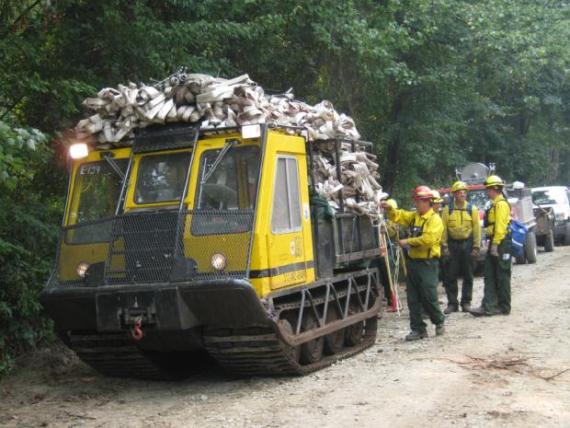
Fire hose “spaghetti” at the Lateral West Fire, 2011. USFWS photo by Brad Lidell
Fern Lake Fire, November 27, 2012. Photo by Dennis Geving
An additional squad of smokejumpers has been ordered to supplement the forces working on the Fern Lake Fire in Rocky Mountain National Park eight miles west of Estes Park, Colorado.
Due to the steep terrain and hazardous trees, firefighters are only able to attack the fire in areas that provide an adequate margin of safety. Their objective is to keep the fire on the north side of the Spruce Creek Drainage. Much of the recent action has taken place in that area where spot fires across the creek are being suppressed with the assistance of Helitanker 715. Two 5,000-gallon portable water tanks have been set up in Upper Beaver Meadows from which the helitanker is drafting water. Local fire departments are hauling water to keep the tanks full.
When the additional smokejumpers arrive the 1,488-acre fire will have 60 personnel assigned.
Neptune Aviation Services will retire the first two of its seven operational P2V Neptunes by the start of the 2013 wildfire season, as the aerial firefighter phases in its growing fleet of former commercial jets, modified as air tankers.
The Missoula-based company, which has been operating the specially configured BAe 146 jets since 2011, currently has three, with two more slated to enter the fleet during the first half of 2013. The four-engine jets, all relatively low-cycle, were procured from airlines and leasing companies to replace Neptune Aviation’s former US Navy Neptune patrol aircraft. The twin-piston engine powered P2Vs, dating from the early Cold War Era, had been retrofitted with tanks for fire retardant chemical dropping following their retirement from military service.
“The BAe 146, which we selected as our next-generation air tanker, has at least 20 years of service ahead of it as an aerial firefighter,” said Neptune Aviation President Dan Snyder. “As we take delivery of additional aircraft, we will continue to retire our remaining P2Vs at the rate of about two per year, depending upon the needs of the US Forest Service.”
Snyder added that Neptune Aviation Services is currently in discussions with TronosJet Maintenance for the acquisition of a sixth BAe 146. The Prince Edward Island company has partnered with Neptune on the BAe 146 modifications, which includes the installation of an internal tank with a capacity of 3,000 gallons of fire retardant. Long term, the operator plans to fly as many as 11 modified BAe 146s. In a related development, Neptune Aviation Services, according to Snyder, has taken the lead on the BAe 146 Air Tanker Modification Project from Tronosjet.
“Most of the modification and engineering work has shifted to Neptune Aviation Services, which includes all of the revisions made to the initial modification work,” he explained. “The revisions were based on our operational experience with the aircraft and will improve the performance of the tank system.” Going forward, Snyder added, TronosJet Maintenance will be responsible for procuring the aircraft, as well as technical support.
Currently, eight of the company’s P2V pilots have been trained on the BAe 146 airtanker, while another four are going through the ground school at Neptune Aviation Services in Missoula. The ground school is being directed by a former Air Wisconsin instructor pilot.
“The simulator portion of training is conducted at Oxford Training Academy in the UK,” Snyder explained. “The pilots get a BAe 146 type rating, following a successful check ride in the airplane with a Neptune examiner pilot.”
Helitanker 715 drafts water from one of two 5,000-gallon portable water tanks (affectionately known as “pumpkins”) in Upper Beaver Meadow while working on the Fern Lake Fire in Rocky Mountain National Park west of Estes Park, Colorado. NPS photo.
The Aerial Firefighting and Natural Resources Committee of the Helicopter Association International (HAI) held a meeting Monday through Wednesday of this week in Boise, Idaho. According to the HAI, 75 members attended, with much of the group’s time devoted to helicopter operations under contract to the federal government for wildland firefighting support.
Presentations were made by Dennis Pratte, manager of the FAA’s General Aviation/Commercial Division, on public operations conducted by commercial operators on contract to a government agency; and by Frank Gladics, former senior staff member of the Senate Energy and Natural Resources Committee, on legislative issues relative to aerial firefighting.
Other agenda items included unmanned aviation vehicles (UAV), governmental economic crises, and wildfire aircraft operations.
The next meeting of the committee will be on March 5, at HELI-EXPO 2013 in Las Vegas.