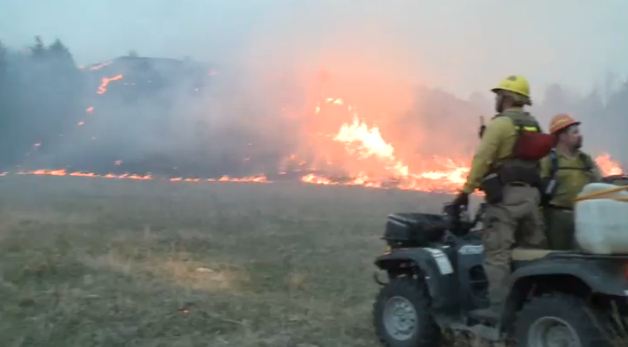
Senate defeats bill to fund wildland fire

On Friday the US Senate failed to pass an amendment that would have fully funded U.S. Forest Service wildland fire management for 2013. Introduced by Senators Jon Tester (Montana) and Mark Udall (Colorado), the amendment to the Supplemental Appropriation for Disaster Assistance would have restored $653 million to the Forest Service’s Wildland Fire Management Account, which funds wildland fire preparedness, suppression, hazardous fuels reduction, fire research and development, and state fire assistance. The amendment would have increased the budget request for the Wildland Fire Management fund to the projected median cost of the 2013 wildfire season, $1.584 billion.

The amendment was defeated when Senator Jeff Sessions (Alabama) raised a point of order against the proposal, and the Senate failed to waive it in a 51-44 vote.


Coulson modifies 2 helicopters for night flying

Coulson S61, C-FMAY.
One of Coulson’s S61s, C-FMAY. Photo by Coulson

Coulson Aviation has modified two helicopters so that they can be flown at night. The company, according to Vertical Magazine, took one of their four Sikorsky S61s and a Bell 206B Jet Ranger to Boise, Idaho to get Aviation Specialties Unlimited to make the modifications necessary to be compatible with night vision goggles (NVG).

Coulson also installed a hoist and a medivac interior on the S61, similar to the systems on Los Angeles County’s SH-3 Sea King helicopters, so that it could be used to extract injured personnel from remote areas day or night. This capability could save the lives of firefighters who are victims of accidents after sunset.

Two of the company’s S61s, including the NVG-equipped ship, are in Australia now working on a fire contract. Night flying is not part of the agreement but Coulson hopes to demonstrate to the authorities the benefits of fighting fire at night, when fires move more slowly and firefighting can be more effective.

The US Forest Service will experiment with one night-flying helicopter in 2013, even though helicopters have been fighting fire at night for decades.

More fire crew videos, fire season summaries

UPDATED January 1, 2013: added a video from the Wind Cave National Park fire organization.

=============
Yesterday we posted two videos that hotshot crews produced which summarized their 2012 fire season. Today we have more.

The first one is the Entiat Hotshots (based on the Okanogan-Wenatchee National Forest in Washington):

Next is the Sawtooth Hotshots (Sawtooth National Forest in Idaho):

And finally, Lakeview Helitack: (near Lakeview, Oregon)

From the fire personnel at Wind Cave National Park:

Let us know if you are aware of any other good videos summarizing the 2012 fire season.


Thanks go out to Matt

Bobcat and bear rescued by firefighters, recovering, will be released

Chips bobcat rescued
Mad River crew Superintendent Tad Hair holds Chips, a rescued bobcat. Photo by US Forest Service

You may have heard about Chips and Boo Boo, the bobcat kitten and bear cub that were found with burn injuries on wildfires last August.

In both cases wildland firefighters found and rescued the young critters, which were then treated for their burns and rehabilitated by wildlife rescue organizations.

Chips was found August 24 by members of the Mad River hand crew on the fire that inspired the name of the bobcat, the Chips Fire, burning on the Lassen and Plumas National forests in California. Not wanting to disrupt a natural process, the crew tried to walk away but the bobcat followed them. When they stopped it curled up on the boots of crew superintendent Tad Hair. The crew searched for tracks that belonged to its mother and found none. A closer assessment revealed that the kitten had burned paws and eye injuries so they rescued it and contacted Lake Tahoe Wildlife Care, a nonprofit organization that rehabilitates injured or orphaned wildlife and returns them to the wild.

Chips has now recovered from her wounds and will eventually be released into the wild, hopefully next spring. One obstacle that must be overcome is her tendency to be friendly with humans. She has been introduced to two male bobcats who hiss and bare their claws at people and is being taught to hunt by having to chase down live mice.

Boo Boo Bear
Boo Boo, shortly after being rescued. Photo by Karen Dunlap, USFS

Boo Boo the bear cub was also found by firefighters on August 24, but on the Mustang Complex Fire in Idaho. Like Chips, Boo Boo had burned paws. An Idaho Fish and Game Officer and a member of the Whiskey Flats Crew took the cub to the Garden Valley Ranger Station, and later transferred it to the nonprofit Snowden Wildlife Sanctuary in McCall, Idaho.

Boo Boo’s paws are still sensitive but the cub is climbing trees and playing with five other orphaned cubs in a two-acre enclosure in the sanctuary. The plan is to release it into the wild in June after hunting season ends.

Other similar stories:


Thanks go out to Kelly

Hotshot Crew videos, 2012 fire season

At least a couple of hotshot crews have put together videos summarizing their fire seasons this year. This first one is from the Wyoming Hotshots and is called “Part 1”, covering fires in Wyoming, Montana, South Dakota, Nebraska and Colorado. It includes some excellent photographs and skilled editing. HERE is a link to their videos from 2011.

The video below is from the Lone Peak Hotshots’ 2012 fire season. If you don’t think you’ll enjoy seeing blisters on a person’s foot being lanced with a pocket knife, skip the first 35 seconds.

Let us know if you are aware of any other good videos summarizing the 2012 fire season.

Update December 28. We have more here.


Prescribed fire training in Nebraska

Nebraska Rx fire academy
Nebraska prescribed fire academy, screen grab from Emily Kreutz video

The Nebraska Public Broadcasting System is reviewing their best stories of 2012, and among that group is their coverage of a prescribed fire academy sponsored by The Nature Conservancy near Gothenburn, Nebraska. The Nebraska PBS site has an interesting article as well as a video describing the training which occurred in March.

Here is an excerpt from the article:

==============================================================

…More and more, field operations for controlled burns are dictated by knowledge gleaned from scientific research. It’s long been known fire behavior is influenced by weather, the amount and type of available fuel and the lay of the land.

Since so much knowledge has been passed from one generation to the next, there’s an unusual tension between new science and the traditional, often effective, methods of harnessing the benefits of fire.

“I think that prescribed burning is more of an art than a science, but you do have to understand fire behavior and use that,” said Doug Wisenhunt of the USDA’s Natural Resource Conservation Service. He admitted to mixed feelings about crews in the field relying too much on computer models and mathematical formulas.

“You can calculate some of that, but in general, it’s just kind of knowing how the fire is going to react when you are burning at that time.”

Firefighters who lost homes in High Park fire rebuilding to beat deadline

At least five and perhaps as many as eight volunteer firefighters lost their homes in the High Park Fire west of Fort Collins, Colorado in June. Most of them were fighting the fire while their homes burned along with one of the Rist Canyon Fire Department’s stations. Now some are facing a deadline imposed by insurance companies to have the structures rebuilt within a year.

Helping to meet the deadline are volunteers of another type, wielding hammers and saws during winter weather — providing assistance to people they have never met. The Denver Post has more about theses volunteers.

Minnesota to contract for 3 helicopters

The Minnesota Department of Natural Resources has posted solicitations for firefighting helicopters at their bases in Cloquet, Princeton and Roseau. Here is an excerpt from their web site:

Service of a helicopter that is fully operated by qualified personnel, and equipped to meet specifications for use in administration, management and protection of lands from wildfire in Minnesota. The types of services which aircraft would generally be required to perform, but not restricted to are: Transportation of personnel, Equipment and supplies, Reconnaissance flights, Fire detection flights, Photography work involving, prolonged slow flight, Helicopter–bucket and fire missions, Administrative flying, Incident Support. Project Technical information contact: Bill Schuster at 218-327-4573.


Merry Christmas!

What ever your beliefs may be, I hope you have a wonderful holiday season and a safe, happy, and productive new year. And thanks for being  member of the Wildfire Today community.

Be careful out there.

Video about wildfire and the endangered Cape Sable Seaside Sparrow

Deer Hammock Wildfire from Into Nature Films on Vimeo.

This five-minute film features a lightning-ignited wildfire and the endangered Cape Sable Seaside Sparrow in Everglades National Park. These last, remaining sparrow populations increase the complexity of fire management in the Everglades.

The video was produced by Jennifer Brown of Into Nature Films. If her name sounds familiar it may be because we embedded one of her other films that she produced for Everglades NP when she was working there under a short-term appointment. That video, River of Fire, is excellent. It’s a shame that the National Park Service could not figure out a way to retain an employee with such unique and valuable skills. But she is still available as a contractor.