It’s not exactly a training film, but you might enjoy this 11-minute music video about aerial firefighters during the fires of 1988. This could be the first time you’ve ever seen a guitar player wearing Nomex gloves!
Thanks go out to Dennis.

It’s not exactly a training film, but you might enjoy this 11-minute music video about aerial firefighters during the fires of 1988. This could be the first time you’ve ever seen a guitar player wearing Nomex gloves!
Thanks go out to Dennis.


Researchers at Pacific Northwest National Laboratory, which is affiliated with the Department of Homeland Security, must have seen the movie Minority Report too many times. The video below which been around for a couple of years teases how the lab is developing future work environments for the emergency management community called Precision Information Environments (or PIEs). PIEs will hopefully provide tailored access to information and decision support capabilities in a system that supports the multiple user roles, contexts, and phases of emergency management, planning, and response.
Do you think the windshield of a fire vehicle will ever be able to instantly transform into a huge computer monitor?
Thanks go out to Jim

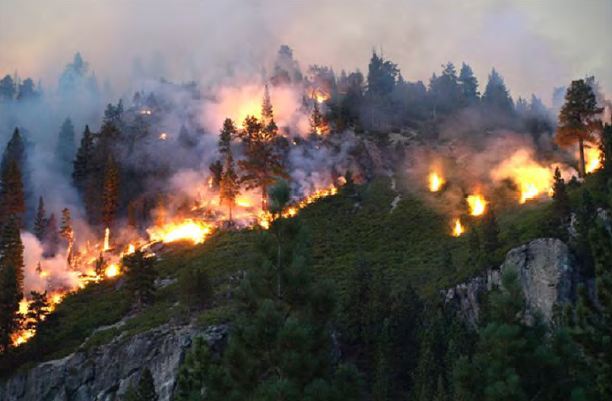
The National Park Service has released a report about last summer’s Reading Fire in Lassen Volcanic National Park in California which, after being monitored for two weeks and burning 95 acres, grew to 28,079 acres, escaping the park boundaries. The fire started from a lightning strike on July 23, 2012 and was contained on August 22. For the first two weeks it was managed under a “Wildland Fire for Resource Benefit” strategy.
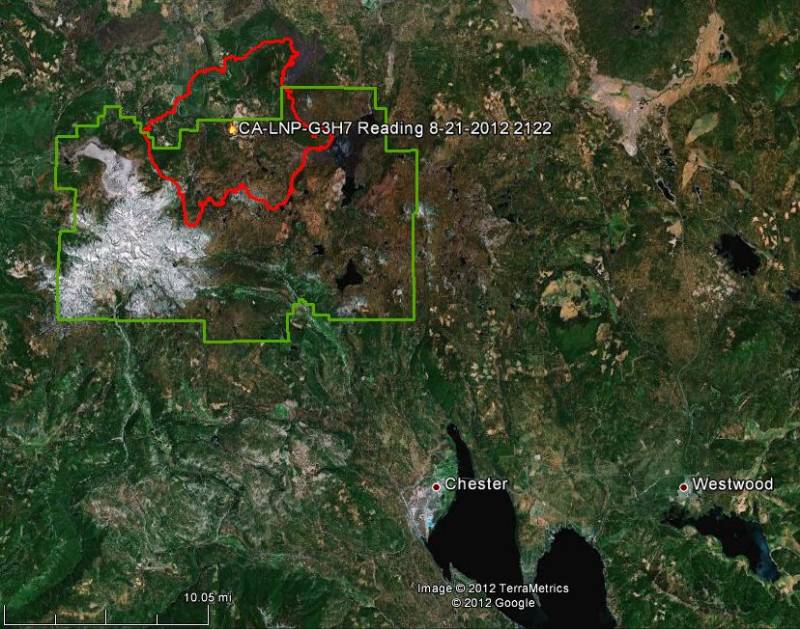
The expectation was that they could stop the fire when it reached the Lassen National Park Highway, about a mile north of the point of origin. On August 6 when the fire was 140 acres the Type 4 Incident Commander transitioned to a Type 3 IC. Later in the day the fire ran for about a mile and a half, blowing right across the 2-lane highway. Then a Type 2 Incident Managment Team was ordered, which eventually transitioned to a Type 1 IMTeam on August 13. When the fire was contained it had burned 11,071 acres of US Forest Service land outside the park boundaries and 75 acres privately owned, for a total of 28,079 acres. By August 23 the National Park Service had spent $15,875,495 observing, managing, and later suppressing the fire.
As we have stated before, managing a fire with your hands tied by utilizing little to no aggressive suppression action, is extremely difficult, requiring an extraordinary amount of skill, knowledge, expertise, experience, and luck. Especially if the fire starts in mid-July, leaving 6 to 12 weeks of weather ahead that is conducive to rapid fire spread. Few people can do this. It is impossible to predict accurately how weather will affect a fire more than 10 days ahead.
Here are some some excerpts from the 53-page report:
Continue reading
The Salt River Project, an Arizona utility company, collaborated with the Coconino National Forest to produce the training video below that discusses dangers and safety practices for wildland firefighters working near powerlines. The Missoula Technology Development Center reviewed the video and found it suitable for training wildland firefighters.
The video explains:
U.S. Forest Service and Bureau of Land Management employees can access the video on the internal Forest Service network at http://fsweb.mtdc.wo.fs.fed.us/programs/fire/video/safety.htm

This is the sixth in a series of articles on FireAviation.com featuring aerial firefighters answering 12 questions about their profession. We hope to get participation from senior pilots, as well as Air Operations Branch Directors, Air Tactical Group Supervisors, and others that have worked closely with fire aviation. Our objective is to not only provide our readers with interesting articles, but these very experienced aerial firefighters may also reveal a few gems of information that could prove to be valuable to those considering or just beginning a career in fire aviation. If you have a suggestion of someone who would be a good candidate for these questions, drop us a line through our Contact Us page. And their contact information would be appreciated.
Today we hear from Gordon Harris. After being a smokejumper, his first job as an aerial firefighting pilot was flying Volpars on a Bureau of Land Management smokejumper aircraft contract in Alaska. After that he began flying the U.S. Forest Service Infrared aircraft and serving as a Relief Smokejumper Pilot. Later he became the Chief Pilot for Infrared Flight Operations and after that the National Aviation Officer for the USFS. He was also a member of the Smokejumper Aircraft Screening and Evaluation Board. When Gordon retired in 2007 from the U.S. Forest Service he was the National Smokejumper Program Manager and the Air Tactical Supervisors Coordinator.
In a later article Gordon will describe for us a harrowing incident in a smokejumper aircraft, a Shorts Sherpa, when it was descending flat at about 5,000 fpm with virtually no indicated airspeed.
****

Who is one of the more memorable aerial firefighters you have known? And why?
Nels Jensen – One of the most totally “involved” leaders and enthusiastic people I’ve known with the advantage of being a highly skilled pilot and firefighter.
One piece of advice you would give to someone before their first assignment working on a fire?
Do not let any perceived sense of “urgency or emergency” over-ride the facts of Safety, protocol, procedure and most of all – Common Sense. “Use your Checklist”.
Besides the obvious (funding), what is the number one thing government Fire and Aviation should focus on?
Tough one! Safety is the standard answer probably, but I think effective use of resources is really foremost – on the ground side, when night ground firefighting was curtailed or greatly reduced, it seems to me that fires started getting bigger, more destructive and more dangerous. On the aerial side, the big safety push for grounding airtankers for airworthiness issues eliminated a lot of resources for the aerial aspect and as a result put immensely more pressure on the remaining resources. I’m not convinced these moves improved safety at all.
One suggestion you have for ground-based firefighters about fire suppression tactics, or working with aircraft?
Don’t call for aerial resources if you don’t really need them – use them effectively if you do.
One thing that you know now that you wish you had known early in your career?
Just because a job pays better or looks like a great career move, does not necessarily mean it is the right job at the right time for you. Make sure you develop your career in a logical manner! Take things slow when moving up the career ladder.
Which two aircraft manufactured within the last 20 years would make the best air tankers?
I do not have a well formed opinion on this, although I always thought the BAE-146 looked like a likely candidate and have not heard anything on how that project went. I also always thought the P3 was one of the best ones out there.
List the aircraft you have flown, or flown in, on fires. Which is your favorite, and why?
Of the aircraft listed, I was pilot in command on the first 8 listed and was a smokejumper in the others (except DC3-TP which I flew as co-pilot and gave smokejumper captain check rides in)
My favorite to fly and “best tool for the job” are two different things. I loved flying the Volpar, Shorts Sherpa, Sabreliner and Merlin the most. Best tools are different – and there again, variations.
If I had to single out one airplane as “most suitable” for multi-missions, probably the Beechcraft King Air 200 for being “user friendly” and good performance.
Each airplane had its “best aspects” and “not so good” for different mission profiles, not really a one-size fits all. I could write more on each airplane and which specific mission profile I thought each was best at or why I like it/dislike it but I think that is probably outside the scope of this survey.
The funniest thing you have seen in aerial firefighting?
Flying from Missoula to McCall one day in a Cessna 206, Nels Jensen and I could see an airtanker ahead of us flying very slow and doing S turns. We caught up with it, followed awhile, Nels recognized the plane and knew who was flying (not to mention names, he was the son of an Airtanker company owner). Finally Nels keyed the mic and said (calling the pilot by name), and so what do you think you’re doing, aren’t you suppose to “reload and return”, like today sometime? Maybe you should push the throttles up a little and fly a straight line! All the other pilot said was “oh damn, you are everywhere Nels”, and then bumped it up about 30 knots and managed to fly straight. He was “milking the Hobbs meter”.
How many hours have you spent in firefighting aircraft?
Rough estimate is 3,500-4,000 hours.
Your favorite book about fire, firefighting, or aerial firefighting?
Young Men and Fire
The first job you had in aerial firefighting?
From 1969-1972, then first pilot job flying as aerial firefighter was flying a Volpar Turboliner on a smokejumper contract for BLM Alaska. That year (1980) I got to bring the first contingent of BLM Smokejumpers to Grand Junction, CO when they started developing the Great Basin Smokejumper Program. Became full-time USFS Infrared Pilot (Merlin II and King Air 200) and relief Smokejumper pilot (Twin Otter) in 1987 at Boise.
What gadgets, electronic or other type, can’t you live without?
GPS is sure nice.
The Southwest Fire Science Consortium has produced a video that explains the advantages and disadvantages of masticating wildland vegetation, or fuels.
The video is very well planned and produced, cramming a great deal of information into an 11-minute presentation. The videography is first-rate, the speakers do an excellent job, and the sound, thanks to the use of a remote microphone, is high quality. My only suggestion for improving a very technical video like this is to ask the people that are representing their agency and presented as experts to wear their uniforms, and especially to ditch the coveralls and Hawaiian shirts. It could enhance the credibility and professionalism. Having worked for both the U.S. Forest Service and the National Park Service, it is surprising how different the two agencies are about this. The USFS has virtually no policies that are enforced about how and when to wear their uniform in the field, while the NPS, at least in some parks, goes to the other extreme, even requiring ties for many of their employees as part of the winter uniform.

The National Interagency Fire Center announced an award today.
****
BLM firefighters Ben Oakleaf and Chris Swisher have much in common.
They’re both BLM smokejumpers. They both worked on the Midnight Suns Interagency Hotshot Crew in Alaska. They’re both highly respected in smokejumping circles. They’re both described by their supervisors as having a great work ethic and outstanding attitudes. They’ve been good friends for about a dozen years, starting when they met while working as hotshots.
And they were both surprised when they were named winners of the “Al Dunton Award,” which honors the late BLM pioneer in fire and aviation management.

“It was a surprise,” says Swisher, who jumps out of Fort Wainwright, Alaska. “I didn’t know anything about it until I was told that I won.”
“I didn’t even know I was nominated until the jumper manager called me into his office and told me. I was very surprised,” says Oakleaf, who is part of the Great Basin smokejumpers, based in Boise, Idaho.
Part of the reason Swisher and Oakleaf were nominated is due to their work in combining the first-year smokejumper training. For a dozen years, the Alaska and Great Basin rookie jumpers trained separately. That didn’t seem the best way to teach the ropes to the new jumpers, Swisher and Oakleaf thought.
“Combined rookie training was done in the past. There’s been talk about it through the years, about doing the training that way again,” Oakleaf says. “We both have great respect for the two BLM smokejumper bases. We thought combining the training would be a good thing to do.”

Smokejumper management agreed and Swisher and Oakleaf were given the challenging assignment to make it happen.
The combined rookie training took place in April of 2012 in Alaska. By all accounts, it was a huge success. Combined training is again scheduled for April of this year, in Idaho.
“They were analytical, deliberate, mutually respectful of one another’s opinions, and ultimately convincing that the timing was right to give this combined effort another shot,” says Hector Madrid, manager of the Great Basin smokejumpers. “They developed guidelines, the training syllabus, a logistics plan and selected a cadre that shared the same viewpoints about rookie training.”
The effort proved worthwhile, according to Bill Cramer, Alaska smokejumper manager.
“The end result was that we had a strong group of first-year jumpers who came ready to contribute. The training could not have been done any better,” he says.
Great Basin jumpers often help Alaska jumpers in the spring, the peak of the northern fire season. In turn, Alaska jumpers often “boost” firefighting efforts in the Lower 48 during July and August, when the fire season is busiest in the West.
Having the same training and familiarity with one another is a big advantage.
“The more we know each other and about each other, the more seamless it is when we integrate the crews,” says Oakleaf.
But it was more than the combined rookie training that distinguishes Swisher and Oakleaf. Their supervisors say the two excel in every aspect of the smokejumping program.
“He seeks challenges, he accepts responsibility, he always looks for ways to improve,” says Cramer of his colleague Swisher. “That’s what resonates with me. It’s not just what he did in 2012, but the way he continually performs his job.
“He’s humble, without reason to be,” Cramer adds. “From his perspective, he just shows up and tries to do his job the best way he can. He doesn’t think he’s anyone special.”
Madrid is equal in his praise of Oakleaf.
“Ben’s strength is that he leads by example. No matter his experience, he’s never been above or beyond doing a task. He has great firefighting and jumping skills. He’s the full package,” says Madrid. “His attitude is second to none. He’s never in a bad mood, never had a bad moment, no matter the situation.”
The “Al Dunton Award” was established last year. Dunton was a rookie smokejumper in Fairbanks in 1967. He managed the smokejumper base there from 1972 through 1984 and remained active in fire management throughout his career. Much of BLM’s success in fire management can be traced back to Dunton’s work and innovations. The award was established by the interagency smokejumper base managers and the National Smokejumper Association, with the support of Al Dunton’s wife, Mary, and other family members.
Last year’s BLM winner was Gary Baumgartner.
The respect level is high between the award recipients.
“On a personal note, (organizing) the combined rookie training was fun to do with Chris. We’ve been good friends now for a long time,” Oakleaf says.
“I think there are more worthy people than me,” says Swisher, “but I’m glad that Ben was chosen.”
Says Cramer of the two, “I wish we could put them in a copy machine and duplicate them. Of course, if we did, the rest of us might be out of a job.”

This is the sixth in our series of articles on FireAviation.com featuring aerial firefighters answering 12 questions about their profession. We hope to get participation from senior pilots, as well as Air Operations Branch Directors, Air Tactical Group Supervisors, and others that have worked closely with fire aviation. Our objective is to not only provide our readers with interesting articles, but these very experienced aerial firefighters may also reveal a few gems of information that could prove to be valuable to those considering or just beginning a career in fire aviation. If you have a suggestion of someone who would be a good candidate for these questions, drop us a line through our Contact Us page. And their contact information would be appreciated.
Today we hear from Hugh Carson, an Air Operations Branch Director. He served as the Bureau of Land Management’s State Aviation Manager for Utah and Nevada, later becoming the Aviation Training Developer for the BLM at the National Interagency Fire Center in Boise.
****

Who is one of the more memorable aerial firefighters you have known? And why?
I’m with Walt Darran, it’s gotta’ be Don Ornbaum, whom I had as PIC for the Stead contract my first year as a State Aviation Manager for the BLM in Nevada. One of the smartest, crustiest, most humorous guys I’ve ever run into. I sure wish we’d followed up on that airtanker pilot oral history project – Don would have had a lead role, for sure. But Don also had a co-pilot named Wally Griffin, whom I hired the next year as the Nevada OV-10 pilot ‘til he absconded north to be the AFS Aviation Manager.
One piece of advice you would give to someone before their first assignment working on a fire?
Review situation awareness cues and LCES. It all comes down to that in staying alive.
Besides the obvious (funding), what is the number one thing government Fire and Aviation should focus on?
Being open to “new” technology and platforms that, outside of the feds, are becoming ubiquitous. I would put Unstaffed Aerial Vehicles at the head of this list, followed by the use of the CL-415 as a primary airtanker. And we should not spend 5 years studying aircraft and systems whose use is a no-brainer. If the feds don’t understand the train is leaving the station, the states and municipalities will leave the feds in the dust.
One suggestion you have for ground-based firefighters about fire suppression tactics, or working with aircraft?
Fire suppression: Measured, slow, and aware. Aircraft: Get with the helitackers and ATGS/ASMs early, one on one. Ask questions, do some what ifs. The more ground folks understand aviation, the less friction we have, and the easier it is to develop synergy.
One thing that you know now that you wish you had known early in your career?
Active listening.
Which two aircraft manufactured within the last 20 years would make the best air tankers?
CL-415, and an un-built one for which we should have obtained funding 20 years ago. An airtanker specifically built for the environment. Still a dream.
List the aircraft you have flown, or flown in, on fires. Which is your favorite, and why?
Lama [helicopter]. Power.
The funniest thing you have seen in aerial firefighting?
This not something I saw, but rather something that happened. Happy Camp, ’87. Team is anticipating aerial firing with PSD potassium permanganate ping pong balls. Carson orders 30,000 PSD Unit on Equipment order but the balls have to go on a Supply Order. Despite specific cross-referencing of the orders, sure enough, 2 days later someone said that a Ryder truck was outside with my ping pong balls. The driver opens the back gate and . . . and . . . there they were. 30,000 regular ping pong balls, though minus paddles and tables. The buzz on this had pretty much calmed down, but this should give it some more legs.
How many hours have you spent in firefighting aircraft?
1000
Your favorite book about fire, firefighting, or aerial firefighting?
The first job you had in aerial firefighting?
AD-1 Helitack Crewmember, 1970, Glenallen, AK.
What gadgets, electronic or other type, can’t you live without?
Since I’m a DJ on community radio, it’s my 2 Tb External Drive with 28,000 songs on it.
Today we have the ninth article of our series in which we ask current and retired leaders in the wildland fire service to answer 12 questions.
We appreciate everyone who is cooperating with this project. Some of their responses may add to the knowledge base of our new firefighters coming up through the ranks. If you would like to nominate someone who would be a good candidate for these questions, drop us a line through our Contact Us page. And their contact information would be appreciated.
Below we hear from Edy Rhodes, a former Area Commander. She worked for the U. S. Forest Service for 25 years before transferring to the National Park Service, retiring as their Division Chief of Fire, Aviation and Structural Fire.
****
When you think of an excellent leader in the fire service, who comes to mind first?
Too many to mention, but here are a few:
What is one piece of advice you would give to someone before their first assignment as an Incident Commander?
In general, “Before you get on the horse, be ready to ride!” Specific to large incident management, provide strategic leadership and all it entails from being proactive, confident, decisive and a good communicator with your team and all stakeholders involved.

If someone is planning a prescribed fire, what is one thing that you hope they will pay particular attention to?
An approved plan, appropriate weather conditions, adequate resources, and good communication by all.
One of the more common errors in judgment you have seen on fires?
Assuming that everyone is on the same page; Failing to “connect the dots” and “close the loop” with those that need critical information that may affect them.
One thing that you know now that you wish you had known early in your career?
What a rewarding career that fire management would be! The opportunities to travel, see remarkable places, and work with extraordinary people has enriched my life tremendously.
The stupidest mistake you have seen on a fire?
It was on a RX burn, when the fire jumped the line on our section, setting off a huge, grassy field next to the municipal sewage treatment plant, which was adjacent to the regional airport. Thank goodness, we were able to get the treatment plant personnel to turn on the effluent sprinklers, which extinguished the fire, before the smoke completely shut down airport operations. We got a lot of phone calls on that one!
Your most memorable fire?
The Yellowstone Fires of 1988.
The funniest thing you have seen on a fire?
A couple of mules got loose from their pack string and went bucking down the mountain scattering their load everywhere!
The first very large fire you were on?
The Hog Fire, Klamath NF, 1977.
Your favorite book about fire or firefighting?
Young Men and Fire
The first job you had within the fire service?
Forester Trainee and firefighter on a local crew on the Daniel Boone National Forest, KY.
What gadgets, electronic or otherwise, can’t you live without?
Laptop, iPhone and iPad. Love my Google maps!


According to the National Park Service’s Facebook page, the Grand Canyon National Park Helicopter made the cover of the FAA’s Helicopter Flying Handbook.
It is interesting that the FAA Photoshopped-off the N-number and other identification. Below is an NPS photo of the ship taken from Grand Canyon’s brochure for their Helicopter Training Academy.

The US Forest Service removed the identification from the P2V in the photo below which is on their Air Tanker contract web page, and was also on their 2011 Air Tanker Contract:
