The Jurupa Fire is 80 percent contained and there has been no change in size, it is holding at 311 acres. Full containment is estimated for 8 p.m. this evening.
****
UPDATE at 4 p.m. PT, March 1, 2013:
Riverside County FD reports the fire is 40 percent contained, has burned 311 acres, and the spread has been stopped. At 12:47 p.m. the temperature was 83 degrees, 5 percent RH, with northeast winds of 10-15 mph gusting to 25. Voluntary evacuations have been cancelled (if such a thing is possible).
The LA Times reports that fire officials said two structures burned, ignited by airborne embers. One was a residence and the other was an outbuilding. An RV also burned at another location after embers caused its awning to catch fire.
****
UPDATE at 9:00 a.m. PT, March 1, 2013
Jurupa Fire, Photo by Brandy Carlos
The Jurupa Fire near Riverside, California has burned 200 acres and is 30 percent contained, according to Jody Hagemann of the Riverside County Fire Department. Firefighters worked through the night on Thursday taking advantage of winds that were less strong than the breezy conditions that pushed the fire earlier.
The Press Enterprise reports that Rick Mullins, who lives about a quarter-mile from the fire, said his neighborhood experienced an ember shower that ignited the awning of his RV which spread to the trailer engulfing it in flames. The heat from that fire slightly singed his house but it was not seriously damaged.
On Friday there will be 20 engines, 1 dozer, 1 helicopter, and 8 hand crews assigned to the fire.
Helicopter dropping on Jurupa Fire, Photo by Brandy Carlos
****
Originally posted at 11:15 p.m. PT, February 28, 2013
Voluntary evacuations are taking place for the Jurupa fire near Riverside, California. At 11:15 p.m. local time on Thursday, the fire had burned 150 acres and was 20% contained according to the Riverside County Fire Department. Most of the fire is burning along both sides of the Santa Ana river bottom in areas that make access difficult for firefighters.
A travel trailer about a quarter-mile from the fire burned freely for several minutes until a helicopter dropped water on the blaze. It may have been caused by burning embers from the main fire.
The fire started at about 4:45 p.m. at Jurupa Regional Park at Rio Road and Calle Hermosa. At 7:30 p.m. one helicopter was still dropping water on the flames.
This animated video explains forest management, prescribed burning, fire return interval, and fuel management in 100 seconds.
The video is very well done and gets its point across quite efficiently, however it may be obvious to some that it was produced by an organization like the Oregon Forest Resources Institute which represents forest producers, small woodland owners, forest sector employees, academia, and the general public. The group appears to be similar to the Idaho Forest Products Commission that came up with the “Thin the Threat” bumper sticker last year.
Fire in the Grampians. Taken at 1700 hours Friday Feb. 15 by Tom Goldstraw
Tom Goldstraw, one of our loyal readers in Australia, sent us these photos of a fire in the Grampians region of western Victoria. He reports that the fire was 170 hectares (427 acres) when he arrived and it had burned 35,000 hectares (86,000 acres) when they left. It was a tough trip, he said. Lighting ignited 12 fires, many of which were swept up in two large fires.
Thanks Tom!
Monday 18th Falling back to asset protection, D7 dozer retreating after multiple spot fires closed off all exit roads. ( we all fell back to a wool shed which would have been the most protected asset in the state D7 4 pigs and 10 heavy tankers) Monday 18th Sky crane filling with VicForests and DSE crews filling from quick fill, fire came out into the paddocks moments after this photo (Fire behaviour increasing rapidly and only 1130am) Sunday 17th, waiting for the fire to cool down and start dozer work and back burning operations from the private property interface Monday 18th, fire well into the private paddocks burning behind our safe area near the wool shed
CAL FIRE expects to fully contain the River Fire on Thursday which has burned 407 acres east of Lone Pine, California. Thick brush and winds measured at 25 mph challenged the 500 firefighters that initially fought the blaze after it started on Sunday. Remaining on the fire Wednesday morning are 234 personnel, 11 engines, 6 crews, and 2 water tenders. CAL FIRE is calling it 85 percent contained.
Oregon may regulate exploding targets and sky lanterns
A bill has been introduced in the Oregon legislature, HB 3199, that would prohibit the use of sky lanterns (or fire balloons), exploding targets, and tracer ammunition on land within the boundaries of a forest protection district. (UPDATE: the bill was signed by the Governor and will take effect January 1, 2014.)
“Concealed carry is a right, target shooting is not”
Those were the words of Utah state senator Margaret Dayton who resurrected her bill that would give the state forester the authority to ban target shooting on state lands during periods of enhanced wildfire danger. Earlier she withdrew the bill after it received criticism from some shooting enthusiasts. The bill passed the Senate this week along with another that would allow firefighters to access water on privately owned land to aid them in fire suppression efforts.
A bill is speeding through the Colorado Senate that would add safeguards to prescribed fires conducted in the state. Senate Bill 13-083 would:
Establish control over prescribed burning within the Division of Fire Prevention and Control in the Department of Public Safety;
“Prescribed Burn Managers” must be certified by the Division for prescribed fires occurring on state lands or conducted by state agencies on private lands. This does not apply to “burning conducted by an agency of the federal government”;
A Prescribed Burn Manager must be on site during a prescribed burn “until the fire is adequately confined to reasonably prevent escape”;
Allows the Division to collect fees for providing training and certifications.
Getting manufactured crisis fatigue?
While the people we send to Washington to conduct the nation’s business have not passed a federal budget in four years, and they propel us from one manufactured crisis to another, some of us may tire of the hype as we reel from one ridiculous deadline to another. Unfortunately the impacts on the land management agencies from the budget cuts required by the sequester will be significant unless they are reversed within the next few weeks.
On October 13, we first wrote about the sequester, which will require federal wildland fire programs to be cut by at least $218 million, or 8.2 percent.
Here are some excerpts from an article at the Union Democrat with examples of impacts on the National Park Service and U.S. Forest Service in California:
The Associated Press obtained a Park Service memo Friday that detailed some of the planned Yosemite cuts. Staff reductions would end guided ranger programs at Wawona and the Mariposa Grove of Giant Sequoias, eliminate a program in which 3,500 volunteers provide 40,000 hours of activities and mean less frequent trash pickup due to loss of campground staff.
Park administrators fear that less frequent trash pickup would potentially attract bears into campgrounds.
Seasonal road closures like that of Tioga Road may be extended later than usual because there will be less staff available to clear snow.
“The reductions would limit the National Park Service’s ability to sustain a full complement of seasonal employees needed for interpretive programs, maintenance, law enforcement and other visitor services as we are preparing for the busy summer season. Local communities and businesses that rely on recreation to support their livelihoods would face a loss of income from reduced visitation to national parks.”
In the Stanislaus National Forest, cuts could reduce funds available for fuels reductions that help prevent catastrophic forest fires. About $134 million in lost wildland fire management funds would lead to as many as 200,000 fewer acres treated nationwide, U.S. Agriculture Secretary Tom Vilsack wrote in a letter dated Feb. 5 to U.S. Sen. Barbara Mikulski, D-Md., chairwoman of the Senate Appropriations Committee.
The Forest Service is also prepared to close up to 670 of 19,000 developed recreation sites nationwide, such as campgrounds, picnic areas and trailheads, according to Vilsack.
Webinar today: Debunking Myths in Wildland Fire
Today from 1 until 2 p.m. MT:
Sarah McCaffrey will present findings from recent research on social issues of fire management with particular emphasis on the accuracy of various accepted truths about the public and fire management and the variables that actually are associated with approval of different fire management practices.
10 Tanker Air Carrier issued a statement Monday on their Facebook page about the bid protests that they, along with Coulson, filed over the contracts for next generation air tankers that the U.S. Forest Service announced that they were going to award last summer. The company has two DC-10 air tankers that carry 11,600 gallons of retardant, about six times more than a P2V, but they were not going to receive exclusive use contracts for the aircraft. The USFS had to cancel the process just before the contracts were signed. Four months later the solicitation was reissued with 31 changes, requiring responses by November 1, 2012.
The DC-10 air tankers have received excellent reviews from firefighters and aviation managers, but the USFS has in the past only offered them call when needed contracts, meaning they may or may not be used at all, and if they were, it would be intermittently.
10 Tanker’s statement appears to be partially in response to Colorado Senator Mark Udall’s remarks on the issue Thursday, in which he suggests that the protests may be ignored (emphasis added):
Mark Udall, who serves on the U.S. Senate Energy and Natural Resources Committee, urged private contractors to respect the U.S. Forest Service’s upcoming decision to award contracts to several U.S. companies to supply next-generation air tankers. Protests and challenges of past contract awards have already delayed the Forest Service’s acquisition of seven next-generation air tankers — which Udall championed last year. Additional protests could leave Colorado and the West without these tanker resources for the 2013 wildfire season.
“Air tankers are critical firefighting resources that can save lives and prevent small blazes from becoming catastrophic wildfires,” Udall said. “When I met with Northern Colorado firefighting and emergency-management officials this week, they all agreed that we need to ensure that Colorado and the Forest Service have the resources they need to fight fires now. If contractors continue to challenge agency decisions, I will urge the Forest Service to use its emergency authorities to override the challenges and finalize the tanker contracts as soon as possible. Colorado cannot wait.“
Below is the text from 10 Tanker’s statement:
A widely published Associated Press article recently related the story of the long-term decline in the U.S. Forest Service’s aerial tanker fleet to the Next Generation Air Tanker solicitation bid protest last year by 10 Tanker Air Carrier and another bidder. Some members of Congress have expressed support for Forest Service to use emergency authorities to work around the bid protest. What the article omits and members of Congress may not realize is that it was the General Accountability Office (GAO) that found the 10 Tanker bid protest to be valid. That caused the US Forest Service to withdraw from the bid protest process, to amend the solicitation to correct its discriminatory issues, and to reissue the solicitation.
As you may know, GAO is the investigative arm of Congress “charged with examining matters relating to the receipt and payment of public funds.” As a part of that responsibility, GAO is also charged with handling bid protests, but they do not undertake that role unless there is obvious discrimination in an agency’s contract decisions. In this case, they found that the Forest Service used a decision process that discriminated against 10 Tanker Air Carrier. The issues involved cost basis in which 10 Tanker clearly offered the lowest cost per gallon of retardant delivered on fires, and also involved the USFS use of outdated, third party input that, had the well-known facts been used, would have been in 10 Tanker’s favor.
Had 10 Tanker’s bid been awarded, we could have provided the same protection to the public with four aircraft this 2013 wildfire season that is the equivalent of 15 – 16 competing aircraft that will not be available for use for several years.
10 Tanker wholeheartedly agrees that responsible leaders, including the Chief of the USFS, should use emergency procedures and resources to protect the public in an emergency. However, we discourage the declaration of an emergency as a means of providing a long-term solution to this on-going issue. We are confident it will be resolved within the next several months and thank you all for your support as we move closer to the upcoming fire season.
****
It has has been 1 year, 2 months, and 25 days since the USFS first issued a solicitation for next-generation large air tankers, but no contracts have been awarded.
A Lessons Learned report has been released for a serious burn injury that occurred on the Saddle Salvage Natural Fuels burn unit, a prescribed fire somewhere in the Northwest. Oddly, neither the agency or even the state were identified, but the injured firefighter was eventually transferred to Harborview Burn Center in Seattle.
Briefly, a firefighter’s Nomex pants caught fire while he was using a drip torch to ignite vegetation during a black-lining operation. He suffered second and third degree burns over 20‐25% of his body, both legs and the left hand. He spent five weeks at the burn center but is now back to work on light duty. A full recovery is expected.
The report found that the management of the response to the injury went very well. Quite a bit went right.
A lab analysis of the protective clothing worn by the victim indicated that fuel was present on his pants and boots. Some of the fuel may have been deposited onto the clothing the previous day during ignition operations. Nomex contaminated with torch fuel is flammable even with small amounts of fuel and a low ratio of gas to diesel (1:5 gas to diesel) mixture.
The drip torch was inspected later at the Missoula Technology Development Center. Investigators found that the breather (vent) tube was in the torch but not attached to the breather tube screw. If the breather tube was disconnected from the breather tube screw during use, and the breather screw was open, fuel would drip from the screw.
A lab analysis of the drip torch fuel mix was completed. The analyzed torch fuel was not drawn from the injured employee’s torch, but did come from another torch that was used on the burn unit. Investigators concluded that the fuel was approximately a 1:1 gas/diesel mixture, which is a much higher concentration of gasoline than is specified in the U.S. Forest Service Health and Safety Code Handbook.
SYLMAR, CALIFORNIA – Investigators from the Los Angeles Fire Department are seeking the public’s help in identifying the person responsible for igniting at least a dozen fires in the northeast San Fernando Valley.
The intentionally set blazes – involving Italian Cypress trees, took place in Sylmar, California between November 4, 2012 and February 18, 2013 as seen on an interactive map.
An article that appeared in the Missoulian and several other newspapers discusses research by Headwaters Economics about the costs of fighting wildfires in the wildland-urban interface. It includes some controversial quotes from a gentleman who is often sought by reporters when they need a quote about U.S. Forest Service fire management policies.
Below is an excerpt from the article. You will have to go to the Missoulian site to read the aforementioned quotes.
If Montana’s forest fringes continue filling with houses, wildland firefighting costs could double, according to a report by the Bozeman-based Headwaters Economics.
“Protecting homes is a major cost and safety issue in fighting fire,” said Headwaters author Chris Mehl. “But the real question is personal responsibility: Who pays for that? Right now, the federal government – the Forest Service, BLM or FEMA – pays for a disproportionate share of the cost of fighting fires and cleaning up afterward. States and municipalities pay a small share of the cost.
“The challenge is, if we keep building these homes in the wildland-urban interface, who should bear the cost? Will localities say we’re not willing to bear the cost and you landowners must bear more? We need to look at land-use planning.”
Tanker 48 dropping on the Fern Lake Fire in Colorado, Dec. 4, 2012. Photo by Paul Filmer
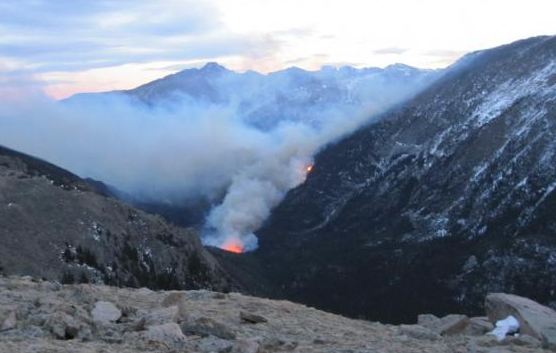
The Fern Lake Fire created problems for firefighters in Colorado’s Rocky Mountain National Park from the minute it started on October 9, 2012. At first it was the steep, inaccessible terrain, but very soon the 9,000-foot altitude and especially the low temperatures became another foe to deal with as the fire kept burning into November and December. The order for the Type 1 incident management team that was placed December 1 has to be one of the latest orders for a Type 1 team ever put into the system, although there have been some December orders a few times in southern California during Santa Ana wind conditions.
Today a guest author who was there will tell us what it was like at that winter fire in Colorado. Rae Brooks worked as a public information officer with the Type 1 team in December at the Fern Lake Fire. Her background is in journalism.
****
ESTES PARK, Colo. — Sweltering heat and long summer days are the usual operating theater for wildland firefighters. At the Fern Lake Fire in northern Colorado, firefighters entered a new world of winter firefighting, where pumps freeze, dip lakes ice over, darkness descends early, and fire prediction models say nothing should be burning at that time of year anyway.
Most firefighters had long ago packed away their gear and turned their attention to skiing or Christmas shopping, when the call came in early December for hundreds to come to Estes Park to help battle a persistent blaze in Rocky Mountain National Park.
“This is definitely a first for me, much less at 9,000 feet,” said veteran firefighter Kevin La Bella of Palmer Lake, Colo., a safety officer on the fire. “I’ve lived on the Front Range for 30 years and I’ve never heard of a major fire here in December.”
Early in the Fern Lake fire, Forest Canyon blow up. NPS Photo
The New York Times called the nearly 3,500-acre blaze “perhaps the most unusual sign of the nagging drought” currently plaguing the United States. The Fern Lake Fire, The Times reported, is burning “on peaks that should be covered in snow right now.”
Although winter fires remain atypical, it is clear that fire seasons in the United States are beginning earlier, ending later and burning more acres annually. Six of the most destructive fire seasons have occurred in the past nine years. More than 9.3 million acres burned in 2012, the third highest since record-keeping began more than half a century ago.
The disconnect for many firefighters began while driving to Estes Park, listening to Christmas carols on the radio. Strains of “White Christmas” and other holiday standards also wafted around the incident command post, which, in order to escape the cold, was located in a hotel convention center. More typically, schoolyards, agricultural fairgrounds, or yurts hastily assembled in cow pastures serve as fire headquarters.
After 70 mile-per-hour winds caused the fire to double in size on Dec. 1, forcing the evacuation of more than 600 homes, a national Type 1 incident management team was deployed to handle the fire. Type 1 teams manage the nation’s most complex emergencies. Continue reading
New data that the National Interagency Fire Center released about the 2012 wildfire season reveals that almost half, or 48 percent, of the requests for large air tankers could not be filled. Of the 914 requests, 438 were rejected as “unable to fill” (UTF), meaning no air tankers were available to respond to the fire; 67 were cancelled for various reasons.