Florida: Huckabee Fire burns 16,000 acres

Map of Huckabee Fire
Huckabee Fire
Huckabee Fire. NPS photo.

UPDATE at 12:16 p.m. ET, April 1, 2013

The Huckabee Fire 26 miles east of Naples, Florida continued to require intermittent closures of Interstate 75 overnight due to smoke and fog, but it reopened Monday morning. Burning in Big Cypress National Preserve, the fire has blackened 20,000 acres and is 40% contained, according to Cass Palmer, the Incident Commander of a Type 3 incident management team running the fire.

On Sunday firefighters conducted a 4,000-acre burnout which reduced the visibility on the Interstate and required a temporary closure. A minor accident on the highway was managed as an incident within an incident by the Florida Highway Patrol.

Firefighters have observed the fire spreading at 80 to 100 chains per hour (5,280 to 6,600 feet per hour) and spot fires up to 600 feet ahead. A large Type 1 helicopter and a Hotshot crew arrived at the fire Sunday.

According to the Incident Status Summary, the Incident Commander expects to fully contain the fire on Monday, April 1.

****

(Originally published at 9:29 p.m. ET, March 31, 2013)

Map of Huckabee Fire
Map of Huckabee Fire at 3:48 p.m. ET, 3-31-2013. The red areas indicate locations most recently burned that were detected by a satellite.

A wildfire in Big Cypress National Preserve has forced the closure of Interstate 75 in Alligator Alley. As of 1 p.m. ET the Huckabee Fire 26 miles east of Naples, Florida had burned 16,000 acres since it started 48 hours earlier. The fire is 10 percent contained and the cause is described as suspicious by the staff of the Preserve.

I checked the weather at the Panther East automatic weather station 2.5 miles northwest of the fire and the conditions have not been extreme. The temperature on Sunday ranged from an overnight low of 47° to a high of 86°. The minimum relative humidity on Sunday was 37 percent, which is a little low for south Florida. The wind has been 8 mph out of the southwest with gusts to 15.

Aviation briefing, March 31, 2013

Coulson’s C-130 conversion in San Bernardino

Coulson's C-130 Taxiing
Archive photo of Coulson’s C-130 taxiing before the conversion. Coulson photo.

The Press-Enterprise has an article about the air tanker conversion that Coulson is working on at the San Bernardino, California airport, converting into an air tanker what the article identifies as a C-130Q. According to the article test flights are scheduled to begin in April. Coulson is hoping to receive a next-generation air tanker contract for the aircraft.

Wildfire Today first wrote about Coulson’s C-130 April 9, 2012.

Santa Maria reduces air tanker landing fees

The Santa Maria Public Airport 55 miles north of Santa Barbara, California has reduced the landing fees charged to air tankers using the airport. An article in the Santa Maria Times says the fees will be reduced from $1 per 1,000 pounds to 50 cents per 1,000 pounds. In addition to this fee, firefighting aircraft have to pay ramp handling fees and fuel flowage fees.

After being downgraded to a call-when-needed air tanker base for three years, the Los Padres National Forest in October, 2011 restored it to full-time status during the fire season.

Contracts for next-generation air tankers

Late in the day last Wednesday the U.S. Forest Service announced contract awards for eight “legacy” air tankers, which included seven P2Vs and one BAe-146. Some people within the agency thought contracts for next-generation air tankers would also be announced last week, but that did not happen. The USFS is probably bending over backwards this time in an attempt to minimize the chances of the awards being protested again. Last summer after the awards were announced but not yet finalized, two companies that were not slated to receive contracts filed protests, which sent the agency back to the drawing board, starting the process over again after making dozens of changes in the solicitation.

It has been 487 days since the USFS began the solicitation process for next-generation air tankers.

Prescribed fire along the Fall River

Nearly every year the city of Hot Springs, South Dakota asks the Hot Springs Volunteer Fire Department to conduct a prescribed fire along the Fall River. The burning reduces the woody vegetation which could clog the flood control channel where the river passes through the city. Before it was channelized and the Cold Brook Dam was constructed upstream, the city suffered frequent floods.

These photos were taken by Bill Gabbert, Saturday, March 30, 2013.

Fall River Prescribed Fire

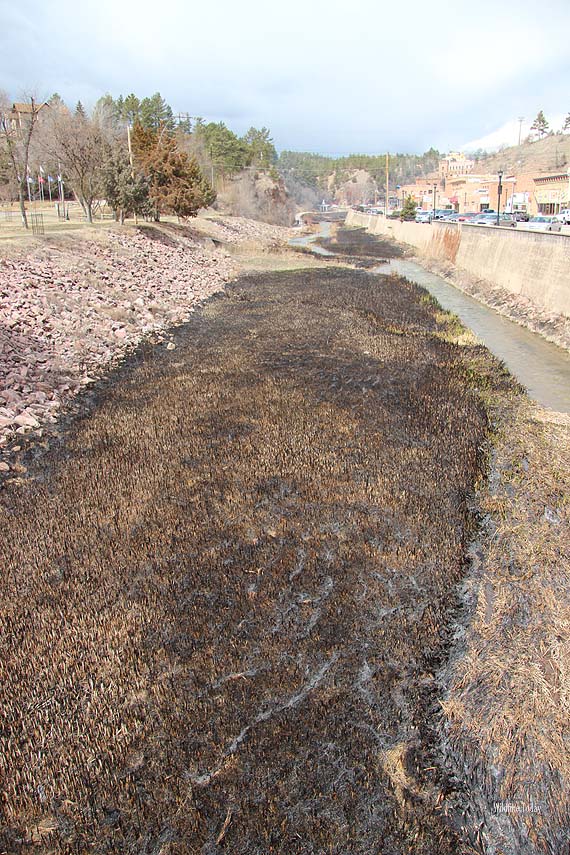
The photo above shows a section of the river just as the burning began. Below is the same area on hour or two after the fire passed through.

Fall River Prescribed Fire

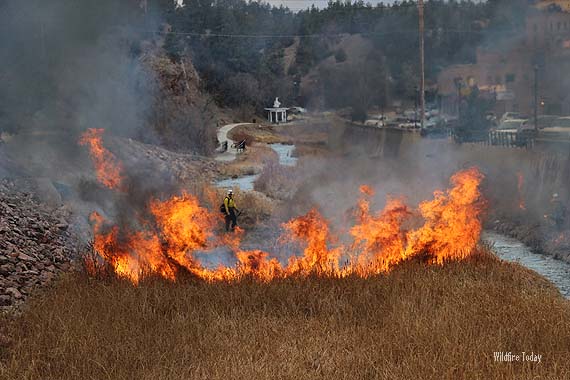
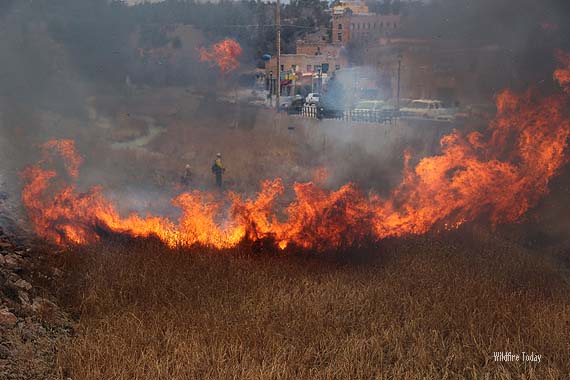
Even though there had been a light rain the night before and the relative humidity was in the mid-50s, the cattails burned very well.

Fall River Prescribed Fire Fall River Prescribed Fire

I shot all of these photos at 1/500th second, and was pleased with the way it captured the flames, such as in the image above where a ball of fire can be seen about 20 feet above the main flame front. I used two cameras, both Canon T3i’s. The lenses were also Canon, 100-400mm and 17-85mm lens.

Fall River Rx fire 034smaller

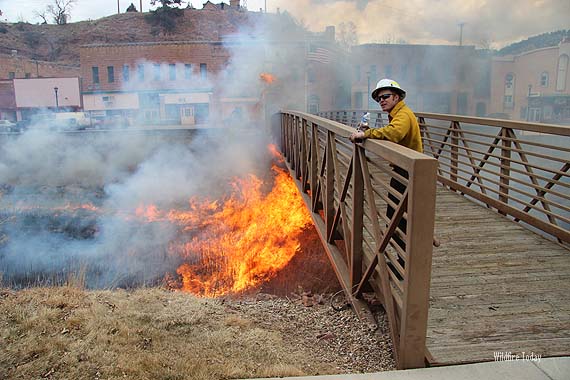
The flames impinged on the wood deck of the pedestrian bridge, but apparently there was no damage. More photos are below.
Continue reading

Utah bill approved to restrict target shooting during enhanced fire danger

The Governor of Utah has signed legislation, S.B. 120, that will allow the state forester to restrict target shooting during periods of enhanced wildfire danger.

When first introduced by state Senator Margaret Dayton it was temporarily withdrawn after the bill received criticism from some, including Utah Shooting Sports Council Chairman Clark Aposhian who was quoted as saying:

If it restricts gun owners from going there, then it should also restrict bird watchers. It has to be closed to everybody.

The legislation does not close areas to the public. It allows the state forester to “restrict or prohibit target shooting in areas where hazardous conditions exist”.

According to Utah State Forester Dick Buehler, of the 1,528 fires in the state in 2012, 33 were caused by target shooting which cost over $16 million to suppress. In October, 2012 when we wrote about the increasing number of fires started by target shooters using exploding targets, we found 10 fires started by these devices in Utah over a 5-month period last year. One of them burned over 5,500 acres.

The legislature in Oregon is considering a bill, HB 3199, that would prohibit the use of sky lanterns (or fire balloons), exploding targets, and tracer ammunition on land within the boundaries of a forest protection district.

South Dakota fire meteorologist analyzes wildfire potential

Percent of normal precipitation, Dec-Feb

South Dakota State Fire Meteorologist Darren Clabo gave a presentation in Rapid City Thursday covering the current fire weather conditions and the potential for the coming months. Below is an excerpt from an article in the Rapid City Journal:

April, May, June and July are typically the region’s wettest months, when the area receives 50 percent of its annual average of 21 inches precipitation. With the exception of the Northern Hills and northeastern South Dakota, most of the state had no appreciable snow pack this winter after a warmer-than-average summer that depleted soil moisture, Clabo said.

“My biggest concern is the southern Black Hills, southwestern South Dakota, down to the Pine Ridge Escarpment,” Clabo said. “I’m concerned about western South Dakota. I’m concerned about the Missouri River Valley.”

Last year, much of the Northern Great Plains and Rocky Mountain regions saw less than 50 percent of their average rainfall. Temperatures were also 3 to 5 degrees above average.

“2012 was the hottest year on record in North America. That’s extreme,” Clabo said.

And, there are indications that a warm spring and summer are on the horizon, Clabo said.

Although an improvement in drought conditions is predicted, Clabo is less than optimistic about the possibility of any significant drought relief. He points out that most of western South Dakota is in an extreme or severe drought, according to the national Drought Monitor.

New Jersey firefighter killed while conducting prescribed fire

Jeffrey Scheuerer
Jeffrey Scheuerer

A firefighter with the State of New Jersey Forest Fire Service died while working on a prescribed fire Thursday, March 28. Jeffrey Scheuerer, 35, of Raritan Township, died from injuries after being struck by a vehicle near Round Valley Reservoir, according to Hunterdon County Prosecutor Anthony Kearns.

“Mr. Scheuerer and other members were conducting a controlled burn along Route 629 near Round Valley Reservoir,” Mr. Kearns said. “According to our preliminary investigation, it appears that a heavy smoke condition associated with the controlled burn was present at the time of the crash and may have caused reduced visibility when a shift in the wind occurred. Mr. Scheuerer was struck by a vehicle and did not survive his injuries.”

On his days off Mr. Scheuerer served as a member of the Readington Volunteer Fire Company.

Our sincere condolences go out to his family and coworkers.

Firefighters dealing with numerous large wildfires in Scotland

While some areas in Scotland are still without electricity due to recent heavy snow storms, other areas are dealing with large wildfires. Very impressive photos of the fires can be found on the BBC web site.

One of the fires on the Ardnamurchan peninsula was two miles long and approaching the village of Strontian. Other fires are near Lewis, Skye, Mallaig, and Glenelg.

Forest Service announces contracts for legacy air tankers

(Originally published at 9:53 a.m. MT, March 28, 2013; updated at 2:15 p.m. March 28, 2013)

On Wednesday the U.S. Forest Service awarded contracts to two companies for what they are calling “legacy” air tankers, for a total of eight aircraft in 2013. Minden will receive a contract worth $17.1 million and Neptune’s contract will total $180 million.

Minden will have their Tanker 48, a P2V, working under this new contract for one year, with options for four additional years, according to Mike Ferris, spokesperson for the USFS in Boise.

Dan Snyder, President of Neptune Aviation, told Fire Aviation today that their company will have five P2Vs on contract for five years. Two other Neptune aircraft, one P2V and one BAe-146, will have a one-year fixed contract, with options for four additional years.  The optional years will be totally up to the USFS — if they have the need, desire, and the funds, they could activate the additional years, one at a time.

These awards mean that the USFS will have eight air tankers working this year under this “legacy” contract. Beginning in 2014 if the optional years are not activated, there will be six, if the information we have been provided is correct.

Mr. Snyder said they expect to have their signed contract in their hands within the next two days.

We attempted to talk to Tim Christy, Director of Flight Operations for Minden, but he was unavailable. Minden had one P2V on contract last year after their other one, Tanker 55, was damaged June 3 while landing on disabled landing gear, the same day that Neptune’s Tanker 11 crashed in Utah, killing the two pilots. For the last two or three years Minden has been working on converting a BAe-146 into an air tanker.

We are still waiting to hear from the U.S. Forest Service about contract awards for next-generation air tankers powered by turbine, turbofan, or jet engines. That solicitation was first issued 484 days ago. Recently U.S. Agriculture Secretary Tom Vilsack in a letter written to Senator Mark Udall of Colorado, said contracts will be awarded “soon” for seven next-generation air tankers.

Also pending are contract awards for very large air tankers, such as a DC-10 or 747, which can carry 11,600 and 20,000 gallons, respectively. The P2Vs usually hold about 2,000 gallons while the BAe-146 has a 3,000 gallon capacity. The P2V cruises at about 225 mph. The BAe-146 more than doubles that speed, at 498 mph.

While it may seem surprising that a jet-powered BAe-146 received a contract through a solicitation for “legacy” air tankers, Mr. Snyder of Neptune said they were allowed to put any air tanker they wanted on their proposal as long as it met the specs in the solicitation. He said the USFS was looking more at cost than technical specifications, and wanted “best value”.

Neptune still has the two fully operational BAe-146 next-generation air tankers that worked on fires in 2012, Tankers 40 and 41. They will operate them for one more season, Mr. Snyder said. After they they may be modified. The company is also finishing the conversions of two more BAe-146s that will have a much improved tanking system that Mr. Snyder said will fix some of the issues uncovered in their first two converted aircraft, including trail-off of retardant, consistency, and constant flow. The new systems will still hold approximately 3,000 gallons, but the exact capacity has not been determined. The tanks will be internal, and from the outside will look very similar to Tankers 40 and 41. But the redesign is so different that the Interagency AirTanker Board (IATB) is requiring that they go through the expensive grid tests, in which retardant is dropped over a grid of hundreds of containers to determine the consistency and volume of the retardant when it reaches the ground. Neptune is negotiating with the IATB on the date and location of the test. If the IATB certifies the new tank design, Mr. Snyder expects that Neptune’s third and fourth BAe-146s could be available in the Spring or early Summer.