
The LA Times has an interesting article about our aging air tanker fleet.
Continue readingCAL FIRE’s Situation Report
The California Department of Forestry and Fire Protection published their weekly situation report today, detailing the wildfire activity over the last week.
San Bernardino Tanker Base pumped a quarter million gallons of retardant July 19

Below is how the U.S. Forest Service describes a record-setting day for pumping retardant into air tankers on July 19 during the Mountain Fire west of Palm Springs:
****
“On July 19th 2013, there were 6 airtankers assigned to the Mountain Fire working out of the San Bernardino Airtanker Base. The day started at 6am and we were load and return until 9pm. Everything ran as smoothly as it could have. The retardant contractors never stopped mixing and loading retardant, the airport control tower made sure our airtankers had priority over other aircraft and the fuelers on the airport only left the base to fill up the trucks and come right back. The air crews followed direction and supported the base operations. In addition to this, the Forest Service crew performed flawlessly, the Ramp Manager never missed a beat and choreographed a very complex operation safely and efficiently, the Parking Tenders remained on point, knew their jobs and performed them well, the Aircraft Time Keeper never missed a radio or telephone call. Contractors, cooperators, permanent employees, temporary employees and AD’s side by side made this day the biggest single day in history and it could not have come together more perfectly.
The Ramp resembled that of a busy aircraft carrier with moving aircraft, vehicles and personnel. There were many opportunities for things to go wrong, but everyone had great situational awareness and was looking out for each other. Without the hard work of each individual involved at SBD on July 19th, we couldn’t have made such a mark in history. Just a little perspective, last year we pumped 400,020 gallons all year. During the Mountain fire we not only had a historic day of 260,036 gallons, but we also hit the million gallon mark for the year. We pumped 1 million gallons in one week which is unprecedented.
There were news crews, sound recorders, VIP tours and many other visitors looking to get as close as they could to these remarkable aircraft and crews. A special thank you to Johnny Rangel, Marc Durocher, Brian Nuno, Angel Soria, Stewart Miller, Katie Kangas, Dustin Bryant, Lance Dominguez, Steve Fortier, Mike Reza and Matt Bashaw. SBD would not have been as successful without the hard work and dedication of these 11 people. – Leslie Casavan”
Thanks go out to Ken
How the media handled the release of the Yarnell Hill Fire report
We wrote on September 27 that the media might find it difficult to develop story lines or come up with coherent, introspective, meaningful coverage about yesterday’s release of the Yarnell Hill Fire report if it did not include causes and recommendations. The report provided more information about the deaths near Yarnell, Arizona on June 30 of 19 firefighters, members of the Granite Mountain Hotshots.
The document did not identify causes or contributing factors like we have seen in other fatality reports. It had some conclusions and recommendations, but they were fairly mild and did little toward pointing fingers at specific acts or omissions that caused the accident.
This made it difficult for reporters who in most cases know little about wildland fire to summarize the report in a short news article. Facts about outflow winds, rate of spread, and staying in the black, meant little.
Many of them looked for something that was easy to understand or was measurable, like “radio problems” which was in the headline of some stories, or the number of air tankers. A radio programming mistake, leaving out the tone guard on frequencies, at first made it impossible to use those channels for communication. Some radio systems require not only that the correct frequency be programmed, but that a brief audible tone be added. If the tone is not included when transmitting, the receiving radio will ignore the transmission. The report said crews developed “workarounds so they could communicate using their radios”. Apparently this problem was solved or at least partially mitigated. The report did not elaborate on the “workaround”.
Here are some of the headlines and the first points mentioned about the causes, in articles we found about the release of the report:
- Washington Post: In the first paragraph mentions an “unpredictable desert thunderstorm” and “confusing radio communications”.
- Huffington Post’s headline: “Yarnell Fire Radio Problems Cited In Deaths Of 19 Firefighters, According To New Investigation”.
- Associated Press headline at Firehouse.com: “Video: Yarnell Hill Fire Report Indicates Radio Issues”.
- AZCentral.com, at the top of the article is a short video of lead investigator Jim Karels mentioning the radio programming issue.
- LA Times cites “problems with radio communication”.
- Associated Press at ABC15.com, in the first paragraph, said the report “…cites poor communication between the men and support staff, and reveals that an airtanker carrying flame retardant was hovering overhead as the men died.” (I would like to see a video of that “hovering” air tanker, which was a DC-10.)
- NPR Blog cited “weather reports that may have been misunderstood [and] radio communications that the investigators deem ‘challenging.’ “
- ABC7 news in Denver: “…poor communication between the men and support staff, and reveals that an airtanker carrying flame retardant was hovering overhead as the men died.”
- New York Times: “…it outlined several problems, like radios that sometimes did not work properly, updates that did not give a precise sense of the crew’s movements, and the 33-minute period of radio silence.”
- BBC: “…inadequate communication played a role in their fate…The report authors describe radio communications as ‘challenging throughout the incident’.”
In most of these articles citing radio issues, they are referring to the programming mistake, but some go on to discuss a failure of people to adequately communicate their thoughts to one another, which at times was an issue and led to confusion about the location of the Granite Mountain Hotshots. Other related problems were too much radio traffic on some frequencies and the workload of the Aerial Supervision Module which resulted in them missing some incoming radio calls from the 19 trapped firefighters.
Yarnell Hill Fire report released
(Originally published at 11:19 MDT, September 28, 2013; updated at 6 p.m. September 28, 2013. Observations after reading the report are at the bottom of this article.)
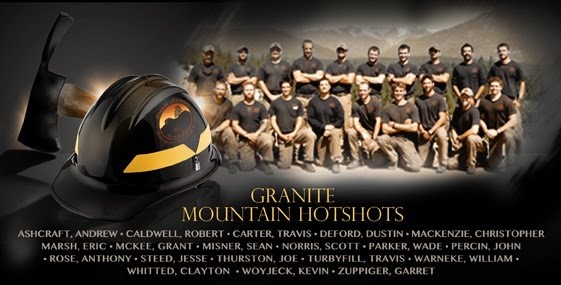
The Arizona State Forestry Division has released the Serious Accident Investigation report of the Yarnell Hill Fire, which on June 30, 2013, killed 19 members of the Granite Mountain Hotshots. It was produced by a very large cast of characters, 18 core Team Members, 17 Support Team Members, and 19 Subject Matter Experts, for a total of 54 people.
The report found:
The judgments and decisions of the incident management organizations managing this fire were reasonable. Firefighters performed within their scope of duty, as defined by their respective organizations. The Team found no indication of negligence, reckless actions, or violations of policy or protocol.
A news conference about the report was live-streamed by at least two Phoenix area television stations. In the question and answer period several national news organizations as well as local media asked questions of the five-person panel which consisted of the Arizona State Forester, two people from the investigation team, and two officers from the Prescott Fire Department.
You can download the report (6Mb file) and some “Frequently Asked Questions” about the investigation.
Below is a 21-minute video released by the investigation team today, which they described as a “A brief overview of the Yarnell Hill Fire Investigation report.” Much of it comes word for word from the report but it makes effective use of Google Earth to provide an overview of the geography of the fire.
Granite Mountain Hotshot Christopher MacKenzie shot the two video clips below shortly after 4:00 p.m. on June 30, 2013. These are the last images of the hotshots before they died. The video was unexpectedly made available today for the first time by the Prescott Daily Courier, which has an article about how the video and other photos of the fire were found.
Our observations after reading the report and viewing the press conference and the question and answer session.
The official report commissioned by the Arizona State Forestry Division, a case of them investigating themselves, did not break much new ground. There was little of a negative nature written about the crew or their employer, the Prescott Fire Department, which was barely mentioned. The Granite Mountain Hotshots were fully qualified, staffed, and trained and they were on day 13 of a permitted 14 days in a row of fighting fire. And, there was “no indication of negligence, recklessness actions, or violations of policy or protocol”.
Why did the Granite Mountain 19 leave the “black”?
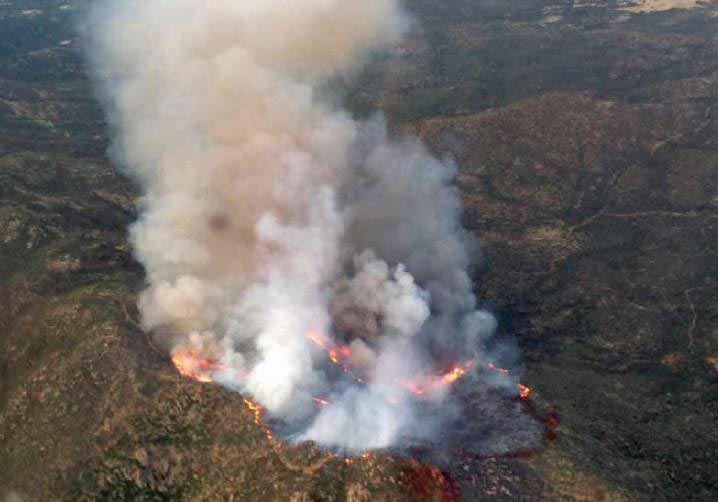
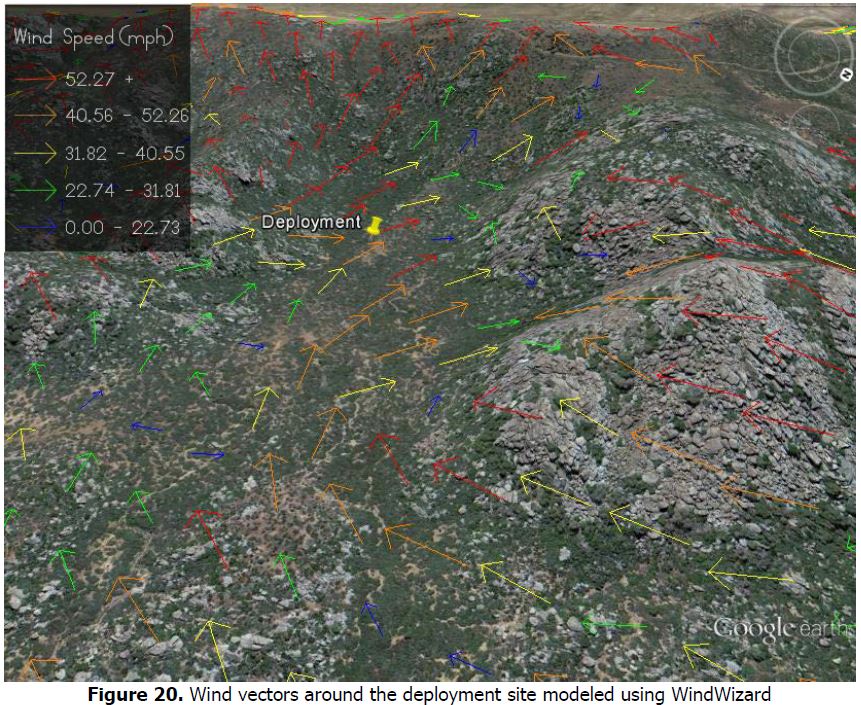
The investigators emphasized that they were unable to answer one of the most-asked questions about the fatalities — why the crew left the safety of the already burned area, the black, to attempt to walk 1.6 miles mostly through unburned brush to another safety zone, the Boulder Springs Ranch. They came to within 0.38 miles of their destination when they encountered one of the heads of the fire that had wrapped around the ridge to their left in the box canyon and was headed toward them, cutting off their path probably much to their surprise. Click the map below to see a larger version of the wind at the deployment site.
No one knew where the crew was in relation to the fire
There was confusion about the location of the crew. Other firefighters thought they had either remained safely in the black where they had been for a while, or they had headed north to another safety zone. But instead, they traveled south. When they reported that they were entrapped and were deploying their fire shelters, no one knew where they were. Finally they told Air Attack they were on the “south side”, but even though a DC-10 air tanker was orbiting and ready to drop on them, airborne personnel could not find them, either due to heavy smoke or because they were looking in the wrong place. But under the extreme wind and fire conditions, it is unlikely that air support would have helped the firefighters very much.
Improving situational awareness
This is another fire, like the Esperanza Fire, where if the fire overhead, such as a Division Supervisor, Operations Section Chief, or Safety Officer, had known the location of the personnel on the fire in relation to the real-time spread of the fire, it could have saved lives — 24 on these two fires alone.
It is irresponsible for the wildland fire agencies to continue to do nothing to improve the situational awareness of firefighters, which has proved fatal to too many of them.
We have written about this several times before. Many local fire departments, EMS divisions, and police units have the ability to send location data to dispatchers. If the analog or digital ground-based radio systems being used today can’t handle this task in remote areas, then use a satellite-based system. The U.S. Forest Service asked for proposals to purchase thousands of little location devices last year, and adding high tech video systems to air attack ships could help. We have also written about a device we called a Firefighter’s Emergency Situational Awareness Device, a FESAD.
One of the recommendations in the report was to “review current technology that could increase resource tracking, communications, real time weather, etc.” The Q&A panel today said, in response to a question, that the surviving family members of the 19 Hotshots strongly suggested while being briefed this morning that tracking systems for firefighters be utilized.
Very Large Air Tanker not ordered because of “steep terrain”
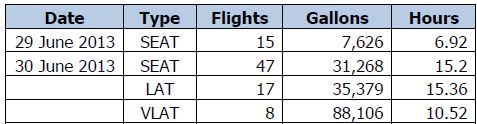
The information that the state of Arizona released on July 16 about the resources deployed on the fire said a DC-10 Very Large Air Tanker (VLAT) was in Albuquerque and available on June 29, but was not ordered due to Air Attack’s concern about its effectiveness in steep terrain and inability to deliver retardant before cut-off time. The way this was addressed in today’s report was “ICT4 declines the VLAT offer at 1750 [June 29] based on fire conditions.” There was nothing about “steep terrain”, which didn’t exist on the fire to the extent that it would severely limit the effectiveness of a DC-10 VLAT. In fact, the next day, June 30, they used the hell out of both DC-10s, dropping over 88,000 gallons in 8 flights. A recommendation in today’s report was to “…develop a brief technical tip for fire supervisors/agency administrators on the effective use of VLATs.”
The DC-10s may have been effective on June 29 when the fire was still small, but by the time they both arrived on June 30, the day of the entrapment, the wind event was making it difficult for anything dropped from the air to slow down the fire — too much heat, and too much wind blowing the retardant away before it hit the target.
Aerial Supervision Module taking on too many roles?
During the time of the entrapment the roles of Air Attack and Lead Plane were filled by a single aircraft called an Aerial Supervision Module (ASM), coordinating all of the aerial firefighting, directing air traffic, preventing aircraft from bumping into each other, developing tactics, AND serving as Lead Plane, physically leading the air tankers into their targets about 200 feet above the ground. The Lead Plane duties limited their ability to perform full Air Attack responsibilities over the fire at the same time. The report said, “ASM was too busy handling multiple duties to communicate with the crew just prior to the deployment”.
One of the recommendations in the report is to request the National Wildfire Coordinating Group to develop guidance to identify at what point is it necessary to separate the ASM and Air Attack roles to carry out required responsibilities for each platform.
No overwhelming force
The ordering and use of ground and aerial firefighting resources was less than aggressive on June 29, the day before the tragedy when the fire was still small. The only air tankers used that day were two single engine air tankers, and for only part of the day, dropping a total of 7,626 gallons. After being released, they were requested again by Air Attack, but dispatch only allowed one to respond to the fire, wanting to keep one in reserve in case there were other fires. General Norman Schwarzkopf’s philosophy when confronting the enemy was to use “overwhelming force”. This strategy also is effective when confronting a wildfire. Overwhelming force for a short amount of time can prevent megafires burning for weeks, consuming many acres, dollars, and sometimes homes and lives.
Senator’s suggestion for donations in memory of Granite Mountain Hotshots could be confusing

The web site for Senator John McCain’s political action committee (PAC) has a shaded block on the right side of the screen suggesting that you make a donation in memory of the 19 firefighters that were killed on the Yarnell Hill Fire June 30:
In memory of the Granite Mountain Hotshots. Join John McCain in honoring their memory by making a donation.
It does not say how or to whom the donation should be made, but the sole purpose of the PAC is to solicit donations for Senator McCain and other politicians.
Below the quoted text are icons for the National Fallen Firefighters Foundation, Prescott Firefighter’s Charities, and 100 Club of Arizona. If you click on the icons you will visit those sites where it is possible to donate money to those organizations.
In the same shaded block, below the text and the icons, are fields for entering your email address and zip code. If you do that it takes you to the Senator McCain PAC donation page, asking you to make a “generous donation” so that “Country First PAC will be able to financially help like-minded candidates across the country as they run for elected office”.
Or, if you click on the Donate button at the top-right of the screen you are taken to the same Country First donation page to give money to politicians.
This is at best, confusing. Invoking the memory of the 19 dead firefighters and locating the text in the same shaded block as a link to donate to the Senator’s PAC is a bait and switch tactic. Conflating charity-type donations with requests to assist a politician is an insult to the legacy of those firefighters.
If the Senator would like to encourage donations to help the surviving families of the Granite Mountain 19, he should do it in a way that could not be confused with his requests for money for his political action committee.
Below is a screen grab from Senator McCain’s PAC web site. Click on it to see a larger version.
 As usual, if you’d like to comment on this article, keep it nonpartisan.
Smokejumper killed in training accident
A Boise Bureau of Land Management smokejumper died Friday afternoon in a training accident near Prairie, Idaho.
Continue readingAn unusual way to publicize the release of the Yarnell Hill Fire report
If a politician has to release information, but they want it to attract as little attention as possible, they do it late on a Friday afternoon or on the weekend. The thinking is that fewer people consume news on a Saturday or Sunday and there are not as many reporters on duty to cover it.
The Arizona State Forestry Division decided to release the Serious Accident Investigation report of the Yarnell Hill Fire fatalities at 10 a.m. MST tomorrow, September 28. The choice of the day of the week led some people to assume the agency wanted to keep the report as much under the radar as possible.
The timing of the relase was a puzzling decision, especially in light of another one they made that will have the opposite effect. A person or organization calling themselves “The Yarnell Hill Fire Investigation Report Rollout Team” sent an email to many, many people Wednesday (about 150 other names were on the distribution list of the message I received) asking them to help spread the word about the report by joining something called “Thunderclap”. After you join using your Facebook and Twitter user names and passwords, “Thunderclap” will use those social media sites to send messages on your behalf so that everyone who reads your posts on those services will see a message that looks like it came from you, but was sent by Thunderclap announcing that the report on the Yarnell Hill Fire has been released.
An excerpt from the email:
…Once the report is released on September 28, 2013 10:00am, Arizona Standard Time, this tool allows us to utilize other people’s Facebook and Twitter accounts to push out the link to the report, nationally, all at one time. To make this work, we need people to know about the campaign we have built on the Thunderclap website and we hope you will be willing to get involved and let people know via your email lists and social media sites.
Arizona State Forestry Division using Thunderclap is a solution in search of a problem — and creates some serious privacy concerns, turning over your social media passwords to a company no one has ever heard of.
No matter what the Arizona State Forestry Division does to encourage or discourage coverage of the report, it is going to be huge news. I expect it to be covered by the big five national television networks. Since the deaths of the 19 members of the Granite Mountain Hotshots June 30 on the Yarnell Hill Fire, the mainstream media has been all over wildland fire, firefighters, and hotshot crews. So a Saturday release of the report will not eliminate coverage, and asking hundreds of people to turn over their Facebook and Twitter accounts to spread the word is not going push the tidal wave of media frenzy much faster.
If the State of Arizona follows the new federal guidelines for serious accident reports, it will not include any conclusions, or recommendations. This will make it difficult for the media to come up with coherent, introspective, meaningful coverage. They will be able to report facts, but their relevance to the fatalities could be difficult for them to understand. We heard from an Associated Press reporter who made an appointment to talk with us Saturday afternoon, that the State will not write a second, secret report containing the conclusions and recommendations as required in the new guidelines for federal agencies. That is because the State of Arizona has a very strong open records law prohibiting such shenanigans. But the concept of open records is on the back burner in the U.S. Forest Service as Fire Aviation confirmed when attempting to get a simple list of Type 1 helicopters on exclusive use contracts. It took five months and a great deal of time, going through the Freedom of Information Act process.
Below are some excerpts from the 6,212 words in the Thunderclap terms of service.
****
“We reserve the right to modify or replace these Terms of Use and/or to change, suspend or discontinue the Services at any time in our sole discretion.
The way you support a message is to grant the Service access to your Facebook®, Twitter® or Tumblr® account to post that message on your behalf as a status update in your timeline or as a Tweet, as applicable.
When you join a Thunderclap, your username and profile picture from the third party service you joined through may appear on this Website (or otherwise through the Services) indicating that you are a supporter of that message. Also, after you join a Thunderclap, you have the option of sharing that you support that message via Twitter, Tumblr and/or Facebook. You do this by granting the Services access to your Twitter, Tumblr and/or Facebook accounts through standard Twitter, Tumblr and/or Facebook APIs.
By supporting a Thunderclap via Facebook, you grant us the right to use, reproduce, modify, display and distribute for purposes of displaying your Facebook username, Facebook profile picture, and any modifications or changes you make to the message on or through the Services and Facebook to indicate you have joined, supported or your other affiliation with that message.
By supporting a Thunderclap via Twitter, you grant us the right to use, reproduce, modify, display and distribute for purposes of displaying your Twitter username, Twitter picture, and any modifications or changes you make to the message on and/or through the Services and Twitter to indicate you have joined, supported or your other affiliation with that message.”
Identify this air tanker

Does anyone know what air tanker is shown in the image above? It is a screen grab from a new USDA video that can be viewed at Wildfire Today. This scene is from 1:06 to 1:16, lasting about 8 to 10 seconds. The retardant may not be coming from the belly of the aircraft, so it could be a MAFFS C-130. Also, the retardant appears to broken up into tiny droplets rather than having a few scattered chunks, indicative of a pressurized system as seen in the MAFFS. Those guys shoot tons of in-flight video.
The aircraft part on the left seems odd, since there’s nothing similar on the right side. But that could be because of the placement of the camera, possibly being off-center.
“The Heart of a Firefighter”
The U.S. Department of Agriculture has produced a very slick video about wildland firefighting, named “The Heart of a Firefighter”.
The purpose of the video is “show what we do as USFS firefighters and also the drive and passion of the people that fight fire”, according to Jason Steinmetz of the USFS Washington Office. This is a two-minute “teaser” of the final product which is expected to be five to eight minutes long.
It is well done and worth viewing.
Over on Fire Aviation we are discussing the model of air tanker shown in the video at 1:06.
Can anyone identify the firefighters in the video? If so, give us their name and the minute/second in the film.
UPDATES:
September 27, 2013: A few people have recognized the female firefighter standing in front of the red engine with the Pulaski at 1:41, as being Kelsey Chaloupka of the North Haines VFD in South Dakota.
September 28, 2013: Brad told us: “The engine at 00:23 is Rock Hill Fire E-5 (type 4) out of Buffalo, WY. The nozzle man is Tom Provost. I believe that was the Beaver Creek Fire in Idaho.”