A still image from a video of the Casselton train derailment, showing a very impressive mushroom cloud of flame.
So, you pull up to the scene of a railroad accident in your Type 6 wildland fire engine with 150 gallons of water……
You probably heard about the train derailment on Monday of oil-carrying railroad cars one mile outside Casselton, North Dakota. The video below, shot by by Darrin Radermacher, shows one of the half dozen explosions heard by residents of the town.
Two trains were involved in the accident. BNSF spokeswoman Amy McBeth said the train carrying grain derailed first, then knocked several cars of the oil train off adjoining tracks. BNSF said both trains had more than 100 cars.
The railroad crew was able to detach and remove from the scene about 80 cars of the oil train. Firefighters, unable to get near the fire, were allowing it to burn itself out. By nightfall on Monday the flames had diminished and the temperature had dropped to 15 below with a windchill of 32 below.
On December 11 Aero Flite’s Tanker 160 began a series of retardant drop tests for their Avro RJ85 at Fox Field in southern California. The aircraft, converted into an air tanker by Conair, was expected to perform 20 to 25 drops over a two or three day period. The process involves dropping retardant over a grid of thousands of cups, intended to measure the volume and consistency of the pattern when it hits the ground. The Interagency AirTanker Board requires passing this and other certifications before an aircraft can be “carded” as a federal air tanker, which makes it eligible for a contract to fight fires. Both paid and inmate fire crews were on hand at Fox Field to assist with the set-up of the grid and the collection of the cups after each drop.
Tanker 160, an RJ85 which is similar to a BAe-146, is being converted by Conair for Aero Flite, which received a contract June 7 for two RJ85s. The aircraft were not ready and missed the contractual start date a couple of months later. The U.S. Forest Service then issued “cure notices” to Aero Flite and two other companies that received the next generation contracts for five air tankers, none of which met the required start date. Aero Flite responded saying the aircraft would be available between April and June, 2014. Later in a justification for awarding a sole source contract to Neptune for two BAe-146 air tankers, the USFS wrote they were “not confident that five of the seven contracted NextGen airtankers will be available to fight fires in 2014″.
Thanks go out to the Los Angeles County Fire Department which took these photos.
Structure fire in Hot Springs, SD. Photo by Bill Gabbert.
The County Commissioners of Lewis and Clark County in Montana recently approved a resolution making it clear that county-level firefighters are not under an obligation to protect a home from a wildfire in the Wildland Urban Interface (WUI). Below is an excerpt from an article in the Missoulian:
“…A lot of crews think they have to protect homes, and we’re trying to make it clear they’re just sticks and bricks,” said Sonny Stiger, who helped write the resolution. “This lets our firefighters know they’re not obligated to put their lives on the line to save homes.”
Stiger, a retired fire and fuels specialist with the U.S. Forest Service and a board member with FireSafe Montana, said building defensible space around homes in the urban interface is the sole responsibility of property owners who choose to live there.
Stiger said the new resolution makes it clear that homeowners should not expect firefighters to put their lives at risk to defend property.
“We can save a lot of homes going back in after the fire front passes, or in the case of the Yarnell Hill fire, not going in at all,” Stiger said, referring to the Arizona blaze that killed 19 firefighters in June. “It’s time we stepped up at the county level to deal with this, and to let (firefighters) know they’re not obligated to protect homes…”
The resolution says in part:
Homes in the Wildland/Urban Interface will not dictate fire suppression tactics, strategies, or the location of fire lines.
The article claims this is a “first-of-its-kind resolution”, which may be the case. There is no doubt that some homeowners who moved into the WUI and refuse to cut or thin the trees and brush growing within 100 feet of their houses will be furious at this concept. Some of them take no responsibility as a property owner to make their homes fire-safe, but expect firefighters, many of them volunteers, to risk their lives to save their structures.
Placing the primary responsibility to protect a home from wildfire on the property owner, where it belongs, is very appropriate. County, city, and state regulations recognizing this do not exist in many areas..
On the Yarnell Hill Fire there was at least one person in a supervisory role who asked the Granite Mountain Hotshots to move from their safe, previously burned area, over to the the town of Yarnell in order to protect the structures, many of which were described later as not defendable due to brush and trees very close to the buildings. Some of the homeowners had done little or nothing to make their homes fire-safe. As the crew hiked through unburned brush toward the town, they were overrun by the fire and killed.
In the structural firefighting world you will sometimes hear opinions about risk-taking while fighting fire, including:
Risk a lot to save a lot.
Risk a little to save a little.
Risk nothing to save nothing.
“Risk a lot” usually refers to rescuing occupants or preventing their death. “Save nothing” may apply to an abandoned building.
In wildland fire, vegetation could be in the “nothing” category. Sure, wildland fuels may have ecological, watershed, aesthetic value, or monetary value in the case of timber or pasture, but most vegetation has adapted or evolved to burn on a regular basis and will usually grow back. Houses grow back too, but firefighters don’t. Firefighters should never risk much to save acres OR houses.
The documentaries and other tributes to the 19 firefighter victims of the June 30 Yarnell Hill Fire continue to pour in. The latest one was produced by The Weather Channel and includes a 16-minute video and a lengthy article.
From The Weather Channel:
****
“On June 30, 2013, 19 firefighters from the Granite Mountain Hotshots were killed battling a wildfire near Yarnell, Arizona. Huge questions remain about the last moments of their lives. Why did they move out of a safe area in their final minutes of life? Why did the fire move so quickly? Could their deaths have been prevented?
The tragedy also raises a crucial environmental issue: Has the very act of fighting wildfires made our forests more dangerous?
Weather.com investigates in this original documentary. Read our full report here.
Executive Producers: Greg Gilderman, Neil Katz, Shawn Efran
Producers: John Carlos Frey, Joe Halderman
Editor: Brandon Kieffer
Composer: Nathan Matthew David
Coordinating Producer: Brady Leifer
Associate Producer: Katie Wiggin
Production Assistants: Benjamin Heller, Kait Walsh”
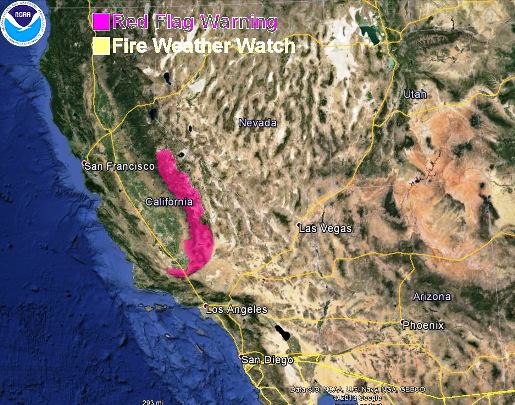
Red Flag Warnings for elevated wildfire danger have been issued by the National Weather Service for some areas in California through 4 p.m. PST Monday for very low humidities in the southern Sierra Nevada and the Tehachapi Mountains. This includes the Kern County Mountains, the Sierra Nevada from Yosemite National Park to Kings Canyon National Park, and the Tulare County Mountains.
Winds are expected to be northeast at 5 to 15 mph with gusts to 20, along with relative humidities of 10 percent or less.
The Red Flag Warning map was current as of 10:41 a.m. MDT on Monday. Red Flag Warnings can change throughout the day as the National Weather Service offices around the country update and revise their forecasts. For the most current data, visit this NWS site.
Wolverine eating road killed deer in Bitterroot National Forest. USFS photo.
U.S. Forest Service researchers in Montana set up 30 trail cameras in burned over areas to capture images of carnivores willing to climb a tree to dine on road killed deer. Below is an excerpt from an article that appeared in the Ravalli Republic.
There was no way of knowing what kind of critters might venture through the charred trees left last year in the wake of a wildfire in Soldier Creek.
“The ground was basically dust,” said Bitterroot National Forest biologist Andrea Shortsleeve.
Far up in the head of the West Fork drainage not far from Devil Creek, a team of Bitterroot National Forest researchers led by the biologist decided to set a photographic trap in an effort to see what might show up.
So they tied a leg taken from road-killed deer high up on blackened tree with a stout piece of wire. And then they carefully placed a series of stiff wire brushes into the bark of the tree to capture some fur from passing carnivores.
After that was done, they attached a trail camera to a nearby tree with its lens pointed at the bait…
(Originally published at 9:29 a.m. PST, December 28, 2013; updated at 10 a.m. PST December 29, 2013) The National Weather Service has issued Red Flag Warnings for elevated wildfire danger in some areas of California Saturday night through Sunday. The areas affected include the greater Bay area, the southern Sierras, and in southern California the counties of Los Angeles and Ventura. Santa Ana winds are expected to gust in the 50 to 60 mph range across the mountains with occasional gusts to 70 mph. In the coastal and valley areas 40 to 55 mph winds are expected. Humidities will likely lower into the teens and single digits on Sunday. The winds will diminish Sunday night but the warm and dry conditions will persist into Monday.
AT 9:53 PST on Sunday morning the weather station at Chilao north of Los Angeles recorded 8 percent relative humidity, sustained winds of 42 mph, and wind gusts to 67 mph.
As 2013 is winding down, we took a look back at the articles that have been the most popular so far this year, and other statistics about visitors to Wildfire Today.
The number of views of the stand-alone pages for articles, (articles can also viewed by visiting the home page, WildfireToday.com, at which you can see the six most recent articles):
(Originally published at 10:16 a.m. MST December 26; revised at 12:55 p.m. MST December 27, 2013)
This 34-minute documentary about the Yarnell Hill and 1994 South Canyon Fires is more evidence of how the deaths of 19 firefighters in Arizona on June 30 continues to resonate not just in the firefighter community but in the public as well. Six months later the media is still producing lengthy articles, sometimes a series of articles, and films inspired by the tragedy. This makes us think that if there is similar interest within the leadership of the wildland fire agencies there could be hope that lessons are being learned and meaningful changes could occur that may reduce the chances of it happening to another crew of 10 to 20 people. But there was similar hope almost 20 years ago when 14 firefighters died on the South Canyon Fire.
The documentary was produced by the Magic Valley Times-News which has recently published a series of articles about wildland firefighting:
UPDATE: December 27, 2013: We found another article in the series: Questioning Authority: The South Canyon Solutions. While this article is interesting reading, and quotes Pete Blume who was the BLM Fire Management Officer at Grand Junction during the South Canyon fire, like most of the other articles it has a number of factual errors, for example claiming that the South Canyon fatalities directly led to several specific changes, some of which did not come about as a result of the fire. And there’s this:
An IC on a big wildfire today, for example, may appoint someone to oversee logistics, such as care and feeding of the crews; someone to spearhead finances, dealing with contractors’ shift tickets, crew time reports, etc.; and another person on operations, i.e. strategy and tactics, who may set up two divisions of teams, each responding to their respective supervisors.
This shows a lack of understanding of the Incident Command System by the writer, a system that was first used on the Pacoima Fire in 1975 and became widely used in the 1980s. And “two divisions of teams”? Please.
****
Below is an excerpt from the last section of the “20 Years After the South Canyon Fire” article:
****
“….Meanwhile, seasoned fire managers report to officials in Washington, D.C., who may be from forestry, fisheries or recreation.
“People who come into these situations aren’t coming from fire,” said Alex Robertson, [deputy fire staff officer for a vast swath of Oregon, working for the U.S. Forest Service and BLM]. “Many times, they have zero experience on fire, but we’re coming to them for decisions. … it could mean a bad deal for some poor firefighter on the ground because of a decision made many miles away.
“We’re trying to explain risk and exposure to someone who doesn’t know what it means to be on top of a snag patch with flames 100 feet high.”
“I’m looking at 20-plus years in fire service, but decisions are being made by somebody with 90 days,” said one manager, whose identity is being withheld to protect his career. “It may be a very talented, brilliant individual, but they don’t have the same mental slides. It’s troubling that somebody with 90 days’ experience is making decisions for firefighters nationwide.”
“Why would we hire non-fire people into a fire agency?” asked another supervisor, whose identity also is being withheld. “But it still happens today. People in charge of fire and aviation should have an understanding of fire and aviation. But the people in charge don’t.”
Military aviation people without fire experience often are hired under the federal “veterans’ preference,” and no one begrudges a job for someone who risked their life for their country. “But it takes so long for Department of Defense people to learn fire service,” the supervisor said. “We’ve got to get the focus back to the firefighters on the ground. You could have become a master in biology or some ‘ology,’ and you have to have at least 90 days’ experience. But you could become a fire management officer for a district.”
Administrators “have to be allowed the time to learn (fire),” said Joe Brinkley, [manager of the McCall Smokejumper Base, brother of Josh Brinkley and a triplet brother of Levi, who died in the South Canyon fire]. “Somehow there has to be a relationship where everybody’s talking to everybody.”
That’s why leaders need to take time outside of the fire season to “build these relationships and trust” with top administrators, Alex Robertson said. “They’re going to make decisions that put firefighters at risk. So we’re trying to build those relationships.” “