Unusual fire activity at Hot Springs National Park

Hot Springs National ParkWildland fire personnel at Hot Springs National Park southwest of Little Rock, Arkansas have had a couple of unusual fire responses over the last week. On Thursday evening a fire broke out in the historical Majestic Hotel in downtown Hot Springs. The hotel was built in 1882 but has been closed since 2006. Fox16 news reports that municipal fire departments were using 500,000 gallons of water an hour on the massive blaze. National Park Service wildland fire engines do not, of course, fight structure fires, but one of their engines has been assigned to the fire since Thursday night, alternating with a U.S. Forest Service wildland engine.

Teresa Horn, spokesperson for the Park, told Wildfire Today Friday afternoon that the engine crews’ assignment on the fire, which is now in the mopup stage, was to patrol the nearby neighborhood looking for burning embers and spot fires — not unlike what the firefighters might do on a wildland fire, except this time it was in a city.

Back in its glory days, the eight-story 400-room hotel was frequented by Babe Ruth. The Pittsburgh Pirates and the Boston Red Sox also stayed at the hotel during their spring training decades ago.

The other unusual fire response was for an actual wildland fire on February 21, but with a twist. From the National Park Service’s Morning Report:

****

“Ranger Andy Griggs came upon an unoccupied suspicious vehicle on Blacksnake Road inside the park while on patrol on Friday, February 21st. A routine check on the vehicle’s tag indicated that the registered owner had extensive felony arrests on his record and that he was operating it with a suspended driver’s license.

This area of the park has been a popular area for “scrappers” looking for old bottles and other historic artifacts. Several archaeological sites are in this same area.

Chief Ranger John Hughes, Operations Supervisor Jeff Johnson, Ranger Clint Forte and his canine partner, “Saki,” responded. While waiting for additional park units to arrive, a single gunshot was heard from a distance.

Rangers searched the area for approximately an hour, eventually coming upon the owner of the vehicle and another man, who admitted that they had been looking in the area for items that could be taken to a scrap yard.

While the on-scene interviews were being conducted, a third man was found a short distance away from the truck. As he was being interviewed, a plume of smoke was seen coming from the mountainside in an area where he’d come from. The man admitted to starting the wildfire to draw attention to himself, as he felt that he was lost in the woods and hoped that his two companions would see the smoke and come to his aid.

NPS fire crews, Forest Service firefighters and Hot Springs Fire Department personnel responded to fight the fire. At the time, the area was under a burn ban, as the park had not received any measurable rain for quite some time and winds were gusting to approximately 20 mph with the relative humidity at 16%. By the time the fire was completely extinguished, an acre-and-a-half of park land had burned.

The man who started the fire will be charged in federal court once the case has been turned over to the US attorney. The other two men were both taken into custody, as they were both wanted on outstanding warrants from another jurisdiction.

Forte is the case agent for the arson; Jeff Johnson served as the incident commander for the fire.”

USFS to have 14 lead planes and 16 ATGS ships this year

Lead 6-5 on the Whoopup Fire
Lead 6-5 on the Whoopup Fire in South Dakota, July 18, 2011. Photo by Bill Gabbert.

Yesterday we wrote about the Bureau of Land Management’s fleet of lead planes and Air Tactical Group Supervisor (ATGS) aircraft. The BLM recently awarded a contract for the first jet-powered lead plane, one that has a better chance of keeping up with the “next-generation” air tankers, including the DC-10s, BAe-146s, and MD-87s. They will have a total of three lead/Air Supervision Module aircraft and nine ATGS platforms on exclusive use contracts.

Jennifer Jones of the U.S. Forest Service tells us their agency will have 14 lead planes and 16 ATGS platforms on exclusive use contracts in 2014. An additional 9 ATGS aircraft will be on call when needed contracts. The lead planes are Beechcraft King Air 90GTs, all supplied by the Greenwood Corporation, while the ATGS aircraft are Cessna 337 Skymasters and reciprocal and turbine engine twin Commanders. The contractors for the ATGS platforms include North Cascade Air Transport, Spur Aviation, Van Arsdale, Baker Aircraft, Ponderosa Aviation, Rogers Helicopters, and Mountain Aviation.

All of  the USFS lead planes will be able to produce smoke to mark the targets for the air tankers.

Lead plane 6-5
Lead 6-5 flying into a smoky Ferguson Canyon on the Whoopup Fire in South Dakota, July 18, 2011. Photo by Bill Gabbert

The next opportunity for the USFS to acquire jet-powered lead planes will be in 2015 when the contracts are re-issued.

Wildfire briefing, February 27, 2014

Dynamic Aviation Citation lead plane
Dynamic Aviation’s Citation CJ lead plane. Photo courtesy of Dynamic Aviation.

BLM awards contract for first jet-powered lead plane

The Bureau of Land Management has awarded a contract for the first jet-powered lead plane in the United States. Lead planes fly ahead of the much larger air tankers that drop retardant on fires. They identify the targets and evaluate the fire and wind conditions. Dynamic Aviation, with headquarters in Bridgewater, Virginia, will be supplying a Cessna Citation CJ to serve as a lead plane and Air Supervision Module (ASM) this fire season. With the jet-powered air tankers now in use, including DC-10s, BAe-146s, and MD-87s, there is a need for a lead plane that can keep up with the “next-generation” air tankers.

(More information is at Fire Aviation.)

Evacuations ordered in southern California fire areas before storm

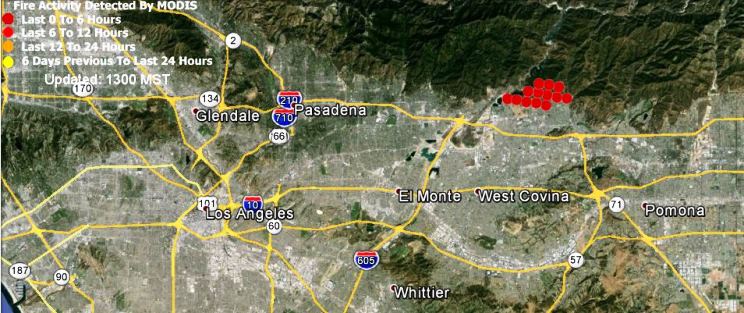
Mandatory evacuations have been ordered for about 1,000 homes that could be affected by debris flows out of recent wildfires in the Glendora and Azusa areas. The Colby Fire burned 1,952 acres of the hillsides above the communities on January 16, 2014.

Weather forecasters have predicted several inches of rain for some areas in southern California between Thursday and Saturday.

Map showing the approximate location of the Colby Fire at 10:37 a.m. PST, January 16, 2014
Map showing (in red) the approximate location of the Colby Fire at 10:37 a.m. PST, January 16, 2014. (click to enlarge)

“Ice makes a good firebreak”

From The Nature Conservancy, describing a prescribed fire in Oklahoma:

Crews use drip torches to start the 475-acre controlled burn at the Four Canyon Preserve

“We took advantage of a break in the weather on February 1 and completed a 475-acre prescribed burn at the Four Canyon Preserve. This work was funded by a ConocoPhillips and National Fish and Wildlife Foundation grant, and it wouldn’t have been possible without their help,” said Chris Hise, Four Canyon Preserve Manager. “It’s very early in the season to be burning here, but we’re trying to stay ahead of a worsening drought situation. I had the odd experience of carrying a drip torch along the frozen banks of the Canadian River. Ice makes a good firebreak.”

More info, and photos, are at The Nature Conservancy’s website.

NASA photograph of a fire in Australia

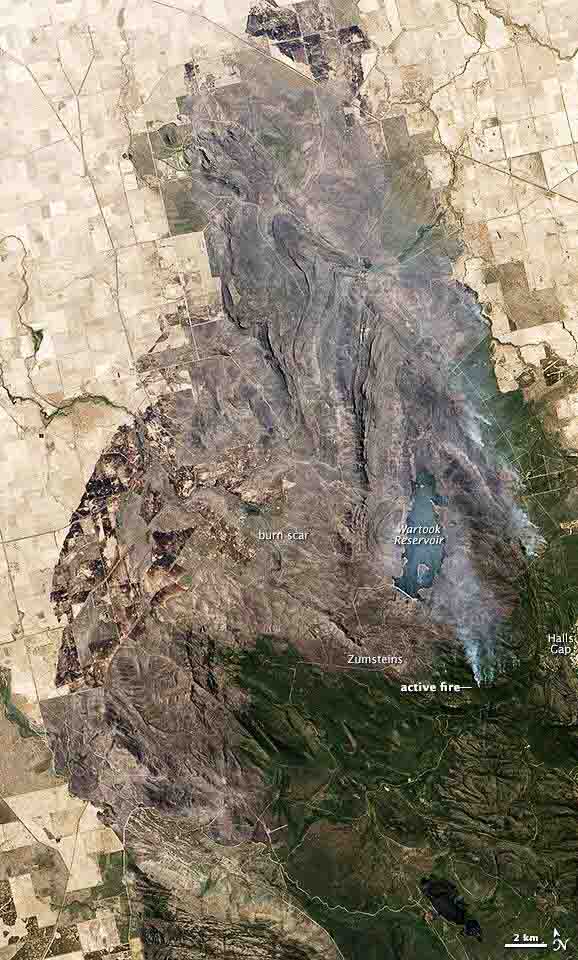
A large fire burning in and around Grampians National Park in Victoria, Australia, was nearly contained when the Operational Land Imager on the Landsat 8 satellite acquired this image on January 19, 2014. The burned land is gray-brown in this natural-color image. Active fires were burning on the east side of the burn area, sending up plumes of smoke.

Bushfire in Grampians NP, Victoria, Australia
Bushfire in Grampians NP, Victoria, Australia. NASA photo.

Fascinating video of an Aussie engine crew fighting a bushfire

This GoPro video of an engine crew fighting fire in Australia on February 9, 2014 is fascinating. It shows the Mt. Macedon 1 crew of the Country Fire Authority (CFA) suppressing a fire near Gisborne, Victoria using a remote controlled front-mounted nozzle and firefighters on the back of the truck using two additional nozzles. An Erickson Air-Crane helicopter is also seen making several water drops. You might notice how fast the driver can back the truck up after their path on a dirt road is suddenly blocked by flames.

The crew shot about two hours of video and edited it down to six minutes of highlights.

The fire burned about 2,500 hectares (6,200 acres) and five homes at Riddells Creek and Gisborne South in what the CFA said was the biggest fire in the area in 30 years.

Like it says at the end of the video — they had a busy day.

Before you comment on the tactics, remember our comment policy, and consider that your view of the fire is like looking through a soda straw.

USFWS prescribed fire in Oregon

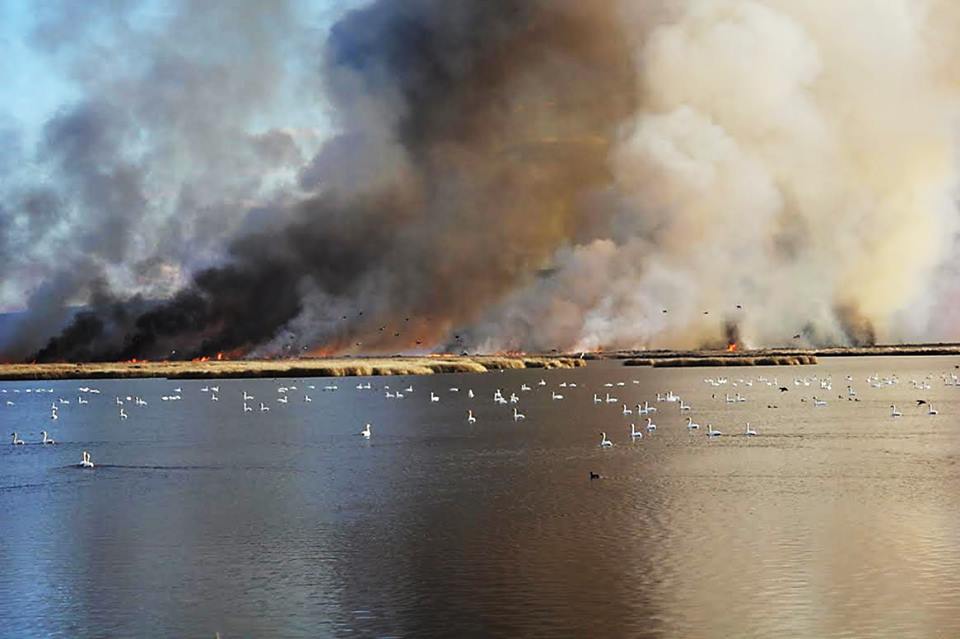
Rx fire at Malheur Nat'l wildlife Refuge. USFS photo by Shane Theall.
Rx fire at Malheur Nat’l wildlife Refuge. USFS photo by Shane Theall.

According to the U.S. Fish and Wildlife Service. their….

Malheur Fire Program and the Burns Interagency Fire Zone conducted a 2,250-acre prescribed fire on the Deer Park Unit of Malheur National Wildlife Refuge this week. Located in southeastern Oregon’s high desert, at the northern end of the Great Basin, the 187,000-acre National Wildlife Refuge is famous for its spectacular concentrations of wildlife. With its abundant water resources in an otherwise arid landscape, the Refuge hosts more than 320 bird species and 58 mammal species.

Rx fire at Malheur Nat'l Wildlife Refuge. USFWS photo by Carla Burnside.
Rx fire at Malheur Nat’l Wildlife Refuge. USFWS photo by Carla Burnside.

BLM awards contract for first jet-powered lead plane in the U.S.

Dynamic Aviation Citation lead plane
A Dynamic Aviation Cessna Citation. Photo courtesy of Dynamic Aviation.

The Bureau of Land Management has awarded a contract for the first jet-powered lead plane in the United States. Lead planes fly ahead of the much larger air tankers that drop retardant on fires. They identify the targets and evaluate the fire and wind conditions. Dynamic Aviation, with headquarters in Bridgewater, Virginia, will be supplying a Cessna Citation CJ to serve as a lead plane and Air Supervision Module (ASM) this fire season. With the jet-powered air tankers now in use, including DC-10s, BAe-146s, and MD-87s, there is a need for a lead plane that can keep up with the “next-generation” air tankers.

The Dynamic Aviation aircraft is not the first jet-powered lead plane. British Columbia currently operates two Citations as Bird Dogs, according to information we received from a spokesperson for the U.S. Forest Service.

In January the Citation was for sale at Controller.com with an asking price of $1.1 million. During the off season it will be at their headquarters, where they operate a heavy maintenance and modification center, engine shop, and a privately owned airport. The company employs over 550 people and in September of last year began construction on their fifth hangar, named Hangar E. In addition to the new (to them) Citation, they have Beechcraft King Airs and Bombardier Dash 8-100s.

Dynamic Aviation King Airs
Dynamic Aviation’s King Airs. Photo courtesy of Dynamic Aviation. (click to see larger version)

Caleb T. Stitely, an account manager at Dynamic Aviation, told us that the company has a contract with the BLM to supply two additional Cessna Citations beginning in 2015.

Randall Eardley, a spokesperson for the BLM said this year the agency will have three lead plane/ASMs on exclusive use contracts (the Citation and two King Air E-90s) and a fourth one on call when needed status (a King Air E-90). All four will be supplied by Dynamic Aviation. In addition, the Department of the Interior owns a King Air BE-200 that the BLM will use for Lead/ASM operations this coming fire season.

The U.S. Forest Service owns a Cessna Citation Bravo II equipped with a system for mapping fires using infrared imaging technology. It can download the imagery in near real time once each night to infrared interpreters on the ground who use it to make maps showing the location of fires.

The BLM will also have nine Air Tactical Group Supervisor (ATGS) platforms on contract this year. Three are on contract now and the other six are still out for bid. Spur Aviation will operate an Aero Commander AC690B, and Ponderosa Aviation will also have an Aero Commander AC690B and one Aero Commander AC680T.

We are working on collecting information about the U.S. Forest Service’s fleet of lead planes and Air Tactical platforms and hope to write about that in a day or so.

New Mexico’s fire season potential

The National Weather Service at Albuquerque has published information about the winter weather in New Mexico and how that could affect their wildfire season. Below are some excerpts:

****

“…The grasses have since turned dormant and now provide significant carryover fuel. Wildland fire mangers next consider whether there has been sufficient enough heavy-wet snow to mat or compress the standing grass. Snowfall thus far has been well below normal but some areas did receive enough early season (November-early December) snow to partially mat down some of the previous grass growth. This is important because standing grass is much more susceptible to fire spread than matted grass. Figure 3 shows a photo series taken at similar times at a Sandia mountain location (at 8000 feet) east of Albuquerque from 2010 to 2014. The 2014 photo shows some grass compaction while the 2013 photo showed little grass compaction.”

wildfire season New Mexico Snow at Sandia Mountain

Fire season pauses for heavy rain in California

Wet storm in southwest

The fire season which has only slowed down, not ended, in southern California will definitely be paused for the next week or so. About five to six inches of rain will be arriving in some areas of southern California Thursday through Saturday according to the Predictive Services Unit in southern California. Most of the rest of the state as well as much of Arizona will also see very heavy rain. Can we call this a “season ending event” for California?

****

INTERAGENCY FIRE WEATHER CENTER – PREDICTIVE SERVICES UNIT
WEDNESDAY, FEBRUARY 26, 2014
SOUTHERN CALIFORNIA GEOGRAPHICAL AREA COORDINATION CENTER

Two storms will bring rain to the region. The first storm, the weaker of the two will bring 1-2 inches of rain to the central coast with lesser amounts elsewhere today and tonight. A strong storm Friday will produce over 4 inches of rain and a few thunderstorms on south-facing slopes of Southern CA. Strong southwest winds will occur Friday. Elevations above 6,000 feet will see periods of heavy snow Friday and Saturday. The storm will depart Sunday afternoon with drier and warmer weather returning by Monday.

Wildfire suppression simulation combined with flight simulation

According to their web site, E-Semble “develops simulation software for the education, training and assessment of incident response and safety professionals, such as police, fire and medical services”. In the video above, they combined flight simulation software with their wildfire response simulation.

Fire simulations have changed since the 1980s. The one we used at Descanso Station in California used four overhead projectors behind a rear-projection screen, and two four-track reel-to-reel tape recorders that enabled eight possible sound effects. Involved in putting on the simulations were a director, an audio technician, a visual technician, and three to four role players. It was a very effective training tool.