
GAO sustains protest of non-competitive air tanker contract
The Government Accountability Office announced today that they sustained the protest filed by three companies over the sole source air tanker contract that the U.S. Forest Service awarded to Neptune Aviation December 12, 2013. The non-competitive contract, worth about $141 million, specified that Neptune would supply two or more next-generation air tankers, BAe-146s, for the next four to nine years beginning in 2014.
More details are at Fire Aviation.
GAO sustains protest of air tanker contract

(Originally published at 3:15 p.m. MT, March 31, 2014; updated at 8:40 a.m. MT April 1, 2014 with the text of a statement released by the GAO, and again at 11:20 a.m. MT April 1, 2014 with a response from the USFS.)
The Government Accountability Office announced today that they sustained the protest filed by three companies over the sole source air tanker contract that the U.S. Forest Service awarded to Neptune Aviation December 12, 2013. The non-competitive contract, worth about $141 million, specified that Neptune would supply two or more next-generation air tankers, BAe-146s, for the next four to nine years beginning in 2014.
A spokesperson for the GAO said their review concluded that the U.S. Forest Service “could not reasonably justify” the non-competitive process used in awarding the contract to Neptune.
The three companies that protested the sole source contract were Coulson Aviation (USA), Inc; 10 Tanker Air Carrier, LLC; and Minden Air Corp. If only the minimum two air tankers were signed up, the value of the contract would be about $141 million. If the options for five additional tankers were utilized, it would be hundreds of millions.
The protest automatically halted the activation of the sole source contract when it was filed in December.
We asked the USFS for their reaction to the GAO decision, and if other air tankers will be brought on, either by activating options under existing legacy or next-gen contracts, or will additional contracts be pursued? We received the following statement issued by their Washington office Tuesday morning:
The U.S. Forest Service is committed to ensuring that we have all of the resources we need to fight wildland fire and protect the lives and property of the American people. Airtankers are an important part of our efforts and we are currently reviewing the GAO recommendation.
In the protest filed with the GAO, hundreds of pages were submitted, listing dozens of reasons why the three companies felt the sole source contract should be terminated.
The Coulson company argued that on several occasions they told the USFS that they could supply more than the one C-130, but were told that the funding situation was too uncertain to commit more air tankers. Then a few months later, the USFS issued a contract potentially worth at least $141 million.
10 Tanker made similar offers, and in fact had a second DC-10 fully certified and on a call when needed contract that they would have liked to convert to an exclusive use next-gen contract. They also said they are working on retrofitting a third DC-10 which they expect to have ready to go by the end of calendar year 2014.
This was the third USFS air tanker contract that has been officially protested in the last two years. Two of those were sustained by the GAO, the recent sole source contract and the original attempt to issue contracts for next-gen air tankers, while the third, filed by Neptune, was dropped five months before the company received the sole source award in December.
Neptune will have six Korean War vintage P2Vs (2,082 gallons each) and one jet-powered BAe-146 (3,050 gallons) on exclusive use contract this year in what the U.S. Forest Service calls the “legacy” air tanker category. The company expects to have four additional BAe-146s ready to fight fire this year that are not currently on contract.
10 Tanker Air Carrier has one DC-10 Very Large Air Tanker on exclusive use contract and another on a call when needed contract. The company is in the process of retrofitting a third DC-10. They each carry 11,600 gallons of fire retardant.
Coulson has one 3,500-gallon C-130Q on exclusive use contract and hopes to acquire and convert a second C-130.
Minden has a contract for a BAe-146 but it has not yet been tested or approved by the Interagency AirTanker Board.
The complete text of a statement by the GAO about the decision is below. It was written March 31 and released April 1, 2014.
****
“The following is a statement from GAO regarding today’s decision resolving bid protests filed by Coulson Aviation (USA) Inc., 10 Tanker Air Carrier, LLC, and Minden Air Corp., B-409356.2 et al., March 31, 2014.
On March 31, the U.S. Government Accountability Office (GAO) sustained, or upheld, the protests filed by Coulson Aviation (USA) Inc., of Port Alberni, British Columbia, Canada, 10 Tanker Air Carrier, LLC, of Albuquerque, New Mexico, and Minden Air Corp., of Minden, Nevada, challenging the sole-source award of a contract by the Department of Agriculture (USDA), U.S. Forest Service, to Neptune Aviation Services, Inc., of Missoula, Montana, for airtanker services to support wildland firefighting. The contract contemplates Neptune providing at least two modern large airtankers for up to 9 years (the contract also contains options to add up to five additional aircraft in each year). The total estimated value, based on all possible aircraft over all years, is approximately $496 million.
Continue reading
Takeoff aborted due to a fish strike
From the Missoula Independent, March 31, 2014:
****
“After a jet aborted its takeoff at Florida’s MacDill Air Force Base because the crew thought it had hit a bird, possibly an osprey, wildlife manager Lindsey Garven searched the runway for a dead bird but found only a fish. DNA samples from the fish and the jet confirmed the accident was a fish strike. Garven said the 9-inch sheepshead was probably dropped by a bird that had been eating it on the runway until the jet scared it off. The incident is only the second reported collision between an aircraft and a fish, the first having occurred in 1987 between a fish and a Boeing 737 taking off from Juneau, Alaska. (The Tampa Tribune and The New York Times)”
Wildfire Awareness Week, 2014

Many states observe Wildfire Awareness Week, with goals of raising the public awareness of wildfires and promoting actions that reduce the risk from wildfire to homes and communities.
- Arizona: Southwest Wildfire Awareness Week, March 30-April 5, 2014
- California: always the first week in May, May 4-10, 2014
- Colorado: Flood Safety and Wildfire Awareness Week, March 16-21, 2014.
- Florida: second week in April
- Idaho: first full week in June
- Kansas: February 16-22, 2014
- Michigan: Wildfire Safety & Awareness Week, March 16-22, 2014
- Montana: June 2-8, 2014
- Nebraska: March 24-28, 2014
- New Mexico: Southwest Wildfire Awareness Week, March 30-April 5, 2014
- Nevada: Wildfire Awareness Month, May 1-31, 2014
- Oregon: (first full week of May) May 7-11, 2014
- Pennsylvania: March 16-22, 2014
- South Dakota: May 2-9, 2014
- Washington: May 5-11, 2013
(UPDATE May 3, 2014: News3 reports, “A multi-state proclamation, signed by the Governors of Nevada, California, Idaho, Oregon, Utah and Washington, recognizes May 2014 as Wildfire Awareness Month and encourages all citizens to “learn to live safely in a wildfire environment.”)
The seven states and four Canadian provinces in the Northeast Forest Fire Protection Commission’s Compact will observe Wildfire Awareness Week April 20-26, 2014. This will include the states of Maine, New Hampshire, Vermont, Connecticut, Massachusetts, Rhode Island, and New York, as well as the Canadian provinces of Quebec, New Brunswick, Nova Scotia and Newfoundland Labrador.
If you have updated information about exactly when states will observe Wildfire Awareness Week this year, or standard time periods each year, let us know.
The International Association of Wildland Fire has proclaimed the weeks of May 1–7 (northern hemisphere) and October 1–7 (southern hemisphere) to be “Global Wildfire Awareness Week”. The NPFA will observe May 3, 2014 as the first “National Wildfire Community Preparedness Day”.
Handout materials
- Organizations can order many free Firewise outreach materials (including brochures, posters, bookmarks, DVDs, door hangers, stickers, and an interactive Firewise Challenge Exhibit Kit) from http://firewise.org/catalog.aspx.
- A variety of wildfire prevention materials are available to local, state, tribal and federal partners to purchase from http://www.symbols.gov.
- The U.S. Fire Administration also has some free publications and handouts.
Red Flag Warnings, March 31, 2014

Warnings for elevated wildfire danger have been issued by the National Weather Service for areas in Colorado, New Mexico, Texas, Arizona, Kansas, Nebraska, Missouri, Iowa, and Alabama.
The Red Flag Warning map was current as of 9:17 a.m. MDT on Monday. Red Flag Warnings can change throughout the day as the National Weather Service offices around the country update and revise their forecasts. For the most current data, visit this NWS site.
Wildfire briefing, March 30, 2014
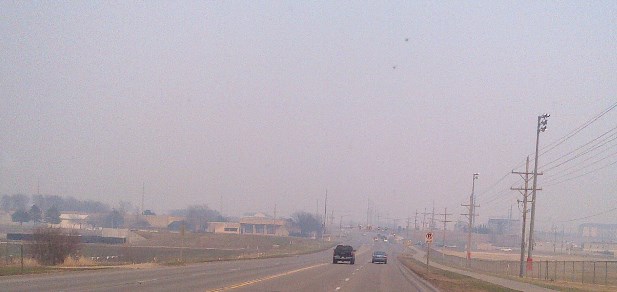
Prescribed fire smoke in the Flint Hills
In light of the discussion on Wildfire Today about prescribed fire as a tourist attraction in the Flint Hills of Kansas, Eric Ward sent us the above photo that he took Saturday afternoon in smoky Manhattan, Kansas. He explained that many of the ranchers in the area conduct extensive burning projects this time of the year in order to enhance weight gains of cattle if they plan to stock pastures in May. On days when the relative humidity and wind speed are within an acceptable range, the evidence of the burning is very visible in the atmosphere, especially if weather for the previous week or so has been bouncing between snow and red flag weather conditions, as it has this year.
Colorado report recommends contracting for air tankers and helicopters
 A long-awaited report about aerial firefighting by state agencies in Colorado was released Friday by the Colorado Firefighting Air Corps (CFAC). Some of the more significant recommendations include:
- Increase the number of Single Engine Air Tankers (SEAT) on exclusive use contracts from two to four.
- Contract for the exclusive use of four Type 3 or larger rotor-wing aircraft. (Type 3 helicopters can carry 100 to 300 gallons.)
- Contract for the exclusive use of two Type 2 or larger air tankers. (Type 2 air tankers can carry 1,800 to 3,000 gallons). The contingency, if the State is unable to contract for two air tankers, is to contract for two helitankers, or a combination of one fixed-wing air tanker and one helitanker.
More details are at Fire Aviation.
Arizona seeks to immunize the state from liability from wildfires
A bill that was approved unanimously Tuesday by the Arizona Senate Appropriations Committee, House Bill 2343, would exempt the state and state employees from prosecution for harm resulting from the action, or inaction by state employees on state lands. Hundreds of millions of dollars in claims have been filed by the families of the 19 firefighters killed on the Yarnell Hill Fire and by property owners whose homes burned. The fire was managed by the state of Arizona in June, 2013.
Firefighters assisting with Oso landslide
Personnel that usually can be found at wildfires are helping to manage the response to the tragic landslide at Oso, Washington. We have reports that some of the resources assisting include Washington Incident Management Team #4 (a Type 2 team), miscellaneous overhead, and some Washington Department of Natural Resources chain saw teams. The IMTeam was dispatched on March 27.
New topic from “Safety Matters”
The “Safety Matters” group has released their “Topic #5”, and they are seeking input from wildland firefighters. Below is an excerpt:
…2014 marks the 20th Anniversary of South Canyon and the 38th Anniversary of Battlement Creek. Both fires fit the model of firefighters dying in a brush fuel type, on a slope, during hot and dry conditions.
The loss of the Granite Mountain Hotshots indicates that a significant accident occurs every 18 to 20 years. Is there a reoccurring cycle, and if so why? Could it be related to a cyclic turnover of firefighter culture, training and attitude? What are the thoughts of Safety Matters readers?
Bushfire season ends in New South Wales
The bushfire season has reached its official end in New South Wales.
Tribute to author Norman Maclean
The Daily Beast has reprinted an excellent essay that Pete Dexter wrote for Esquire in 1981 about Norman Maclean. It explores a side of of the author that is not revealed in his book about firefighters, Young Men and Fire. Mr. Dexter spent quite a bit of time with Mr. Maclean, who at that time was writing the final chapter. Mr. Maclean also wrote A River Runs Through It, which was made into a movie starring Robert Redford and Brad Pitt. The Esperanza Fire, a book written by his son John N. Maclean, is working its way towards becoming a movie.
U.S. National Guard assists with fire in Puerto Rico
From the AP:
Puerto Rico has enlisted the U.S. National Guard to help extinguish a fire that has ravaged a forest in the island’s central region. Firefighting Chief Angel Crespo says that about 40 percent of the Modelo Forest in the town of Adjuntas has been destroyed. Authorities say they believe the fire was intentionally set and that it has consumed up to 290 acres (117 hectares). A U.S. National Guard helicopter helped dump water over the area on Friday.
Fantastic photo
Listening to details of UN report on climate change @bbc5live-will #wildfire become more of an issue for Fire Service pic.twitter.com/Cc8hsYty0z
— Dave Walton (@ACOWestYorkFire) March 31, 2014
Colorado releases aerial firefighting report
 The long awaited report required by the Colorado legislature about options for aerial firefighting in the state was released today by the Colorado Firefighting Air Corps (CFAC). The CFAC was created but not funded last year, and the next step is for decisions to be made about what aerial resources the state will acquire, if any, and then possibly, provide funds to operate them. The 103-page report, titled “Report to the Governor and General Assembly on Strategies to Enhance the State’s Aerial Firefighting Capabilities“, has a number of recommendations:
- Increase the number of Single Engine Air Tankers (SEAT) on exclusive use contracts from two to four.
- Contract for the exclusive use of four Type 3 or larger rotor-wing aircraft. (Type 3 helicopters can carry 100 to 300 gallons.)
- Contract for the exclusive use of two Type 2 or larger air tankers. (Type 2 air tankers can carry 1,800 to 3,000 gallons). The contingency, if the State is unable to contract for two air tankers, is to contract for two helitankers, or a combination of one fixed-wing air tanker and one helitanker.
- Develop early detection and remote sensing capabilities by securing two fixed wing aircraft equipped with modern fire-detecting sensors that would be operated to actively identify and locate small fires in high-risk wildland and wildland urban interface areas. The report explains that these aircraft will help achieve “the goal of generating an incident assessment for every fire within 60 minutes of report or detection”.
In addition to assessing every fire from an aircraft within 60 minutes, the report also recommends that the “appropriate aviation suppression resources be delivered to the fire” within 60 minutes. These two goals, if accomplished, would be a major step forward, not only for the state of Colorado, but for most states and federal agencies. Of course CAL FIRE can usually deliver retardant to a fire within 20 minutes of the first report, but that is a very high bar.
The state government of Colorado has very little in the way of wildland fire initial attack capability, and relies on local agencies for fire protection. In fact, the report admits:
Colorado does not have the ability to deliver an appropriate and timely suppression response to small fires while they are still small.
The report mentions several alternative aircraft for acquisition and conversion to air tankers, including S-3, C-27J, and C-130 from the Federal Excess Personal Property (FEPP) program. It basically threw out the S-3 for performance reasons, and said that there were no C-27Js available in the FEEP. Contrary to popular belief, it said, there were no C-130s available either. Another aircraft considered was the MD-10 that possibly could be donated by FedEx. That option was not chosen, because they:
…present much the same issue as surplus military aircraft that do not already have a proven, fielded system; that being it could add significantly to both cost and time to implement. Additionally, the age and condition of the donated aircraft could cause significant inspections and revitalization.
In addition, the cost of the engineering needed to modify the MD-10 for a retardant tank, avionics, and related equipment in order to obtain a Supplemental Type Certificate (STC) could cost between $30 and $40 million. Installing the retardant system could add another $10 million for each aircraft.
In discussing the problems with locating and obtaining information about the Waldo Canyon and High Park Fires during the early stages, which together killed three people and burned 605 homes, the report said:
Colorado’s remote sensing fixed wing aircraft would be on site within approximately 30 minutes of launch and would employ thermal imaging sensors to survey the reported area. The fire would be located and mapped, and this information would be loaded in real time to the state’s information management system [a new system the report recommends] . Within an hour of the first report of smoke, the local incident commander would have access to a map of the fire, ingress and egress paths, fuels involved, fire behavior, values at risk, weather forecast, and other data needed to make informed decisions regarding the appropriate management response.
In spite of the recommendation in the report that the aircraft be provided by contractors, there is another recommendation (on page 48) saying:
…the government-owned/contractor model presents the most attractive mix of affordability and efficiency. If the initial purchase cost of the airframes precludes this option, the contractor-owned/contractor-operated model is also a reasonable approach.
Then, to confuse the issue further, in the next paragraph it says:
It is not recommended to pursue the government operated model.
The report optimistically expects that the contracted helicopters and air tankers would begin operations within six months of “program initiation”. Apparently the state of Colorado has a contracting department that is many times more effective than the one operated by the U.S. Forest Service, but that is a very low bar.
They expect the two Type 2 or larger air tankers to cost $11.9 million and the four Type 3 or larger helicopters to cost $4.7 million for exclusive use contracts each year. It appears they want to purchase the two “multi-mission fixed wing aircraft” at a cost of $10 million plus $1.7 million for operations, maintenance, and training.
The total cost for the aviation program, including miscellaneous costs for insurance, equipment, hangar leases, etc, would be $33.6 million the first year and $23.6 million in subsequent years.
Thanks and a hat tip go out to Bean.
CAL FIRE moves to peak staffing in Southern California
 Despite some rain in march, fire activity remains high
Despite recent rainfall, CAL FIRE continues to respond to a significant increase in wildfires, especially in Central and Southern California where rain totals have done little to combat drought conditions. Starting Monday, March 31, CAL FIRE will move to peak staffing levels in San Diego, Riverside and San Bernardino Counties.
“Even with rain in March, our fire activity has remained 200 percent more over average statewide,” said Chief Ken Pimlott, CAL FIRE director. “The rain has been great, but it has not been enough to make up for our dry winter and California’s drought.
While CAL FIRE never was able to transition out of fire season in 2013, the return to peak staffing means all equipment and facilities will be staffed around the clock. The move comes several months earlier than normal, but is needed as spring temperatures rise and dry out conditions even more.
Between January 1 and March 22, CAL FIRE has responded to over 800 wildfires that have charred nearly 2,300 acres. In an average year for the same time period, CAL FIRE would typically respond to under 275 wildfires for approximately 1,000 acres.
A nozzle that does not need a hose?
If the nozzle in the video were real, it would revolutionize firefighting. Unfortunately it was created with special effects by Daniel Hashimoto, the father of three-year old James. Mr. Hashimoto, a DreamWorks animator based in Los Angeles, employs the skills he uses at work to make incredibly realistic-looking short videos featuring James performing super hero type stunts.