A prescribed fire escaped at a national wildlife refuge east of Orlando on Monday. The plan was to burn 660 acres within St. Johns National Wildlife Refuge, but multiple simultaneous spot fires outside the burn unit exceeded the capability of the firefighters from Merritt Island National Wildlife Refuge who were conducting the burn. An additional 72 acres of private land and 200 acres of Brevard County property outside the refuge burned — 600 acres in the original planned unit were completed.
The escape was knocked down by 43 personnel on Monday. Today spokesperson Candice Stevenson of the U.S. Fish and Wildlife Service said the fire is 70 percent contained. Agencies involved in the suppression of the escaped fire included the U.S. Fish and Wildlife Service, Brevard County, Florida Forest Service, the City of Titusville, and the U.S. Forest Service.
That is something you don’t see every day — deicing an air tanker. Some overnight snow at Cheyenne required deicing on the Modular Airborne Fire Fighting System, or MAFFS, air tankers that are in Wyoming for training, certification, and recertification this week. C-130s from Charlotte, NC, and the base at Cheyenne are participating. These National Guard units each provide two C-130s, a portion of the eight that can be called up nationwide, if the atrophied United States air tanker fleet, down to nine now, needs supplemental aircraft.
Ground training for MAFFS crews at Cheyenne, April 28, 2014. AEGMAFFS photo.
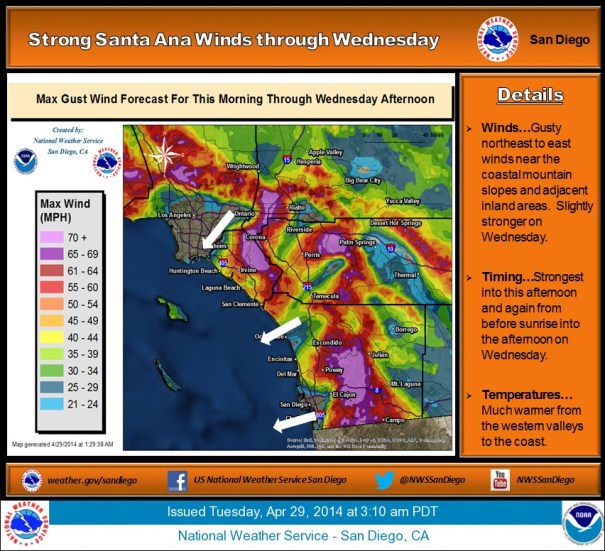
We have updated information from the National Weather Service about the wind event in southern California that is now predicted to last into Thursday.
1:14 PM PDT TUE APR 29 2014
RED FLAG WARNING FOR LATE TONIGHT INTO THURSDAY EVENING…
A RIDGE OF HIGH PRESSURE OVER THE WEST COAST COMBINED WITH OFFSHORE FLOW FROM SURFACE HIGH PRESSURE OVER THE GREAT BASIN WILL BRING MUCH HIGHER TEMPERATURES AND VERY LOW HUMIDITIES WITH POOR OVERNIGHT RECOVERIES THROUGH THURSDAY. THE OFFSHORE FLOW WILL ALSO BRING PERIODS OF STRONG AND GUSTY NORTHEAST WINDS NEAR THE COASTAL MOUNTAIN SLOPES AND ADJACENT INLAND AREAS…WITH STRONGEST GUSTS TO AROUND 85 MPH WEDNESDAY MORNING. MODERATE STRENGTH AND LESS WIDESPREAD NORTHEAST WINDS WILL CONTINUE INTO THURSDAY WITH EVEN WEAKER WINDS INTO FRIDAY.
****
(Originally published at 8:30 a.m. PDT, April 29, 2014. Updated at 10:30 a.m. PDT, April 29, 2014 to add a new Red Flag Warning issued at 9:35 a.m. MDT.)
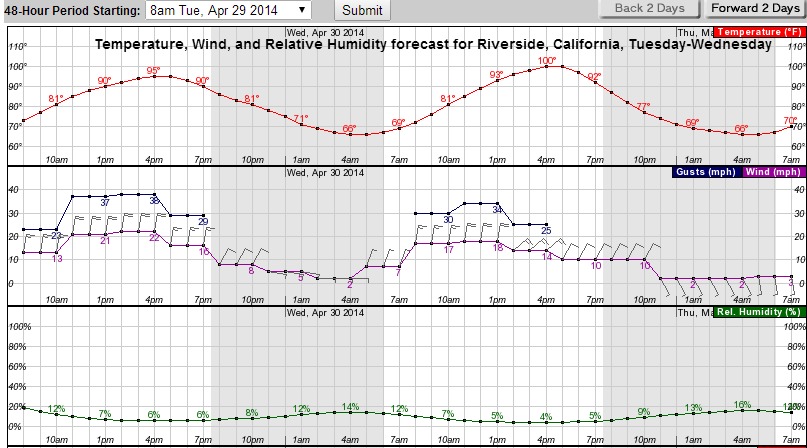
Riverside, CA weather forecast for Tuesday and Wednesday. (click to enlarge)
Wind gusts exceeding 80 mph and single-digit humidities are in the forecast for some areas of southern California Tuesday and Wednesday. A High Wind Warning issued by the National Weather Service at 1:55 a.m. Tuesday predicted sustained winds of 25 to 40 mph with gusts to 80 today, increasing on Wednesday to 30 to 45 mph with gusts to 85. That forecast applies to Orange County coastal areas, San Bernardino and Riverside county valleys, the Inland Empire, San Diego County valleys, and the mountain areas in the counties of San Bernardino, Riverside, and San Diego.
The graphical forecast (above) for Riverside shows relative humidities as low as 6 and 4 percent today and Wednesday, respectively, and high temperatures of 95 and 100.
In spite of this forecast, and live fuel moistures that are typical of July, there is no Red Flag Warning in effect for the area, only a Fire Weather Watch for portions of Los Angeles and Ventura Counties. UPDATE at 10:18 a.m. PDT Tuesday: the NWS issued a Red Flag Warning for portions of Los Angeles and Ventura Counties at 9:35 a.m. PDT
In anticipation of this wind event, CAL FIRE has moved engines and hand crews to the southern part of the state. Air tanker and helitack bases in the area were ordered to be ready to fly at 7 a.m.
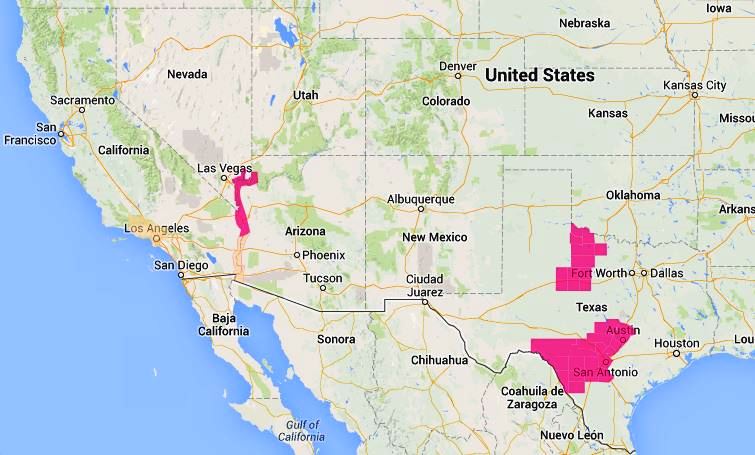
Red Flag Warnings (in red) and Fire Weather Watches (in yellow) areas — 8:30 a.m. PDT April 29, 2014
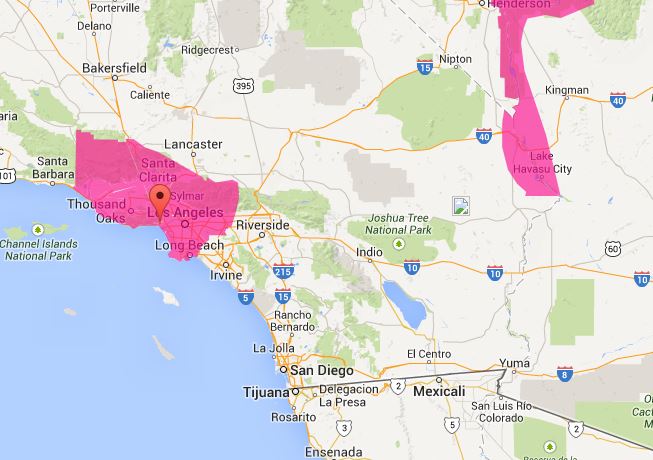
The Red Flag map above was current at 8:30 a.m. PDT, April 29. The revised map below was captured at 10:23 a.m. PDT, April 29, showing all of the Fire Weather Watches had been cancelled, and Red Flag Warning issued for portions of Los Angeles and Ventura Counties.
Red Flag Warnings in southern California — 10:23 a.m. PDT, April 29, 2014
Near-real-time wind speeds in southern California can be monitored at this NOAA website.
Red Flag Warnings can change throughout the day as the National Weather Service offices around the country update and revise their forecasts. For the most current data, visit this NWS site.
SEAT base dedication at Chadron, NE. South Dakota Wildland Fire Div photo.
A new base for Single Engine Air Tankers (SEATs) was dedicated at the Chadron Municipal Airport in Nebraska on Saturday, April 16. Thanks to the Nebraska legislature’s passage in 2013 of the Wildfire Control Act, three SEAT bases are now available in the northwest part of the state. Last year a contracted SEAT came on duty July 15. Other bases managed by the Nebraska Forest Service (NFS) are at Valentine (see photo below), and Alliance. A fourth base is scheduled for construction at North Platte Regional Airport later this year.
SEAT base in Valentine. Nebraska Forest Service photo.
The National Multi-Agency Coordinating Group announced today that the Department of the Interior is funding 33 exclusive use Single Engine Air Tankers (SEATs) in 2014 as national shared resources. Historically, SEATs have been funded as primarily a local or regional resource with assigned home bases. The 2014 exclusive use SEAT fleet will not have assigned home bases. They will be treated as national shared resources similar to Large Air Tankers (LATs). Geographic area Coordination Centers (GACCs) can preposition SEATs using the same mechanisms and rationale used for other national resources.
There are three start dates — May 26th, June 5th and June 12th. Based on the number of DOI National Exclusive Use SEATs allocated to their GACC, Bureau of Land Management State Aviation Managers and Bureau of Indian Affairs Regional Aviation Managers will coordinate with fire staff and the Geographic Area Coordinating Group to determine the initial starting location of DOI Exclusive Use SEAT’s.
As National assets, DOI National Exclusive Use SEATs will be moved to areas of greatest need. Within Geographic Areas, Fire Staff on an interagency basis will provide direction to the Dispatch system on the mob/demob of SEATs to meet existing or forecasted fire loads within their jurisdiction. GACCs can preposition SEATs using the same mechanisms and rationale used with LATs.
Below are some of the provisions of the contracts:
These are one year Exclusive Use contracts with 4 option years.
There are no designated bases under these contracts.
Notice to Proceeds will be issued giving the contractor direction on where to report to at the beginning of the contract.
The Mandatory Availability Period will be 100 days with three different start dates — May 26th/June 5th/June 12th.
The aircraft will be AT-802s with an Interagency Airtanker Board approved gate system.
The Level I Pilots will be on a fixed 6/1 work schedule set at the start of the contract.
No relief pilot is required.
Companies can exchange pilots.
The contracts allow for the government to order an additional service truck at a daily flat rate of $500 when needed to augment the existing truck or to utilize the second one at a remote base.
The AT-802 holds 800 gallons of retardant. This compares to the 2,000 to 3,500 Large Air Tankers can carry, or the 11,600 gallons the DC-10 holds. But, SEATs are a very useful tool in the aerial firefighting tool box — a tool box that should have a variety of types and sizes of aircraft with different capabilities and niches.
As the western fire season gets under way, there are nine LATs available on exclusive use contracts, and one Very Large Air Tanker, a DC-10. It is possible that an additional five “next generation” LATs may eventually meet the requirements of the contracts that were issued to them a year ago and could be added to the fleet.
Fire weather forecasters depend on data from weather balloons and many other sources to develop our forecasts. During a strong wind, as evidenced by the 6 p.m. launch at Albuquerque on April 26, it can be a challenge. Watch as the balloon nearly blows apart then narrowly misses the observation tower and the forecast office.
…“We’ve had great success at apprehending arsonists,” [John Bird, an investigator for the state Division of Forestry] said. “And the word has gotten out. It doesn’t matter if people are on foot, riding four-wheelers or inside vehicles. The dogs can track them back to their homes. Once people realize that, they tend to be a whole lot less inclined to go out and start fires.”
With noses more than a million times more sensitive than those of their human handlers, the agency’s bloodhounds have proven themselves capable of some amazing olfactory feats.
“We’ve tracked some suspects for miles,” Bird said. “We’ve had cases where the suspect had set fires from his vehicle and the dog was still able to track him. We even had one case in which the dog tracked seven different people to their homes. It turned out that all of them were involved in a single arson. Every time we harness these dogs, they do something that amazes us.”
On Friday the Colorado Senate unanimously passed a revised version of SB14-164, completing another step towards the state being able to issue contracts for firefighting aircraft. If the House passes the same version of the bill, this year there would be up to three helicopters fighting wildland fires in the state and in 2015 they could add up to four large air tankers to the fleet.
This version of the bill is very different from the one that was first introduced, which listed numerous specific requirements for the types and capabilities of the aircraft, including night flying air tankers, which would have been the first on the planet Earth.
The configuration of the bill allows and actually states, that the legislators intend for the subject matter experts that will work for the Colorado Firefighting Air Corp (CFAC) to make the decisions about the specifications of the aircraft. The legislation when it was introduced took many of those decisions out of the hands of the fire aviation specialists. Instead, they were made by politicians who had no applicable expertise. The current version passed by the Senate requires that the CFAC adhere as nearly as possible to the recommendations as presented in the Special report: Colorado firefighting Air Corp, report to the Governor and General Assembly on strategies to enhance the state’s aerial firefighting capabilities, which was released March 28, 2014.
The bill allows the CFAC to use 19.3 full-time equivalent (FTE) positions, or employees, in the fiscal year that begins July 1, 2014. A previously passed bill, “FY 2014-15 Long Bill”, appropriated $19.67 million for the Division of Fire Prevention and Control to acquire aircraft.
The legislation also creates a “center of excellence for advanced technology aerial firefighting”, to…:
Serve as a laboratory to evaluate the “three fundamental contributing factors to successful aerial firefighting: effectiveness, efficiency, and sustainability”.
Conduct research to evaluate new technology in a variety of settings, such as initial attack, night operations, and operations in wildland-urban interface areas.
Produce data and documentation on science and technology relevant to aerial firefighting.
Since the Senate has passed the bill, it is now up to the House, where it was introduced April 25 and referred to the Agriculture, Livestock, and Natural Resources Committee.
A devastating fire in Valparaiso, Chile that began on April 12, 2014 destroyed about 2,500 homes and killed 15 people. This video was shot on April 14 from an unmanned aerial vehicle.