More Atlantic articles about wildland fire

On May 28 we pointed our readers to two excellent articles at The Atlantic about wildland fire. One was a very well done video about fire research activities at the Missoula Fire Sciences Laboratory. The other was an article that summarized many of the story arcs about the Yarnell Hill Fire, and was written by Brian Mockenhaupt. 

I met Brian last year a couple of days before the memorial service in Prescott, Arizona for the 19 firefighters who died in the Yarnell Hill Fire. He was beginning to research wildland fire and the issues surrounding the Yarnell Hill fatalities. A former Army infantryman, he had spent  a lot of time in recent years writing about the military and the wars in Iraq and Afghanistan. “Wildfires”, he said, “are a new area for me, and yet I’ve already seen some striking parallels in command and control, and in the after-action review process in looking at what went wrong, whether in battle or fire.”

Having read Wildfire Today, Brian asked if he could interview me. It turned out that we were both going to be at the memorial service, so when it was over, and after I interviewed Tom Harbour, the Director for Fire and Aviation for the U.S. Forest Service, I met with Brian for about half an hour as thousands of mourners filed out of the Tim’s Toyota Center arena.

He said recently that one of the things he remembered about our conversation on that memorable, sad day, was that I told him about firefighters’ “slide files”. Our young firefighters today may not even know what a slide is. Before digital photography there were two frequently used ways to take pictures and and process film. The most common was to create a negative from the film and then make a paper print. The other was to use slide film, which was processed into a positive right on the film, and placed in a cardboard holder. The sides, as they were called, could be put in a slide carousel, a circular tray that could hold up to 140 slides. It could then be projected onto a large screen for an audience. When the El Cariso Hot Shots developed the first comprehensive 32-hour training program for rookie wildland firefighters in 1972, we produced a slide program that was synced to recorded audio on a Wollensak cassette recorder. Later it was converted to VHS video tape, thankfully — because setting up and using the slide projector and the tape recorder was a pain in the ass. Sometimes human error would cause the slides to get out of sync with the audio if they were not started correctly.

What I told Brian about slide files was that firefighters who learn, record mental images or slides of fire situations especially if they were unusual or surprising. They might remember the fuels, weather, and topography, and the fire behavior that was the result. The could record what tactics worked, or didn’t work, or how long it takes to hike up a 100 percent slope when it is 4 p.m. on a hot day and you’re carrying 30 pounds of gear after working hard for 10 hours. Or what the spotting distance would be, or the flame lengths when the fire hits a hand line on a ridge.

Then…. after building up a slide file from thousands of fire events, when a crucial situation is encountered the firefighter can quickly search that data base and hopefully find conditions that match what they have in front of them. Drawing on what happened before, maybe years or decades before, they can make a better prediction about what will happen next, than another firefighter could that had not encountered that “slide”. This, obviously, can reduce the chance of something unpleasant happening to the firefighter and anyone they are supervising. It can also make them more efficient, effective, and productive in their job.

When a firefighter is experiencing a given set of conditions, and especially if it is a tense, crucial situation, they should take a few seconds. Look up, down, and around, and take a slide, then carefully file it away in your carousel. You never know when you might need to replay it.

The reason Brian mentioned to me that I told him about slide files that day in Prescott, was that in researching his latest article about wildland fire, two experienced firefighters at the National Interagency Fire Center in Boise brought up the concept. He wrote about it in How to Read the Mind of a Wildfire, published today in The Atlantic.

It is a very interesting article, and ranges from tree ring research to Harry Gisborne to Richard Rothermel to reductionist fire spread models to physics-based models that require a super computer. Below is an excerpt from the piece:

…“One of the big things about fire behavior is looking at the exceptional events, the 1 in 100,” says Richard Bahr, the head fire-behavior analyst at the National Interagency Fire Center, who was trained by Rothermel in the 1980s. Those outliers have always existed, but are exacerbated today by climate change, bug infestations, invasive grasses, and fires so intense that they create their own weather. “We are living in a time that is unprecedented, with the extremes we’re seeing in temperatures, precipitation, and winds, and with that, the effects are unpredictable,” Bahr says. “If you don’t have that in your slide tray, you aren’t going to believe it.”

***

In Los Alamos, New Mexico, Rodman Linn showed me the next generation of fire models, which can map out fire not just in the middle of the bell curve, but out on the tails as well, where firefighters more often meet the unexpected. Linn is a researcher at Los Alamos National Laboratory, which primarily develops and studies weapons and their effects for the military. Models of weapon effects and the spread of fire share the same scientific underpinnings. For his doctorate dissertation in theoretical fluid dynamics, Linn built FIRETEC, which uses physics-based models for combustion, heat transfer, and turbulence to simulate the spread of wildfire. Unlike FARSITE, which can run on laptops, FIRETEC requires the supercomputers at Los Alamos National Laboratory.

FIRETEC doesn’t treat fire as a wall moving through a uniform fuel bed, but divides a landscape into cells as small as a cubic meter and approximates the type and condition of fuel, the terrain, and the weather within each small space. One cell might have a tree, while the surrounding cells are grass, or the wind might be blowing south in a cell, but west in an adjacent space and north in another.”

Brian also wrote an article, published May 23, about the 10 members of a fire use module that were overrun by the Little Venus Fire in 2006 and had to deploy their fire shelters. He interviewed some of the firefighters that experienced the event, for the article titled, What It Feels Like to Lie Face Down and Let a Wildfire Burn Over You.

An excerpt:

…[Lathan Johnson, the fire use module leader] did a quick headcount and came up one short. He didn’t know that one of his firefighters had panicked and split off from the group a few minutes earlier. They didn’t have time to look for her: they couldn’t outrun the fire, and if they waited any longer to deploy, they might not have enough time to get under their shelters before the wall of flame washed over them. Between them and the fire was a 30-foot rock face, which would give some shelter from the heat and flame.

“We’re going to deploy here,” Johnson told the crew. For a moment, he saw their fear and disbelief. But then they set to work, reverting to procedures that they knew well from annual training exercises.

Firefighters on the Slide Fire discover historic site

 cabin site
Firefighter Leo Holley, who discovered the cabin site. USFS photo.

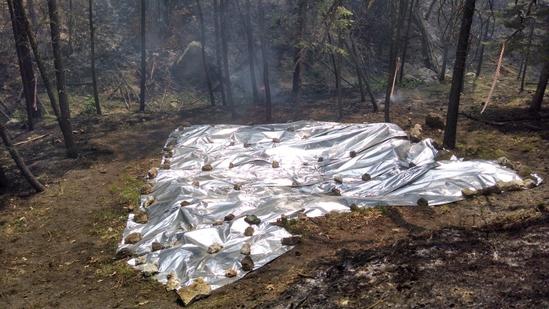
Firefighters from the Coronado National Forest working on the Slide Fire near Sedona, Arizona discovered the almost imperceptible remains of a historic log cabin. Leo Holley made the initial find and he worked with several other firefighters to protect the site from being consumed in the fire, constructing fireline and later placing aluminum fire shelter material over the area.

Mr. Holley first noticed that there were logs laying at right angles and continued to examine clues until he decided it was probably a cabin site.

Below is an excerpt from an article in the LA Times (which has more photos of the firefighters and the site):

“What is remarkable is that archaeological remains of the cabin were almost imperceptible,” [Jeremy Haines, a U.S. Forest Service archaeologist] said. “Forest Service archaeologists work … to protect these special places, and Leo’s discovery demonstrates how much we depend on firefighters to help us do this job.”

The cabin probably belonged to someone who was pushing the margins of habitable space because all the prime land is farther south, Haines said.

The cabin was probably destroyed years ago by a wildfire. The cabin was probably no more than 150 square feet. The firefighting crew also found a collapsed mound of rocks, which may have been the chimney.

Cabin site protected from the fire
Cabin site protected from the fire by fire shelter material. USFS photo.

The Slide Fire has burned 21,217 acres and the incident management team is calling it 75 percent contained.

Forest Service considers designing a new fire shelter

The U.S. Forest Service’s Washington office has directed their Technology and Development Center to conduct a review of the fire shelter system, which includes the fire shelter, fireline pack, practice shelters, and training. The Forest Service said the review “had been scheduled to begin in 2015, but due to factors both internally and externally, the WO-FAM requested this review process start in 2014.”

One of those “factors” is of course the deaths of 19 firefighters on the Yarnell Hill Fire on June 30, 2013 in Arizona. They all deployed shelters, but none of them survived, however it is not certain if they were all completely inside the devices when they were overrun by the fire. This review, which will include a search for different, more heat-resistant lightweight materials, may find that in order to protect firefighters entrapped in 2,000-degree flames they would have to carry something that would be too bulky and heavy to transport for 16 hours a day over steep terrain while constructing fireline on a hot day. Or, there might be a technological breakthrough with a radical new design and unthought-of materials.

This review will take three years, but one of the first steps is surveying firefighters for input.

Fire shelter
The current fire shelter. USFS photo.

Wyoming: 200 firefighters participate in wildland fire training

WYOFIRE training

Wyoming State Forestry hosted their annual wildland fire training again this year at Camp Guernsey Joint Training Center, in Guernsey, Wyoming. They cleverly call it WYOFIRE, which comes from “Wyoming Fire Incident Readiness Exercise”. The objectives are to train and qualify wildland firefighters in Incident Command System positions and to provide the opportunity for firefighters to familiarize themselves with the processes of reporting to incidents, actions while at incidents, and how to properly demobilize.

This year there were about 200 registered for the May 16 through 18 event. We visited on May 17 and observed live fire training by personnel from Rochford FD (South Dakota), Camp Guernsey FD (Wyoming), and Big Laramie Valley VFD (Woming).

All of the photos were taken by Bill Gabbert for Wildfire Today.

WYOFIRE training

WYOFIRE training
National Guard Blackhawk helicopter crews trained, dropping water from buckets.
WYOFIRE training
Drafting water out of a lake.

Continue reading

Colorado sheriff who battled with fire chief asked to resign

Sheriff Terry Maketa.
Sheriff Terry Maketa. El Paso County Sheriffs office photo.

The Colorado Springs Gazette is reporting that the El Paso County commissioners voted unanimously, 5-0, Thursday requesting that Sheriff Terry Maketa resign immediately amid recent allegations of misconduct. Sheriff Maketa’s name may be familiar to Wildfire Today readers, since he initiated a very public campaign of criticism against Bob Harvey, the Fire Chief responsible for the first two hours of the initial attack of the Black Forest Fire in Colorado Springs, Colorado. The media campaign the Sheriff launched was unprecedented, in our experience.

Colorado is one of a few states that give the local county sheriff the responsibility for fire suppression on non-federal land, regardless of the individual’s knowledge or experience in fire suppression.

The reports we have read about the effort to push the Sheriff out of his job do not mention his vendetta against Chief Harvey, but refer to allegations of sexual impropriety, discrimination, creating a hostile workplace, violating civil rights, and more.

When one of the commissioners asked the Sheriff to resign on Tuesday, Maketa issued a statement saying he intends to serve the seven months remaining in his term.

Night flying fire suppression drill scheduled in California

The Kern County Fire Department in Bakersfield, California will be hosting a night flying and night vision goggles (NVG) fire suppression drill on June 5. The Department recently distributed the following information. It is interesting in that it will involve not only night flying helicopters, but also crews, engines, and dozers.

****

“On June 5, 2014 the Kern County Fire Department will be hosting the Southern California Interagency NVG Fire Suppression Drill in the Greater Tehachapi area. Kern County Fire Department, Orange County Fire Authority, Los Angeles City Fire Department, Los Angeles County Fire Department, Ventura County Fire/Sheriff, and the US Forest Service will participate in the drill with their aircraft.

The drill will begin at 2:00 PM with aircraft arriving at the East Ramp of Tehachapi Municipal Airport, the Drill Helibase. The airport east ramp will be closed to other aircraft and access will be limited to drill participants, Fire Service observers, and support staff only.

The Drill In-briefing will commence at 3:00 PM, following the brief aircraft will conduct area familiarization flights during daylight and return to the Helibase where dinner will be provided at 18:00. NVG Fire suppression operations will commence at approximately 8:45 PM, concluding at approximately 1:00 AM on June 6th. Fire suppression apparatus, including crews, engines, and dozers will be stationed at the burn site on Cummings Ranch.

Helicopters will depart the Helibase on order from the HLCO, proceed to the Tank-Fill site near Brite Lake, take on water and commence water-drop operations by flying circuits from the Tank-Fill site to the fire site on Cummings Ranch. Aircraft will complete as many evolutions as required for each pilot to demonstrate proficiency in night water drop operations. Additionally, Fire Crews will have the opportunity to work with night water-dropping helicopters to practice, train, and develop night water-drop coordination procedures (Identification, Communication, Feedback, etc.).

Aerial Supervision will be provided by the USFS Night Air Attack airplane and Kern County Fire NVG HLCO.”


Firefighters rescue wolf pups

Medics Eric Zucker and Alicia Renfer rehydrate and remove porcupine quills from a wolf pup
Medics Eric Zucker and Alicia Renfer rehydrate and remove porcupine quills from a wolf pup. KNWR photo by Stephen Miller.

From LiveScience:

Firefighters rescued five wolf pups from an abandoned den Tuesday (March 27) as they battled the massive Funny River Fire in southern Alaska’s Kenai Peninsula. The pups had not been hurt by the blaze, according to a Facebook post by firefighters with the Kenai Wildlife National Refuge, who discovered the den.

Medics with the fire crew fed the fuzzy brown puppies glucose (sugar water) and plucked porcupine quills from their skin. In reward, they got some excited licks from the tiny pups. With help from the Alaska Department of Fish and Game, the litter was taken to Anchorage, where they await a permanent home.

The pups are being treated and housed at the Alaska Zoo in Anchorage, where they are on antibiotics for the porcupine quill wounds. Since the pups have been handled by humans, they might not be candidates for release back into the wild.

Kenai National Wildlife Refuge firefighter Brian Nichols with wolf pup
Kenai National Wildlife Refuge firefighter Brian Nichols with wolf pup. KNWR photo.

Our primary coverage of the Funny River fire is HERE.

Satellite photos of Funny River Fire

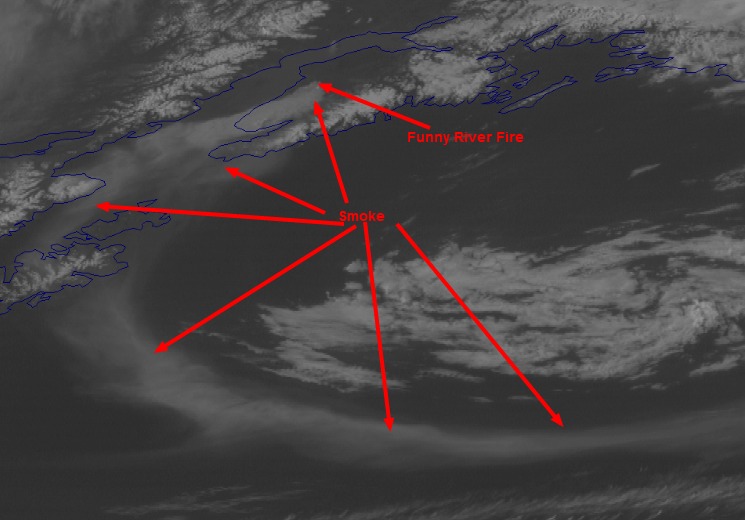
Funny River Fire in Atmospheric Cyclone
Funny River Fire in atmospheric cyclone, via Discover Magazine.

Discover Magazine has a very interesting animation from a weather satellite, showing the smoke from the Funny River Fire on the Kenai Peninsula in southern Alaska being swept up into a huge cyclonic system over the northern Pacific. The image above is a screen grab, to which we added the arrows and the smoke and fire labels, but check out the video animation.

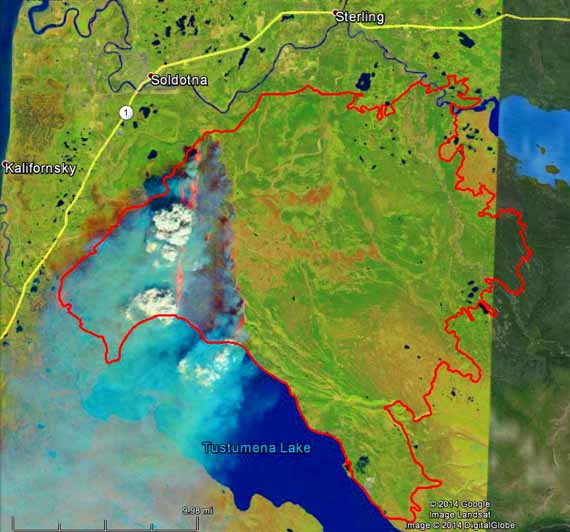
Funny River Fire, Landsat
Funny River Fire, Landsat, false color, 1:13 p.m. local time, May 20, 2014. The red line is the fire perimeter at 12:29 a.m. on May 29, 2014.

NASA has released photos of the Funny River Fire at Soldotna, Alaska taken May 20 at 1:23 local time by a Landsat satellite a day after the fire started on the 19th. We added a red line to the photos that represent the fire perimeter at 12:20 a.m. on May 29, 2014. In the false color photo above, the infrared sensor can see through some of the smoke and detects the heat, shown as orange, on the east and west fire edges.

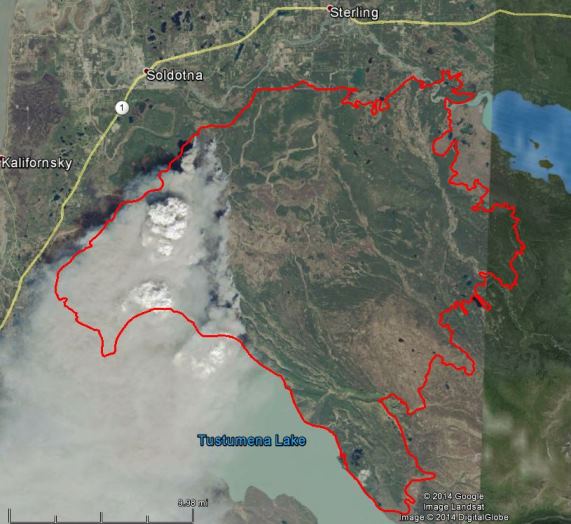
The photo below is true color, as would be seen by the human eye.

Funny River Fire, Landsat,
Funny River Fire, Landsat, true color, 1:13 p.m. local time, May 20, 2014. The red line is the fire perimeter at 12:29 a.m. on May 29, 2014. The clouds are pyrocumulus, created by the fire.
Funny River Fire May 25
Funny River Fire. Photo taken from the ground on May 25, 2014 by Josh Turnbow.

Our primary coverage of the Funny River fire is HERE.

Last survivor of Mann Gulch Fire dies

Mann Gulch Fire
Investigators on the Mann Gulch Fire looking south from Foreman Dodge’s escape fire.

The last of the three firefighters who survived the 1949 Mann Gulch Fire died Monday. Robert Sallee passed away from complications following open heart surgery.

Mr. Sallee was 17 when he parachuted into the Helena National Forest (map) above the fire along with 14 other smokejumpers from Hale Field in Missoula, Montana. As the crew worked their way toward the bottom of the fire at the Missouri River, the winds changed causing the fire below them to blow up and begin moving in their direction. As the crew retreated up the steep slope, Foreman Wagner Dodge lit an escape fire in the light fuels and told the rest of the crew to join him in the burned area, but none of them did. Mr. Sallee and another crewman, Walter B. Rumsey, took a different route than the other smokejumpers, squirming their way through a narrow crevice in a rim rock, finding much better conditions in a rock scree on the other side of the ridge. Foreman Dodge, when the main fire caught up with his escape fire, eventually followed the other two where the three of them had to keep moving around in the rock scree as the fire burned around them. The blowup burned about 3,000 acres, claiming the lives of 12 of the smokejumpers and one former smokejumper who had been fighting the fire for 4 hours before the jumpers arrived.

Foreman Dodge died five years later from Hodgkin’s disease, and Mr. Rumsey died in an airplane crash in 1980.

Norman Maclean wrote Young Men and Fire, a book about the smokejumpers and their demise in Mann Gulch. His son, John N. Maclean helped to edit and make some of the finishing touches on the book which was published in 1992, two years after his father’s death. John said that Mr. Sallee became a companion for Norman while he was collecting information for the book, and in later years was very generous in telling his story about the fire. John said Mr. Sallee had abundant social skills and “was almost courtly in his personal manner”. John later wrote Fire on the Mountain about the 1994 South Canyon Fire that killed 14 firefighters in Colorado.

About eight years after the Mann Gulch fire the “Ten Standard Firefighting Orders”  were developed and incorporated into firefighter training.

Funeral arrangements are pending at Hazen and Jaeger Valley Funeral Home in Spokane, Washington.


Thanks and a hat tip go out to Jay, Dave, Steve, Chris, and Shaun.