Shawna Legarza, a former Hotshot who is now the Director of Fire and Aviation for the U.S. Forest Service’s California Region was interviewed for the CBS evening News.
The subject came up of tracking the location of firefighters. We have written often about what we call the Holy Grail of Wildland Firefighter Safety, a system that could track in real time the location of firefighters on the ground AND the location of the fire, all displayed on one screen — anything from a cell phone or seven-inch tablet to a laptop computer at the Incident Command post. This data should be available in real time to ground and aviation personnel on fires, as well as key supervisors and decision makers in the Operations and Planning Sections. Knowing the positions of personnel relative to the fire would be a massive step in improved situational awareness and could reduce the number of firefighters killed on fires. This information could have saved 24 lives in recent years — 19 on the Yarnell Hill Fire and 5 on the Esperanza Fire. In both cases the firefighters and their supervisors did not know where the firefighters were relative to the location of the fire.
The technology is available right now. The military has been using it for years. Our leaders in wildfire suppression need to make the decision to get it done.
Smoke from Oak, Diego, and San Juan Fires, 6-30-2014. Wildfire Today and WeatherUnderground
Smoke from three fires in southwest Arizona and northern New Mexico is having a significant impact in those states as well as in parts of Texas Oklahoma, Colorado, and Kansas.
But that smoke is small potatoes compared to what is going on in northern Alberta, the Northwest Territories, and off the coast of New Brunswick. The smoke that is now over the Atlantic probably drifted across much of Canada and parts of New England.
There is not much current information available about the Diego Fire on the Santa Fe National Forests in New Mexico, but we determined that it is 25 miles northwest of Los Alamos, 7 miles southwest of Coyote, and 67 miles north of Albuquerque. It is listed at 1,000 acres at Inciweb, but it appears to be much larger than that in the satellite imagery we have seen.
The Oak and San Juan Fires in southwest Arizona are listed at 11,000 and 5,700 acres, respectively.
To see the most current smoke reports on Wildfire Today, visit the articles tagged “smoke” at https://wildfiretoday.com/tag/smoke/
In addition to remembering the 19 members of the Granite Mountain Hotshots who were killed a year ago today, this Week to Remember will include a commemoration to honor the 14 firefighters who died 20 years ago, July 6, 1994, on Storm King Mountain while fighting the South Canyon Fire.
The public is invited to the event for the South Canyon Fire which will be on July 6 from 4:45 p.m. until 6 p.m in Two Rivers Park in Glenwood Springs, Colorado.
Those 14 firefighters were: Kathi Beck, Tamera Bickett, Scott Blecha, Levi Brinkley, Robert Browning, Doug Dunbar, Terri Hagen, Bonnie Holtby, Rob Johnson, Jon Kelso, Don Mackey, Roger Roth, Jim Thrash, and Richard Tyler.
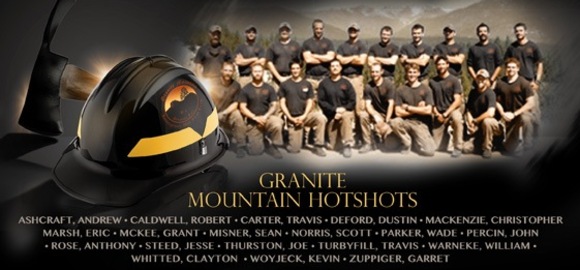
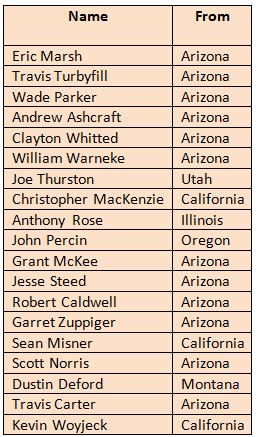
Today marks a year since all but one of the 20 members of the Granite Mountain Hotshots were killed while fighting the Yarnell Hill Fire in Arizona, June 30, 2013. A great deal of controversy still surrounds the incident, and the first two lawsuits were filed last week. But today I hope we can put those things aside and simply honor those 19 firefighters.
The media likes to call hotshot crews “elite”, and it is true — they are the best of the best. They are highly trained, extraordinarily physically fit professional firefighters, and excel as working as a team. That made it all the more shocking that they were suddenly taken from us.
Today let us grieve, again, for the loss. Our loss, their friends’ loss, and most of all the loss that their families will feel every day for the rest of their lives. Let us thank those 19 for their service, and pause for a few moments to honor their memory.
Nineteen white hearses brought the Granite Mountain Hotshots back to Prescott, Arizona, July 7, 2013, An Honor Guard escort accompanied each Hotshot. Photo by Bill Gabbert. Thousands of mourners said goodbye to the Granite Mountain Hotshots, June 9, 2014. Photo by Bill Gabbert.
MD-87 at Redmond, June 9, 2014. Photo by Jeff Ingelse. (Click to enlarge.)
All three of Erickson Aero Tanker’s MD-87s have been “recalled” — pulled out of service “due to intermittent engine surges when dropping [retardant at] high coverage levels”. John Kent Hamilton, the Aviation Safety Manager for the U.S. Forest Service Rocky Mountain Region, said the company believes they have a fix for the problem.
Erickson has developed and flight tested a new spade profile that has proved to eliminate this problem by keeping the fluid column much more vertical. They are in the final engineering approval stages and should be able to install with full approval early next week.
Since we ran a photo on January 6 of an MD-87 dropping water in an early test of the retardant system, there have questions raised on our site about retardant being ingested into the engines. That possibility gained further traction on June 9 with a photo of a parked MD-87 with what appeared to be retardant residue above the wing in front of an engine.
When we asked Kevin McCullough, the President of Erickson Aero Tanker, on June 9 if there were any problems with the MD-87s ingesting retardant into the engines, he said there were none.
The first two MD-87s, Tankers 101 and 105, began working June 4 and June 8, respectively. Soon thereafter, a third one, Tanker 103, reported for duty.
A few days after the MD-87s began dropping retardant on fires, a retardant leak inside the aircraft required that they be returned to their home base for repairs.
The last time we can remember an air tanker model being recalled was February 8, 2012 when the Federal Aviation Administration issued an Emergency Airworthiness Directive that required inspections of P2V aircraft after a 24-inch crack was found in a wing spar and skin on one of Neptune Aviation’s P2V-7 air tankers. This grounded the entire fleet of federal air tankers until all 11 of them were cleared the next day. Today we have a mix of five aircraft models, all with different retardant systems, reducing the chance that all of them will be shut down at the same time due to a defect.
Map of the Eightmile Fire. The red line was the perimeter at 1 a.m. June 29. The yellow line is from about 26 hours earlier.
The Eightmile Fire was less active on Saturday than it was on Friday when it grew from about an acre to almost 500 acres. It started on Monday from a lightning strike and is being managed, rather than totally suppressed, as a confine/contain fire. Early Sunday morning a mapping flight determined that it had grown by about 29 acres over the last 26 hours, to 524 acres. The Incident Management Team is calling it 25 percent contained.
The pre-evacuation notice for the 16 residence in Red Rocks subdivision remains in effect. On Saturday aircraft dropped 140,253 gallons of water and 71,315 gallons of retardant. Firefighters are constructing fireline in one Division on the fire, and are “continuing to seek opportunities and scout areas for tactical options” on the other three.
While they are deciding what to do, the area is under a Red Flag Warning from Sunday at noon until 7 p.m. for strong winds, low relative humidity, and dry fuels. The winds should be out of the west at 10 to 20 mph with the relative humidity at 10 percent. Monday will be a little cooler, less breezy, with a 20 percent chance of rain. **** (UPDATED at 8:48 a.m. MDT, June 28, 2014)
Map of Eightmile Fire at 10:30 p.m. MDT, June 27, 2014.
The Eightmile Fire 7 miles northeast of Cañon City, Colorado was mapped Friday night at 496 acres. It started from a lighting strike on Monday, June 23 and on Friday morning was still only about one acre in size. The fire is just east of Phantom Canyon Road (67), east of Eightmile Creek, and six miles west of Highway 115. It is burning on Bureau of Land Management land primarily in a Wilderness Study Area. The BLM is not totally suppressing the fire, but instead is employing a Confine/Contain strategy. Friday night the BLM issued this evacuation advisory:
The Fremont County Sheriff, in cooperation with Eightmile Fire managers, has issued a pre-evacuation notice for 16 residences in the Red Rocks Subdivision. Specifically, the residents on the west side of County Road 132 from mile marker 5 to mile marker 9.5. Residents are encouraged to be prepared to evacuate should the need arise. Again, this is a pre-evacuation notice only.
3D Map of Eightmile Fire, looking East at 10:30 p.m. MDT, June 27, 2014.
This is another trailer for the Disney movie, Planes: Fire & Rescue which will be in theaters in the United States beginning July 18. I can’t remember the last time I’ve been to an animated film, but I’ll have to check this one out. All of the other trailers we’ve seen for the movie (posted at Fire Aviation) emphasized aerial firefighting resources, but this one features ground-based resources, with one Single Engine Air Tanker and a couple of other aircraft thrown in for good measure.
Some actual wildland firefighters served as subject matter experts with the movie makers. That shows up in some of the terminology used, including in this one-minute clip, “Can you make it to your safety zone?”, and “Load and return”.
It is interesting that Disney went to such lengths to use the jargon that firefighters use. It makes you wonder who their target audience is for this animated feature. The producers of the Howie Long movie, Firestorm, did not pay that much attention to detail.
ToysRus, Walmart, and Amazon are already selling die-cast action figures.
CNN put together the above video about Los Angeles County’s Blackhawk helicopters, which they call Firehawks. The footage is impressive, and looks like an advertisement for Sikorsky and the maker of the “souped up” engines, General Electric. Some of the scenes actually did come from a commercial for GE that we had on our site in February.
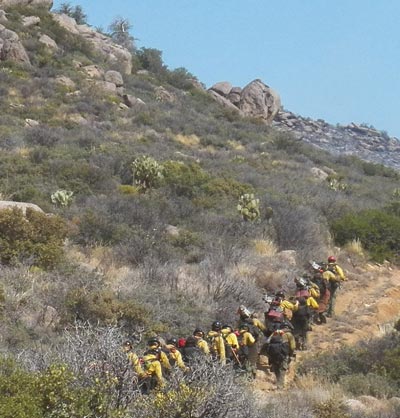
Granite Mountain Hotshots hiking to their assignment, June 30, 2013. Photo by Joy Collura.
It has been almost a year since 19 firefighters were killed on the Yarnell Hill Fire, June 30, 2013. The dust has settled near Yarnell, Arizona and many claims have been filed against various government agencies. One of those was converted into a lawsuit Monday when it was filed in Maricopa County Superior Court in Phoenix. It lists 162 property owners who name the state and the Arizona State Forestry Division as defendants. From the suit:
If the Arizona State Forestry Division had competently managed, contained and suppressed the Yarnell Hill Fire, no member of the Granite Mountain Interagency Hotshot Crew would have died. And Yarnell and its people would have escaped devastation.
That was the first of several lawsuits that will probably be filed. The second was issued Wednesday by 12 of the families of the firefighters killed in the fire.
While the sudden deaths of 19 people is horrific, it would ease our pain somewhat if we thought that something, anything, could come out of this that resembled lessons learned. If a few tidbits could be found in the ashes of the fire that could help others avoid a similar fate, maybe we could move forward with a glimmer of hope.
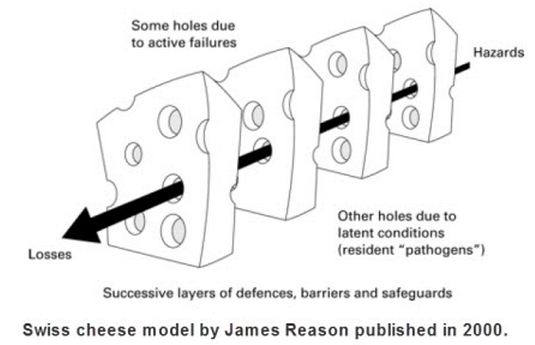
An experienced firefighter can analyze the two official reports about the fatalities, and combined with reading between the lines and drawing conclusions based on their knowledge, they can nit pic using 20-20 hindsight like a Monday morning quarterback. We succumbed to what we saw as inevitable and after the second report came out in December wrote a piece listing 19 issues, or holes in the slices of Swiss cheese, that when combined, the holes align, permitting (in James T. Reason’s words) “a trajectory of accident opportunity”, so that a hazard passes through holes in all of the slices, leading to a failure.
We put the 19 issues into four categories: supervision of aerial resources, supervision of ground personnel, planning, and communication. This was not the first time these issues, or deficiencies have been seen on wildland fires. Communication, for example, is listed in almost every investigation report for a fatality on a fire. And it was not the first time that firefighters took on an assignment without an adequate briefing, without a current map of the fire, had incorrectly programmed radios, no safety officer, no written incident action plan, or that an incident management team arrived on the third day of a fire without any Division Supervisors.
When you combine all of the slices of the Swiss cheese and their 19 holes, failure is not inevitable, but it becomes more difficult to avoid. When a sleepy fire awakens and becomes complex all within the space of a few hours, it taxes the infrastructure that has been put in place. A robust organization can be resilient in the face of adversity, recovering quickly from difficult conditions, possibly even compensating for 19 holes. But if the organization and decision making, affected in some cases by little sleep over the previous 48 hours, is stressed and tested beyond its limits, undesirable results are more likely to occur.
It is conceivable that if one or more of the issues, or holes, had not occurred, we would not be mourning the 19 members of the Granite Mountain Hotshots.
One thing we don’t know about the fatalities on the Yarnell Hill Fire is why, exactly, the 19 firefighters walked into what became a lethal firetrap in a canyon. Nothing in the reports shed much light on how that decision was made, or by whom. It seems counter-intuitive that experienced firefighters would leave the safety of a previously burned area and expose themselves to the fire as they walked through unburned, very flammable vegetation, especially after a warning had been issued over the radio about an approaching thunderstorm cell with strong winds.
As the lawsuits work their way through the court system, the discovery process may yield information the government agencies that commissioned the reports preferred to be kept out of the public eye. Questions may be answered.
We can label them mistakes or unfortunate decisions, but what was done on the fire has been done before. Most of the time firefighters are lucky and get away with it, returning to their families when the fire is out. Other times they become documented in fatality reports.
While there may be few cultural changes coming out of this fire, other than perhaps being more aggressive and attacking new fires with overwhelming force, many firefighters and managers will move some basic safety principles closer to the surface of their ongoing evaluation of conditions on a fire. Supervisors may double and triple-check the location of their fire resources, and confirm through active listening techniques that orders and assignments are absolutely clear and understood. And that works both ways, up and down the chain of command. Fire managers could evaluate the supervision of aerial resources more often to ensure that the workload and span of control are within reasonable limits. Agency administrators could be certain that the management structure on a fire is appropriate for the complexity, and that “short” incident management teams are rarely if ever used. Transitions from one incident management organization to another may be watched more carefully.
Based on what we know about the fire, there is no earth-shaking revelation that can become a lesson learned. They have already been taught. Firefighters have been making the same mistakes for decades. They end up in reports that sit on shelves or hard drives. Unfortunately, another firefighter will repeat them. And they might be lucky, or resilient, and go home to their family when the fire is out.
Air Spray has received a new Single Engine Air Tanker (SEAT) and will be getting a second one in a few weeks. The Air Tractor 802 holds 800 gallons of fire retardant and can get into narrow canyons that are more of a challenge for the larger 3,000 to 4,000 gallon “next generation” air tankers.
Air Spray has a contract for one of them with the State of Oregon and will be seeking employment for the other one.
Air Spray mobile retardant base. Photo by Air Spray.
They have a mobile retardant base installed on a large trailer which will be heading to Oregon with the AT 802.
Air Spray mobile retardant base. Photo by Air Spray.
Their effort to convert two BAe-146 jet-powered airliners into air tankers is going slower than they expected. When we visited their project at the Chico, California airport in March and talked with Ravi Saip (Director of Maintenance/General Manager) and Paul Lane (Vice President and Chief Financial Officer) they said they hoped to have most of the work done by the end of the summer, then they would begin the testing, tweaking, improving, and certification phases. In an article in the Chico ER, Mr. Saip was quoted as saying they now expect one of the BAe-146s to be ready for the 2015 fire season, and “They took longer to modify than we expected”. Other air tanker companies converting BAe-146s have found that much of the aircraft’s infrastructure in the belly has to be worked around and/or relocated in order to install an internal tank and door system as they are doing.
Ravi Saip and Paul Lane of Air Spray, March 21, 2014, in front of one of their Lockheed Electras at Chico, California, which is under a CWN contract with CAL FIRE. It will be in Chico again beginning in August, 2014. Photo by Bill Gabbert.