More regulations for drones on the way

The United States and Australian governments will be developing additional regulations for Unmanned Aerial Systems (UAS), or drones. With the entry price of around $500 without a camera, the number of these things in the air is increasing substantially. It is a pretty safe bet that many people found one under their Christmas tree this year. Drones have already created problems on wildfires in both countries.

The PBS News Hour recently covered the subject, indicating that Congress will develop their own rules, in lieu of the FAA’s failure to develop anything substantial so far:

… “That appears to be what some key lawmakers have in mind. “We in Congress are very interested in UAS,” Rep. Bill Shuster, R-Pa., chairman of the House Transportation and Infrastructure Committee, said at a hearing this month, referring to unmanned aerial systems, or drones. “We understand UAS are an exciting technology with the potential to transform parts of our economy. … It is our responsibility to take a close look.”

One of the committee’s first priorities next year is writing legislation to reauthorize FAA programs and overhaul aviation policy. The bill is expected to include directions from lawmakers on how to integrate drones into the nation’s aviation system. The last reauthorization bill, passed in 2012, directed the agency to integrate drones by Sept. 30, 2015, but it’s clear the FAA will miss that deadline.”…

Now Congress is going to provide directions on how to operate UAS’s in the National Airspace …

A scary thought — Congress developing aviation rules.

Below are excerpts from Queensland Country Life about how Australia plans to deal with the proliferation of UAS:

AUSTRALIA is set to have among the world’s toughest rules on drones after the Civil Aviation and Safety Authority (CASA) rewrites its regulations in the new year.

CASA spokesman Peter Gibson said the “huge growth” in popularity of the flying “unmanned aerial vehicles” – which are helicopter-like craft, with GPS and cameras – meant regulations had to be “updated”.

At the moment drones for commercial use by police, fire services, aerial photographers and in some agricultural settings are regulated by CASA. Commercial users – there are 180 in Australia, a jump on only 34 in 2013 – need a licence. But recreational users do not.

Mr Gibson said drones must be kept more than 30 metres away from other people and must not be flown over crowds of people at beaches or sporting events.

Drones can only be operated in daylight where the operator can see them, should be kept more than 5 kilometres from airports and be flown below 121 metres.

Infringement notices can be issued if these regulations are broken. Prosecutions can be enforced if anyone is injured.

Late last year CASA struck a deal with a big drone manufacturer, DJI Phantom, in China, to insert written guidelines in the boxes. This follows incidents of drones being flown over bushfires and crime scenes to capture video and photographs. In October 2013 a drone flew over a bushfire near Sydney, forcing emergency services to ground firefighting aircraft.

A man who flew a drone at the scene of a siege at Altona North in Victoria two weeks ago will be fined $850. The drone crashed into a power line and fell, nearly hitting a police officer. In June a drone narrowly missed a rescue helicopter in Newcastle. It was flying at nearly 300 metres.

We heard from Dick who said:

Retired USFS Smokejumper and Pilot Willis Curdy from Missoula starts Monday [January 5, 2015] as a member of the Montana House. He’ll introduce legislation limiting drones.

Here is an excerpt from an article at Fire Aviation last summer:

A privately operated drone (or unmanned aerial vehicle) caused concern on the Sand Fire south of Placerville, California on Sunday. The person that was controlling the aircraft and getting video footage of the blaze was told by authorities to stop because of the potential danger to helicopters, lead planes, and air tankers flying over the fire.

A video shot from the drone was uploaded to YouTube showing that the aircraft was directly over the fire, which could have been a serious hazard to helicopters and air tankers operating at 50 to 180 feet above the ground.

There are reports that Air Attack, when informed of the drone, came close to grounding all firefighting aircraft until the threat could be mitigated. However the operator was found and instead, the drone was grounded.

Last month the U.S. Forest Service and the Department of the Interior issued an Interagency Aviation Safety Alert about the hazards of unmanned aerial vehicles operating near wildfires.

Thanks and a tip of the hat go out to Bean.

NFL player decides he’d rather be a firefighter

Danny Watkins
NFL

It’s a pretty incredible story.

A very talented NFL pro football player gave up his multi-million dollar a year job to do what he really wanted — to become a firefighter.

Danny Watkins was born  in Kelowna, British Columbia. He didn’t play American football in Canada at all, but did play hockey and some rugby. He was fascinated with firefighting and at the age of 16 became the first junior firefighter with the West Kelowna Fire Department. He was large, 6 feet tall, and after a while he began responding to calls. There is a report that on a medical aid, he singlehandedly lifted a 250-pound man.

After high school he joined the department in a part-time capacity, and lived in the firehouse for a while. Knowing that he needed some formal education to further his career, he researched colleges with fire science programs and enrolled in Butte College in Oroville, California in 2008, at the age of 24. At 6-feet-3 and 305 pounds, the football coach convinced him to be on the team. By the season opener he was the starting right guard. That year he watched on television for the first time an entire football game, and was hooked. In his second year he was contacted by nearly 50 four-year universities and selected a football scholarship at Baylor.

Mr. Watkins was selected with the 23rd overall pick by the Philadelphia Eagles in the 2011 NFL Draft, at 26 becoming the oldest first-round selection since 1980, signing a four-year contract worth $7.9 million. Before the draft, most players take a test, the Wonderlic personality/intelligence test. He reportedly scored a 40, while the average score for an offensive lineman is in the low 20s. He was one of the smartest guys in one of the smartest position groups in football. By week 5 of the regular season he was the starting right guard for the Eagles.

He was very effective and involved with football while at Butte and Baylor, but when he moved to the pros, he seemed to be disinterested or preoccupied. Many football players at the NFL level spend much of their unscheduled time at the team facility studying or working out. Mr. Watkins used some of that time to visit fire houses in Philadelphia. He became friends with some of the firefighters and it is said that he sometimes provided them with tickets to the Eagles games. He was reportedly photographed at the scene of a fire with an elite crew, Rescue 1, outfitted in personal protective gear and carrying a cutoff saw. But fighting fire was not something his coach wanted him to do.

During his second year at Philadelphia he dealt with a nagging ankle injury and was traded to Miami for his third year in the league, getting a one year contract.

The Monday Morning Quarterback has a long, interesting, detailed article about Mr. Watkins, and includes this quote from him about his third and final season in the NFL:

Then I got to Miami, and the whole Jonathan Martin and Richie Incognito scandal happened, and I looked around and realized this isn’t where I wanted to be. I re-evaluated how things were going, and I knew I was ready to be a fireman again. I missed it so much.

He spent that season as a seldom-used reserve and when it was over, walked away. He never announced his retirement. He just left when his contract was over at the end of the 2013 season.

Many teams called his agent asking if he would come to their facility to work out and discuss his availability, but he was not interested.

Now he is doing what he really wanted all along. He is fighting fire with a department near Dallas.

NTSB report on the crash of Tanker 11

Air Tanker 45
Air Tanker 45, similar to Tanker 11, on final to drop on the Whoopup Fire near the South Dakota/Wyoming state line in 2011. Photo by Bill Gabbert.

The National Transportation Safety Board probable cause report on the June 3, 2012 crash of Tanker 11 concluded that while preparing to drop retardant on the White Rock fire near the Utah/Nevada state line, the flight crewmembers “did not properly compensate for the wind conditions while maneuvering”. The aircraft impacted the ground before it reached the location for the intended drop, causing the death of pilots Todd Tompkins and Ron Chambless.

A photographer got some pictures of the tanker as it was attempting to make the drop (below). It is likely that the pilots jettisoned the retardant when it became obvious they were too low.

tanker 11 crash
Tanker 11 before the crash. Photo from NTSB.

The P2V, operated by Neptune Aviation, was about to make its second drop on the fire that day. Shortly before the crash it made a dry run over the target area, then when lining up for the drop on the next pass took a different path, which was lower, and made a wider right turn, according to the report.

T11 flight pathThe same day that Tanker 11 crashed, another P2V, Tanker 55 operated by Minden, had a mechanical failure and landed at Minden, Nevada with a main landing gear not fully extended. The aircraft was heavily damaged, but there were no serious injuries. The landing was recorded on video.

In June of this year Tanker 48, another Minden P2V, landed with a collapsed nose gear. Thankfully there were no reported injuries.

We covered the 2012 accidents on Wildfire Today (before Fire Aviation was created).

On June 26, 2010 air tanker 44, a P2V operated by Neptune Aviation also experienced a hydraulic failure upon landing, had no brakes, and went off the runway at Rocky Mountain Metropolitan Airport (JeffCo) in Colorado (map). Both pilots self-evacuated and were walking around when the fire apparatus arrived to put out a fire in one of the engines. Neptune repaired the aircraft and put it back into service.

The NTSB released a nine-page Factual Report on the crash of Tanker 11. Below is the complete text of the one-page probable cause report, released September 24, 2014:

****

14 CFR Public Use
Accident occurred Sunday, June 03, 2012 in Modena, UT
Probable Cause Approval Date: 09/24/2014
Aircraft: LOCKHEED P2V-7, registration: N14447
Injuries: 2 Fatal.

NTSB investigators either traveled in support of this investigation or conducted a significant amount of investigative work without any travel, and used data obtained from various sources to prepare this public aircraft accident report.

Tanker 11 departed the tanker base to conduct its second fire retardant drop of the day in the same location. Upon arriving in the fire traffic area, Tanker 11 followed the lead airplane into the drop zone, which was located in a shallow valley 0.4 mile wide and 350 feet deep. The lead airplane flew a shallow right turn onto final and then dropped to an altitude of 150 feet above the valley floor while approaching the intended drop zone. While making the right turn onto final behind the lead airplane, Tanker 11’s right wing tip collided with terrain, which resulted in a rapid right yaw and subsequent impact with terrain. The wreckage created a 1,088-foot-long debris field, and a postimpact fire ensued.

Two witnesses took photographs of the accident sequence photos, and an examination of these photographs showed that the lead airplane was positioned ahead of the tanker throughout the flight; however, the orientation of the lead airplane compared to the orientation of Tanker 11 indicated that Tanker 11 did not directly follow the lead airplane’s path to the final drop course. Rather, it was about 700 feet left of the lead airplane’s path and made a wider right turn as it attempted to align with the final drop course. The accident flight crewmembers had previously flown nearly the same exact drop and the lead pilot cautioned them about tailwind conditions during the flight; however, the wider turn suggests that they did not properly compensate for the wind conditions while maneuvering. In addition, the previous flight was conducted at an altitude above the ridgeline. GPS evidence indicates that the accident flight was conducted below the ridgeline, which would have made it more difficult to detect the rising terrain during the wider turn. A review of the airplane’s cockpit voice recorder audio information revealed that the flight crew did not recognize or attempt to correct the reduced clearance between Tanker 11 and the rising terrain until about 2 seconds before impact.

The National Transportation Safety Board determines the probable cause(s) of this accident as follows:

  • The flight crew’s misjudgment of terrain clearance while maneuvering for an aerial application run, which resulted in controlled flight into terrain. Contributing to the accident was the flight crew’s failure to follow the lead airplane’s track and to effectively compensate for the tailwind condition while maneuvering.


Aerial mulching on the King Fire

heli-mulching King Fire
A helicopter lifting a sling load of straw mulch. USFS photo.

Two months after 12 firefighters were entrapped and eventually led to safety by a pilot in a helicopter, helicopters again played an important role in the King Fire in northern California.

In late November the U.S. Forest Service (USFS) and the Sacramento Municipal Utility District (SMUD) began a joint project to drop straw mulch from helicopters over approximately 1,200 acres of Eldorado National Forest land that burned with moderate to high intensity during the recent King Fire. The purpose of the project is to protect critical infrastructure from potentially severe post-fire erosion that may occur with winter storms. The infrastructure at risk includes Eleven Pines Road, which serves as the primary route from Highway 50 to the northern end of the Eldorado National Forest, and the Brush Creek and Slab Creek reservoirs, which are integral to SMUD’s hydroelectric facilities in the Sierra Nevada Mountains.

heli-mulching King Fire
A completed straw mulch unit. USFS photo.

“This is a great example of the outstanding collaboration we’ve had during all phases of the King Fire,” said Eldorado Forest Supervisor Laurence Crabtree. A contract was awarded to Bradco Environmental, a company based in Crestline, CA, to complete the work. Large bales of certified weed free straw, a by-product of rice grown in California, were loaded into horizontal grinders which chopped the straw into four to eight inch pieces of mulch prior to aerial application. Two medium sized helicopters were used to drop the mulch onto slopes ranging from 15% to 60% grade, treating approximately 80 acres per day with each helicopter.

All of the treatment areas were identified by Forest Service soil scientists and hydrologists as sites needing immediate attention before heavy winter rains and snow arrived. This emergency erosion prevention project is designed to reduce the amount of sediment eroding off hillsides due to the loss of vegetative cover associated with the fire. Excessive sediment can block culverts and impact water quality in streams and reservoirs which could lead to flooding, road closures, decreased water storage capacity and loss of hydroelectric generation. This joint helimulching project is expected to prevent several thousand tons of sediment from eroding.

On December 4, 2014, due to the predicted weather for the following couple of weeks, all mulching operations were halted until the King Fire receives a significant warming and drying period or until after spring snow melt. This could be several months. Storm patrols and engineering work will continue throughout the winter.

heli-mulching King Fire
Burned Area Emergency Response crew inspects a straw mulched unit. USFS photo.

Articles tagged “King Fire” on Wildfire Today.

A look back at the “air tanker crisis”

A month after two Korean War vintage P2V air tankers crashed on the same day in June, 2012 killing two people, the Society of American Foresters magazine published an article about the state of the U.S. air tanker fleet. At that time there were only 9 large air tankers on exclusive use contracts in the United States, down from 44 in 2012. Eight days after those fatalities the U.S. Forest Service issued contracts for approximately seven air tankers that were built in the 1980s and 1990s. The agency is expected to issue another similar contract for an unknown number of retired airliners in 2015. Earlier this month a bill passed in Congress that earmarked $65 million, apparently for the USFS to purchase one new aircraft to be converted into an air tanker.

Below is a piece we had on Wildfire Today, July 17, 2012, about an article in the magazine of the Society of American Foresters. Since it was published, most of the recently contracted “next-generation” air tankers have served admirably, and a couple of them are spending the North American winter on contracts in Australia during the down under summer fire season. However, there have been hiccups, which is not unexpected when placing a new tank design in a jet airliner that had not previously been used to drop retardant on forest fires.

****

P2V on the Whoopup fire
A P2V over the Whoopup Fire, July 18, 2011. Photo by Bill Gabbert.

We were recently interviewed by Steve Wilent who wrote an article about what we are calling the air tanker crisis for The Forestry Source, a publication of the Society of American Foresters. The article is reprinted here with their permission.

=============================================================

From the July 2012 edition of The Forestry Source. © 2012, The Society of American Foresters (www.eforester.org)

Forest Service Bolsters Airtanker Fleet After Two Crashes

By Steve Wilent, Editor, The Forestry Source

As massive wildfires burning in the Southwest made for an ominous beginning to the 2012 fire season, two airtankers crashed in June, leaving two crew members dead and underscoring warnings about the safety of the US Forest Service’s aging and depleted fleet. Both aircraft were 50-year-old Lockheed P2Vs originally designed for US military anti-submarine patrols. With the crashes, the agency had just 9 large airtankers under contract, down from a fleet of 44 in 2002.

The two firefighters died in the same June 3 crash in western Utah when their P2V veered off course and slammed into mountainous terrain, according to a preliminary National Transportation Safety Board report. The second accident occurred on the same day near Reno, Nevada, when another P2V crash-landed after its landing gear failed to deploy.

“The pilots of Tanker 11 lost their lives protecting public safety and natural resources,” said Tom Harbour, Director of Fire and Aviation Management for the U.S. Forest Service. “As the entire fire and aviation community grieves their loss, we must ensure that we maintain our capability to fulfill our responsibilities to be prepared to respond vigorously to wildfires threatening people, communities, infrastructure, and natural and cultural resources.”

On June 11, the agency announced the addition of eight aircraft to the fleet, including one DC-10, and said it would arrange for 5 additional large helicopters to be activated earlier than scheduled. On June 13, President Obama signed a bill, rushed through Congress after the two crashes, that waives certain Forest Service airtanker contracting requirements, allowing the agency to speed up issuing contracts for “next generation” aircraft.

Even before the crashes, critics called for strengthening of the agency’s weakened airtanker fleet.

“With an aging fleet that has dwindled from 44 airtankers in 2002 to 11 this year, and will continue to decline in the years to come, I am unconvinced the USFS’s current airtanker fleet is prepared to adequately address an immense wildfire or even what is sure to be a long fire season,” wrote Colorado Sen. Mark Udall in an April 12 letter to Forest Service Chief Tom Tidwell.

Such concerns are not new. Following the crashes of two airtankers in 2002—one of which was filmed by a television news crew as its wings broke off in mid-air—the Forest Service and Bureau of Land Management commissioned a Blue Ribbon Panel to assess the federal wildfire aviation program. Among its eight major findings, the panel determined that “The safety record of fixed-wing aircraft and helicopters used in wildland fire management is unacceptable.” The report is available on the Source Extras page, www.safnet.org/members/archive/source_extras.cfm.

Since then, more-stringent safety requirements and inspections have led to many aircraft being deemed less than airworthy, a key factor in the reduction in the fleet’s numbers.

In February, the Forest Service released a “Large Airtanker Modernization Strategy” (www.fs.fed.us/fire/aviation/) that recommended contracting for 18 to 28 “next generation” large airtankers that are more reliable, faster, and can carry more retardant than the “legacy” airtankers.

2002 Report Still Valid

Former Texas state forester Jim Hull, now retired, was co-chair of the Blue Ribbon Panel.

“The report that we did nearly a decade ago is just as valid today as it was back then,” Hull said in a June interview. “There has been a continuous cycle of trying to use the old, worn-out military planes, and we’ve been doing this now for over 50 years. At some point, somebody’s got to wake up and realize that we’ve got to do something different.”

However, Hull cautions against assuming that the age of the aircraft had anything to do with the two crashes in June, pending a final report by the National Transportation Safety Board.

“It seems to me that one of our findings seems to be continually overlooked,” Hull said. “And that is the fact that no one in Congress or the administrations since then, whichever party has been in power, has seemed inclined to wake up to the fact that this is a national issue. It’s not a Forest Service or BLM issue, it’s a national issue—it’s going to take national leadership to provide adequate aerial firefighting capability for the nation. You can’t blame the agencies. I think they’re probably doing the best that they can possibly do with the funds that they have. Until the leadership of the nation is willing to mandate [the establishment of a modern airtanker fleet] and the funding to go with it, I don’t see any way that were going to resolve this problem.”

Bill Gabbert, former executive director of the International Association of Wildland Fire and editor of the Wildfire Today web site (wildfiretoday.com), said the Forest Service bears the responsibility for the state of the airtanker fleet.

“Since the fatal crashes in 2002, the Forest Service just hasn’t stepped up to the plate to make any decisions,” Gabbert said. “They have not shown any leadership on how to rebuild the fleet. They have managed the problem strictly in a negative sense, by banning certain types of aircraft from the fleet, but they haven’t done anything to encourage or make it easier for the private contractors to add to their fleets. It’s extremely difficult under the current procedures for a private vendor to buy an aircraft and pay to have it retrofitted as an airtanker.”

A key factor, Gabbert said, is that a contractor seeking a loan to buy and retrofit an aircraft can’t show a bank that it will receive enough income to justify the loan.

“There’s no guarantee that a contractor will receive a certain amount of income, even if they do get a contract for an aircraft. They don’t know how much they will fly or how much they will make. They don’t know if the aircraft will pass tests by the Inter-Agency Airtanker Board. There are just too many unknowns. There are just too many unknowns,” said Gabbert.

The solution, said Gabbert, is for the agency to purchase its own airtankers.

“I’ve reluctantly come to the conclusion that about the only way to ensure that we rebuild the fleet with safe aircraft is for the Forest Service to come up with a specific proposal, not one full of generalities like they did a few months ago [with the Large Airtanker Modernization Strategy],” he said. “They need to submit a specific, detailed proposal to Congress to ask for money to buy brand-new aircraft, including funding to retrofit them as airtankers. Brand-new, state-of-the-art, safe aircraft. And then they should issue contracts to private contractors to fly and maintain those airtankers. If we don’t do that, then we are just going to get more old, discarded aircraft.”

Happy holidays


lighted tree

We hope your holidays are filled with peace and happiness.

Happy Holidays

holidayWhatever you celebrate this time of the year, we hope you are safe and joyful.

A Christmas Eve(ning) in Wind Cave National Park.

elk  in Wind Cave National Park

These photos were shot over a 61-minute period in Wind Cave National Park this Christmas Eve(ning). The elk is a 6×6.

coyote  in Wind Cave National Park

I have heard of wolves doing what I saw this coyote doing. I think he was hunting mice or some other small creature. The nearest prairie dog town was about 400 feet away. He would be very still for a while, then would suddenly leap a foot or two up in the air, and forward, then come down with his nose right at the ground.

antelope in Wind Cave National Park

Wind Cave deer

bison in Wind Cave National ParkThe animals are, top to bottom:  elk, coyote, pronghorn antelope, white tail deer, and bison.

The military assists with firefighting in 2014

coco fire marine helicopter
Marines assist in efforts to contain the Coco Fire in San Marcos, California, May 15, 2014. U.S. Marine Corps photo by Cpt. Tyler C. Gregory.

The Department of Defense included these photos in a collection of images that look back on 2014.

marine helicopter wildfire
A CH-53E Super Stallion helicopter prepares to release water from a Bambi bucket to help fight wildfires on Marine Corps Base Camp Pendleton, California, May 16, 2014. The fires burned more than 6,000 acres. U.S. Marine Corps photo by Lance Cpl. Tabitha Castellano.
national guard helicopter wildfire
Army Chief Warrant Officer 4 Noel Larson and Army Chief Warrant Officer 2 Nick Gliem line up their UH-60 Black Hawk helicopter to help fight wildfires near Leavenworth, Washington, July 31, 2014. Washington National Guard photo by U.S. Army Staff Sgt. Dave Goodhue.

Acres burned in Canada in 2014 were three times the average

According to a summary of the 2014 wildfire season in Canada prepared by Environment Canada, the number of acres burned in the country was three times the 20-year average, due primarily to heavy fire activity in the Northwest Territories and British Columbia.

Here is how they summed it up:

****

“While conditions were not favourable for wildfires in most areas of the country in 2014, it was still a huge wildfire year in Canada. According to the Canadian Interagency Forest Fire Centre, although the absolute number of wildland fires was 10 per cent less than the 20-year average, the area burned was three times higher than the 20-year national average (4.6 million hectares vs. the normal 1.5 million hectares). So even with parts of Canada being, at times, soaked by heavy rains or underwater from floods, the Northwest Territories and British Columbia made up for it all with exceptional warmth and dryness that brought sparks to infernos in no time flat.

In the Northwest Territories it started with a cold winter and scanty snows that left the ground and forest litter dry. With summer came clear skies and record warm temperatures that optimized already perfect conditions for fires to spread. The principal culprit was a stalled ridge of drying air anchored over the Mackenzie River valley for weeks. Temperatures from Tuktoyaktuk to Yellowknife averaged well above historic averages. The Mackenzie region averaged 1.6°C warmer than normal – the seventh warmest summer in 67 years. Yellowknife had 22 days in June and July at or above 25°C, compared to an average of eight, and only two days in June and three in July with rain. In a 91-day span, from the May long-weekend onwards, Yellowknife received only one-half its normal rainfall. As further evidence of the dryness, water levels in the Mackenzie River dropped to some of the lowest seen in more than 30 years.

So it was no surprise to anyone that the Northwest Territories had its worst fire season in 30 years with nearly 3.4 million hectares razed. That’s seven times the normal acreage consumed and six times the size of Prince Edward Island. At the peak of the fire season, smoke, ash and moisture from intense fires travelled as high as 15 km in the air, easily circling the globe. Some plumes travelled south and east affecting air quality in the northern plains of the United States, the Canadian Maritimes and even as far as Portugal. The fires caused a host of problems, including highway closures due to reduced visibility, the destruction of fibre optic cables and the interruption of Yellowknife’s main power supply line.

Health risks were also a concern as the city’s hospital treated twice the usual number of patients for respiratory and allergy issues. Smoke was so thick that, at times, it was hard to breathe indoors with the windows closed let alone venturing outside. Widespread forest fires also stranded visitors and adversely affected busy tourist camps and attractions. In August, firefighters and residents finally got a breather when cooler and wetter weather took hold. Temperatures dropped significantly and rainfall was 50 per cent more than normal for the month.

In British Columbia, an overheated wildfire season scorched the third-biggest loss of timber in the province since authorities began recording wildfire statistics more than 60 years ago. Fires burned more than 338,000 hectares through the province – seven and a half times the normal area charred on average over 20 years. No homes or notable structures were destroyed, but the province more than quadrupled its firefighting budget, spending $266 million.

Conditions for the wildfire season started in 2013 when places like Victoria experienced their driest October-to-December on record. Summer perfected conditions for igniting and spreading wildfires as average temperature across coastal and southern portions of the province made for the third-warmest summer over 67 years of record-keeping and one of the top ten driest summers. Record-high July maximum temperatures soared into the low 40s in several interior communities. Some places claimed it was the driest summer in more than half a century. Among the major fires were those that burned in vast dead pine forests killed by mountain pine beetles or on steep, inaccessible terrain, increasing risks and challenges to firefighters and communities.

Nearly 400 firefighters from Ontario, the Maritimes, Alaska and even Australia pitched in to help. The biggest and most difficult forest fire was near the Chelaslie River south of Burns Lake in northwestern British Columbia. It burned 133,162 hectares, accounting for more than 30 per cent of land burned in the province this year. Another big fire occurred in northern British Columbia near the Alberta border when a lightning strike whipped by strong winds caused 3,800 hectares to burn at Red Deer Creek. And a fire at Smith Creek, west of Kelowna, forced 2,500 people out of their homes. Over the course of the summer a series of smoke advisories and special air quality statements, issued by the province and Environment Canada respectively, were put in place for many regions, including the Okanagan Valley where residents of Peachland were urged to keep small children, the elderly and pets inside. On occasion, even Vancouver and the Fraser Valley were subject to air quality advisories as smoke plumes hung heavy over the skies.

Fortunately, timely rains and cool temperatures from September through October saved British Columbia from a second disastrous forest fire season and brought much-needed moisture to the somewhat water-starved province. Rainfall in Victoria and Vancouver totalled more than 40 per cent above normal, with Vancouver experiencing its wettest September-October in 10 years.”

****

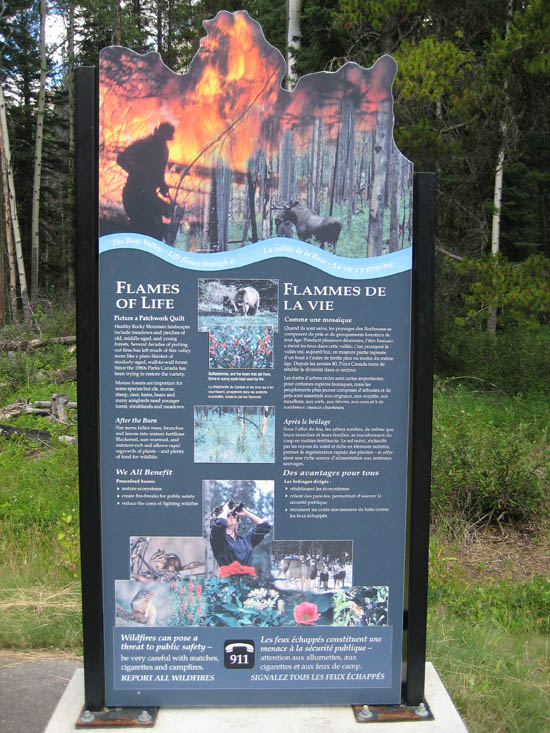
fire Alberta Bow Valley
An interpretive sign in Alberta’s Bow Valley. Photo by Bill Gabbert.

(To see a high resolution 3.8MB version of the above photo, click HERE.)