Why don’t we record fireground radio transmissions?

The most significant unanswered question about the 19 fatalities on the 2013 Yarnell Hill Fire is, why did the Granite Mountain Hotshots leave the safety of a previously burned area and walk through unburned brush toward a ranch. Undoubtedly some of the firefighters that were working on the fire heard radio transmissions during which the order to relocate was discussed, but due to lawyering-up and the refusal of the U.S. Forest Service to allow their firefighters to provide information, other firefighters may never know why or by whom that fateful decision was made.

It is possible that a simple device costing less than $200 could have recorded the fireground radio transmissions and this issue could have been settled within hours of the accident. And a lesson may have been learned, preventing other firefighters from making the same mistake.

Cockpit voice recorders in an aircraft capture conversations and radio transmissions, dash cameras in law enforcement vehicles record audio and video, and recently there have been recommendations that every police officer wear a body camera.

dash camera
An example of a dash camera.

One of the recommendations from investigators following the death of Dallas firefighter Stanley Wilson, and earlier than that, Dallas Lt. Todd Krodle, was that on-scene radio transmissions be recorded.

Firefighter Wilson’s widow, Jenny, said she had one simple wish: that fireground radio transmissions be recorded. After the Dallas FD balked at spending the money, FirefighterCloseCalls looked into recording devices. Here is an excerpt from their article:

…Stop the bullsh*t—a system that records repeated or simplex radio transmissions won’t break the City-or most any other jurisdiction. It can be done through a central location or battalion chief buggies can be equipped with them…simple fireground recorders. And you don’t even need to form a committee.

As an example, I searched and found www.FireVideo.net and for much less than $200.00 each, you can have a dash (or rear of command buggy) recorder with audio and video for every buggy-it can record over 10 hours and it automatically turns on.

So let’s just say the “big D” has 9 battalions and a few other senior chiefs/safety officers etc per shift. So, for about $2000.00 total, EVERY on-duty DFR buggy has a working, state of the art recorder. That’s less than it will cost to buy lunch at the next city council meeting. Where there’s a will, there’s a way. That was easy.

Either way, it’s 2015 and it’s ridiculous to not be able to go back and listen to fireground channels-after fires that went well or ones such as this one where Captain Wilson was tragically killed.

Look, if we can go on the Internet and watch Freddie firefighter with his helmet cam stretch a booster line to a raging mulch bed on fire, fireground channels can be recorded right at the buggy. It may cost some a little money, but that’s the price of putting a sign in front of a building and calling it the “FIRE DEPT”.

Recording fireground radio transmissions on a wildland fire is very different from recording those at a structure fire, but that does not mean it is impossible, or that we should throw up our hands and say it can’t be done. Low power direct transmissions from hand held radios do not travel much beyond line of sight, but if there were a few recording devices in vehicles scattered around a fire there is a chance that a key conversation could be recorded that might later lead toward a lesson learned.

It would not be a perfect system. Not every channel would be recorded, and some would be missed. But for less than $200 per Battalion Chief’s vehicle, a National Forest, a state agency, or a county fire department with a heavy wildland responsibility should experiment with a few devices.

Two Yarnell lawsuits dismissed

Yarnell Hill Fire
The Yarnell Hill Fire burns into Yarnell, Arizona in 2013. Photo by Joy Collura.

A Maricopa County Superior Court judge on Wednesday dismissed two lawsuits filed against the state of Arizona by residents of Yarnell whose homes burned in the 2013 fire that killed 19 members of the Granite Mountain Hotshots.

The judge decided that the state did not have a duty to protect the property when it undertook management of the fire. The homeowners plan to appeal.

The 8,400-acre fire destroyed 127 residences in the Yarnell area.

Bill introduced to require local approval or collaboration of prescribed fires

Cold Brook Fire April 13, 2015
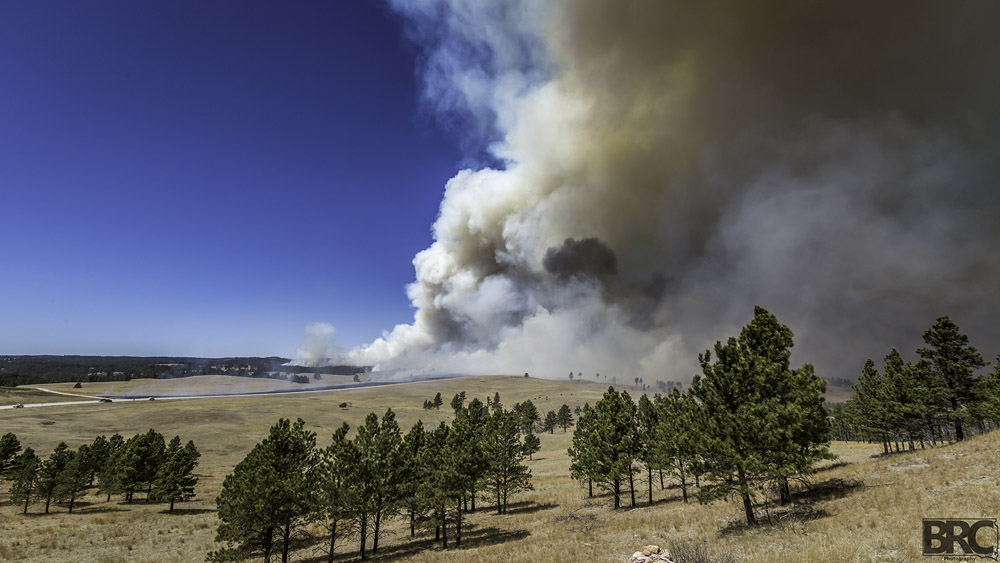
Cold Brook Fire April 13, 2015, looking northwest shortly after the prescribed fire crossed Highway 385. Photo by Benjamin Carstens (click to enlarge)

The same U.S. Senator who earlier made some guesses about what caused the Cold Brook prescribed fire in Wind Cave National Park to escape control in South Dakota, burning an additional 5,420 acres, has introduced a bill that would require “collaboration with state government and local fire officials before a prescribed burn could be started on federal land when fire danger is at certain levels in the area of the prescribed burn”.

The text of Senate Bill 1100 introduced by Senator John Thune is not yet available; the passage above was included in a newsletter distributed by his office on April 29.

Our position is that it is very appropriate for the legislative Branch to provide oversight of actions taken by the Executive Branch of government. However, that oversight should NOT be a knee-jerk reaction based on the quick assumptions and guesses of a Senator about what caused a particular outcome. Wait until the facts are in, THEN provide reasoned advice based on science.

An example of a Senator’s ready-fire-aim approach to fix a perceived problem is Senator Maria Cantwell’s and Representative Doc Hastings’ hastily conceived Public Law 107-203 in 2002 following the Thirtymile Fire that killed four firefighters. That bill resulted in the firefighters’ crew boss being charged with 11 felonies, including four counts of manslaughter. The law destroyed the process of obtaining information about the cause and prevention of serious accidents on the fireline. We hope that Senator Thune is not following in Senator Cantwell’s ill-conceived footsteps.

Politicians should take a breath, and resist the overwhelming temptation to criticize the administration of the other party before the facts are known.

Below is a press release from the office of Senator Thune:

****

“Thune Introduces Bill to Prevent Reckless Prescribed Burns on Federal Lands

U.S. Sen. John Thune (R-S.D.) last night introduced a bill that would require collaboration between federal and local officials before initiating a prescribed burn on federal lands when fire danger is high. Thune’s bill follows two prescribed burns in South Dakota in the past two years that have burned out-of-control, one set by the Forest Service (FS) in northwestern South Dakota known as the Pautre Fire and most recently one set by the National Park Service (NPS) on April 13, 2015, known as the Cold Brook Fire at Wind Cave National Park.

“Over the past two years, the federal government has twice exercised a complete disregard for imminent fire danger by starting prescribed burns under unsafe conditions in South Dakota,” said Thune. “The Pautre Fire caused extensive property losses and both fires required multiple firefighting units, equipment, and personnel to fight the out-of-control fires. It is reasonable to require federal agencies to collaborate with state governments and local fire officials before setting prescribed burns under these conditions, and that is exactly what my bill would do.”

Both prescribed burns in South Dakota were started under extremely dry conditions. Thune’s bill looks to address numerous issues that came about as a result of these fires. Under Thune’s bill, the Cold Brook Fire would not have been set due to the restrictions on prescribed burns during dry conditions unless state and local officials had consented. Additionally, if this bill had been enacted at the time of the Pautre Fire, individuals impacted by out-of-control burns would be reimbursed for their damages in a timely manner. Pautre fire victims still have not been reimbursed by the FS, nor has the FS accepted fault.

Thune’s bill, the Prescribed Burn Approval Act of 2015, would require the head of a federal agency to first collaborate and obtain approval from state government and local fire officials if the Grassland Fire Danger Index indicates a high, very high, or extreme fire danger or the FS has declared very high or extreme fire danger. Thune’s bill also stipulates that should a federal agency proceed with a prescribed burn that damages private property, it is liable for any damage to private property caused by the burn, with damages to be paid within 120 days of receipt of a substantiated claim.

Ukrainian Prime Minister says wildfire near Chernobyl contained, but…

Map of fire near Chernobyl
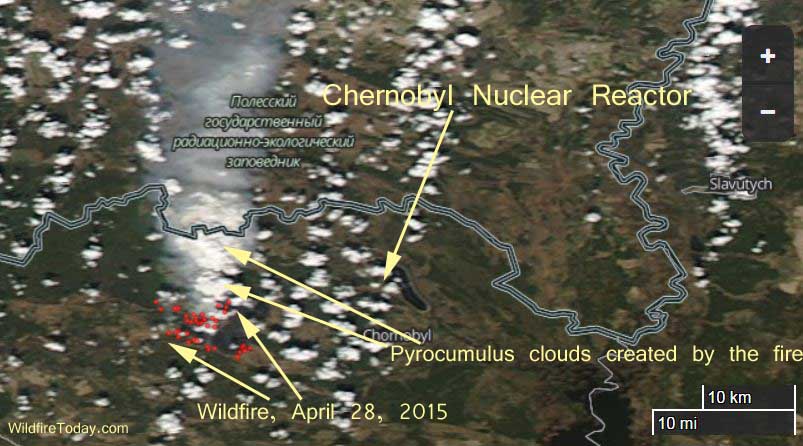
Map of the fire near Chernobyl 4-28-2015. This photo was captured later in the day than the one we posted previously. It shows pyrocumulus clouds created by the fire, indicating extreme fire behavior, rather than smoke from a “contained” fire. The red dots represent heat detected by a satellite. NASA photo.

The Prime Minister of the Ukraine was quoted as saying the large fire east of the melted-down and abandoned Chernobyl Nuclear Reactor is “localized and contained. Radiation levels are normal”, he told a government meeting on April 29.

On April 28 we published a photo showing the location of the fire about 10 miles (16 kilometers) west of Chernobyl. It included smoke being pushed to the north and one cloud that could have been a pyrocumulus created by the fire. Today, April 29, we found a satellite photo (above) that was taken later in the day on April 28, that showed massive pyrocumulus clouds, which would indicate extreme fire behavior from a very active fire that was far from being contained.

The blaze, which we estimate to be at least 9,000 acres, is burning in an area contaminated with radioactive particles which could become airborne during a wildfire. It is burning within the Chernobyl Exclusion Zone, also known as the 30 Kilometer Zone, or the Chernobyl Zone of Alienation.

The video below was uploaded April 29, 2015. Here is the description:

Fire engulfed a large sector of woods in the exclusion zone around the destroyed Chernobyl nuclear power plant on Tuesday.

Other articles on Wildfire Today tagged Chernobyl.

Wildfire burns within 10 miles of Chernobyl nuclear reactor

Map of fire near Chernobyl
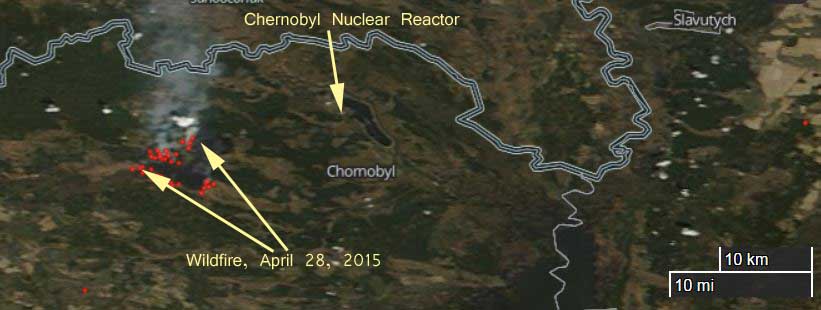
Map of fire near Chernobyl 4-28-2015. The red dots represent heat detected by a satellite. NASA image. (click to enlarge)

A wildfire is burning within about 10 miles (16 kilometers) of the Chernobyl nuclear plant that melted down in the Ukraine in 1986. According to NASA imagery, the fire appears to be well within the Chernobyl Exclusion Zone, also known as the 30 Kilometer Zone, or the Chernobyl Zone of Alienation. The area is still heavily contaminated with nuclear radiation and for years officials have been contemplating how to mitigate the potential for a fire in the dead forest, killed by the melt-down, which would release radioactive particles into the smoke and be carried downwind, perhaps for very long distances.

An article at RTnews reports that the Ukraine Interior Minister Arsen Avakov said the fire has burned about 400 hectares (988 acres).

Our extremely rough estimate of the size of the fire based on the satellite imagery is that it has burned about 9,000 acres. When the photo was taken the smoke was being pushed north, at about 90 degrees to the path that would take it closer to the disabled nuclear plant, east of the fire.

Excerpts from the article:

“The forest fire situation around the Chernobyl power plant has worsened,” a statement on Avakov’s Facebook page says.

“The forest fire is heading in the direction of Chernobyl’s installations. Treetop flames and strong gusts of wind have created a real danger of the fire spreading to an area within 20 kilometers of the power plant.

Police and National Guard units are on high alert. Ukraine’s Prime Minister personally went to the affected area to oversee the firefighting. He says the situation is under control, “but this is the biggest fire since 1992.”

The potential danger in this fire comes from the radioactive contaminants the burning plants have absorbed, ecologist Dmitry Shevchenko told RT. “A lot of radionuclides have accumulated in the soil, the trees and other plants. And of course when something like a fire happens, together with the smoke, the radionuclides can travel great distances.”

We have written numerous times about the challenges presented by the contaminated vegetation near Chernobyl. Articles tagged Chernobyl.

Nurse dies after falling from hoist on medical helicopter during rescue mission in Texas

From the AP:

AUSTIN, Texas — A nurse died after falling from a hoist on a medical helicopter while rescuing a woman from a hiking trail in Austin, emergency personnel said Tuesday.

Kristin McLain, 46, became detached from the hoist Monday night as the rescued hiker was lifted to the EC-145 helicopter from the Barton Creek Greenbelt where she had taken a fall, according to a STAR Flight news release.

McLain died at the scene. STAR Flight did not release any information about why or how far she fell. The company uses four helicopters for rescues and emergency transport in Travis County.

Lisa Block, a spokeswoman for Travis County Emergency Services, had few details on the circumstances of McLain’s death. She said the hoist is an arm that extends off the helicopter that allows rescuers to direct a carrier to a patient and that “typically a rescuer will go with that carrier.”

Kristin McLain
Photo of Kristin McLain posted at STAR Flight Hangar, via KXAN

Our sincere condolences go out to the family and co-workers of Kristin McLain.

Additional lessons that could be learned regarding the Yarnell Hill Fire

One of the presentations last week at the International Association of Wildland Fire conference, “Managing Fire, Understanding Ourselves”, concerned additional lessons that could be learned from the 19 fatalities on the 2013 Yarnell Hill Fire. Specifically, use of the term “MAYDAY” and the National Grid mapping system.

Most of the following presentation was prepared by Al Studt, of Cape Canaveral Fire and Rescue. It was presented at the conference by wildland fire consultant Richard McCrea. It is used here with their permission.

To  view the slides, click the triangular play button and allow them to automatically advance every 10 seconds, or manually click the right arrow when you want to view the next slide.

Authorities in Texas concerned about exploding targets

An article in the Tyler Morning Telegraph explains how law enforcement authorities in Texas are concerned about the spreading use of exploding targets in the state. It also reports that an eight-year old boy was killed in Oklahoma by shrapnel from an exploding target.

Below is an excerpt:

Reports of mysterious, loud booming explosions in rural areas across East Texas have sheriff deputies and fire departments searching their jurisdictions for the cause.

Although there typically is no lingering smoke, fire or other signs to point authorities to locate the source, Smith County Sheriff’s Lt. Gary Middleton and other law enforcement officials believe many of the explosive sounds are the result of people using shooting targets designed to explode when hit.

“A lot of these calls are due to people shooting (various brands of explosive targets) which are perfectly legal across much of the nation at this time,” Middleton said.

The targets are sold as kits containing two chemical components — such as ammonium nitrate and aluminum powder — that separately are not explosive, but when mixed together are primed for eruption. The target kits are available to the public in most gun stores and large sporting goods retailers.

Manufacturers of the product say the products are safe when used as intended, but law enforcement officials warn improper use could result in serious injury. In several instances across the nation, the shrapnel from blasts resulted in serious injuries and death.

Earlier this year, an 8-year-old boy in Oklahoma was killed when an outdoor stove stuffed with the material was shot and exploded, sending shrapnel into the child. The child’s adult relative has been charged with manslaughter in the death…

Military training starts fire in northern Michigan

Pyrotechnics used by the military during training in northern Michigan (map) started a fire that burned about 700 acres Saturday, according to military officials on the scene.

Below is an excerpt from 9&10News:

…The fire tore through parts of Camp Grayling  in Crawford County around 2:00 yesterday afternoon and burned an area North of Kyle Lake Road.

New information now suggests that a Marine infantry battalion training on site employed pyrotechnics and signal flares and inadvertently started the fire.

A senior Camp Grayling official tells Northern Michigan’s News Leader that, after realizing the fire was too large to effectively extinguish, crews made the decision to keep the flames contained to a well-defined area–and then treated it as an unscheduled controlled burn, making ‘the best of a bad situation’.