Forest Service awards contracts for seven additional air tankers

Conair RJ85 first flight
The first flight of Conair’s BAe Avro RJ85 air tanker in September, 2013 built for Aero-Flite. Conair photo by Jeff Bough.

Today the U.S. Forest Service announced contract awards for seven additional large and very large air tankers. The aircraft being added to the exclusive use contracted fleet are four BAe-146s operated by Neptune Aviation, two RJ85s flown by Aero-FLite, and one DC-10 operated by 10 Tanker Air Carrier.

The contract solicitation, issued November 26, 2015, is for what the USFS calls “next generation” air tankers, which must be turbine or turbofan (jet) powered, can cruise at 300 knots (345 mph), and have a retardant capacity of at least 3,000 gallons. The DC-10 carries 11,600 gallons, while the others can hold up to about 3,000 gallons.

This brings the total number of next-gen air tankers on exclusive use contracts to 14. There are also seven “legacy” air tankers on exclusive use contracts, all operated by Neptune. Six are Korean War vintage P2Vs which usually carry about 2,100 gallons and are powered by two 18-cylinder radial engines. There is also one BAe-146 on the legacy contract.

These new next-gen awards, which begin this year, are for a five-year period with options for five additional years, with at least 160 days of mandatory availability every year.

The daily rates for Neptune’s BAe-146s, which is paid even if the aircraft is not used that day, varies during the possible 10-year period from $29,000 to $32,640 each day, while the hourly flight rate is from $8,000 to $9,274.

The daily rate for Aero-Flite’s Rj85 are from $28,581 to $35,546, and their flight rate is $7,559 to $9,862 per hour. The daily rate for the DC-10, a Very Large Air Tanker, are from $34,000 to $35,000, and the hourly rate is $13,600.

These rates do not include the cost of fuel, which will be paid by the government.

Most of the contracts the U.S. Forest Service has attempted to issue in recent years for large and very large air tankers have been protested, which suspends the activation of the contract until the Government Accountability Office adjudicates the dispute. This contract has already been protested by Coulson Aviation and Erickson Aero Tanker even before the closing date of the solicitation. However, the GAO decided in July to deny the protests. But that does not mean that there will not be additional protests now that the contracts have been awarded.

More information:

Details of the rates awarded under the new contract.

Nightline features smokejumpers

Tuesday night ABC’s Nightline had a nine-minute story on smokejumpers that featured the crew at Redding, California.

Below is Nightline’s description of the video.

Mitch Hokanson, 39, peers out the window of the roaring aircraft. Down below, a thin smoke coil emerges from a patch of pine trees. It’s been a dramatic fire season in the West. Drought conditions mixed with a rash of lightning strikes have caused small fires to break out. Close to 8.9 million acres have been burned by wildfires so far in 2015 — well above last year’s 3 million acres during the same time period.

Inside the plane, nine men strapped with parachutes and gear are ready to leap out the open door. They are part of an elite, and rarely seen, group of wildfire fighters employed by the U.S. Forest Service. Their mission: to stop the flames before they spread.

While it might take days for other crews to reach remote fires, depending on the location, this team can be at the scene, battling a fire in 30 minutes. The pay is modest, conditions treacherous, and hours can be long. Meet the California Smokejumpers.

You can see the video in a larger format at ABC’s website.

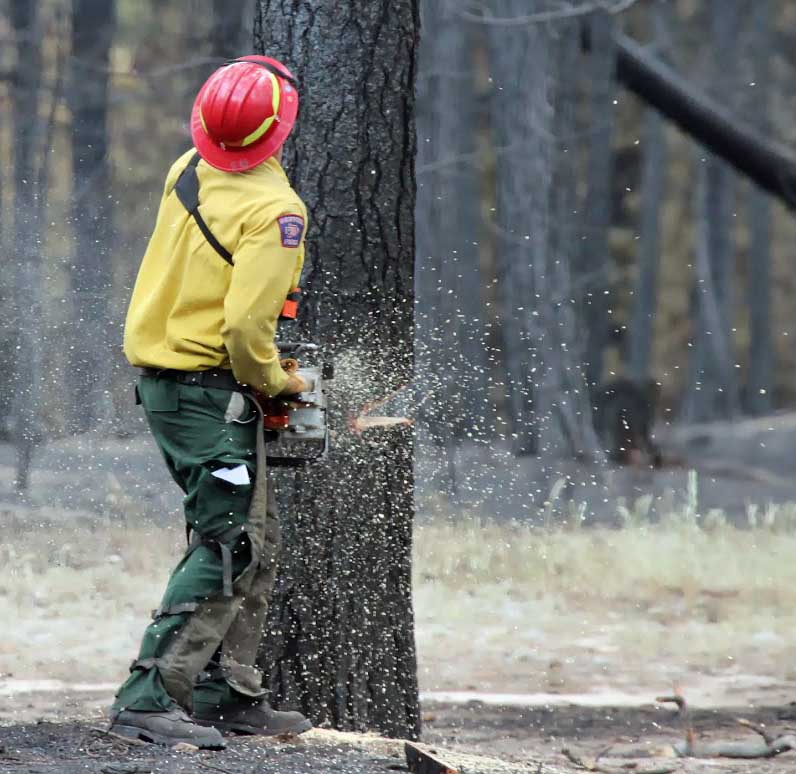
Smokejumper operates chain saw
A smokejumper operates a chain saw at a wildland fire. Screen shot from the Nightline video.

Not all Forest Service aircraft are FAA type certified

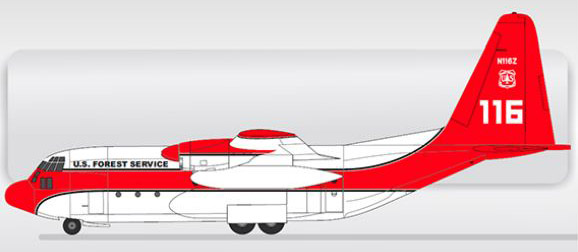
HC-130H paint design
This is the US Forest Service approved paint design that will be used on the seven HC-130H air tankers acquired from the Coast Guard. The aircraft will be maintained and operated according to Coast Guard guidelines, rather than Federal Aviation Administration procedures.

After the Governor of Montana wrote a strongly worded letter to the Secretary of Agriculture complaining about what he called “nonsensical restrictions” that prohibit the use of the state’s five UH-1H helicopters on U.S. Forest Service protected lands, we started looking into the root of the problem. The former military helicopters are actually owned by the USFS, and are leased to the state under the provisions of the Federal Excess Personal Property (FEPP) program which require that the helicopters be maintained in full compliance with Federal Aviation Administration (FAA) regulations. But the Montana Department of Natural Resources and Conservation (DNRC) apparently does not hold FAA Airworthiness Certificates for the helicopters.

However, the USFS does not maintain all of their government owned aircraft in strict compliance with FAA regulations.

When we asked the USFS why the agency does not allow the non-certificated Montana aircraft to be used on USFS lands, Public Affairs Specialist Jennifer Jones, told us:

The Forest Service and the State of Montana Department have different standards and regulations to which each must adhere. Federal agencies, including the Forest Service, follow federal operational aviation safety standards that prescribe minimum specifications for the types of aircraft. These performance specifications provide an industry recognized margin of safety.

The USFS and the rules governing the loan of FEEP aircraft require the Montana helicopters to be maintained and modified according to FAA standards. Since these requirements are not met, the helicopters can’t be used on USFS fires.

Even though the USFS requires compliance with FAA procedures for their contracted air tankers and helicopters — and the state of Montana’s aircraft — the following USFS aircraft are not FAA certified, nor will they be:

  • Tanker 118, the HC-130H acquired from the Coast Guard that has been dropping retardant on fires this summer using a Modular Airborne FireFighting System (MAFFS). Neither the aircraft or the MAFFS have ever been certificated by the FAA.
  • The other six HC-130H aircraft that are being transferred from the Coast Guard to the USFS.
  • Four C-23A Sherpas used for smokejumping and hauling cargo.
  • Two AH-1 Cobra helicopters.
  • The eight MAFFS units used in military C-130s for fighting wildfires, and the modifications made to the C-130s so that they can use the MAFFS.

After the seven HC-130H aircraft are finished with their heavy maintenance and air tanker retrofitting, they will be owned by the USFS and maintained and operated by contractors. But they will not be brought under the FAA umbrella, according to Mrs. Jones:

The U.S. Forest Service’s firefighting mission is a Public Use mission in government owned aircraft. The Forest Service maintains airworthiness on Tanker 118 in accordance with Coast Guard maintenance standards, and the Coast Guard maintains engineering authority.

The Air National Guard and Air Force Reserve C-130s used to drop retardant with the MAFFS are maintained, modified, and operated according to military procedures.

Below is an excerpt from the USFS solicitation for the Next-generation V. 2.0 air tankers, issued November 26, 2014. From Section C:

Aircraft shall conform to an approved type design, be maintained and operated in accordance with Type Certificate (TC) requirements and applicable Supplemental Type Certificates (STCs). The aircraft shall be maintained in accordance with an FAA approved inspection program and must include an FAA approved Supplemental Structural Inspection Document (SSID), Structural Inspection Document (SID), or Instruction for Continued Airworthiness (ICA) for the airframe structure, as applicable with an ICA and Airworthiness Limitations Section (ALS) approved by the manufacturer (or equivalent) and the FAA for the airtanker role.

The USFS is not the only federal agency operating former military aircraft that bypasses the FAA. Others include the Coast Guard, NASA, and NOAA.

We asked a person in the commercial air tanker industry (who did not want their name disclosed) about the USFS not following FAA procedures:

The FAA governs the largest fleet of commercial aircraft in the world and are looked upon by foreign agencies as the golden standard. They can certify an A380 to pack 700 people but cannot certify a restricted category airtanker? The USFS is hiring a ton of ex-military people who all stick together with their other Air Force buddies and think the military is the be-all-end-all.

I think it would be fair to argue that the FAA knows much more about airtankers than the Air Force or the Coast Guard. The USCG maintenance program is not setup for an airtanker mission profile, nor is the USAF. I talked to the FAA guy who was on all the calls with the USFS about this program and he was in disbelief when they finally made the decision not to have any FAA involvement.

Update on federal contracts for firefighting aircraft not yet awarded

Here is a list of pending, and still unawarded, federal contract solicitations that we are aware of for firefighting aircraft or equipment:

Purchase of one to seven NEW large air tankers. The USFS intends to spend some funds appropriated by Congress that were specifically earmarked for the purchase of at least one brand new air tanker. The specs call for an internal removable retardant tank that holds at least 3,000 gallons. A meeting was held in D.C. with interested potential vendors on August 26, 2015 to talk about the purchase. So far, only a draft synopsis has been issued. The omnibus federal appropriations bill that was passed in December by Congress included a provision to allocate $65 million for the U. S. Forest Service air tanker fleet. This effort may be to spend those funds. And it may never see the light of day in passed legislation, but there has been a proposal to allocate left over firefighting funds each year toward the purchase of new air tankers. That could be why they are talking, here, one to seven new large air tankers which could be spread over multiple years.

Amphibious Water Scooping Aircraft (the USFS refuses to call them “air tankers”). The USFS intends to award contracts for up to two water scoopers. Issued August 20, 2015. Response date: September 11, 2015.

Next Generation V. 2.0 Large Air Tankers. This will be the second batch of awards for next generation air tankers. They intend to contract for up to seven. Issued November 26, 2015. Response date was modified at least once; latest was: April 9, 2015.

Retardant Delivery System. This was issued by the Air Force to obtain retardant tanks for the seven HC-130H former Coast Guard aircraft the Air Force is putting through heavy maintenance and retrofitting as air tankers before they are transferred to the U.S. Forest Service. The solicitation was modified 14 times. Presolicitation was issued July 29, 2014. The response date was changed at least once; latest was May 15, 2015.

Air Tanker Base Facilities Assessment. This is only a Request for Information at this stage, but we assume that an actual solicitation will be issued at a later date. The purpose of the assessment is to determine possible locations for basing, at least in the winter, the seven HC-130H aircraft the USFS will be receiving from the Coast Guard after the heavy maintenance and air tanker retrofitting is complete. Issued September 2, 2015. Response date: September 25, 2015.

These are the solicitations we were able to find at FedBizOpps.gov for firefighting aircraft and related items. If you’re aware of others that are still pending, let us know.

UPDATE, September 28, 2015: In responding to Kenneth’s comment about options for new air tankers, we mentioned Lockheed Martin’s new LM-100J (the commercial version of the C-130J) which COINCIDENTALLY sells for about $65 million, the amount appropriated in the legislation. We wrote about the aircraft in December, 2014. In searching for a link to the LM-100J today, we found the following image in a promotional video on Lockheed’s website, which shows the aircraft spraying fire retardant from a pressurized Modular Airborne FireFighting System (MAFFS).

Lockheed's LM-100J
An artist’s conception of a Lockheed Martin LM-100J using a slip-in MAFFS to dispense fire retardant. Screen shot from Lockheed’s video.

Keep in mind that Mark Rey who oversaw the Forest Service as the former Under Secretary of Agriculture for Natural Resources and the Environment, has been a lobbyist for Lockheed Martin since he left the federal government in 2009 through that proverbial revolving door. The company hired him to lobby the Forest Service to buy the company’s “firefighting equipment”. Since 2009 Mr. Rey has been paid at least $432,000 by Lockheed Martin, according to Open Secrets.

DC-10 air tanker arrives in Australia

air tanker 910
T-910 prepares to depart Albuquerque for Australia. Photo by 10 Tanker Air Carrier.

The second air tanker from North America has arrived in New South Wales for their summer bushfire season. Tanker 910, one of three DC-10s operated by 10 Tanker Air Carrier, arrived on September 28 after flying from Albuquerque, New Mexico. The aircraft flew at 28,000 feet and 512 mph in between stops for fuel at Hawaii and Pago Pago. It dropped into Brisbane, Australia to go through customs and is expected to arrive at RAAF Base Richmond in Sydney at 10:08 p.m. US Mountain Time on September 28.

Tanker 910 joins Tanker 132, an L-382 Hercules operated by Coulson, which has been down under since the first part of September. New South Wales has contracted for the two of them to help ground-based firefighters during the Australian summer. They will be stationed at RAAF Base Richmond in Sydney.

Coulson says the L-382 has their latest Coulson SMART 4,400-gallon (16,655 liter) retardant tank system. The DC-10 carries 11,600 gallons (44,000 liters).

Victoria will have two large air tankers under contract again this summer, beginning in November unless they are needed earlier. A year ago during Australia’s 2014-2015 summer two large air tankers from North America were under contract in the state, Coulson’s Tanker 131, a C-130Q, and Conair’s Tanker 162, an RJ-85. The two aircraft dropped more than a million liters (264,000 gallons) of fire retardant across the state, completing 81 drops across Victoria, South Australia and Western Australia.

Tanker 132
Leading Aircraftmen Lewis Holland and Brendan Donnelly of No 37 Squadron tow an Air Start Cart to Tanker 132 at RAAF Base Richmond in Sydney. Photo by CPL David Said.

Report: USFS won’t let forest ecologist talk about reforming fire management

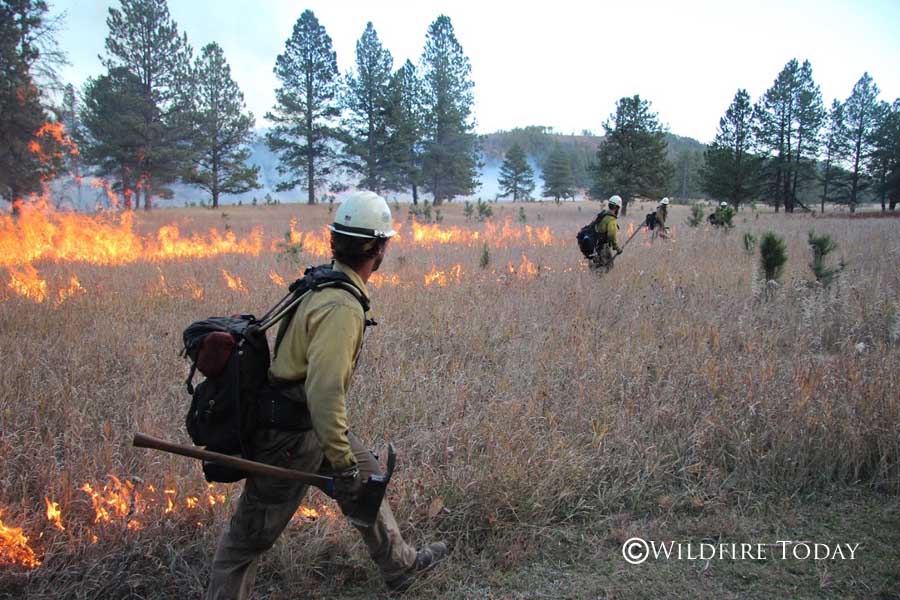
Norbeck prescribed fire,
Alpine Hot Shots ignite the Norbeck prescribed fire in Wind Cave National Park, South Dakota. October 21, 2014. Photo by Bill Gabbert.
An article at Capital Public Radio claims that the U.S. Forest Service will not let a forest ecologist talk about an article he co-wrote titled “Reform Forest Fire Management”. The two-page opinion piece about making forests less prone to wildfire appeared in Science, and was written primarily by USFS and university employees.

Below is an excerpt from the article at Capital Public Radio about the controversy:

****

“The US Forest Service Pacific Southwest Research Station won’t let forest ecologist Malcolm North talk about the study he authored in the journal Science.

The agency even unsuccesfully requested that Science editors hold the article or remove North’s name and affiliation from the peer-reviewed study.  The paper “Reform Forest Fire Management” says suppressing every fire in overgrown forests is not only expensive but dangerous and ill-advised.

Strong words perhaps, but UC Berkeley Fire Scientist Scott Stephens, who co-authored the paper, says they are not controversial.

“I read the paper many times,” says Stephens. “I just didn’t see something jump, like this would be something that would really cause great problems.”

The study considers ways to make forests less prone to wildfire, by thinning trees in overgrown forests, using controlled burns or allowing natural fires to burn under the right conditions.

US Forest Service policy actually supports those actions, but the authors point out such efforts rarely occur. In the decade ending in 2008, only 0.4 percent of ignitions were allowed to burn as managed wildfires…”

Disagreements over salvage logging versus natural recovery after fires

black forest fire faller tree
Black Forest Fire near Colorado Springs, Colorado. June 15, 2013. Photo by Bill Gabbert.
The debate has been going on for decades — should loggers rush in after a wildfire and cut down the recently killed trees while they are still merchantable, or could natural processes be allowed to run their course? Timber companies, some politicians, and the U.S. Forest Service often argue for the first option, while some scientists and environmental groups advocate for the natural alternative.

Below is an excerpt from an article in the Los Angeles Times:

…The Forest Service and timber companies say that the dead wood must be removed before the forest can grow and that shrubs have to be killed off with herbicides so the conifers have sun to grow again.

Though part of the Las Conchas fire site was salvage-logged, another section outside New Mexico’s remote Jemez Springs was not.

Four years after the blaze, the Jemez Springs area today is alive with Gambel oak and three-toed woodpeckers, along with occasional conifer saplings growing amid the brush.

“See this?” Hanson said, pulling back a strand of oak to reveal a rubbery green pine sapling just an inch tall. “They said this wouldn’t be here, but we found it. And there’s more.”

By contrast, in places like California’s Rim fire site, salvage crews immediately began felling burned pines and dying trees, spraying the area with herbicide and planting conifer saplings. The result is little ground vegetation but stands of artificially planted conifers returning apace…

The Air Force has one firefighting dozer team

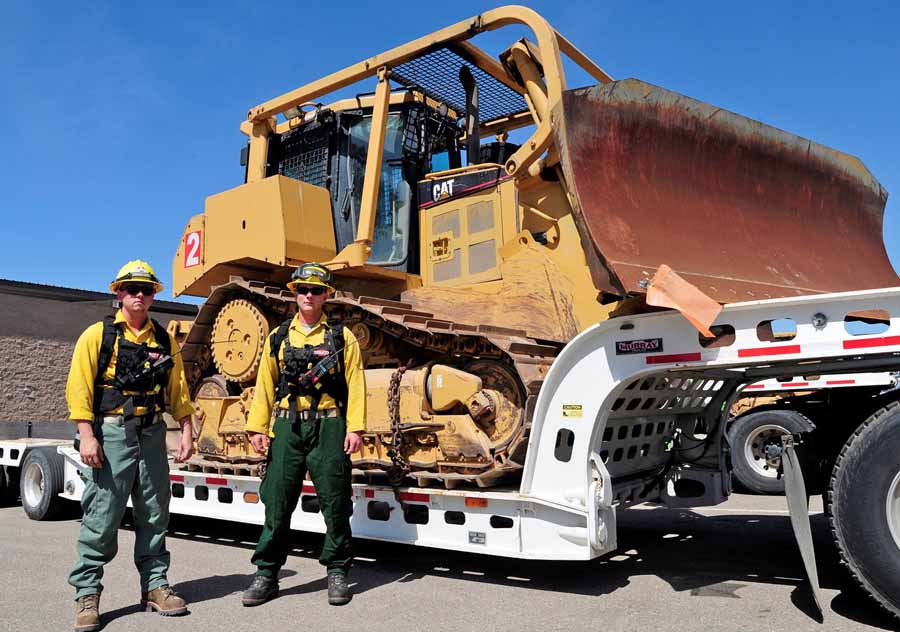
Vandenberg dozer
Senior Airmen Ronald Skala and Thomas Williams, 30th Civil Engineer Squadron heavy equipment operators, with a fire dozer, Sept. 21, 2015, Vandenberg Air Force Base, Calif. The fire dozer team is on stand-by during wildfire season and during every launch, prepared to contain fires that start and prevent damage to base assets. (U.S. Air Force photo by Senior Airman Kyla Gifford.)

The only firefighting dozer team in the U.S. Air Force is at Vandenberg Air Force Base in southern California. The 30th Civil Engineer Squadron heavy equipment operators’ fire dozer team consists of approximately ten Airmen and civilian workers. Their job is to support the firefighters by helping to limit damage and contain the spread of wildfires.

“Because of the sheer size of our equipment we can accomplish a lot within seconds,” said Staff Sgt. Mark Robertson,  a heavy equipment operator. “When we go out to a fire, those who have already responded breathe a sigh of relief because we can accomplish a huge amount of work in a short amount of time.”

When a fire breaks out, the base firefighters are the first to respond. When the fire is too difficult to control, the fire dozer team is called to assist.

“We are supporting the fire department, and will get their call if they need us,” said Raymond Boothe, 30th CES equipment supervisor. “We are not sitting around waiting for a call though — we are constantly working all over base, performing our job as heavy equipment operators.”

“Vandenberg is the only base in the Air Force that has a fire dozer team,” said Robertson. “So this is the only place in our career that we are going to get this kind of experience and training.”

Airmen also receive a Red Card certification, which states the holder has the experience and training necessary to fight wildfires. This certification is utilized by both state and federal fire agencies and is useful for civilian jobs across the nation.

Another significant component of the job is supporting the space mission. The fire dozer team is on stand-by during every launch, prepared to contain fires that start and prevent damage to base assets.

Report of trouble with landowners on the Tepee Springs Fire in Idaho

(UPDATE, October 1, 2015: we further analyzed this incident in a new article, including additional information.)

According to a report filed on SAFENET, a private landowner in Idaho armed with a weapon aggressively accosted firefighters and interfered with fire suppression operations in several other ways. Law enforcement officers had to be called more than once and two hot shot crews refused an assignment ordered by the incident commander.

This occurred on the Tepee Springs Fire which is three miles east of Riggins, Idaho on the Payette National Forest. As of September 24, 2015 the fire has burned over 95,000 acres.

The “event start date” in the report was September 2, 2015 but the harassment apparently occurred over multiple days.

Records show that the Great Basin Incident Management Team #2, led by Incident Commander Chris Ourada, was assigned to the fire from August 28 until September 12, 2015.

It is not clear what person or position on the fire filed the report. This may be just one side of the story, but we will be interested to see if the charges in the report hold up, and what corrective actions will be taken, if there is a need for any, other than “[we are] looking in to this matter”, and “thank you”.

Below is the Narrative from the report. Following that is the “Immediate Action Taken”, and the “Corrective Actions”.

****

Narrative:

On Division Delta on the Tepee Springs fire a “turn down” of assignment occurred where two IHC’s refused an assignment due to numerous safety concerns that were not mitigated. These safety concerns will be addressed below. The IC of the incident responded to this turn down by stating “I am the boss, you work for me and you will do what I say. And I am saying go in there and go direct!” In response to this the crews still refused the assignment and were sent to another division the following day and remained on those divisions for the remainder of the assignment.

Division Delta on the Tepee Springs fire featured large tracts of private land mixed with State, Forest Service, and BLM land. A large elk ranch lay in the middle of the division and was the epicenter of the issues. The land owners, on multiple occasions expressed frustration towards fire fighters with their suppression actions which ranged from verbal threats to aggressive posturing. LEO’s were called on multiple occasions and the incident eventually resulted in two of the land owners verbally accosting a BLM employee while armed with a weapon. The land owners made multiple unsafe demands to fire fighters such as downhill line construction in extremely rugged terrain with fire below them, attempting burnouts on mid-slope dozer lines with no escape routes or safety zones, and to drop water from helicopters with personnel in the work zone (the land owners).

During at least one documented occasion the land owners took it upon themselves to attempt a burnout and began igniting fire below crews without any communication or warning. Crews had to be pulled to safe areas during this. Other unsafe suppression actions by the land owners were extremely fast driving, attacking fires at the head, felling trees in the middle of crews, and operating dozers on federal and state land with no communication with fire resources. In addition to the ill-advised suppression actions their continued harassment of fire line personnel in an attempt to force their own initiatives distracted important leaders from their primary jobs of managing people as well as the entire division and the fire as a whole.

Continue reading