Lynn Biddison, 1927 – 2015

Lynn BiddisonLynn Robert Biddison, one of the legends in wildland fire, passed away October 19, 2015 at the age of 88 as a result of injuries sustained in a vehicle accident in Albuquerque on October 11, 2015. His fire career with the U.S. Forest Service began in 1943 on the Angeles National Forest in southern California, and he retired in 1982 as Regional Fire Director in California.

When I worked in that Region I heard his name referenced many times, always in a positive way, but I did not meet him until after he retired and was working as a representative for the fire retardant company Fire-Trol. I ran into him several times at meetings and he was always friendly and interesting to talk to. He has been mentioned at last five times on Wildfire Today — three times when we asked fire leaders our 12 Questions, once in regard to the first actual use of a fire shelter, and another time when we wrote about the 1970 Laguna Fire.

The family requests that memorial gifts be sent to the National Museum of Forest Service History, P.O. Box 2772, Missoula, MT, 59806. Dedicated gifts can be sent online at www.forestservicemuseum.org by clicking on the “programs” and “ways to help” links. Online condolences can be left for Mr. Biddison at www.FrenchFunerals.com. 

There are two documents about Mr. Biddison that you might appreciate. One is a 2003 interview conducted by Jim Cook and Mark Linane. The other is a letter he wrote in 1982 in which he listed 30 items he considered to be the “Basics of Fire Suppression”.

Below is a summary of Mr. Biddison’s USFS career, from the 2003 interview:

****

“Lynn Biddison started as a firefighter in 1943 on the Angeles National Forest. He volunteered for the Marine Corps and the Navy, but colorblindness kept him out of both services. He was drafted in early 1945. At the induction station he volunteered for the paratroops, but was assigned to the Navy Seabees and served in the Philippines until the end of the war in the Pacific. Once out of the Navy, he went back to work for the Angeles National Forest in 1946 as the TTO (Tank Truck Operator) at Oak Flats. In 1947, he became the Tanker Foreman at the District Ranger Station in what is now downtown Newhall. That job also included spending two days a week as the district dispatcher. During that fire season he witnessed the first time a helicopter was used on a fire, it was the Bryant Fire in Big Tujunga Canyon. In order to keep working in 1948, he had to join the engineering crew building water tanks on the Arroyo Seco Ranger District. He began college that same year at Berkeley studying forestry and spent much of the summer in 1949 at forestry camp on the Plumas National Forest.

In 1950, Biddison was assigned to the newly formed Chilao Hotshots as one of the Crew Foremen. That was the second year of the crew and he was in charge of a 10-man crew, one of three that made up the full 30-man hotshot crew. His crew was made up of Navajo and Hopi Indians from the Sherman Institute at Riverside, California. Then in 1951, the Superintendent left and he was promoted into that position. During his stint running the Chilao Hotshots, Biddison graduated from forestry school in 1951. He took the Forest Service Junior Forester (JF) exam and flunked, but had passed the State Assistant Ranger exam with a score of 95. All through 1952 and part of 1953 he couldn’t get a JF appointment, but was getting offers from the California Department of Forestry. However, being third generation Forest Service, he had his sights set on a professional career with the Forest Service, so he took the JF exam again and with his Veteran Preference he passed. Finally, he got a Junior Forester appointment in 1953. Leaving the hotshots, he became the Assistant Ranger on the Arroyo Seco District and also spent a year as the acting District FCO (Fire Control Officer).

In 1956, Biddison went to the Cajon District on the San Bernardino National Forest as the District Ranger. He kept active in the fire world as a District Ranger and was selected as one of the Region 5 representatives to the first national fire behavior training course (a five week session) held at Missoula, Montana in 1958.

During the Spring of 1960, Biddison moved to the Cleveland National Forest to take the Fire Control Officer position. Again, he remained very active on the national fire scene, attending the first Fire Generalship and Command course held at Marana, Arizona in 1962. Biddison came back to the San Bernardino as the Fire Control Officer in 1964. This job was graded as a GS-13 and along with the Angeles FCO, these were the first GS-13 Forest FCOs in the Forest Service (it wasn’t until the 1970s that Fire Control Officers became Fire Management Officers). During his tenure as a Forest FCO, Biddison was instrumental in establishing the first standing forest overhead teams. By this time in his career, he was being sent as a Fire Boss to large fires all over the country, including a Zone Fire Boss assignment on the infamous Sundance Fire in 1967.

Then in 1968, Biddison went to Region 3 as the Chief of Fire Protection and after 2 years he was promoted to the Assistant Regional Forester for Fire (a position now called the Regional Fire Director). When he arrived in Region 3 they had a fire budget of $2 million and no hotshot crew program. When he left 12 years later, the fire budget was $30 million and there were 13 hotshot crews in the region. Biddison’s last posting for the U.S. Forest Service was back to Region 5 as the Regional Fire Director where he pushed for a back-to-the-basics (1982 letter by Biddison) firefighting ethic. He retired from that position in 1982, nearly 40 years after he started with the Forest Service.”

Aerial ignition by drone

Typically when aerial ignition is used to light a prescribed fire or a burnout operation on a wildfire, it is done with a large plastic sphere dispenser mounted in a conventional helicopter, as in the photo below.

Sitgreaves Complex Fire
Dennis Kirkley of Kaibab Helitack loads the plastic sphere dispenser (ping pong ball machine) with plastic spheres. Grand Canyon Helitack’s A-Star was used to do aerial ignition on the Sitgreaves Complex in northern Arizona August 8, 2014. Photo by Tom Story.

The University of Nebraska is developing an unmanned aerial vehicle that can use plastic spheres to ignite fires. What could possibly go wrong?

Below is an article from the university written by Leslie Reed.

****

University of Nebraska drone aerial ignition fire
Sebastian Elbaum (from left), Dirac Twidwell and Carrick Detweiler have developed a new patent for setting range fires with small drones. The drone injects a liquid into plastic spheres to start a delayed fiery process that allows the balls to fall to the ground before igniting. Elbaum and Detweiler are holding flaming tennis balls similar to those carried by the drones. University of Nebraska photo by Craig Chandler.

A new drone under development at the University of Nebraska-Lincoln could change the way wildfires are fought – and encourage the use of prescribed burns for conservation purposes.

The Unmanned Aerial System for Fire Fighting, or UAS-FF, is under development by a multidisciplinary team of UNL experts in drone technology, fire ecology, conservation and public policy.

The Great Plains, California and other locations around the world are seeing an increasing number of bigger and more intense wildfires in recent years, said Dirac Twidwell, a team member and a range ecology expert and faculty member in the Department of Agronomy and Horticulture.

Twidwell said it’s a trend that results from land management practices, including a decline in human use of fire for ecosystem management, as well as exotic species invasions, drought and climate change.

The aerial robot would have the ability to ignite and monitor fires in remote areas. Novel technology would allow it to operate in harsh environments with limited supervision, enhancing the capabilities of fire management personnel.

“The idea is to provide a safe mechanism for people to perform fire management tasks with less risk and higher efficiency,” said Sebastian Elbaum, a computer science and engineering professor and drone researcher.

The team has successfully performed indoor tests on a prototype. Carrick Detweiler, a faculty member in the computer science and engineering department, said the researchers have been working with the Federal Aviation Administration and hope to have authorization from the FAA and fire departments for a field test of the fire-starting drone as early as March.

“Unmanned aerial devices have the potential to carry out key resource management strategies and could help us deal with something as big as the international increase in severe wildfires,” Twidwell said.

Prescribed burns, where grasslands are burned off according to a predetermined plan, are widely recognized as an effective conservation tool that eliminates invasive species, restores native plants and reduces the risk of wildfire. However, they are underutilized because of perceived safety concerns.

A recent study from Twidwell’s lab shows prescribed fires are actually less less risky to landowners than other commonly used management techniques, and using drones would further reduce the risks posed by lighting prescribed burns by hand and using all-terrain vehicles and suppression vehicles in rough and remote areas.

Many federal agencies use helicopters to ignite such areas, but it’s too costly to use helicopters on private lands.

Elbaum and Detweiler built upon their prior research as co-founders of the Nebraska Intelligent Mobile Unmanned Systems, or NIMBUS, Laboratory to design aerial robots small enough to fit in a firefighter’s backpack, yet smart enough to safely interact with the environment

The drones carry a cargo of ping pong-like balls filled with [a chemical]. Before being dropped through a chute, each ball is manipulated and injected with [another chemical], creating a flame after several seconds. A similar method now is used to start fires for conservation purposes with helicopters and hand-held launchers, Detweiler said.

“We wanted to use proven technology that the prescribed-burn community is already familiar with,” he said.

The drones would have the ability to drop the balls in a precise pattern over the landscape – on the perimeters and interior of a rectangular plot, for example. Detweiler said the robots could be programmed so they don’t fly into areas that are too hot or windy for safe use.

The team is seeking grant funding to develop the next generation prototype with more sophisticated sensing and actuation capabilities, including the ability to operate as a swarm.

Other team members are Craig Allen, research professor and director of Nebraska Cooperative Fish and Wildlife Research, and Lisa Pytlik Zillig, research associate professor at UNL’s Public Policy Center. James Higgins, a mechanical engineering graduate student, designed the prototype’s mechanics, while Christian Laney, a computer science and engineering undergraduate student, was responsible for the control electronics.

The drones could be an especially effective tool in battling Eastern Red Cedar, an invasive tree species that some experts view as one of the region’s most serious ecological threats. It causes extinctions of many grassland plants and birds, collapses forage production important to the beef industry and is contributing to dangerous wildfires.

Detweiler and Elbaum said the drones also might be used in place of manned aircraft and hotshot teams of firefighters dropped by parachute in some wildfire-fighting situations.

“What we’re doing is supporting the expert and the user in the field,” Elbaum said. “The drone and the operator work together to make the job safer, more efficient and cheaper.” “

Senate committee to seek input about wildfire funding from animal and water organizations

The Senate Committee on Agriculture, Nutrition and Forestry will hold a hearing at 10 a.m. ET, November 5 to hear expert testimony about the impact of the federal wildfire budget on natural resources. The list of people who will provide advice to the committee primarily includes individuals from organizations involved with animals and water.

  • Dan Dessecker, Director of Conservation Policy, Ruffed Grouse Society/American Woodcock Society, Rice Lake, Wis.
  • William R. Dougan, National President, National Federation of Federal Employees, Washington, D.C.
  • Ken Stewart, Chair, Board of Trustees, American Forest Foundation, Marietta, Ga.
  • Chris Treese, Manager, External Affairs Department, Colorado River Water Conservation District (Colorado River District), Glenwood Springs, Colo.
  • Chris Wood, President & CEO, Trout Unlimited, Arlington, Va.

The hearing will take place in room 328A in the Russell Senate Office Building in D.C. It will be televised; more information is available at the committee’s web site.

Red Flag Warning, October 29-30, 2015

Red Flag Warning 10-29-2015 wildfire

The National Weather Service has issued a Red Flag Warning for areas north of Los Angeles and east of Santa Barbara on Thursday night and Friday. Strong northeast winds are expected at 30 to 40 mph with gusts up to 60 through passes, canyons, and ridgetops.

The map was current as of 5 p.m. MDT on Thursday. Red Flag Warnings can change throughout the day as the National Weather Service offices around the country update and revise their forecasts and maps. For the most current data visit this NWS site or this NWS site.

(Click on the map to see a larger version.)

Jury finds power companies mostly liable for Las Conchas Fire

Start of the Las Conchas fire
The Las Conchas fire, taken at 1:44 p.m. June 26, 2011, approximately 45 minutes after it started. Photo: Michael Grady

A jury found two power companies were mostly liable for starting the 2011 Las Conchas Fire northwest of Santa Fe, New Mexico that burned 63 structures and 156,000 acres.

Two companies and the U.S. Forest Service share the responsibility for the fire that began when an aspen tree fell into a power line.

Below is an excerpt from an AP article:

Jemez Mountains Electric Cooperative operated and maintained the power lines. Tri-State Generation and Transmission Inc. provides the cooperative with electricity.

Jurors in Sandoval County District Court found the cooperative was 75 percent negligent for the wildfire, Tri-State 20 percent and the U.S. Forest Service 5 percent.

The amount of monetary damages will be determined at a later trial.

Dash cam video shot during the Valley Fire released

The Lake County Sheriff’s Office has released dash cam video shot during the early hours of the Valley Fire. Deputies struggled while the fire was spreading very rapidly to notify and evacuate residents. Four homeowners were killed and four CAL FIRE firefighters were entrapped and seriously burned in the fire that burned 76,000 acres and 1,200 homes in three counties 62 miles north of San Francisco.

At one point in the video you see deputies Rob Rumfelt and Kalen Brockwalder race toward a burning car, but had to turn back due to the intensity of the flames.

Photos of the Be-200 air tankers in Indonesia

Be-200 Indonesia
According to @RusEmbPeru, the Russian-made Be- 200 airtankers saved an eighteenth century mosque on the Indonesian island of Sumatra.

We found these photos on Twitter of the Russian-made Be-200 amphibious scooping air tankers that have been deployed to assist with the wildfires in Indonesia. Two of them arrived in the country October 21, 2015.

Be-200 Indonesia
A Be-200 air tanker at Palembang, Indonesia. Photo via @BNPB_Indonesia.
Be-200 Indonesia
A Be-200 air tanker arrived at Sultan Mahmud Airport Baddarudin, Palembang , South Sumatra, October 21, 2015. Photo via @antaranews.


How much precipitation is needed to end the drought in western states?

precipitation end drought 3 months

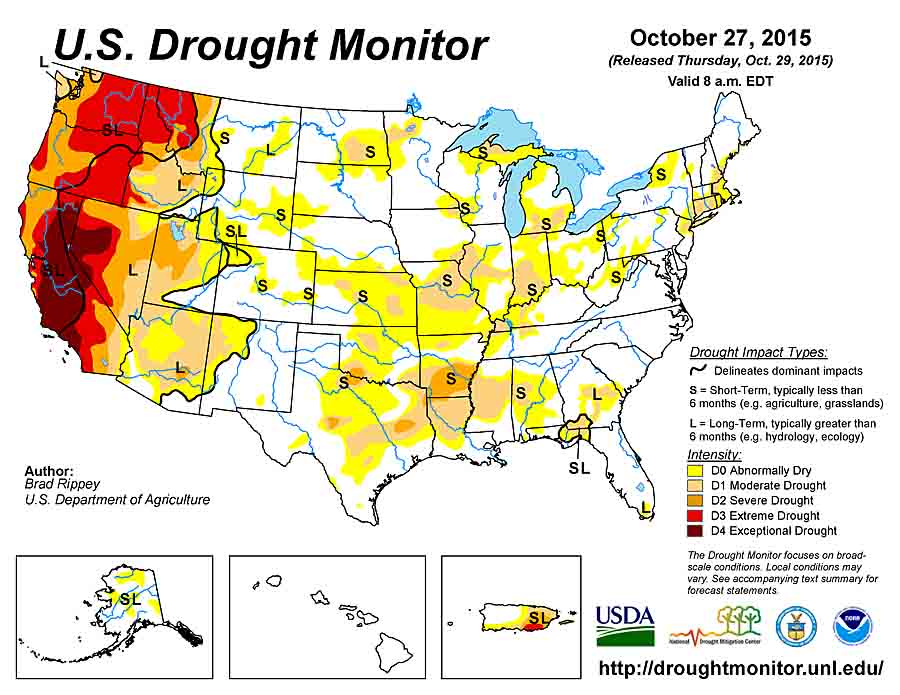
The three-year drought in the western United States and especially in California became more obvious this year as wildfires were influenced by low moisture in live vegetation, and in some areas once-healthy trees began to show drought-induced stress.

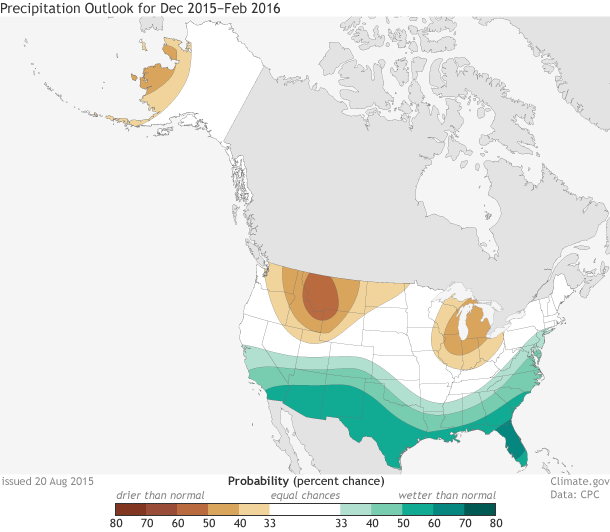
The current El Niño is expected to influence weather patterns during the coming winter and forecasters predict higher than normal precipitation across the southern portions of the United States, including southern California.

The map above illustrates how much precipitation is needed over a three-month period to end or ameliorate the current drought. Most of northern California will need from 6 to 12 inches according to NOAA.

Drought Monitor 10-27-2015


NOAA’s disclaimer about the map at the top of the article:

This [map] only tells you how much precipitation a location needs to get the Palmer Hydrological Drought Index (PHDI) to a certain value based on the model’s equations. It does not tell you how much precipitation is needed to refill a reservoir, restore groundwater to normal, or bring an ecosystem back to normality. It also does not incorporate snowpack into its calculations, and mountain snowpack is a crucial part of hydrology in the U.S. West.

What to expect from El Niño

El Niño forecast

The question of IF there will be a strong El Niño weather pattern in the contiguous United States this winter is now settled. NOAA reports that there is a 95 percent probability that El Niño will continue through the 2015-2016 Northern Hemisphere winter. In an indication of the strength to expect, the June-August average of sea surface temperatures in the Niño3.4 region was 1.22° C above normal. This is the third-highest June-August value since records started in 1950.

El Niño isn’t a storm that will hit a specific area at a specific time. Instead, the warmer tropical Pacific waters cause changes to the global atmospheric circulation, resulting in a wide range of changes to global weather.

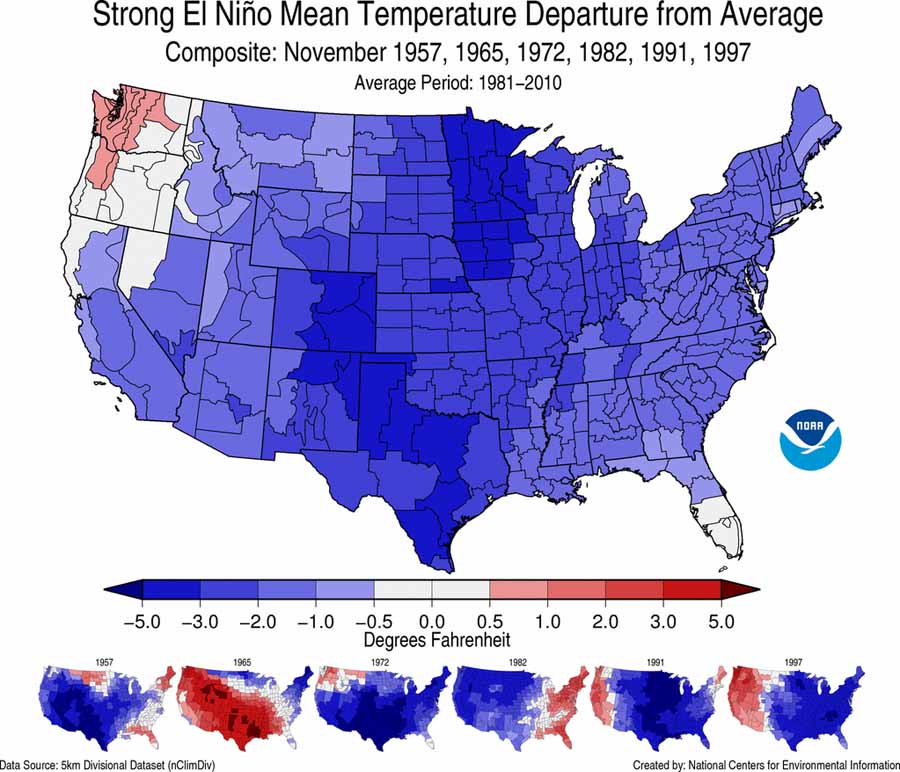
The map above is a composite of how precipitation varied from average during the strong El Niños of 1957–1958, 1965–1966, 1972–1973, 1982–1983, 1991–1992, and 1997–1998. There is a large variability in those six events that makes it difficult to predict the effects at any specific location. The map below is a composite of temperatures for the same periods. Again there is much variability, and you will notice that it is very different from the actual forecast, farther down, for this winter.

El Nino temp composite

The impacts of El Niño are typically largest in the U.S. during the cool months from October through May. During the winter season, the southern half of the country — from California to the Southern Plains, as well as along the East Coast — typically receives above-average precipitation. Below-average temperatures also often accompany this above-average precipitation in these regions. Across the northern half of the country, the winter season tends to be warmer and drier than average, particularly in the Northwest, Northern Plains, and Ohio Valley.

Below are NOAA’s outlooks for temperature and precipitation for December 2015 through February 2016.

precipitation outlook temperature outlook