Summary of the wildfire season in South Dakota

The South Dakota Department of Agriculture summarized the slower than average 2015 wildfire season in the state:

****

Extremely dry conditions got South Dakota’s Wildland Fire season started early in 2015, but it slowed as wetter conditions persevered. For the second year in a row, the largest amount of fire activity was not in the Black Hills.

The South Dakota Department of Agriculture Wildland Fire Division says the state’s largest fire for the 2015 fire season was the 13,949 acre Sheep Draw fire in Harding County in late March.  The second largest fire was the escaped Cold Brook prescribed fire in Wind Cave National Park, which involved 5,400 acres. The third largest fire was the 5,100 acre fire near Gettysburg in April. The largest forest fire in the Black Hills was the 58 acre North Pole fire in March, which was started by slash pile debris burning.

Also for the second year in row, most of the mid-size, 500 to 1,000 acre fires were in Central South Dakota. The majority were started by harvesting on hot, dry days.

The Black Hills stayed relatively wet and quiet for the second year in a row, allowing federal, state and local fire fighters across the state assist the western states with equipment and personnel on large fires

South Dakota Wildland Fire firefighters assisted the Province of Saskatchewan in July with engine crew staffing during the record breaking fire season in Canada. Wildland Fire and volunteer firefighters sent incident management team personnel, hand crews, engine crews and aircraft to support fires activity in California, Washington, Oregon, Colorado, Wyoming, Alaska, Nebraska, Idaho and Montana. All returned without serious incident or injury. The State of South Dakota Single Engine Air Tanker flew on three fires in South Dakota and one fire in Nebraska.

Additionally, Wildland Fire engine crews were called on to provide a significant amount of support to various poultry operations during the spring Avian Influenza outbreak in the eastern part of the state.


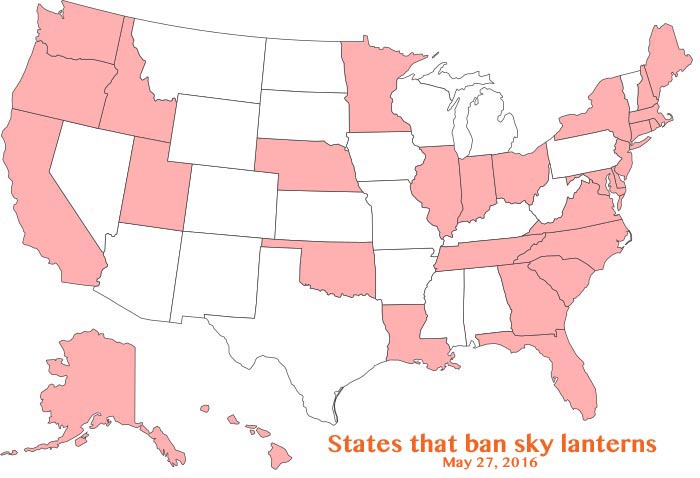
Update on the legality of sky lanterns — banned in 29 states

sky lanterns banned

(The map above is our estimate, based on internet searches, of states that ban sky lanterns. We make no claim that it is 100 percent accurate, and bear no responsibility for how it may be used.)

Sky lanterns are sometimes used to celebrate a new year, a wedding, or they are launched just for the hell of it.

These dangerous devices use a small flaming object to inflate and loft a plastic or paper balloon, like a hot air balloon but on a much smaller scale. The heated air in the balloon is lighter than the surrounding air, causing the lantern to rise — assuming everything goes as planned. Often it doesn’t, and the sky lantern, or fire balloon, settles to the ground, is trapped in a tree, or lands on a roof.

(UPDATE: On February 18, 2016 the Nebraska legislature passed a bill, voting 44 to 0, that would ban sky lanterns in the state. The Governor signed it making Nebraska the 30th state to ban the dangerous devices.)

Fire Balloon, Mercedes
Fire Balloon — a screen grab from a Mercedes commercial on CBS, November 4, 2012.

In case you know someone who is planning on launching sky lanterns on New Year’s Eve, please warn them that they are banned in 29 states, the National Association of State Fire Marshals recommends that they be banned everywhere, and they are illegal to use in states and cities that have adopted the International Fire Code.

After they are launched, they are completely out of control and can rise to 3,000 feet, later landing on the ground, in trees, or on structures. They have ignited roofs and started a fire that burned 800 acres in Myrtle Beach, South Caroline in 2011. In May, 2015 dozens of sky lanterns were released from the Carolina Speedway in Gastonia, North Carolina. The wind blew some of them into a cell phone tower, igniting it just out of range of the water cannon on the Union Road Volunteer Fire Department’s fire engine.

On July 1, 2013 a sky lantern landed in a recycling facility in the West Midlands of England starting a fire causing an estimated six million British pounds of damage.

Also in England cows have been killed after they ate the remains of sky lanterns that fell onto the ranchers property.

An airport in Alaska had to reroute air traffic when multiple sky lanterns flew into airspace needed by aircraft. Several family members were injured when the driver of their car veered off a road to avoid hitting what turned out to be a sky lantern.

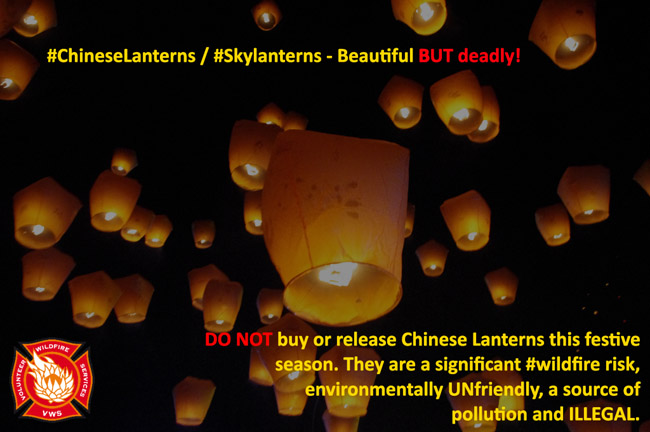
Sky Lantern poster

Below is an example of what can go wrong. You can jump ahead to 3:30.

Sell Art Online


Mississippi men still meet to relive their firefighting days in California

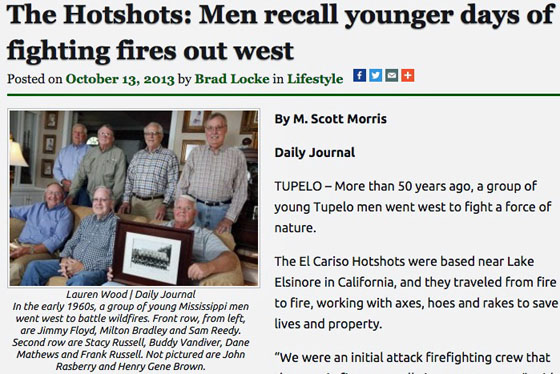
Tupelo hotshots
From the Northeast Mississippi Daily Journal

The Northeast Mississippi Daily Journal has a well written article about a group of nine men from Mississippi that in the early 1960s traveled west to work on the El Cariso Hotshots in southern California. Many of them still live in the area around Tupelo, Mississippi and occasionally meet to share war stories.

I like how the article ends:

…They were young and immortal once, and traveled west to put that immortality to the test. They were brave and maybe a little crazy, but don’t call them stupid.

“If you went out there for the third year, you got to be a smokejumper. They dropped you in a parachute to fight fires,” Floyd said. “We were all smart enough not to go back the third year.”

I grew up in Mississippi and unknowingly followed in their footsteps a decade or so later, applying for the El Cariso job through the Forestry School’s Summer Student Employment Program at Mississippi State University. My application didn’t have the endorsement of a politician (like one of these gentlemen), but I had a previous season of experience working on a Timber Stand Improvement Crew on the Mendocino National Forest running a chain saw all day every day. I spent three seasons on El Cariso before moving on to the newly formed Laguna Hotshots — then engines, prevention, engines again, and Fire Management Officer.

Message to Australians in bushfire-prone areas: “Leave and live”

Lorne-Jamieson Track Bushfire
A community impacted by the Lorne-Jamieson Track Bushfire. Country Fire Authority photo.

One of the many fires that have plagued Victoria, Australia in recent weeks, the Lorne-Jamieson Track Bushfire, destroyed 116 homes. With the state being in the midst of their bushfire season fire officials are encouraging residents to leave early if there is a report of a fire, rather than waiting too late — a mistake that has killed civilians who became trapped on roads and overrun by flames.

Below is an excerpt from an article in The Age written by Craig Lapsley, Victoria’s Emergency Management Commissioner.

****

“…The only guaranteed way of surviving a bushfire is to not be there. That is the underpinning logic behind leaving early.

Fire is neither logical nor forgiving. Few people are adequately prepared, physically or emotionally, or have sufficient resources to remain and defend their properties. And so the message again this summer is to leave early. The message is captured in the slogan “Leave and live”.

On Christmas day, even after a recommendation to evacuate had been made, there were those in Lorne who chose to “wait and see”, the circumstance that has historically led to most bushfire deaths as people leave late and are caught on the roads, in the open or trapped in homes that cannot be defended.

fire crew Otways bushfire
Anthony Hester and his fire crew at the Otways bushfire in Victoria, Australia. Photo by Hamish Blair.

Larger, more complex questions face our community in the months and years ahead. The issue of land-use planning is one of these. More people are seeking to live deeper in the bush and enabling them to do so safely presents significant challenges.  A more structured approach to private shelters in high bushfire risk developments is one option.

More fundamentally, urban development both around Melbourne and regional centres, is being pushed into forested and even grassland areas that are inherently fire prone. New communities must be planned in a manner that does not inadvertently expose them to risk, be it from bushfire or other natural hazards. There is work being done within governments around this but a significant dialogue remains to be had with the broader community.

How existing communities are strengthened both physically and in terms of social resilience remains one of our biggest challenges. The vast majority of the existing building stock in high risk areas across the state is simply not designed to withstand the passage of a bushfire. This will not change within the foreseeable future. Community based planning that factors this inherent weakness into survival strategies has to play a part in strengthening communities against disaster…”

116 homes burn near the Great Ocean Road in Victoria, Australia

Lorne-Jamieson Track bushfire
The Lorne-Jamieson Track bushfire. Country Fire Authority photo.

The Country Fire Authority (CFA) has confirmed that at least 116 homes were destroyed in a bushfire that burned along the Great Ocean Road near Separation Creek and Wye River in Victoria Australia. Many people were forced from their homes on Christmas night, causing traffic jams as residents fled to Torquay or Melbourne.

Lorne fire
Lorne-Jamieson Track Bushfire. CFA map.

One couple who live in nearby Lorne, Wilma and Ian Bishop, did not evacuate but slept in their car near the beach, planning to run into the sea if the fire spread into the town. However the fire bypassed Lorne, inflicting most of the damage in Wye River and Separation Creek.

The fire started December 19 from a lightning strike in Great Otway National Park eight kilometers west of Lorne. At the last report it had burned 2,290 hectares (5,659 acres). On December 24 the resources on the fire included 150 firefighters, 6 air tankers, 7 dozers, and a 40-person incident management team.

Lorne fire IMT
Part of the Incident Management Team on the Lorne-Jamieson Track Bushfire, December 24, 2015. CFA photo.
Lorne fire community meeting
The CFA hosts a community meeting on December 25, 2015, for the Loren-Jamieson Track Bushfire.