List of wildfires in the Southern Geographic Area, as shown in the October 31, 2016 daily Incident Management Report. Click to see larger version.
As most areas in the western states are winding down or have already closed out their wildfire season, the fall fire season in the South is appearing on the radar as leaves fall off the trees and frost kills the herbaceous vegetation, providing additional fuel.
The Southern Geographic Area’s daily report includes nine fires over the last couple of weeks that exceeded 100 acres.
The Nantahala National Forest in western North Carolina has five active blazes that have burned 40, 100, 33, 11, and 374 acres. Elevated fire activity on the Forest has prompted fire management officials to transition from district management to a Type 3 organization. Effective Sunday, this enables more effective management of several fires simultaneously under the umbrella of one incident commander.
Additional resources have arrived to assist in suppressing ongoing fires as well as any new starts. Crews from California, New Mexico, Michigan, Minnesota, Florida and Oregon have joined forces with local firefighters.
None of these fires show up on InciWeb.
Location of wildfires as reported on October 31, 2016 by the Southern Area Coordination Center.
Above: The numbers indicate sustained wind speeds. The solid red areas are Red Flag Warnings. The lines show fronts. Reported at 12:40 p.m. MDT, October 31, 2016.
(UPDATED at 12:58 a.m. MDT October 31, 2016)
As weather fronts move across the Great Plains they are bringing strong winds today. Behind the trough (dashed yellow line) relative humidities are in the teens and twenties.
The National Weather Service has posted Red Flag Warnings for areas in South Dakota, Nebraska, and Colorado.
Red Flag Warnings can change throughout the day as the National Weather Service offices around the country update and revise their forecasts and maps.
Weather forecast for west South Dakota, northeast Wyoming, and northwest Nebraska, October 31, 2016.
Sky lanterns. This photo found on the site of a company that sells the dangerous devices appears to show four of them in the background that have ignited the paper or plastic balloon and are raining down burning debris.
A rancher in the United Kingdom is blaming the death of one of his cows on a sky lantern that landed on his property. These devices are small hot air balloons lofted into the air by fuel burning at the base.
…Last year, David Rowlands of Grange Farm, Mickle Trifford, Chester, experienced the problems of sky lanterns first hand. The Rowlands family lost one of their pedigree Red Poll breeding cows to a sky lantern around bonfire night.
“She started staggering, so we treated her for staggers, but obviously it had no effect.
“The vets assessment was that the oesophagus had been pierced by wire from one of these wretched things, leading to asphyxiation,” Mr Rowlands explained.
“These sky lanterns have either wire or bamboo frames and essentially they’re cannon balls floating.
“Eventually they land and if they land in a field with cattle grazing, the cattle will investigate.
“The animals are inclined to chew things like this, the wire will splinter, penetrating their throats and causing swelling. It leads to asphyxiation, a horrible death taking about 48 hours.”
“How an animal-loving nation can tolerate this sort of risk to cattle and sheep baffles me,” he toldFarmers Weekly.
But Mr Rowlands hopes if more councils ban them it will help as he says he doesn’t think it is deliberate nastiness of the people releasing them, more that they simply don’t understand the risks.
“Our cows don’t think they are worth the risk,” he said…
Above: Junkins Fire, southwest of Pueblo, Colorado. Photo provided by the Incident Management Team on October 19, 2016.
There have been many discussions recently on this website, in the scientific community, and in the more public arena about why the number of acres burned in wildfires has been increasing rapidly over the last several decades. From the mid-1980s through 2015 the average number of acres burned has grown from about 2 million acres a year to around 8 million. Some people like to claim that this was caused by climate change, environmentalists preventing timber from being harvested, or other factors. However, to complicate the issue, some data appears to indicate that between 1920 and 1950, 10 million to 50 million acres burned each year.
It is very difficult to say that one factor caused fire occurrence to change. While comparing acres burned in the early part of the 20th century to what we are seeing in recent decades, many variables need to be considered:
–Weather and climate trends. This has been vigorously discussed in many venues.
–The capacity to suppress wildfires. In the first two-thirds of the 20th century the ability of land managers to suppress wildfires was very different from what we have today. Fire engines now carry many times more water, and transportation systems enable quicker initial attack response. Helicopters and air tankers were brought into the equation. Heavy equipment became more prolific and capable. More efficient communication and dispatch systems were created. Fires are detected more quickly. Firefighters are routinely brought in from hundreds or even thousands of miles away.
–The wildland-urban interface is growing. More people are living and recreating where previously there was less human activity. This can increase the number of fire starts, and the endangered structures often have an effect on the priorities of firefighters and where they are deployed, as opposed concentrating forces where they are most likely to contain the fire.
—Changes in how timber is managed and harvested.
–Fire suppression can result in longer fire return intervals and increases in the amount of fuel available for the next fire.
–Fuel treatments: mechanical and prescribed fire.
–Changes in the vegetation: non-native species, insects, disease.
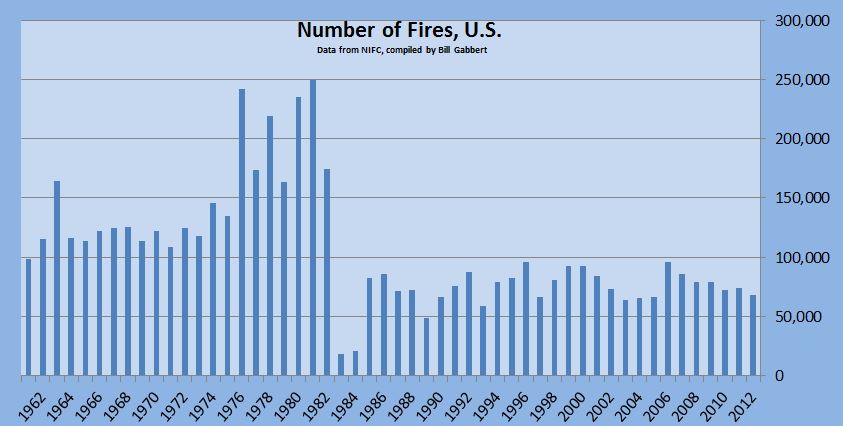
–Accuracy of the fire occurrence data. Can the data for 1920 be compared with the data from 2016? The fire occurrence data at NIFC for 1962 through 2015 shows a huge swing beginning in 1983 and 1984, with the number of fires overnight dropping by about 50%, a trend that continued through 2015. This leads one to lose confidence in the data. One would think that the more modern era, post 1984, would have more accurate information than previous decades.
–Changes in wildfire management policy: full, limited, or no suppression.
Our readers will probably suggest even more factors that affect the number of fires and acres burned.
Considering all of these variables, I am skeptical of reports saying that just one is responsible for changes in the number fires and acres burned.
“…Our research findings provide scientific justification for using soil moisture data from in situ monitoring networks in fire danger rating systems. Such soil moisture data are increasingly available and are not currently being used in the context of wildfire preparedness. ”
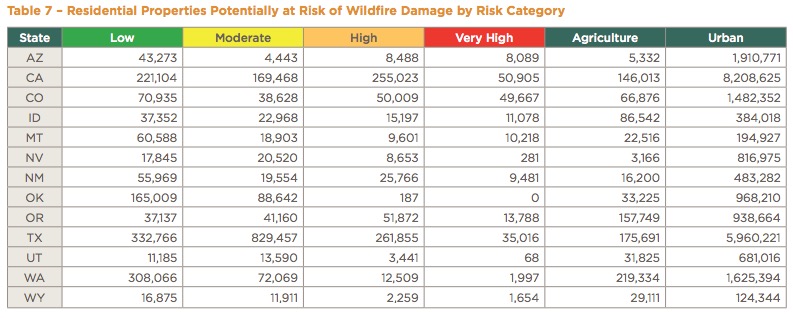
Above: Residences in 13 western states with a high or very high wildfire risk. CoreLogic.
CoreLogic has put together a report that looks at the residential properties in 13 western states that are potentially exposed to wildfire risk. It is an evaluation of the total number of properties at various risk levels, along with the estimated costs of reconstruction of single-family residences.
Residences in 13 western states with a high or very high wildfire risk, by category. CoreLogic.
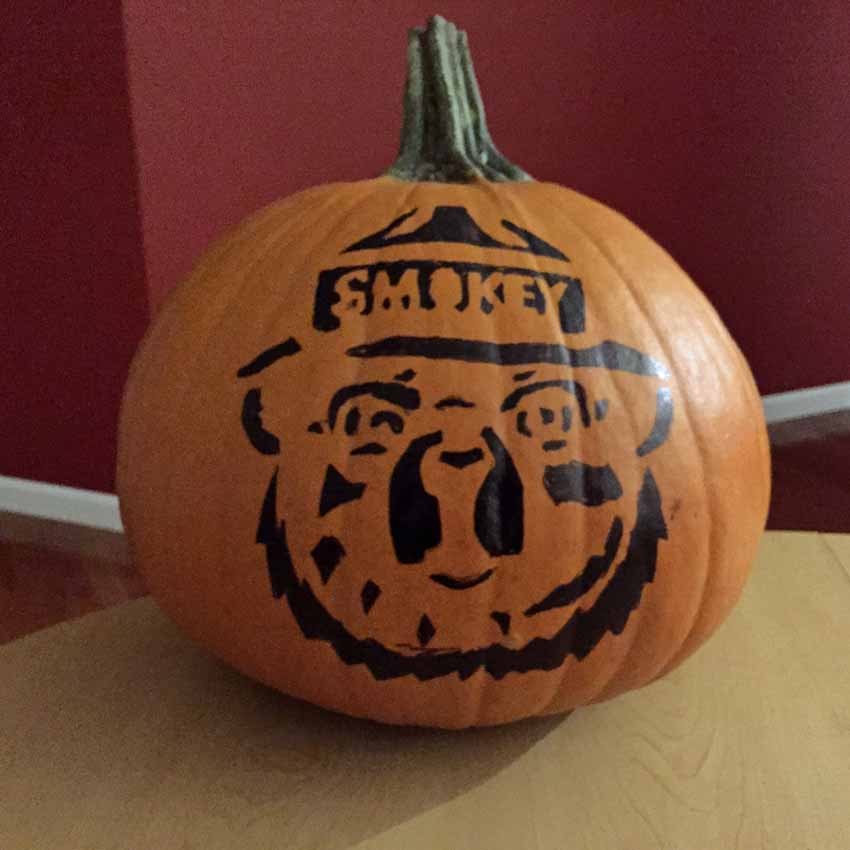
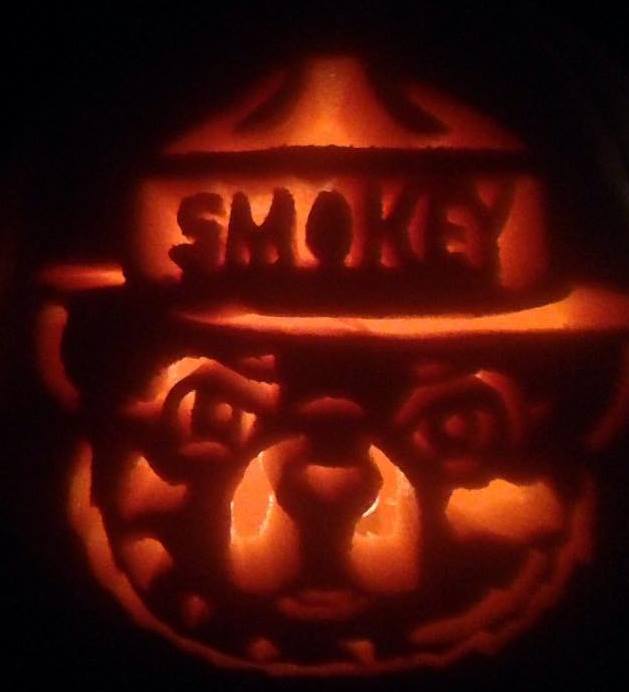
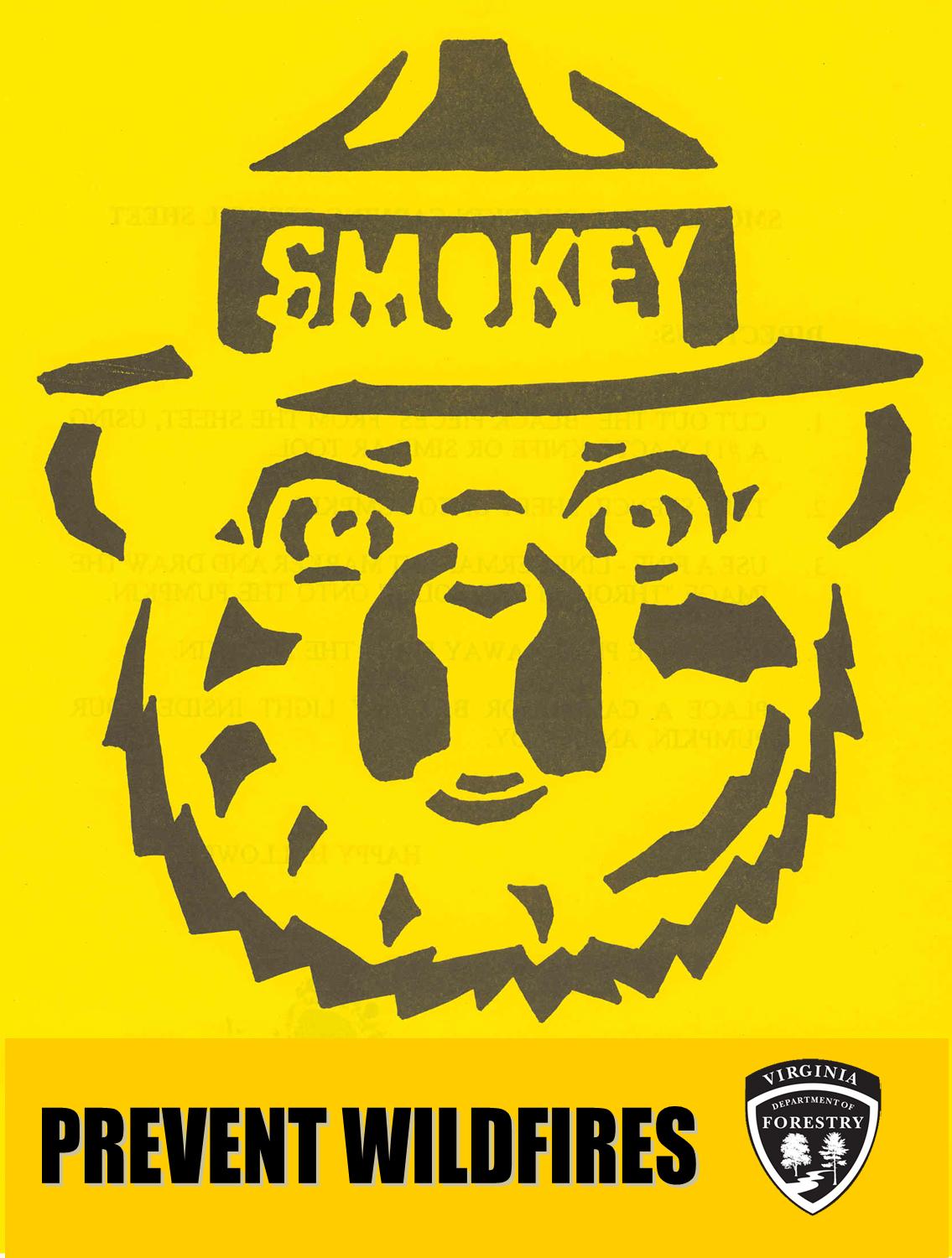
Smokey Jack O’Lantern by Crystal Fajt, October, 2014.
Would you like to have Smokey Bear looking at your trick or treaters from a Halloween Jack O’Lantern? Here’s how, thanks to the Virginia Department of Forestry:
In 1932 Robinson Jeffers published a book of poetry titled Thurso’s Landing and Other Poems that was set in the central coast region of California. One poem in particular was written about a vegetation fire — possibly the Matilija Fire that burned 220,000 acres that year which is the fifth largest recorded fire in the state.
The deer were bounding like blown leaves
Under the smoke in front the roaring wave of the brush-fire;
I thought of the smaller lives that were caught.
Beauty is not always lovely; the fire was beautiful, the terror
Of the deer was beautiful; and when I returned
Down the back slopes after the fire had gone by, an eagle
Was perched on the jag of a burnt pine,
Insolent and gorged, cloaked in the folded storms of his shoulders
He had come from far off for the good hunting
With fire for his beater to drive the game; the sky was merciless
Blue, and the hills merciless black,
The sombre-feathered great bird sleepily merciless between them.
I thought, painfully, but the whole mind,
The destruction that brings an eagle from heaven is better than mercy.
I have to admit — my six-second attention span rarely allows me to concentrate on the content of a poem that is more than a few lines long, but a couple of phrases stood out; Beauty is not always lovely, and in describing an eagle, Insolent and gorged, cloaked in the folded storms of his shoulders.
Mr. Jeffers led a very interesting life, coining the word inhumanism, the belief that mankind is too self-centered and too indifferent to the “astonishing beauty of things.” He briefly studied forestry at the University of Washington, had a scandalous affair with a married woman that was reported in the LA Times, and published many highly acclaimed books. But after writing about his staunch opposition to the United States’ entering World War II critics turned against him.