Tanker 116 at Mather

Tanker 116 Mather California

Jon Wright took this photo of Air Tanker 116, which is one of the first of the seven HC-130H aircraft the U.S. Forest Service acquired from the U.S. Coast Guard to be converted to an air tanker.

Mr. Wright said it spent several hours on February 27 and 28 conducting approaches at Mather Airport east of Sacramento.

Wildfire probability Feb. 28 – March 5

map probability of wildfires

The above map is a National Weather Service product that is new to me. According to meteorologist Nick Nauslar it is derived strictly from a fire history database. It is plotted on a 40km grid with some smoothing and it does not take fuels or weather into account. It is not available online yet, but there is an expectation that it will be soon.

And below apparently is the same data displayed in a different manner.

wildfire occurrence

Use an app to send precipitation observations to the NWS

Rainbow

Many areas where wildland firefighters are working do not have great coverage from weather radar because of the distance from the transmitter or steep terrain blocking the signals. You can help the National Weather Service produce better forecasts by using an app on your phone that can let them know what is happening at your location.

The message below from the National Weather Service in Rapid City uses local examples, but the principles are relevant in other areas:

****

Want to be a citizen scientist and help us determine what type of precipitation (snow, rain, sleet, hail, etc.) is falling?

Download the mPING app and use it to report various precipitation types as they occur. This data is incredibly helpful, especially because the terrain in SD and WY impacts radar coverage (can make it difficult to know what is happening at the surface far from the radar location in New Underwood, SD). Determining precipitation type can be rather tricky without observations at the surface. This is especially true when the temperature is just right that some places receive rain, while others get snow. That’s where the power of mPING comes in handy!

All reports are anonymous – only the location (latitude/longitude), time, and precipitation type are recorded.

The app can be downloaded on Android and iOS devices. If you have any questions, feel free to contact us or check out the mPING FAQ. We appreciate your willingness to help!

Links to the app here: http://mping.nssl.noaa.gov/

mPING FAQ: http://mping.nssl.noaa.gov/faq.php

Cancer and the San Diego Fire-Rescue Department

firefighters, cancer,

Above: Screenshot from Jason Curtis’ film about San Diego firefighters and the occurrence of cancer.

The San Diego Fireman’s Relief Association has produced a short 8-minute documentary about the occurrence of cancer within the membership of the San Diego Fire-Rescue Department, interviewing 15 firefighters who talked about their job and the disease. Many of them looked back knowing what they know now, and wished they had done some things differently.

(UPDATE March 2, 2017: the film was available at the website of the company hired to make the film, but it has been removed until the cancer awareness program associated with it has been rolled out. It may be available again on YouTube or another site in two to three months, according to Robert Bunsold, a board member of the Relief Association.)

The San Diego FD primarily deals with structure fires. The mix of by-products of combustion they are exposed to is different from what a wildland firefighter works in, but unfortunately we don’t know what the significance of that difference is, if any. There are carcinogens in wood smoke but much work still needs to be done to determine the short and long-term effects on wildland firefighters.

Structural firefighters generally wear breathing apparatus (BA) when they are making an interior attack on a structure, and often when they are on the exterior. But wildland firefighters never wear BAs on a vegetation fire because it is not practical. They can be working on a fire miles from their truck for up to 16 hours, but the air bottles only last for minutes.

Some wildland firefighters wear a bandana or dust mask over their nose and mouth, thinking, incorrectly, that they provide some level of protection from particulates. And they have no effect on carbon monoxide and other dangerous gasses.

The smallest and most dangerous particulates in vegetation fire smoke are so small that if one was near an 8-foot high ceiling in a room with perfectly still air, it would take 8 hours for it to fall to the floor. These particles can easily go through a bandana or a cheap mask and make their way to the lungs. Much more expensive respirators with certain types of replaceable filters could provide better air, but they are hot to wear and create too much resistance as the air is forced through the apparatus.

wildfire firefighter smoke
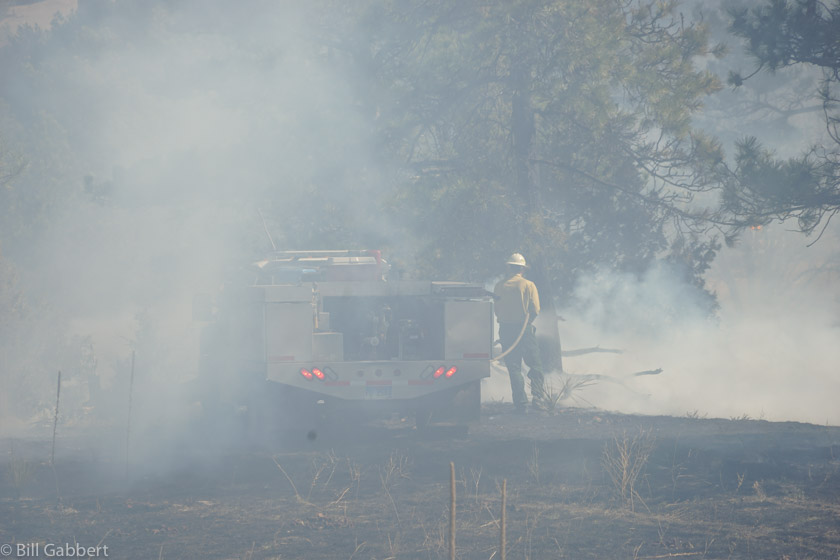
A firefighter works in the smoke on the Water Tower Fire in Hot Springs, SD March 1, 2016. Photo by Bill Gabbert.

There is no registry that tracks their exposure or health during and after their careers. Another bill was introduced in Washington this month to create a registry, but the one introduced a year ago died a quick death, and this newest one has far fewer co-sponsors and so far looks unlikely to pass.

Climate change and the wildfires in Chile

climate change wildfires Chile

During the current statistical period which runs from July through June wildfires in Chile have burned 601,367Ha (1.5 million acres) which is 924 percent of average for the entire 12-month period. That fact alone does not prove anything but it can trigger a need to look at the factors involved.

Below is an excerpt from an article in the Huffington Post:

Santiago, Chile and Los Angeles, California lie roughly the same distance from the equator and are subject to the same climatological forces. Both areas have endured years of record-breaking drought that has thinned forests and desiccated farms. In the summer heat, when winds pick up, fires can start easily and spread rapidly through dried vegetation.

For this, blame climate change. Heat-trapping carbon pollution is driving temperatures up across the globe, setting the conditions for severe heat, persistent dry spells and a high risk of fire. A recent study found that 25 percent of central Chile’s rainfall deficit could be attributed to human-caused climate change. Consistent with planetary warming, Chile is breaking heat records right and left. California is doing the same.

In looking at the chart above, increased emissions of greenhouse gasses did not CAUSE the fires in Chile, but it is possible that their effects created an environment that made it possible for wildfires, once ignited, to spread more quickly than they would have otherwise, and were more resistant to control.

Two New Jersey fire departments use social media to recruit and spread safety message

Amwell Fire Department text and drive

Above: A screenshot from the video shot produced by Carolyn Rizza about texting and driving.

At least two fire departments in New Jersey are using social media in their efforts to recruit volunteers and spread messages about safety.

The website NJ.com has an article about how the Amwell Valley Fire Company and the Township of Clinton are tapping the powers of Facebook and YouTube to interact with their customers.

This first video, about texting and driving, was made by 20-year old Carolyn Rizza, a volunteer firefighter with the Amwell Valley Fire Company as part of a scholarship contest.

The Township of Clinton Division of Fire produced the next video in an effort to recruit new members.

This is a good time to revisit something we posted on February 1, 2017. It is a description of the culture of firefighting in Chile, a country where almost all of the firefighters are volunteers. It was written by “scpen” who left it as a comment below one of the articles we wrote about the 747 SuperTanker assisting the Chilean firefighters.

****

“The tradition of the volunteer fire fighters in Chile is a very old one. To become a volunteer firefighter there is a waiting list in every single town and city across Chile, and it often takes years to get an open slot, typically another member must sponsor the person applying. It is seen as more important and patriotic than volunteering to join the military. It is for life. Even old firefighters that are no longer able to fight fires, still show-up for training and other activities, or help with administration. Often until they die.

At the core, is a sort of belief that fighting fires and rescuing people is such an honor, and so important, that a paid, “professional” group, of fire fighters would not take it so seriously (correct or mistaken). It is not something that can be trusted to the vagaries of government ministers, budget cuts, and so on.

That said, the volunteer departments equipment is mostly provided by the government. Simply the firefighters receive donations in yearly fund raising drives, that they divided between them and is viewed as a thank you for their service through-out the year.

They do receive professional level training. Experts from the around the World are brought in to for training. Firefighters join specialized brigades such as dealing with chemical hazards, high-rise rescues, and so on.

This is not just a bunch of guys standing on the street corner they pick-up, and hand them a garden hose.”

Washington Post writes about firefighters and cancer

firefighters smoke cancer cold brook prescribed fire

Above: Members of a hotshot crew work in smoke on the Cold Brook Prescribed Fire, October 23, 2014. Photo by Bill Gabbert.

Very slow progress is being made toward recognizing the long term health risks of firefighters and more importantly, taking action to mitigate the effects.

This month another bill was introduced that would establish a national cancer registry for firefighters diagnosed with cancer, an occupational hazard that many organizations recognize as a presumptive disease in the profession. The bill is titled Firefighter Cancer Registry Act of 2017. A similar bill with 118 co-sponsors died a quick death in 2016, so there is little hope that this one will fare much better. This newest one has 12 co-sponsors as of today.

On Friday the Washington Post published an in-depth look at the topic in an article titled, Firefighters and cancer: Is a risky job even riskier? The authors interviewed several firefighters who have been diagnosed with cancer and laid out some of the health-related risks of the job.

Here is an excerpt from the article:

In 2015, the Centers for Disease Control and Prevention released the final results of what is currently the largest study of cancer risk among career firefighters ever conducted in the United States. The study of about 30,000 firefighters over a 60-year span showed that compared with the general population, firefighters on average are at higher risk for certain kinds of cancer — mainly oral, digestive, respiratory, genital and urinary cancers.

It is important to provide treatment to firefighters that have been injured on the job, including those suffering from diseases that were likely caused by working in a hazardous environment.

It is also important to take steps to reduce the hazard in the first place. For wildland firefighters who don’t have the luxury of breathing air carried in a bottle on their back, avoiding cancer-causing smoke can be difficult. But in some cases supervisors can minimize the number of firefighters that are forced to work in heavy smoke, or rotate them into areas where there is less. A crew can have a small carbon monoxide detector to identify excessive exposure to the dangerous gas, which on a fire would also be associated with the presence of particulates and carcinogens.

Here is another quote from the Washington Post article:

“Smoke on your gear and smoke on your helmet used to be a sign that you’re an experienced firefighter,” said Lt. Sarah Marchegiani of the Arlington County Fire Department. “But now people just recognize it’s a hazard and not worth it.”

Nevada BLM engine crew
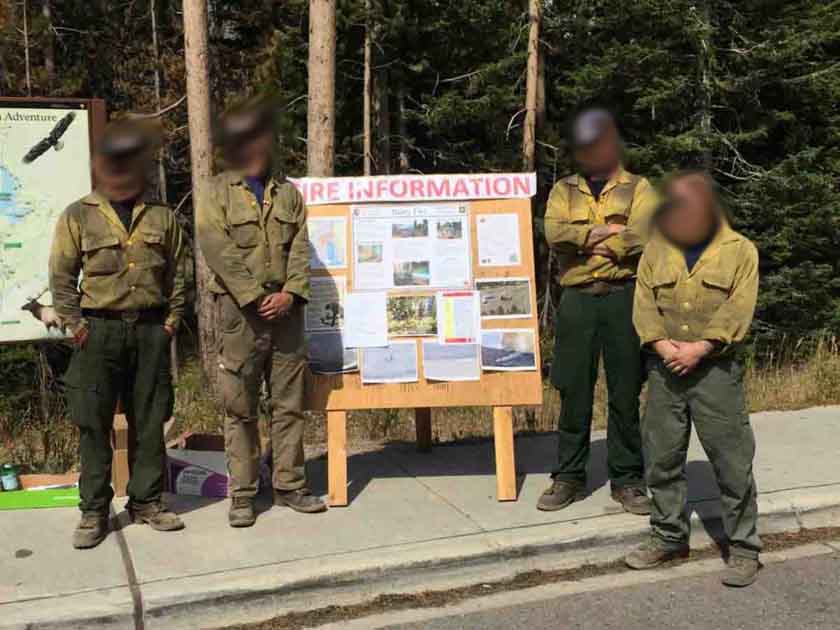
A Nevada BLM engine crew in 2016. Inciweb photo. The faces were blurred by Wildfire Today.

An issue that always creates some controversy on Wildfire Today is the fact that some firefighters feel that refusing to change out of very dirty Nomex even when clean clothes or a laundry service are available proves to their colleagues that they are cool, or experienced, or skilled, or manly. The fact is, the contaminants that accumulate on clothing, personal protective equipment, and line gear are dangerous. Having it in contact with your skin can cause it to be absorbed into the body. If the firefighter’s environment is warm their pores will open which allows chemicals to be absorbed even more quickly. Everybody that is knowledgeable about the issue agrees. Contaminants can even build up to the point where the fire resistance of the fabric is compromised, especially if it includes chainsaw oil or the residue of drip torch fuel.

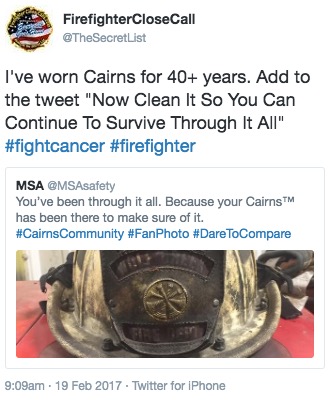
Firefighter Close Calls reports on injuries and accidents in the fire world and has written about the hazards of contaminated fire gear. Here is an example from earlier this week:

Firefighter Close Calls Tweet

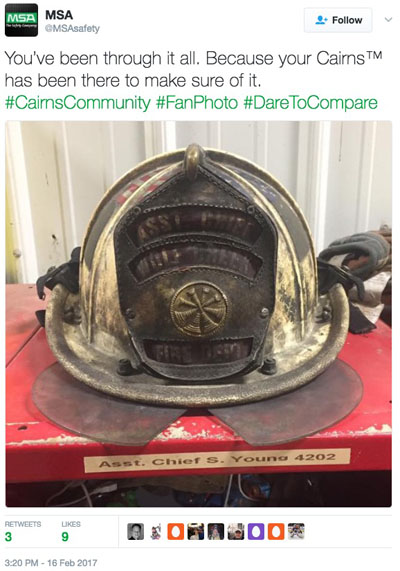
And below is a better photo of the helmet:
Cairns dirty helmet firefighter

The fact that a major manufacturer of personal protective equipment for firefighters uses gear in their advertising that is probably contaminated with carcinogens, is an indicator of the difficulty in solving this health-related problem.

firefighters, cancer,
Screenshot from Jason Curtis’ film about San Diego firefighters and the occurrence of cancer.

Information about the hazards of wood smoke:

Smoke from controlled burn causes two accidents on Kansas highway

Osage smoke highway accident controlled burn
Scene of two accidents on Highway 56 in Kansas, February 18. The photo was taken after visibility had improved somewhat. Photo courtesy of Kansas State Firefighters Association.

Smoke from a controlled burn on February 18 caused two accidents on Highway 56 in Kansas two miles east of the Osage-Lyon county line. The series of accidents began when a truck was hit from behind when it slowed as it entered the smoke and the vehicle in front of it also slowed down.

The second accident happened when other vehicles stopped in the smoke to help those in the first accident. One driver was parked partially in the roadway when she was hit by another vehicle which then kept moving and hit two pedestrians who were helping one of the drivers in the first accident. After injuring the pedestrians the vehicle then hit another car.

The Osage County Sheriff’s Office that provided the above information reported that three people were transported to hospitals and five vehicles were damaged.

Dan Romine, Chief of Osage County Fire District #2, said the smoke across the highway was a lot worse than shown in the photo above when his fire department first arrived on scene.

Contract possibilities for U.S. air tankers in the southern hemisphere

Thursley Common fire 2006

Above: Neptune’s Tanker 03 parked near several portable water tanks at Concepción, Chile February 4, 2017. Neptune Aviation photo.

Air tankers in the United States and Canada usually spend four to seven months each year parked, not turning a wheel, prop, or turbine. While they sit idle, there can be wildfires raging in South America and Australia, where their fire seasons are opposite of the those in the northern hemisphere. Of course the air tanker operators know this and in some cases are pursuing those opportunities.

Three companies have a total of four air tankers on the second year of a two-year “trial” contract in Australia — Conair, 10 Tanker, and Coulson. Word on the street ramp is that Victoria and New South Wales will issue more contracts for large air tankers before the 2017-2018 summer fire season arrives in September or October.

The first time use of large and very large air tankers in Chile over the last 30 days may have opened another market, as the 747, BAe-146, and a Russian IL-76 all demonstrated that they can be effective even without a supporting air tanker infrastructure in the country.

When we saw an article on a Chilean website inferring that their government had reached an agreement with Global Supertanker to facilitate the use of the 747 Supertanker in the country, it got our attention. Wondering if it was fake news, we checked with Jim Wheeler the CEO and President of the company, who told us that while they have been in talks with government officials, nothing yet is final or signed, and used the term “pending contract”. One of the objectives of an agreement, if reached, would be to ensure a fairly fast arrival after being mobilized. Following wheels up at Colorado Springs, the home base of the aircraft, it can fly non-stop to Santiago in 10 hours.

Clouding the issue in Chile is the contracting and political climate. In recent weeks high-ranking government officials there have issued conflicting statements about the effectiveness of the air tankers, at times saying they are valuable and at other times the opposite. All of this has to be analyzed knowing some background information about aerial firefighting in Chile.

Most of the firefighting aircraft that have been used for years in Chile, the single engine air tankers (SEATs) and helicopters, have been made available through contracts with private companies based in Europe. Officials from two of the companies were accused in Spain of contract collusion and international bribery among other crimes, according to a report by Ahora Noticias, a Chilean publication. In light of those problems, there has been pressure in Chile to investigate their contracting procedures for aircraft.

The publication interviewed a consultant in disaster management, Rodrigo Reveco, who implied that a cozy relationship between the companies and the Chilean non-profit organization that has a hand in managing emergency operations, may help explain why there was a reluctance to bring in aerial firefighting assets from other companies evan as the disastrous wildfire conditions worsened in December.

With this issue fermenting in the background, it can be difficult to predict the future of large, expensive firefighting aircraft in the country.