Above: T-10 (a BAe-146), another BAe-146, and an RJ85 (center) at La Grande, OR. Photo by Josh Annas.
The number of RJ85 and BAe-146 air tankers continues to grow. According to BAE Systems there are likely to be 18 of the aircraft that are operational by later this year and there are four more in various levels of conversion.
The two quad-jet aircraft are similar — both are made by BAE — and can carry up to about 3,000 gallons of retardant utilizing gravity to empty the tanks.
During the 2016 wildfire season the 14 in-service BAe 146-200s and Avro RJ85s of Neptune Aviation and Conair/Aero-Flite flew a combined total of over 5,800 tanker missions, dropping in excess of 12.5 million gallons of retardant.
A further eight BAe 146/Avro RJs are under conversion, with four scheduled to enter service during 2017.
Neptune Aviation’s fleet of seven BAe 146s flew a total of 2,880 hours on airtanker operations in the United States and Canada. Dan Snyder, Neptune’s Chief Operating Officer explained: “We are a US national resource. Wherever the US Forest Service has the need or request we can and do get dispatched”.
He added: “The yearly utilization average per aircraft varies greatly from year to year based on the fire season. Some years it is 200 hours per aircraft; others it can be 400 hours per aircraft. Fire operations in a day vary greatly as well. Some days there are no flights; some days only one. Sometimes it can be up to 10-15 missions a day. The distance to the fire, weather, and fire activity all affect this number.”
Seven of Neptune’s BAe 146s are under Exclusive Use Contracts with the USFS, along with four P2V Neptunes. An additional BAe-146 is contracted to CAL FIRE in California.
More recently, one of Neptune’s BAe 146s was on an assignment in Chile for several weeks.
Neptune has acquired and is converting a further two BAe 146-200s into airtankers to be ready for this year’s fire season.
Conair of Abbotsford, Canada, and its US subsidiary Aero-Flite, has a total of seven Avro RJ85s in service as airtankers, with an eighth aircraft under conversion ready for the 2017 fire season.
Four of Conair/Aeroflite’s RJ85s are earmarked for the 2017 Exclusive Use Contract with the USFS.
Jeff Berry, Conair’s Director of Business Development, stated that by early November the seven in-service aircraft had flown more than 430,000 km in support of wildfire operations on hundreds of fires in the United States and Canada during 2016. He added: “That is equivalent to a distance greater than 10 times around the world and the volume of retardant delivered to control wildfires was greater than the volume of six Olympic swimming pools.”
In addition, one of Conair’s RJ85s was recently deployed during the down under summer under contract to the State of Victoria to help in suppressing bushfires.
Warning: Trying to access array offset on value of type bool in /home/customer/www/wildfiretoday.com/public_html/wp-content/themes/jupiterx/lib/api/image/functions.php on line 61
Deprecated: ltrim(): Passing null to parameter #1 ($string) of type string is deprecated in /home/customer/www/wildfiretoday.com/public_html/wp-content/themes/jupiterx/lib/api/utilities/functions.php on line 206
Deprecated: preg_replace(): Passing null to parameter #3 ($subject) of type array|string is deprecated in /home/customer/www/wildfiretoday.com/public_html/wp-content/themes/jupiterx/lib/api/image/class-image-editor.php on line 177
Warning: Undefined array key "extension" in /home/customer/www/wildfiretoday.com/public_html/wp-content/themes/jupiterx/lib/api/image/class-image-editor.php on line 179
Deprecated: preg_match(): Passing null to parameter #2 ($subject) of type string is deprecated in /home/customer/www/wildfiretoday.com/public_html/wp-includes/functions.php on line 3089
Deprecated: is_file(): Passing null to parameter #1 ($filename) of type string is deprecated in /home/customer/www/wildfiretoday.com/public_html/wp-includes/class-wp-image-editor-gd.php on line 95
Deprecated: preg_match(): Passing null to parameter #2 ($subject) of type string is deprecated in /home/customer/www/wildfiretoday.com/public_html/wp-includes/class-wp-image-editor-gd.php on line 95
Above: A Colombian Air Force C-130H makes a water drop at Apiay Air Force Base in Colombia, March 29, 2017. Photo by Bill Gabbert.
Colombia is now on the list of countries that are using Modular Airborne FireFighting Systems (MAFFS) to help firefighters on the ground.
Yesterday, March 29, in a ceremony at Apiay Air Force Base near Villavicencio the Colombian government officially took possession of a new MAFFS II retardant delivery system. A C-130 with the new hardware made two demonstration drops with water in front a crowd of dignitaries, many of whom made speeches, including Colombia’s Minister of Defense Luis Carlos Villegas Echeverri.
Minister of Defense Luis Carlos Villegas Echeverri speaks at the MAFFS ceremony March 29, 2017. Photo by Bill Gabbert.It is the first of the second generation MAFFS to be sold outside the United States. The U.S. Forest Service has eight MAFFS II’s that can be slipped into a C-130 converting it in a matter of hours to a 3,000-gallon air tanker.
A private company, MAFFS Joint Venture based in California, purchased the intellectual property from the now bankrupt Aero Union (that designed and built the MAFFS) and is now manufacturing the second generation systems for sale around the world, with the one in Colombia being their first one delivered. Bradford Beck, the President and COO of MAFFS, said they have a second unit in production for an undisclosed buyer.
Colombian C-130 in which the MAFFS was installed. Photo by Bill Gabbert.Mr. Beck said there are nine MAFFS 1 units outside the U.S. — Brazil, Tunisia, Morocco, and Turkey each have two, and there is one in Thailand.
The main differences between the two versions is that the MAFFS II has onboard air compressors, the retardant exits the aircraft through the paratroop door on the left side rather than out the rear cargo ramp, it has the ability to inject foam concentrate, it can produce coverage levels 1 through 8, and it is more controllable for split drops (starting and stopping the flow). The coverage level refers to the number of gallons per 100 square feet.
Colonel Rodrigo Zapata of the Colombian Air Force said the MAFFS unit will primarily be based at the very busy El Dorado International Airport near Bogota at 8,300 feet above sea level, but it can work out of lower elevation airports as needed. They will be installing a fire retardant plant at El Dorado.
Major General Jorge Borbon said the Air Force has been using helicopters with water buckets for decades, but they have never used fixed wing aircraft to drop water or retardant on wildfires.
We have many photos that we will add later, as well as videos of interviews with key players, including the Colombian Minister of Defense.
Above: Two of the fire engines that were entrapped on Corsica. The engine on the left appears to have small water nozzles on the bar that encircles the top of the cab.
During night firefighting operations on the island of Corsica overnight on March 24 and 25 three fire vehicles were entrapped by the fire resulting in five firefighters suffering first and second-degree burns. Some of the firefighters, it is not clear how many, took refuge in one or more of the fire engines that had vehicle protection systems consisting of water nozzles positioned around the truck that could be activated as needed.
The fire occurred in the French commune of Bastelica in southern Corsica (map). Matthias Fekl, the Minister of the Interior, said Saturday morning:
In the early evening, a group of firefighters found themselves trapped in flames as a result of a change in wind direction. They then took refuge in their vehicles equipped with a self-protection device.
One person is in police custody, suspected of starting the fire.
Three firefighter vehicles were damaged or destroyed in the incident.
The fire engine in the above photo appears to be the same one in the photo (on the left) at the top of this article.
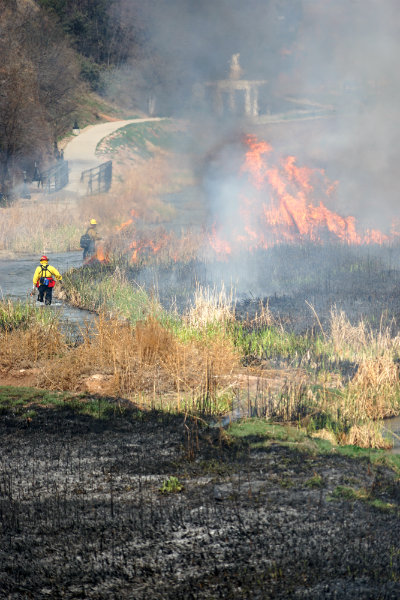
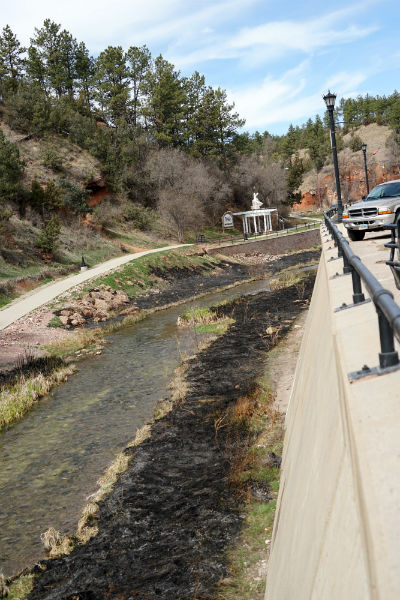
Every one or two years firefighters in Hot Springs, South Dakota treat a portion of the banks along the Fall River with prescribed fire. This reduces the woody vegetation that could otherwise build up to the point where it would impede the flow of water during a flooding event.
The Spring edition of Fire Chief magazine is devoted to the
history, current trends and future of the wildland/urban interface fire threat. An article on pages 14 through 17 by Sarah Calams is titled, “Learn from past wildfires to fight future blazes: Understanding the scope and costs of historic and recent wildfires is necessary to plan for future fire suppression efforts”.
Below is an excerpt from the article, reprinted with their permission:
****
“…In the relatively modern-day United States, the first wildfire was recorded by Lewis and Clark in North Dakota in 1804. A prairie was set on fire and resulted in two deaths and three injuries.
In 1845, 1.5 million acres burned during the Great Fire in Oregon. In 1871, the worst recorded forest fire in North American history occurred in Wisconsin. The Peshtigo Fire burned over 1.2 million acres and killed an estimated 2,200 people. Coincidentally, the Great Chicago Fire occurred on the same day.
Fast-forward to the present and consider the number of major wildfires in the past decade. One of the largest fires in Oregon’s history occurred in 2012, and 19 firefighters were killed during the Yarnell Hill Fire in 2013. The Rim Fire, one of the largest fires in California’s history, also happened in 2013.
While the number of acres destroyed has increased over the decades, the number of fires has decreased. Nonetheless, U.S. firefighting suppression costs are expected to rise.
In 1990, those suppression costs were almost $400 million, while in 2000 costs were a little under $1.5 billion. Likewise, in 2016 costs reached almost $2 billion, according to the National Interagency Fire Center.
More than 10 million acres were scorched in 2015, while a little over 4 million acres were destroyed in 1990. As more acres burn and more human building reaches deeper into forested areas, the WUI threat rises.
Environmental factors
Bill Gabbert, who worked as a wildland firefighter in Southern California for 20 years and currently owns and manages WildfireToday.com, said one reason for the growth of wildfires is due to the more frequent occurrences of extreme weather.
According to Gabbert, extreme weather conditions, including drought and higher temperatures, can result in lower moisture content in vegetation. “Firefighters call this ‘fuel moisture,’” he said. “The less moisture there is in the live and dead fuel, the easier it is for fires to ignite and spread.”
That ignition, according to the National Park Service, is almost always caused by humans. The agency says that humans have a hand in starting 90 percent of wildland fires in the United States.
Human-caused fires can result from campfires left unattended, negligently discarded cigarettes and acts of arson, the NPS reports.
As a result, Gabbert said he’s skeptical of just naming weather as the main responsible factor in the number of fires and acres burned over the years.
“It is very difficult to say that one factor caused fire occurrence to change,” he said.
Other factors to consider, Gabbert said, include the capacity to suppress wildfires, the fact that more people are living and reconstructing in the wildland/urban interface, changes in vegetation and how timber is managed, fuel treatments, and changes in wildfire management policy…”
Above: The Garfield Road Fire in Florida, March 23, 2017. Florida Forest Service photo.
A Nassau County, Florida man intended to burn paperback books but the fire in his backyard escaped and blackened 696 acres and destroyed 2 homes. Approximately 19 outbuildings and 6 homes were damaged in the community 20 miles west of Jacksonville.
Annaleasa Winter of the Florida Forest Service said it was an illegal burn, and that it’s against the law to burn trash in Florida.
VIEWER PHOTOS: Aftermath of Bryceville fire, firefighters still battling blaze, but it’s no longer spreading. pic.twitter.com/NYCfbor37i
The National Weather Service has issued Red Flag Warnings for areas in Kansas, New Mexico, Oklahoma, and Texas for strong winds and low humidity.
The map was current as of 10:10 a.m. MST on Friday. Red Flag Warnings can change throughout the day as the National Weather Service offices around the country update and revise their forecasts.
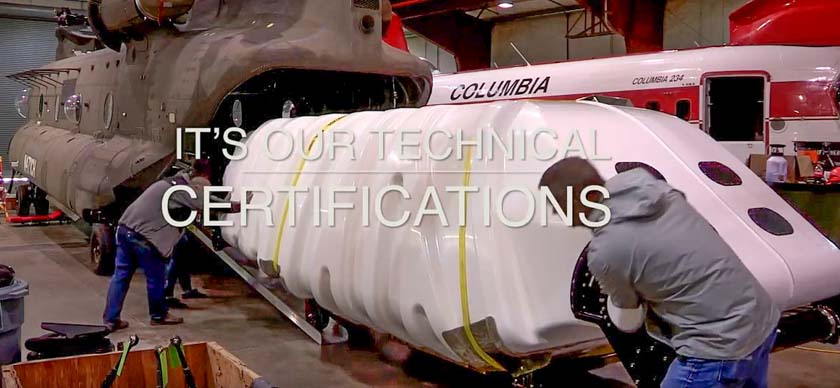
Above: A 2,800-gallon internal water tank in a Columbia CH-47D Chinook. Screen grab from Columbia video.
The last time we wrote about the 2,800-gallon internal water tank for Columbia Helicopters CH-47D Chinooks was April 6, 2016 as Simplex was developing the system soon after they had been granted a supplemental type certificate by the FAA. The tank can be filled in 60 seconds using a pump on a 12-foot-long 10-inch hose. Foam concentrate can be added to the water from a 140-gallon reservoir. The water tank can be rolled onto the helicopter and attached with four bolts. Multiple drops can be selected by the pilot and it has an emergency drop feature.
The tanks were fully operational during the 2016 wildfire season and were used by two of Columbia’s CH-47D’s for a total of 740 hours.
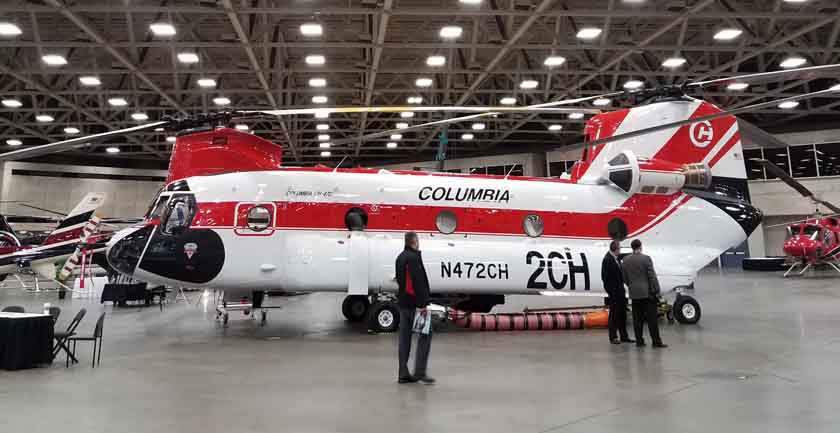
One of their ships was on display during the HAI HELI-EXPO conference in Dallas earlier in March. Thanks go out to Mark Johnson at Columbia for the photo and videos.
Columbia CH-47D Chinook at the HAI HELI-EXPO 2017 conference in Dallas earlier in March. Columbia photo.
When the National Interagency Fire Center started mobilizing aircraft to the central plains after a million acres burned in Kansas and Oklahoma, they dispatched the helicopter you see in the photo above while it was at the conference.
Keith Saylor, Director, Commercial Operations, for Columbia explained that transitioning the helicopter from a static display to a mission-ready firefighting aircraft involved removing the rotor blades, exiting the convention center, then reinstalling the rotor blades. This was followed by a flight to a nearby airport for refueling and overnighting. Called up on March 9, the helicopter was deployed the following day to Ardmore, Oklahoma with two pilots, five mechanics and ground support equipment drivers.
A 2,800-gallon internal water tank being loaded into a Columbia CH-47D Chinook. Screen grab from Columbia video.
The video below shows one of the CH-47D’s making a water drop.
The next video is a Columbia promotional video, but it has some brief interior shots of the internal tank system.
Above: The 747 Supertanker being reloaded at Santiago, Chile, January 28, 2017. Photo by Bill Gabbert.
In January and February two large air tankers traveled from the United States to South America to assist firefighters in Chile that were dealing with an unprecedented number of wildfires. Global SuperTanker’s 747 left Colorado Springs on January 24 and returned on February 13. A BAe-146 operated by Neptune Aviation was down there from about February 4 to March 5.
As far as I know this is the first time that any large air tankers from North America have assisted with wildfires in South America. One limiting factor is that up until recently most of the U.S. air tankers were former military aircraft which were not allowed to be used outside the country. With the industry converting to used civilian airliners and cargo aircraft that restriction does not apply to the newer privately owned aircraft.
In January, 2017 I had been following the increased wildfire activity in Chile and had written about it several times on Wildfire Today. Here is an excerpt from an article published on January 3, 2017:
Wildfire burns 100 homes in Chile
On Monday a wildfire burned approximately 100 homes in Valparaiso, Chile. There are reports that 19 people were injured and hundreds were forced to evacuate. The fire was fought by firefighters on the ground assisted by [single engine] air tankers and helicopters dropping water.
Pushed by strong winds it burned about 120 acres of vegetation 75 miles northwest of Santiago.
But the fires in Chile were receiving very little notice in the mainstream media in the U.S.
Eduardo Frugone, who is kind of a mysterious person in Chile with many connections, read the articles on Wildfire Today and Fire Aviation about the fires in his country and the fatal air tanker crash. I had never heard of him, but on January 18 he sent me an email message through the Contact Us page on Fire Aviation that read, in its entirety:
“We need fire figthing [sic] planes to fly to Chile, need to know if your company can establish contacts right away.
Stand by.”
I, of course, do not have any air tankers, but I forwarded his message to air tanker companies that I thought might have some available. Selecting the companies was a pretty quick decision that I didn’t want to spend a lot of time on. I figured the chances of the person that contacted me having any influence in deploying North American air tankers to South America was very, very slim. As far as I knew the paradigm of contracting for air tankers was limited to federal, state, or provincial governments, not a random person who only had links to private companies in his automatic email signature. So I didn’t want to waste the time of every air tanker company in the world.
I did not contact any company that I knew had 100 percent of their tankers committed to Australia. And I limited the short list to companies that had deployed air tankers on fires in 2016, or that I knew had recently received certification from the Interagency Air Tanker Board, and that I knew how to reliably contact. Not all air tanker companies will return my phone calls or respond consistently to my emails.
I forwarded the email to 10 Tanker Air Carrier, Neptune Aviation, and Global Supertanker. I wrote to them, “I don’t know if this is legit or not, but it might be an opportunity to use your aircraft in Chile.” Two of those companies, Global Supertanker and Neptune, followed up.
So, Eduardo got the ball rolling, through Wildfire Today.
What followed, in the case of Global Supertanker, were eight days of phone calls, email messages, and negotiations.
During the week of January 22 an heir to the Walmart fortune in Denver, Ben Walton with his wife Lucy Ana, got involved. She grew up in Chile and still maintains very strong ties to the people and the country. They have used their foundation in recent years to help the residents in her homeland. In 2016 the foundation helped arrange for $1.5 million worth of medical supplies to be sent to hospitals and rural clinics in Chile. And they also rebuilt a school after it was destroyed by the earthquake and resulting Tsunami in Chile a few years ago.
Lucy Ana Walton and Ben Walton, (left) receive a briefing on the 747 Supertanker, January 23, 2017. Jim Wheeler is on the right. Photo by Bill Gabbert
The Waltons had been following the escalating fire situation in Chile and were familiar with my web sites, Wildfire Today and Fire Aviation, after I had written about wildfires in Colorado. They knew the 747 Supertanker was based in Colorado Springs just an hour south of their Denver home.
In discussions with Jim Wheeler, President and CEO of Global Supertanker, they offered to have their foundation, Foundación Viento Sur, provide the funds for the 747 to ferry to Chile and back, and for five days of firefighting in Chile. They hoped that after they saw the effectiveness of the aircraft, the government would retain the services of the air tanker for as long as it was needed .
Working out the details with the foundation, the Chilean government, and Global Supertanker was a complex procedure that took a while. Ben and Lucy Ana visited Global SuperTanker’s Colorado Springs facilities on June 23 and received a briefing on the use and capabilities of the aircraft. Ben has some pilot training and both of them, but especially Lucy Ana, were very enthusiastic about its 19,200-gallon capacity and its potential to assist the residents of Chile.
Lucy Ana Walton in front of one of the 747’s engines at Colorado Springs, January 23, 2017. Photo By Bill Gabbert.
Attorneys in the U.S. and Chile got involved, and finally late Tuesday morning, January 24, the flight crew received the GO order and departed for South America at about 1:40 p.m. MST.
Mr. Wheeler offered me one of the 12 seats on the 747 for the trip south, and I accepted and became embedded with the crew. I returned on my own February 5 and the aircraft flew back to Colorado Springs nine days later.
Eduardo Frugone, who initially came up with the concept for the deployment of North American air tankers to Chile, helped to facilitate the missions before and during the assignment in exchange for a salary.
The Chilean government was very reluctant to bring in aircraft from outside the country, possibly because they had existing contracts with European companies for single engine air tankers. Questions have been raised about irregularities related to the activities of those companies in Europe and an investigation is underway now in Chile about procedures, before this year, about the acquisition of firefighting aircraft.
Chile is also considering the creation, for the first time, of a “Forest Service”-type agency that would assume the role of coordinating wildfire suppression, a task that presently is done by CONAF, a private, non-profit organization funded by the government and responsible for initiating air tanker contracts.