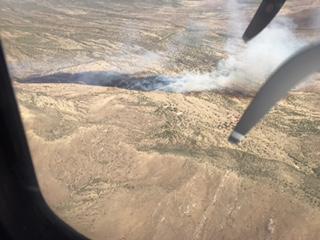
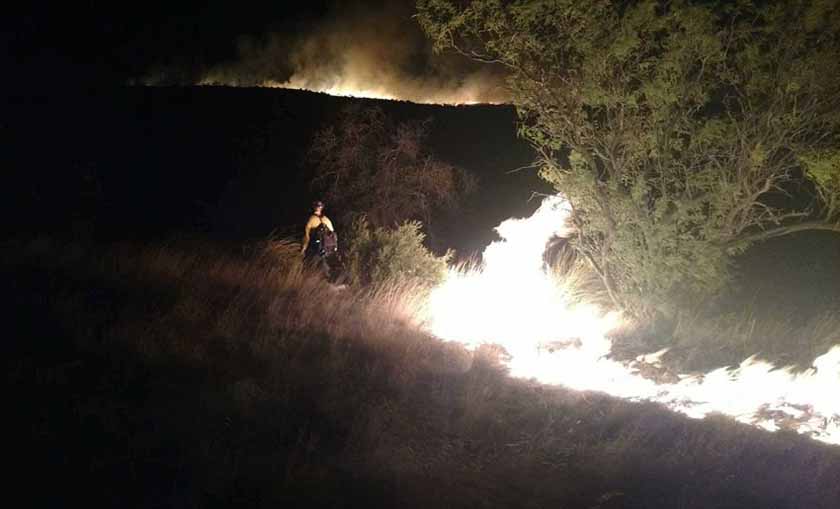
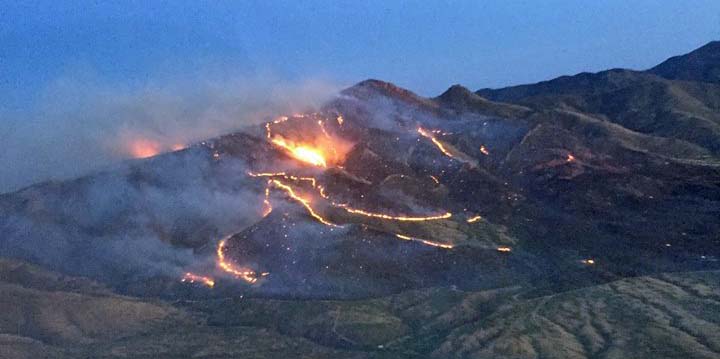
A post shared by Федеральная Авиалесоохрана (@avialesookhrana) on
About 50 wildland firefighter in Russia were mobilized to assist with a wildfire in Buryatia, a mountainous Russian republic in eastern Siberia.
Below is the Google translation of the image’s caption:
Avialesookhrana According to the appeal of the Government of Buryatia to assist in keeping the fire situation under control, the operational headquarters of the Federal Forestry Agency sent 50 air firefighters “Avialesoohrana” to extinguish forest fires in the region
# PAPC # paratroopers # paratroopers # firefighters # help # Buryatia # national park # Tunkinsky # arsons of dry grass # problem # violation # Russia # Siberia # measure # not # forest # Avialesookhrana # Avialesookhrana # Berehiles # smokejumpers # media # TV
And while we’re on the subject of airborne firefighters, back in America:
Above: Logistics Section Chief Cindy Schiffer with the Southern Area Blue Team. From the video.
We appreciate it when local units put together short videos, especially at a fire, showing the public what they are doing. This particular one, filmed at the 21,000-acre Cowbell Fire at Big Cypress National Preserve in south Florida, features Logistics Section Chief Cindy Schiffer explaining how her section provides the support firefighters need to continue battling the fire. It’s very well done.
Warning: Trying to access array offset on value of type bool in /home/customer/www/wildfiretoday.com/public_html/wp-content/themes/jupiterx/lib/api/image/functions.php on line 61
Deprecated: ltrim(): Passing null to parameter #1 ($string) of type string is deprecated in /home/customer/www/wildfiretoday.com/public_html/wp-content/themes/jupiterx/lib/api/utilities/functions.php on line 206
Deprecated: preg_replace(): Passing null to parameter #3 ($subject) of type array|string is deprecated in /home/customer/www/wildfiretoday.com/public_html/wp-content/themes/jupiterx/lib/api/image/class-image-editor.php on line 177
Warning: Undefined array key "extension" in /home/customer/www/wildfiretoday.com/public_html/wp-content/themes/jupiterx/lib/api/image/class-image-editor.php on line 179
Deprecated: preg_match(): Passing null to parameter #2 ($subject) of type string is deprecated in /home/customer/www/wildfiretoday.com/public_html/wp-includes/functions.php on line 3089
Deprecated: is_file(): Passing null to parameter #1 ($filename) of type string is deprecated in /home/customer/www/wildfiretoday.com/public_html/wp-includes/class-wp-image-editor-gd.php on line 95
Deprecated: preg_match(): Passing null to parameter #2 ($subject) of type string is deprecated in /home/customer/www/wildfiretoday.com/public_html/wp-includes/class-wp-image-editor-gd.php on line 95
In 2016 there was an increase in the percentage of requests for large air tankers that went unfilled, increasing from 10 percent in 2015 which was the lowest since 2009, to 13.4 percent in 2016.
Counting the U.S. Forest Service HC-130H air tanker there was a maximum of 21 large and very large air tankers on exclusive use contracts in 2016. However, the two Erickson MD-87 aircraft were not available for most of the year due to problems with the retardant system. The company claims they have fixed the issue and they should be ready to go this summer. A few other call when needed (CWN) large and very large air tankers were activated for weeks at a time in 2016. Unless new contracts for CWN air tankers are issued that will be effective this year, the number of available air tankers in 2017 should be about the same. A new exclusive use contract is expected to be in effect in 2018.
Tanker 12 on the Trailhead Fire. A Cobra helicopter is in the background. Photo July 1, 2016 by Matthew Rhodes.
The number of acres burned in the lower 49 states (which excludes Alaska) was virtually the same in 2015 and 2016, with both being pretty close to average. There were also few extended fire sieges involving multiple large fires occurring at the same time that required a high number of air tankers. Having the fires spread out over time minimizes the number of air tanker requests that go unfilled.
The number of acres burned in wildfires in the lower 49 states (excludes Alaska).
Here are some of the Unable to Fill numbers we computed from the data reported by the National Interagency Fire Center for 2016:
Type 1 and 2 large air tankers: 13.4%
Single Engine Air Tankers: 21.1%
Type 1 helicopters: 12.3%
Type 2 helicopters: 8.6%
Type 3 helicopters: 8.3%
There were only seven requests for MAFFS air tankers, and all were filled.
Above: The image from the new GOES-16 satellite is from March 6, 2017 just as the wind was shifting 90 degrees from the southwest to the northwest near the Kansas/Oklahoma border.
This article is for the weather and remote sensing geeks out there and anyone who is interested in the latest developments about the real time detection of wildfires from space.
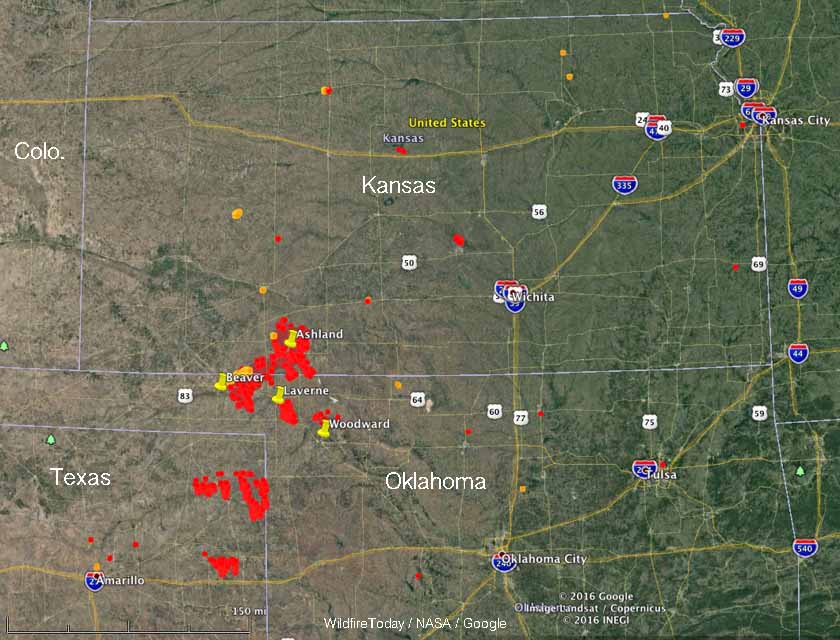
During the siege of wildfires on March 6 and 7 in Kansas, Oklahoma, and northern Texas strong winds before and after a frontal passage fanned existing small fires into huge firestorms that burned about a million acres in Kansas alone. Six people were killed and firefighters were stretched far beyond the capabilities of the mostly rural departments they served.
While this was going on a few meteorologists with access to the new, still being tested GOES-16 satellite were monitoring the emerging wildfire situation. This game-changing satellite orbiting hundreds of miles overhead has a baseline imager that will view the Earth with 16 different spectral bands (compared to five on current GOES satellites) and it will provide three times more spectral information, four times the spatial resolution, and more than five times faster temporal coverage than the current system. It also has the first satellite sensor dedicated to detecting real time lightning.
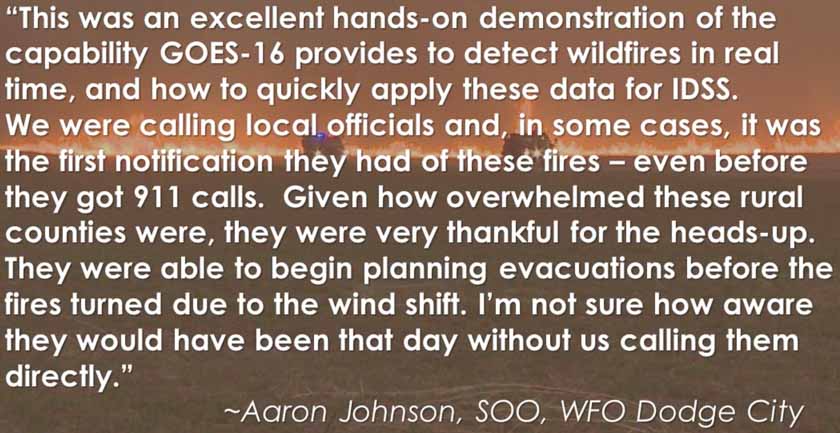
This video explains how data from GOES-16 was used as the fires were burning, including notifying fire departments of what the fires were doing, where they were, and what they were likely to do as the front passed, shifting the wind and the direction of fire spread 90 degrees from the southwest to the northwest.
If you don’t have time to view the entire 12-minute presentation, at least check out the change in direction of spread of the fires that begins at 8:30.
The red and yellow dots represent heat detected by a satellite in the 24 hours before 11:30 a.m. CST March 7, 2017. Map by Wildfire Today.
BLM Unimog Engine 2410 when it was new in 2006. BLM photo.
The Bureau of Land Management has released an Accident Investigation Factual Report for the July 10, 2016 engine rollover north of Winnemucca, Nevada in which two firefighters were killed and a third was seriously injured.
Jacob O’Malley and Will Hawkins lost their lives in the single-vehicle accident on Nevada State Route 140 when a rear tire suddenly and catastrophically failed. The truck only had four tires, there were no duals on the rear. When the right-rear rim dragged along the pavement the left-front was in the air, eliminating any possibility of control by the driver. The 33,000 pound GVWR engine fishtailed and then rolled several times.
The cab was higher than the water tanks and pump package, so it took the majority of the impact as the top of the vehicle struck the roadway during the rollover. All three occupants were wearing seat belts but with the top of the cab and the A pillar being damaged or sheared off, the restraint system failed to operate as designed. Mr. Hawkins was ejected from the cab and then was hit by the rolling wreckage.
Below is an excerpt from the report:
Finding 3.1 (Material): During the rollover, the upper cab structure (made of reinforced carbon fiber) sheared away from the truck frame, exposing the vehicle’s occupants to a hazardous environment. The disintegration of the cab compromised the driver’s and right side passenger’s seatbelt systems.
Discussion 3.1: The lack of cab crashworthiness did not cause the rollover; however, it contributed to the fatal conditions which occurred during the crash. The reinforced carbon fiber cab on the Unimog was manufactured in France and was built to United Nations Code ECE r29 (commercial vehicle occupant protection), which exceeds U.S. cab crashworthiness standards. The U.S. National Highway Traffic Safety Administration (NHTSA) submitted a report to Congress in 2015 on the need for improved heavy truck crashworthiness standards; however, no action has been taken on this report as of February 2017.
The wildland fire agencies should fund research conducted by engineers to determine how to prevent the passenger compartments in their fire engines from collapsing in accidents.
Thanks and a tip of the hat go out to Eric. Typos or errors, report them HERE.
Above: Map of the Sawmill Fire east of Green Valley, Arizona as of April 26, 2017.
Firefighters battling the 46,954-acre Sawmill Fire 23 miles southeast of Tucson have been able to slow the spread over the last two days in spite of strong winds. Satellite imagery from early Friday morning did not show any large concentrations of heat over the previous 24 hours. This does not mean the fire is out, and there is no doubt a lot of line building and mopup work still has to be accomplished.
For the last two days the Sawmill Fire has been most active on the northeast side where aircraft have been assisting firefighters on the ground to slow the spread.
A Red Flag Warning for strong winds is still in place for the fire area as well as most of southern Arizona and southwest New Mexico.
On Thursday the Arizona Department of Transportation reopened Arizona Highway 83 south of Interstate 10.
The Pima County Office of Emergency Management has lifted the pre-evacuation order for residents on the west side of Arizona Highway 83. Residents in the Hilton Ranch area remain under pre-evacuation notice. An evacuation order remains in place for Rain Valley.
The Green Valley News is reporting that several sources they spoke with said a target shooter using exploding targets started what became the Sawmill Fire 8 miles east of Green Valley, Arizona. The shooter reportedly tried to put out the fire, but after he failed he called to report it. The officials in charge of suppressing the fire have not confirmed what caused it.
As of Thursday April 27 the fire has burned approximately 40,000 acres and required the evacuation of several areas. The Green Valley News reported that approximately $1.6 million had been spent to suppress the fire as of Wednesday afternoon.
Exploding targets consist of two ingredients that when mixed by the end user create an explosive when shot by a high-velocity projectile. They have caused many fires since they became more popular in recent years, have been banned in some areas, and caused the death of one person. In June, 2013 a man attending a bachelor-bachelorette party in Minnesota was killed after shrapnel from the device struck him in the abdomen causing his death. The Missoulian reported that several years ago a woman in Ohio had her hand nearly blown off while taking a cellphone video of a man firing at an exploding target placed in a refrigerator about 150 feet away.
After the ingredients are combined, the compound is illegal to transport and is classified as an explosive by the Bureau of Alcohol, Tobacco, Firearms, and Explosives and is subject to the regulatory requirements in 27 CFR, Part 555.
I have to admit that I have become a bit cynical about firefighter legislation. We dutifully report when a bill is introduced that specifically affects wildland firefighters, but they almost never progress beyond the committee stage. A person has to wonder why these bills are drafted if they stand so little chance of seeing the light of day. Is it because Congress is so dysfunctional that very few bills get passed at all unless they are absolutely critical to keeping the doors of government open? Or, do politicians simply want to get their name out there hoping voters will remember it the next time they are up for reelection? Maybe this year with both houses and the Presidency controlled by one party more can get done (he thought very optimistically).
Having said that, below we have information about two bills that were introduced in the Senate on April 26. They are both cosponsored by Senators Steve Daines (D-MT) and Maria Cantwell (R-WA). A handful of other Senators have said they intend to sign on as cosponsors.
S.949 – Wildland Firefighter Recognition Act
It would require the Director of the Office of Personnel Management to create a classification that more accurately reflects the role of wildland firefighters in the Departments of Interior and Agriculture. Their official title would become “Wildland Firefighter”. Employees currently employed, many of them with the title “Forestry Technician”, would have the choice of retaining their previous job series or moving to the new Wildland Firefighter series.
In a press release, the two Senators wrote:
Providing wildland firefighters with the proper title will improve recruitment efforts and morale and also give due recognition to those brave individuals who risk their lives to protect others’ and their property.
This bill has a number of provisions, some of which have been proposed before in various forms:
A pilot program would authorize the department Secretaries to allow seasonal employees to work beyond their 1,040-hour per year limit “in a given year if the covered Secretary determines the expansion to be necessary to stage fire crews earlier or later in a year to accommodate longer fire seasons.”
The incident qualification systems of the Departments of Interior and Agriculture would be merged into one, and no agency would be allowed to require additional competencies to become qualified for a position.
It would allow a firefighter who was injured and disabled on the job to retain the 20-year firefighter retirement track if they return to work in a non-fire position, rather than converting to the 30-year retirement program of ordinary federal employees. It would also allow the injured firefighter’s history of overtime pay to be considered as income for purposes of calculating worker’s compensation disability benefits.
In our April 20 interview with Dan Buckley, the National Fire Director for the National Park Service, he talked about the need for extending the terms of seasonal firefighters, the first item listed in the description of the above bill. That topic begins at 11:49 in the video.
One hurdle to overcome is the fact that little or no action can occur legislatively until the Administration first says yay or nay. And the politically appointed positions that would review these proposed bills are still vacant.
Above: A satellite photographed the darkened outline of the Sawmill Fire east of Green Valley, Arizona on April 26, 2017. The red dots represent heat.
(UPDATED at 9:10 a.m. MDT April 27, 2017)
The growth of the Sawmill Fire east of Green Valley, Arizona slowed Wednesday as decreasing winds allowed air tankers and helicopters to drop water and retardant to assist the firefighters on the ground. The only significant spread that we found on satellite images was an additional 400 acres on the northeast corner of the fire.
As of Wednesday night fire managers were still calling it 40,356 acres.
An evacuation order remains in place for Rain Valley. Since evacuation orders were lifted for Greaterville and Singing Valley, residents of those areas are being allowed through the Arizona Highway 83 closure to access their homes. Arizona Highway 83 remains closed to public traffic.
The area is under a Red Flag Warning on Thursday and Friday for relative humidities in the teens and strong winds. One of the priorities on Thursday is to use aircraft to help secure the firelines before the winds increase.
Today, April 27, a Type 1 Incident Management Team will assume command of the 606 personnel on the Sawmill Fire.
****
(UPDATED at 7:47 p.m. MDT April 26, 2017)
At about 2 p.m. MDT the Incident Management Team said the Sawmill Fire had grown to 40,350 acres. At that time there were seven helicopters and three fixed wing aircraft assisting the firefighters on the ground.
On Wednesday morning the incident management team called it 20,000 acres.
At 2:03 p.m. MDT on Wednesday a heat detecting satellite mapped growth of the fire on the south and northeast sides.
The red area shows the approximate location of the Sawmill Fire at 2:03 p.m. MDT on April 26, 2017. The white line was the approximate perimeter about 12 hours earlier.
The weather station near the fire at Empire recorded on Wednesday a high temperature of 75, a minimum relative humidity of 12 percent, and wind in the afternoon out of the northwest at 8-12 mph gusting at 20-24.
Undated and uncredited photo of the Sawmill fire. Inciweb photo.
****
(UPDATED at 11:16 a.m. MDT April 26, 2017)
A fire that started Sunday morning, April 23 eight miles east of Green Valley, Arizona, has burned (we estimate) about 28,000 acres as of 2:38 a.m. MDT on Wednesday, April 26, 2017, and required evacuations for the communities of Greaterville, Singing Valley, and Rain Valley. It has spread to the east 21 miles, has a perimeter of approximately 63 miles, and crossed Arizona Highway 83 in multiple places.
Sawmill fire map, approximate perimeter 2:38 a.m. MDT April 26, 2017.
The fire is burning on lands protected by the Coronado National Forest, Bureau of Land Management and the Arizona Department of Forestry and Fire Management.
Sawmill Fire, April 23, 2017. Inciweb photo.
On Tuesday the temperature in the fire area was in the low 70’s, the relative humidity was in the 30’s, and the wind was 12-18 gusting at 25-33 mph out of the west. The forecast for the fire area on Wednesday calls for conditions that could lead to significant additional fire spread toward the east and southeast, with temperatures in the mid-70’s, humidity dipping into the single digits, and winds out of the northwest at 10-20 mph gusting to 29.
Tuesday evening Jeff Andrews’ Type 2 Incident Management Team assumed command. Due to the increasing complexity, management will transition to a Type 1 Team on Thursday, April 27.
Sawmill Fire. Photo by Arizona Dept. of Corrections’ Florence Inmate Crew.
A full suppression strategy is being employed to protect nearby values at risk including homes, ranches and outbuildings, communications facilities, power lines, and the Arizona National Scenic Trail.
Sawmill Fire, early in the morning on April 24, 2017. Photo by Arizona Department of Forestry and Fire Management.