
This was Tuesday, June 27, east of San Bernardino, California.
Loading the DC-10’s at Phoenix
The video describes the process of reloading the DC-10’s with fire retardant at Phoenix Gateway-Mesa airport while they were fighting the Goodwin Fire 80 miles northwest of the airport. For a while this week all three DC-10 Very Large Air Tankers were working out of the tanker base and dropping on the Goodwin Fire.
Oregon air tankers

Above: Tanker 62 in Madras, OR.
Todd McKinley shot these photos June 29 at various locations in Oregon. Thanks Todd!
 Tanker 804 in Prineville, OR.
 Tanker 66 in Madras, OR. Notice anything unusual about this aircraft?
 Helicopter 703 in Madras, OR.
 Tanker 05 in Redmond, OR.
Charges dropped against 2 teens initially thought to have started wildfire that burned into Gatlinburg
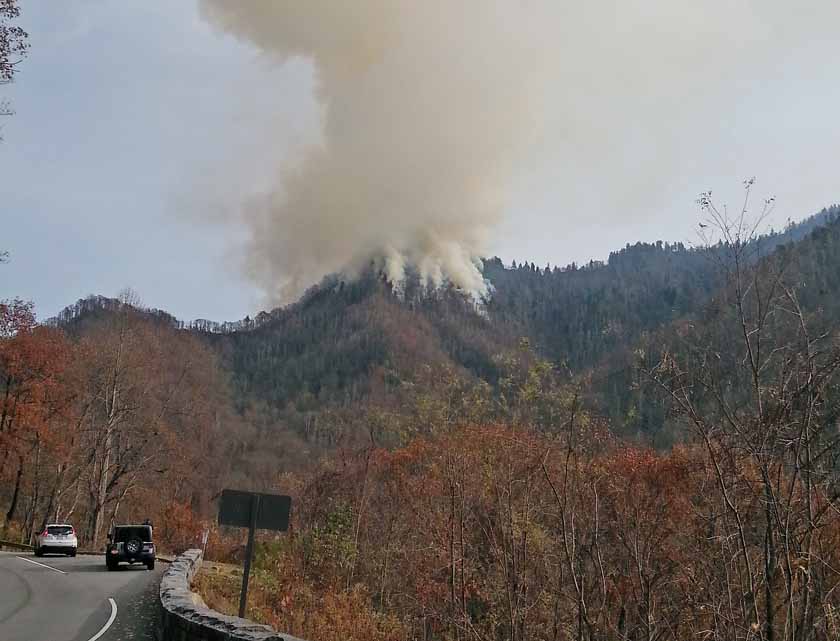
The local prosecutor for the Gatlinburg area announced Friday that he has decided to drop the charges against the two teenaged boys initially thought to be responsible for starting the Chimney Tops 2 Fire that five days later burned into the city in eastern Tennessee killing 14 people, forcing 14,000 to evacuate, destroying or damaging 2,400 structures, and blackening 17,000 acres.
The logic used by Fourth Judicial District Attorney General Jimmy Dunn was that since other fires in the Gatlinburg area were caused by downed wind-blown power lines, it could not be proved that any one particular fire caused specific deaths or property damage.
The arson charge would be within the jurisdiction of the Federal government since it occurred on land administered by the National Park Service.
U.S. Attorney Nancy Stallard Harr issued a statement saying, “the U.S. Attorney’s Office is in communication with the District Attorney General’s office. A review of the evidence in this case will have to take place in order to determine whether it is appropriate to seek approval from the Attorney General to prosecute juvenile offenders in federal court.”
Mr. Dunn also issued a statement, reading in part:
…the unprecedented, unexpected and unforeseeable wind event that started in the early morning hours of November 28,2016, approximately four and a half days after the initial origin of the fire, was the primary reason of the Chimney Tops II fire traveled outside the park into Gatlinburg. But for the winds that reached speeds in excess of 80 miles per hour, it is highly unlikely and improbably that the Chimney Tops II fire would have left the Great Smoky Mountains National Park and reached Gatlinburg.
Greg Salansky, Fire Management Officer for Great Smoky Mountains National Park, said the evening of November 26 he received word that a wind event was in the forecast for the afternoon of the 28th. The winds arrived very early in the morning on the 28th, about 12 hours before they were predicted to begin.
Below is the complete statement issued by District Attorney General Jimmy Dunn today:
****
“For the past seven months, an investigation has been underway into the origin, cause and consequences of a fire that started on November 23, 20165, in an area of the Great Smoky Mountains National Park referred to the Chimney Tops. The investigation is now complete the investigation was led by the Tennessee Bureau of Investigation with the assistance of the National Park Service and local law enforcement, as well as various other local, state and federal agencies. The investigation involved thousands of investigative hours, over 100 witness and expert interviews across multiple states, thousands of potential witnesses, as well as thousands of pages of documents, records photographs and hours of video evidence and audio recordings.
After a comprehensive review of all of the evidence gathered and presented by the Tennessee Bureau of Investigation, Gatlinburg Police Department, Pigeon Forge Police Department, Sevier County Sheriff’s Office, the State, in consultation with other law enforcement agencies and various experts in wildfire progression, has determined that the unprecedented, unexpected and unforeseeable wind event that started in the early morning hours of November 28,2016, approximately four and a half days after the initial origin of the fire, was the primary reason of the Chimney Tops II fire traveled outside the park into Gatlinburg. But for the winds that reached speeds in excess of 80 miles per hour, it is highly unlikely and improbably that the Chimney Tops II fire would have left the Great Smoky Mountains National Park and reached Gatlinburg.
Because of this intervening weather event, the State is unable to prove the criminal responsibility of two juveniles beyond a reasonable doubt for the devastation that occurred outside the Great Smoky Mountains National Park. In addition to the wind, the State’s cause is further complicated by the fact that there were other fires in the area and other confirmed ignition points in the Gatlinburg area from multiple downed power lines that were felled by the wind. Some of these fires appear to have erupted prior to the fire from the Park breaching the Gatlinburg city limits. Once the investigation confirmed multiple fires with multiple points of origin, it became impossible to prove which fire may have caused the death of an individual or damage to a particular structure. Based upon this evidence, the State’s case was narrowed to prosecuting conduct that occurred wholly within the Great Smoky Mountains National Park.
Once the State determined that is prosecution may be limited to conduct and actions occurring within the Great Smoky Mountains National Park, the District Attorney’s Office conducted additional research and investigation into jurisdictional issues regarding criminal prosecution by the State for actions or events that occur wholly within National Park land. This investigation and research revealed the existence of two documents or “Memoranda of Agreement” regarding concurrent criminal jurisdiction between the State of Tennessee and the National Park Service. One of these documents specifically lists the Great Smoky Mountains National Park as being part of a concurrent criminal jurisdiction agreement between the State of Tennessee and the National Park Service on behalf of the Federal Government. The second of these documents is an exact duplicate of the first, save one critical difference: it does not include the Great Smoky Mountain National Park in the agreement. Eleven other National Park Service on behalf of the Federal Government. The second of these documents is an exact duplicate of the first, save one critical difference: it does not include the Great Smoky Mountain National Park in the agreement. Eleven other National Park Service properties are listed on each document. It is unclear how both of these documents got into circulation, but it is clear that both have been used by various agencies in different contests.
After becoming aware of these competing documents, the State notified the Defense immediately and sought advice from the State Attorney General’s Office as well as the U.S. Attorney’s Office as to which document was controlling and whether or not the State could prosecute criminal acts that occur within the Great Smoky Mountains National Park. After reviewing the documents, both the State Attorney General’s Office and the U.S. Attorney’s Office advised that it was their respective opinions that the State of Tennessee does not have jurisdiction to prosecute criminal acts that occur wholly within the boundaries of the Great Smoky Mountains National Park. Therefore, any prosecution for criminal conduct occurring entirely within the boundary of the Great Smoky Mountains National Park must be initiated by the federal government.
Based upon these findings, the State has no other option but to dismiss the charges currently pending in state court as there is no subject matter jurisdiction that would allow the state court to take any action. To retain jurisdiction, the State must be able to prove beyond a reasonable doubt that at least one element of a criminal offense occurred outside of the Great Smoky Mountains National Park and within the State’s jurisdiction. The State has concluded that this burden cannot be met due to the intervening weather event that occurred before any fire reached the State’s jurisdiction. Therefore, the decision to prosecute any individuals alleged to have caused a fire within the Great Smoky Mountain National Park is now within the purview of the United States Department of Justice.
The District Attorney’s Office for the Fourth Judicial District would like to thank all agencies, law enforcement and otherwise, including the TBI, the National Park Service, the Sevier county Sheriff’s Office (with special recognition for the outstanding work done by the GIS Division), the Gatlinburg Police Department, the Pigeon Forge Police Department, the Pittman Center Police Department, the Department of the Interior, the Bureau of Alcohol, Tobacco and Firearms and the Tennessee Department of Agriculture, Division of Forestry, for their incredible hard work in investigating this unprecedented event. This office would also like to thank and commend the hundreds of firefighters and police officers from the national, regional, state and local levels for their extraordinary bravery and courage in confronting these fires.”
Aerial ignition by laser?

I wonder if one day wildland firefighters will be igniting prescribed fires, backfires, and burnouts with lasers. One thing to consider, of course, is the difference between accidently hitting a person on the ground with a plastic sphere vs. a laser.
Four years ago — Yarnell Hill Fire
 Four years ago today, on June 30, 2013, 19 wildland firefighters were overrun by the Yarnell Hill Fire outside Yarnell, Arizona. One way to honor the service of the Granite Mountain Hotshots is for firefighters on this day to take 15 minutes and select one thing — one act, one task, one decision, one directive, or one action — that happened that day and discuss what it means to them. Just one. Don’t be tempted to point fingers, not today. Make it a positive learning experience.
Below is a short documentary produced by the Weather Channel that features the incident.
Thanks and a tip of the hat go out to Perry.
Typos or errors, report them HERE.
Brady Fire — southeast of Edgemont, South Dakota

Above: Brady Fire, June 29, 2017. Photo by Bill Gabbert.
(Updated at 2:09 p.m. MDT July 1, 2017)
The updated size of the Brady Fire is 172 acres. The increase from 95 acres reported yesterday is due to more accurate mapping — the fire has not grown.
****
(Updated at 12:40 p.m. MDT June 30, 2017)
The size of the Brady Fire 7 miles southeast of Edgemont, SD has been revised to 95 acres. Firefighters are estimating that about half an inch of rain fell on the fire Thursday night. In Hot Springs, 15 miles northeast of the fire, there was 0.12 inches overnight in addition to lots of lightning in the southern Black Hills.
Approximately 70 firefighters are on scene today, Friday, mopping up.
****
(Updated at 9:14 p.m. MDT June 29, 2017)
The Brady Fire, discovered Thursday afternoon, has burned dozens of acres southeast of Edgemont, South Dakota. We’ll post more information as it becomes available. The fire is burning in timber and grass on fairly steep slopes on the north side of the Cheyenne River.
The Great Plains Interagency Dispatch Center reported at 5 p.m. Thursday it had burned 25 acres. The fire continued spreading slowly after that time, but received rain from a thunderstorm at 8:15 p.m.


Small squadron of VLAT’s attacked the Goodwin Fire Wednesday
Three very large air tankers, DC-10’s that carry 11,600 gallons of fire retardant, assisted firefighters on the Goodwin Fire in Arizona Wednesday, reducing the fire’s intensity around endangered structures.
As of Thursday morning the fire had burned 24,828 acres at Mayer, Arizona.
The DC-10’s are often used on wildfires, but there are only three of the “Very Large Air Tankers” on contract with the federal government, and it is unusual for all of them to be working the same fire. They were reloading with retardant at Phoenix Mesa-Gateway airport 80 miles southeast of the fire.
Drone forces officials to ground all aircraft fighting the #GoodwinFire https://t.co/whGOMeqY9y pic.twitter.com/cMpUdEMpxQ
— azcentral (@azcentral) June 29, 2017
Rick Hatton, President and CEO of 10 Tanker Air Carrier, said their three DC-10’s completed a total of 14 sorties to the Goodwin Fire during 16 total hours of flying Wednesday. He said the facilities and crews at the air tanker base accommodated the three huge aircraft very well.
Two of the aircraft are on exclusive use contracts with the U.S. Forest Service, and a third is on a call when needed contract.
Even though $2.4 million was spent in 2014 to improve the apron and plumbing at the air tanker base at Prescott, 15 miles from the fire, it was not designed to handle Very Large Air Tankers. But it can accommodate the “large” or “heavy” air tankers, such as the aircraft that can carry 2,000 to 3,500 gallons, including the P2V, BAe-146, RJ85, MD-87, 737, and C-130.
To improve the tanker base, the City of Prescott agreed to accept a $1.44 million grant from the Arizona Department of Transportation (ADOT) which was combined with $1 million from the U.S. Forest Service. The USFS funds were used to add new plumbing infrastructure and a taxiway.
The changes increased the number of loading pits from two to three. The ADOT grant covered 90 percent of the cost of the apron project, and the City of Prescott supplied the additional 10 percent.
Below are photos of the Prescott air tanker base ramp before and after the modifications.
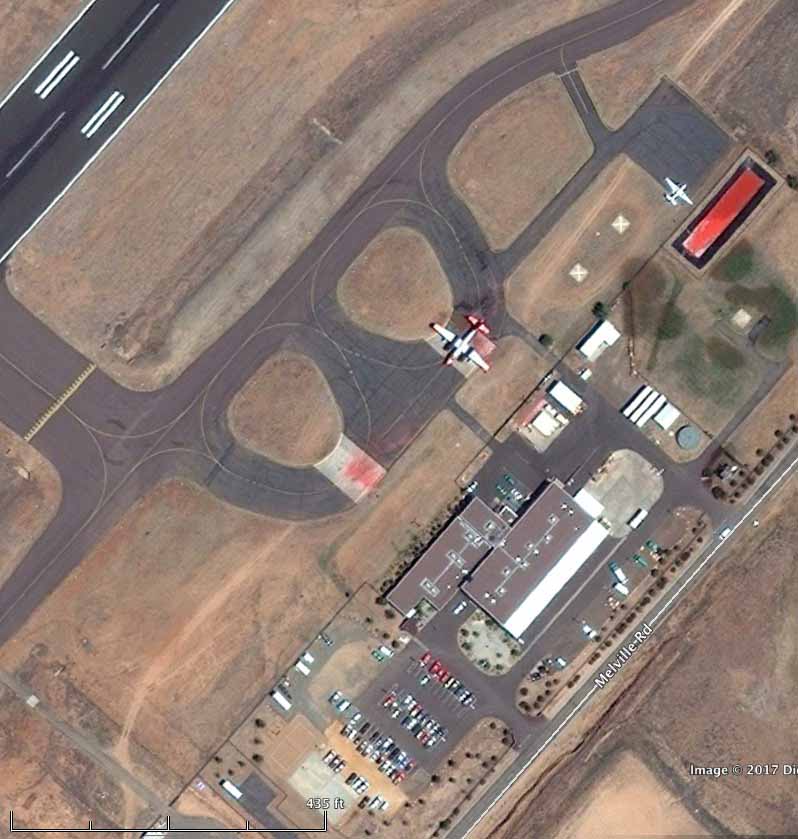 Air tanker base ramp at the Prescott Airport, June, 2010. Google Earth.
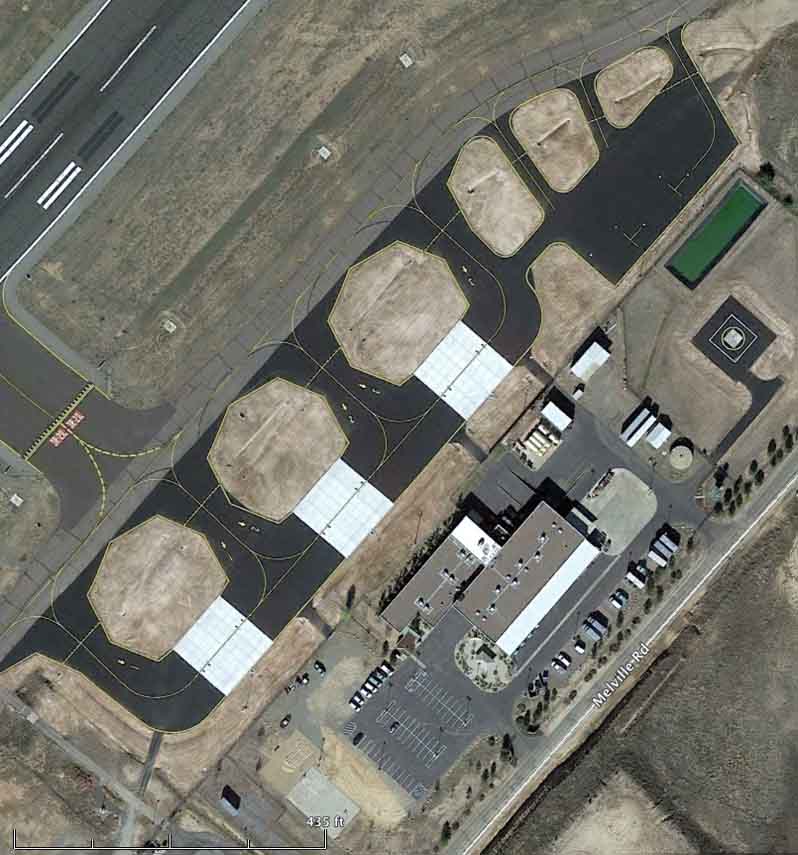 Air tanker base ramp at the Prescott Airport, November, 2015. Google Earth.
As you can see below, Prescott makes a good temporary home for the helicopters working the Goodwin Fire.
Right now on the ramp at PRC #GoodwinFire #Prescott #prescottvalley #AZ pic.twitter.com/VDyclyEG0O
— Guidance Aviation (@GuidanceAv) June 28, 2017
An illegally operated drone flew into the fire area Wednesday, forcing all firefighting aircraft to be grounded for safety reasons. Law enforcement responded and is investigating the incident. Hobbyist drone operators are reminded that “if you fly, we can’t fly.” There is a Temporary Flight Restriction (TFR) over the fire area and it is against federal law to fly a drone within the restricted area. This also happened on the Brian Head Fire in Utah Wednesday, as well as the Lightner Fire in California.
In the video below you will see what appears to be a privately owned Blackhawk helicopter, a Firehawk, dropping retardant on the Goodwin Fire. Most of the time helicopters drop water directly on the flames, but the long term retardant can be effective when applied ahead of the fire.
Video of the #GoodwinFire ?taken by Christina Montiel – USFS on 6/27/17 @PrescottNF pic.twitter.com/H4FTD3KzNd
— CHRISTINA MONTIEL (@cemontiel) June 29, 2017
Another helicopter dropping retardant:
Video of the #GoodwinFire ?taken by Christina Montiel – USFS on 6/27/17 @PrescottNF pic.twitter.com/5loytzmYzd
— CHRISTINA MONTIEL (@cemontiel) June 29, 2017
Brian Head Fire slows, but continues to spread to the northeast

The fire has burned over 58,000 acres.
Continue readingThree DC-10 air tankers help firefighters slow growth of Goodwin Fire in Arizona

Above: Goodwin Fire, June 27, 2017. Photo by Christina Montiel, U.S. Forest Service.
(Originally published at 10:50 a.m. MDT June 29, 2017)
Firefighters were successful Wednesday in halting the spread of the Goodwin Fire near Mayer, Arizona. There was very little movement of the fire yesterday except for the southwest corner and the north side.
The southwest side spread about a quarter mile to the south, while the north side was very active, moving in some areas about 1.5 miles north along 5 miles of fire perimeter.
The growth added about 4,100 acres to the fire, bringing the total size to 24,828 acres.
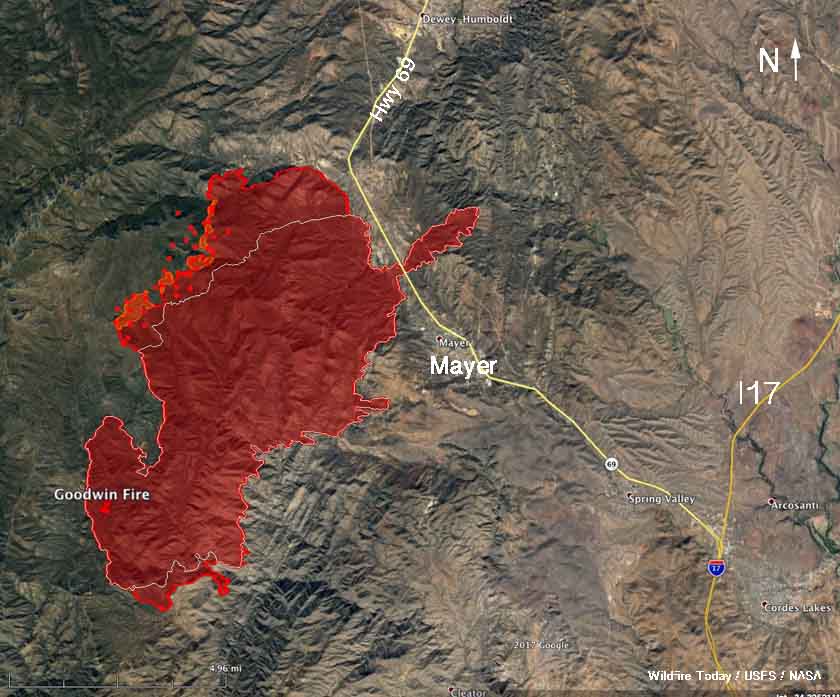
Over 150 firefighters worked Tuesday night creating dozer lines between the fire and Mayer. Those lines were burned out Wednesday which prevented any significant growth toward the town. Firefighters were able to contain the 500 acres that burned east of Highway 69 between Poland Junction and Mayer. Wednesday morning the fire spread into a basin toward Poland Junction, but winds were lighter and the relative humidity did not drop to the low levels that contributed to Tuesday’s expansion.
Evacuations are still in place for several communities and Highway 69 is closed. There has been no change in the number of structures reportedly destroyed — it remains at nine, and it is unknown if they are residences or outbuildings.
Three very large air tankers, DC-10’s that carry 11,600 gallons of fire retardant, assisted firefighters on the ground Wednesday, reducing the fire’s intensity around endangered structures. The DC-10’s are often used on wildfires, but there are only three of the “Very Large Air Tankers” on contract with the federal government, and it is unusual for all of them to be working the same fire. They were reloading with retardant at Phoenix Mesa-Gateway airport 80 miles southeast of the fire.
Rick Hatton, President and CEO of 10 Tanker Air Carrier, said their three DC-10’s completed a total of 14 sorties to the Goodwin Fire during 16 total hours of flying Wednesday. He said the facilities and crews at the air tanker base accommodated the three huge aircraft very well.
Two of the aircraft are on exclusive use contracts with the U.S. Forest Service, and a third is on a call when needed contract.
Even though $2.4 million was spent in 2014 to improve the apron and plumbing at the air tanker base at Prescott, 15 miles from the fire, it was not designed to handle Very Large Air Tankers. But it can handle the “large” or “heavy” air tankers, such as the 2,000 to 3,500 gallon P2V, BAe-146, RJ85, MD-87, 737, and C-130.
And, as you can see below, Prescott makes a good temporary home for the helicopters working the Goodwin Fire.
Right now on the ramp at PRC #GoodwinFire #Prescott #prescottvalley #AZ pic.twitter.com/VDyclyEG0O
— Guidance Aviation (@GuidanceAv) June 28, 2017
An illegally operated drone flew into the fire area Wednesday, forcing all firefighting aircraft to be grounded for safety reasons. Law enforcement responded and is investigating the incident. Hobbyist drone operators are reminded that “if you fly, we can’t fly.” There is a Temporary Flight Restriction (TFR) over the fire area and it is against federal law to fly a drone within the restricted area.
In the video below you will see what appears to be a privately owned Blackhawk helicopter, a Firehawk, dropping retardant. Most of the time helicopters drop water directly on the flames, but the long term retardant can be effective when applied ahead of the fire.
Video of the #GoodwinFire ?taken by Christina Montiel – USFS on 6/27/17 @PrescottNF pic.twitter.com/H4FTD3KzNd
— CHRISTINA MONTIEL (@cemontiel) June 29, 2017
Another helicopter dropping retardant:
Video of the #GoodwinFire ?taken by Christina Montiel – USFS on 6/27/17 @PrescottNF pic.twitter.com/5loytzmYzd
— CHRISTINA MONTIEL (@cemontiel) June 29, 2017