
BLM reports that a command vehicle is believed to have burned during initial attack
Continue reading
BLM reports that a command vehicle is believed to have burned during initial attack
Continue reading
Above: Screenshot from video shot by Jim Watson, Pilot of T-850 GB Aerial Applications, over the Horse Park Fire.
Jim Watson, pilot of the GB Aerial Applications single engine air tanker T-850, shot this video while flying over and dropping retardant on the Horse Park Fire in southwest Colorado May 28, 2018. He was working with Lead 28.
Thanks Jim!
On May 27, the day before this drop by T-850, the fire was exhibiting extreme fire behavior and forced firefighters to withdraw to a safety zone. On that same day during initial attack a command vehicle was abandoned and is thought to be a total loss, according to information in a 24-Hour Preliminary Report. The driver was turning around when the vehicle got stuck. Due to the advancing fire, the driver and passenger had to flee on foot. There were no reports of injuries.
The USFS says we no longer have “fire seasons”. They are now “fire years”.
Continue reading
Above: Tanker 07, a P2V, drops retardant on the Red Canyon Fire nine miles southwest of Pringle, SD July 9, 2016.
The U.S. Forest Service has cut the number of large air tankers on exclusive use (EU) contracts this year by 35 percent, from 20 to 13. We asked the interim Chief of the Forest Service, Vicki Christiansen, why, and she responded in writing Tuesday:
The reduction in Exclusive Use contracts is due to the “Legacy” Exclusive Use Airtanker contract expiring in 2017.
The Forest Service has known for years that 2017 would be the last season for the Korean War vintage P2V’s with the 18-cylinder radial engines. In 2013 the agency began a contracting effort to bring in “next generation” turbine-powered aircraft with the ultimate goal of eliminating the P2V’s. The last four that were on contract in 2017 are now retired and most will find final resting places in museums.
 Victoria Christiansen
In addition to losing the four P2V’s, the Forest Service cut three Next Gen BAe-146’s this year.
In February U.S. Forest Service spokesperson Babete Anderson said budget issues were affecting the availability of ground and air-based firefighting resources:
The Forest Service is working to responsibly allocate ever tighter financial resources in the most responsible manner.
Chief Christiansen told us this week they will have “up to 16” large air tankers available through Call When Needed (CWN) contracts. This is an increase over the 11 the FS told us about in February.
If CWN air tankers are available the cost can be up to 54 percent higher than those on EU contracts.
There are two costs for air tankers — daily plus hourly. If the aircraft just sits at an air tanker base available with a flight crew it only earns the daily availability rate. When it flies, an hourly rate is added.
We averaged the daily and hourly EU and CWN rates for three models of air tankers provided by three different companies, BAe-146 by Neptune, RJ85 by Aero Flite, and C-130 (382G) by Coulson. The numbers below are the combined averages of the three aircraft:
EU Daily: $30,150
EU Hourly: $7,601
CWN Daily: $46,341 (+54%)
CWN Hourly: $8,970 (+18%)
These costs only account for the additional costs of contracting for the air tankers, and do not include any increased costs of new, small wildfires escaping initial attack due to a lack of available air tankers or Type 1 helicopters (which have also been cut, from 34 to 28). And it does not include property damage or, heaven forbid, lives lost.

In addition to the 13 air tankers on EU and the 11 (or 16) that may or may not be available on CWN, the Forest Service will use one Coast Guard HC-130H. They will also have access to up to seven military C-130’s which can be outfitted temporally with 3,000-gallon MAFFS retardant systems. And, they have occasionally borrowed air tankers from Canada and the state of Alaska if they were available.

Above: screenshot from the Hotchkiss Fire District video.
(UPDATE at 6:38 a.m. MDT May 31, 2018)
The Bureau of Land Management has released a 24-Hour Preliminary Report indicating that during initial attack on the Horse Park Fire in southwest Colorado May 27, 2018 a command vehicle was abandoned and is thought to be a total loss. The driver was turning around when the vehicle got stuck. Due to the advancing fire, the driver and passenger had to flee on foot. There were no reports of injuries.
In the second video below (at 0:06) you can hear a radio conversation about losing a vehicle but the firefighters made it out.
****
Originally published at 10:53 a.m. MDT May 29, 2018.
In the three days since the Horse Park Fire started in Southwest Colorado it has burned about 1,500 acres. It’s not a huge fire yet but at times has shown some pretty aggressive fire behavior for the month of May in Colorado.
In the two videos below shot May 27 and posted by the Hotchkiss Fire District you can see that in spite of the date on the calendar firefighters were forced to make a strategic withdrawal when the rapidly spreading fire started moving in their direction.
Warning: the second video has some coarse language as firefighters are being encouraged to relocate.
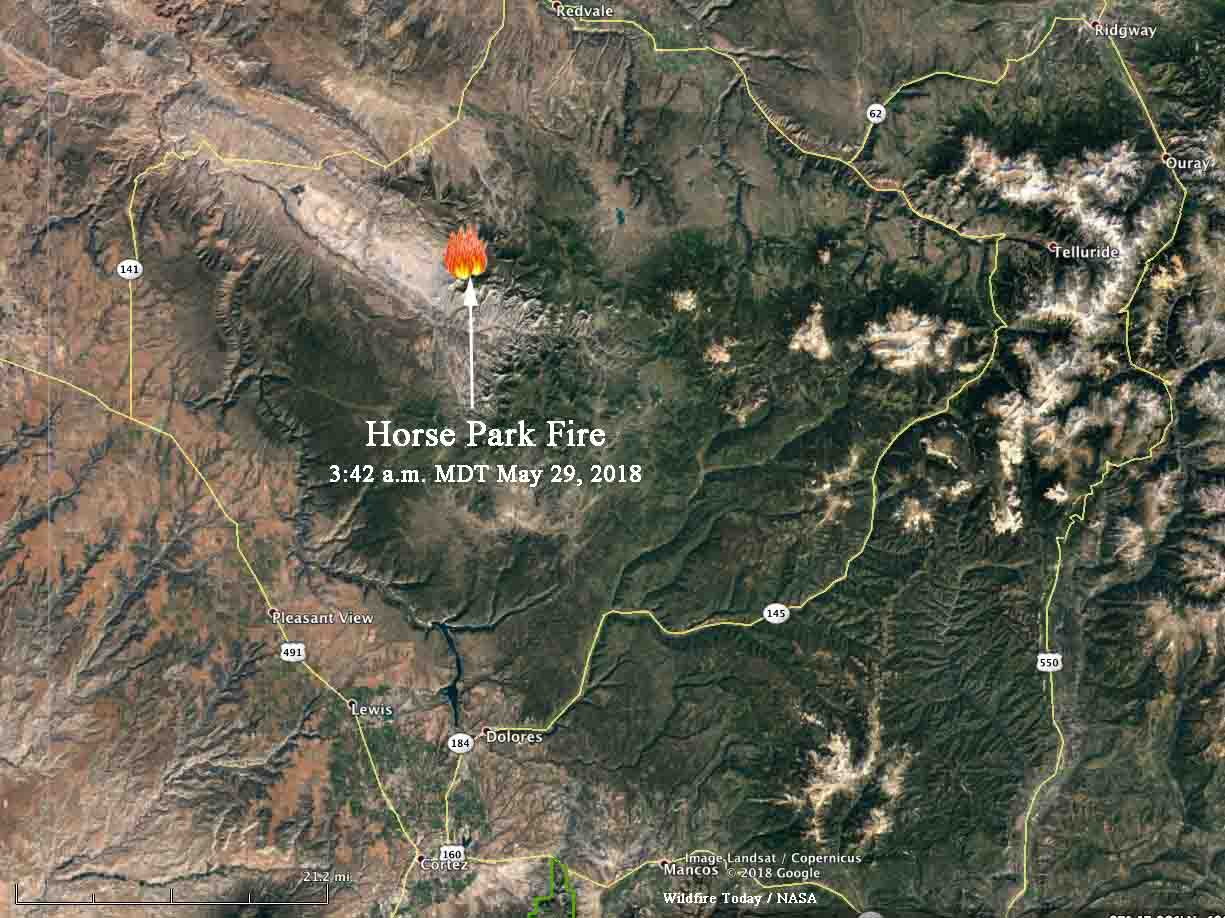
The Horse Park Fire is burning at about 8,000′ in a very remote area 15 miles southwest of Norwood and 40 miles west of Telluride. Jay Esperance’s Type 2 Incident Management Team has arrived and will in-brief at 10 a.m. today.
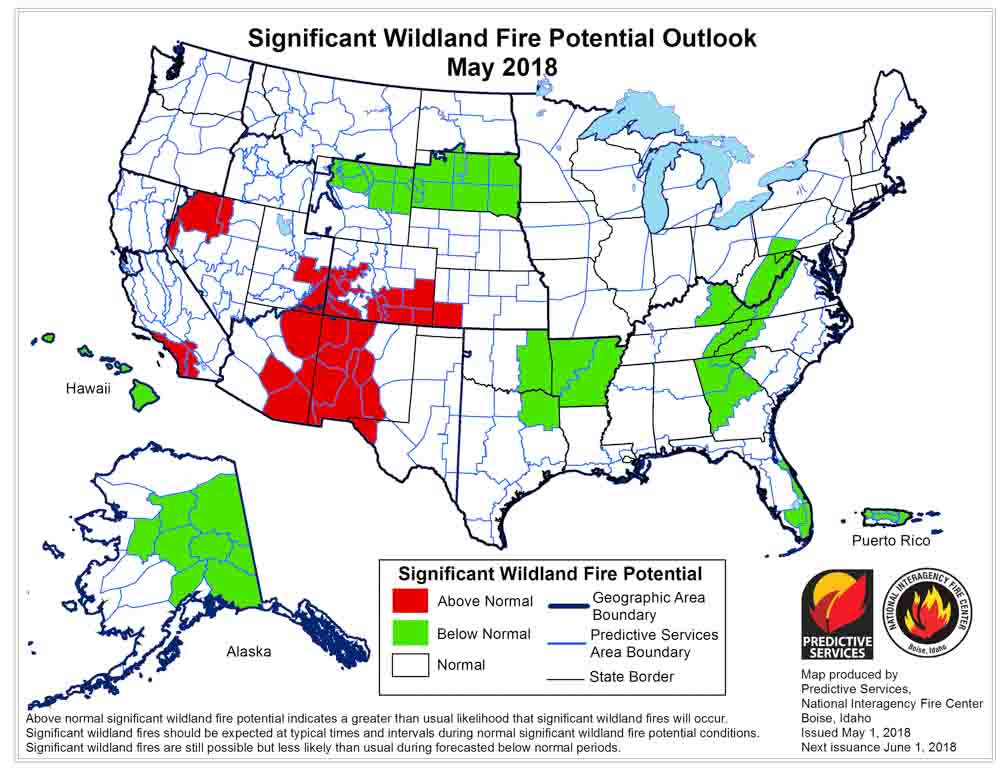
Above normal wildfire activity for most of Southern Colorado was predicted when the latest Wildland Fire Potential Outlook was released by the National Interagency Fire Center on May 1. At that time the conditions were expected to continue through June in Colorado. We should have an updated outlook on June 1.
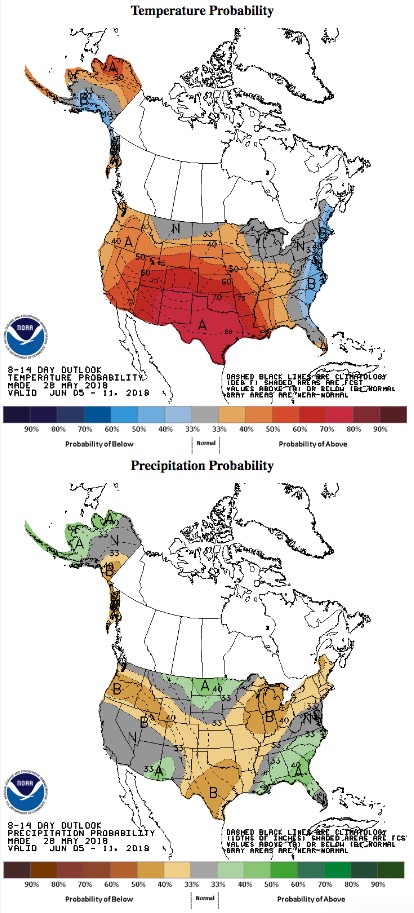
Below are the temperature and precipitation outlooks for June 5 through 11.

The Los Padres National Forest (@LosPadresNF) in Southern California distributed this photo and wrote:
The Spanish Ranch Fire staff ride in Cuyama is part of LP Hotshots’ annual training. This year they invited Horseshoe, Fulton, Springville, Breckenridge & Kern Valley Hotshots to join them on the staff ride. Experiential learning is a key way crews learn lessons from the past.

The photos survived
Continue reading
I was able to get some photos of some smokejumper aircraft at Missoula International Airport last week while attending the Fire Continuum conference. Parked, were two Twin Otters and two C23B Sherpas, and a third Sherpa taxied in while I was there.
Previously I had seen a Sherpa flying through the hills north of the airport. The Sherpa that just landed may have been dropping jumpers for training. The U.S. Forest Service has authorization to obtain 15 of the Sherpas from the U.S Army. So far six have been refurbished and Neptune Aviation is working on a seventh with an eighth soon to follow. It is possible that the remaining seven will be used for parts.
 A Sherpa taxis in after landing at Missoula.

 Two C23B Sherpas at Missoula, May 25, 2018.
 Twin Otters have served smokejumpers for many years.
Five years ago after 19 firefighters were killed while fighting the Yarnell Hill Fire in Arizona on June 30, 2013 the U.S. Forest Service said they were going to move up the planned revision of the fire shelters that failed to be effective when used by the Granite Mountain Hotshots that day. The redesign has now progressed to the point where it will be tested by 60 firefighters this year.
Below is information released by the National Interagency Fire Center about the project.
This summer, a total of 60 wildland firefighters will carry one of four new fire shelter prototypes for “wear testing” as part of the ongoing “Fire Shelter Project Review” that was initiated in 2014 to identify possible improvements to the fire shelter system.
The National Wildfire Coordinating Group (NWCG) Fire Shelter Subcommittee, which is comprised of federal, state, and local wildland firefighters, wildfire safety specialists, fire management officers, and other fire shelter users, selected the four new fire shelter prototypes for wear testing. The USDA Forest Service National Technology and Development Program, which administers the Fire Shelter Project Review, will issue a total of 60 prototypes of four different new fire shelter designs that have shown improved performance in lab tests to wildland firefighters to evaluate durability. The wildfire environment is very rugged and fire shelters must be carried by wildland firefighters for years and still be functional when needed.
Two of the new fire shelter prototypes are designed for ground firefighters and 20 of each of these prototypes will be issued to Interagency Hotshot Crew members for wear testing. The other two new fire shelter prototypes, which have been determined to be too bulky for ground firefighters, will be tested by equipment operators. Ten of each of the bulkier prototypes will be issued. The National Aeronautics and Space Administration (NASA) and the USDA Forest Service have a cooperative work agreement for this project. Two of the prototype fire shelters are NASA designs.
“The biggest job that a fire shelter has to do is be carried around by a wildland firefighter all day, every day, all season long,” said Tony Petrilli, Fire Shelter Review Leader with the USDA Forest Service National Technology and Development Program. “That doesn’t lend itself to the use of a lot of materials that can withstand high temperatures because of weight, bulk, durability and toxicity.”
The current fire shelter, which has been in use nationwide by all wildland firefighters since 2010, offers 54 seconds of survivability in lab tests. The current and previous versions of fire shelters have saved the lives of hundreds of wildland firefighters since the 1960s. The four new fire shelter prototypes that will be wear tested this summer offer increased protection, but two of the four are also bulkier and heavier. The backpacks that wildland firefighters carry weigh an average of 45 pounds. Adding weight and bulk to the fire shelter increases daily physiological stress on wildland firefighters. A 2014 survey of over 3,800 wildland firefighters indicated that they prefer a lighter fire shelter that matches the performance of the current fire shelter over a more protective fire shelter with additional weight and bulk.
Over the last four years, the USDA Forest Service National Technology and Development Program evaluated and tested hundreds of potential fire shelter materials and designs submitted by 23 different organizations from all over the world. The materials and designs were evaluated on weight, bulk, durability and toxicity, which are critical to determine suitability for use in fire shelters. Suitable materials were tested in a small-scale flame test to determine material strength, durability, flammability, and thermal performance. Materials that showed promise in the small-scale test were then constructed into fire shelters and tested in a full-scale, direct flame test to measure the performance of the overall fire shelter design.
After completion of the wear tests, the USDA Forest Service National Technology and Development Program will evaluate the results and conduct a final round of full-scale direct flame testing to ensure the four new fire shelter prototypes are still able to perform after being carried by ground firefighters and equipment operators over the summer. The final results will be presented to the NWCG Fire Shelter Subcommittee which will make a recommendation on whether to adopt one or more of the new fire shelter prototypes or to continue to use the existing fire shelter.
Wildland firefighters are trained to consider fire shelters as a last resort and to avoid situations that can lead to entrapment. As with the current fire shelter, it is likely that none of the four new fire shelter prototypes can ensure survival in all wildfire conditions. Nationwide, in 2017, wildland firefighters deployed fire shelters on two separate incidents when they were caught in fire entrapment situations, all three wildland firefighters survived.

While in Missoula this week I got a couple of photos of Tanker 10, the retired P2V that is now the “gate guard” at the airport.
When it was placed in that position in June of 2017, Kevin Condit, Neptune’s Marketing Manager said, “Neptune and the Missoula aviation community have a very long history, and with the Smokejumpers and the Forest Service in Missoula, they asked Neptune Aviation if Tanker 10 could be the gate guard.”
All of the P2V air tankers with their two 18-cylinder radial engines and two small jet engines are now retired, and most will find homes in museums.
