
Air Tanker 164
Continue readingWildfire activity increases in Colorado

After having received some monsoonal moisture, Western Colorado apparently is drying a bit, and has quite a few active fires.
Below is information provided by the Rocky Mountain Coordination Center July 31, 2018. Some of the larger ones that are active are listed below, north to south.
Cabin Lake: 350 acres, 103 personnel. White River N.F. ICT3 (Thompson) 16 miles SE of Meeker, CO. Fuel model 4 and 10. Extreme fire behavior with crowning, wind-driven runs and spotting. Residential structures and powerlines threatened. Road, trail and area closures in effect.
Red Canyon: 1,500 acres; 136 personnel. White River BLM. ICT4 (Jacob) 45 miles SW of Meeker, CO. Fuel model 5 and 2. Moderate fire behavior with running, uphill runs and spotting. Residential structures, oil and gas infrastructure and FAA Tower threatened. SWA IMT (Andrews) transition of command anticipated 2400 7/30.
Cache Creek: 325 acres; 50 personnel. White River N.F. ICT3 (Spetter/Ottoson(T)) 8 miles SW of Rifle, CO. Fuel model 10. Moderate fire behavior with single tree torching, group torching and long-range spotting. Oil and gas infrastructure, watershed and private timber interests threatened. RMA IMT2 (Esperance) in-brief 2000 7/30.
Lake Christine: has been burning since July 3, 2018. 12,588 acres, 313 personnel. Eagle County. RMA IMT2 (Greer). One mile NW of Basalt, CO. Fuel model 8 and 2. Minimal fire behavior with smoldering and creeping. Threat to residential structures, private inholdings and high voltage transmission lines, communications infrastructure, water supply infrastructure, commercial airline corridor. Road, area and trail closures in effect. Transfer of command to local IMT3 (Anderson) planned for 7/31. Expected containment 8/2.
Buttermilk: 671 acres, (no more information)
Plateau: 1,200 acres, 87 personnel. San Juan N.F. ICT3 (Seekins/Stark (T)). 13 miles N of Dolores, CO. Fuel model 10 and 2. Moderate fire behavior with short range spotting, isolated torching, group torching and wind driven runs. Road and area closures in effect.
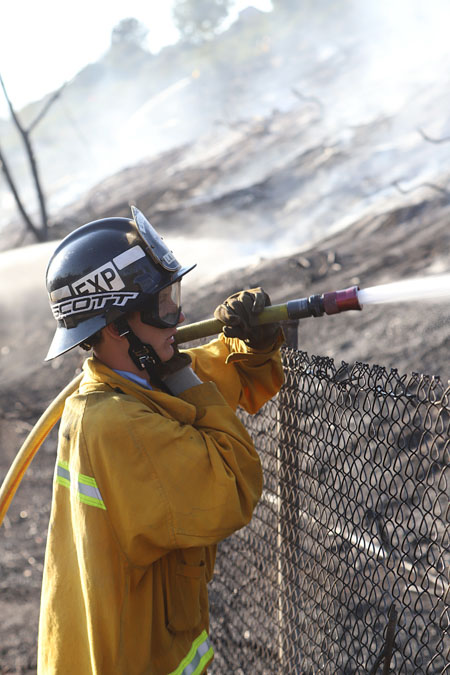
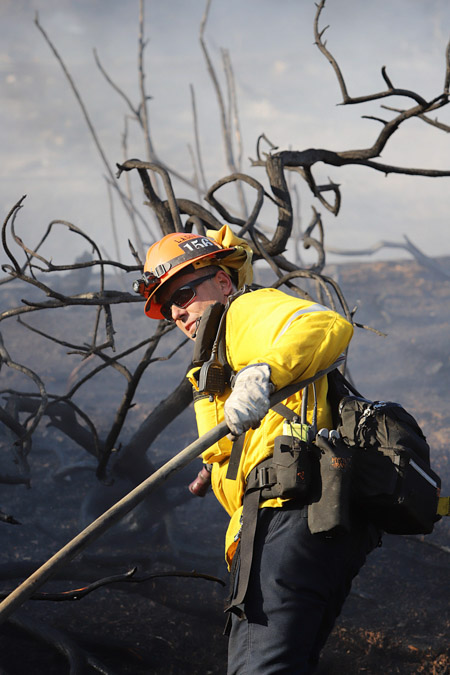
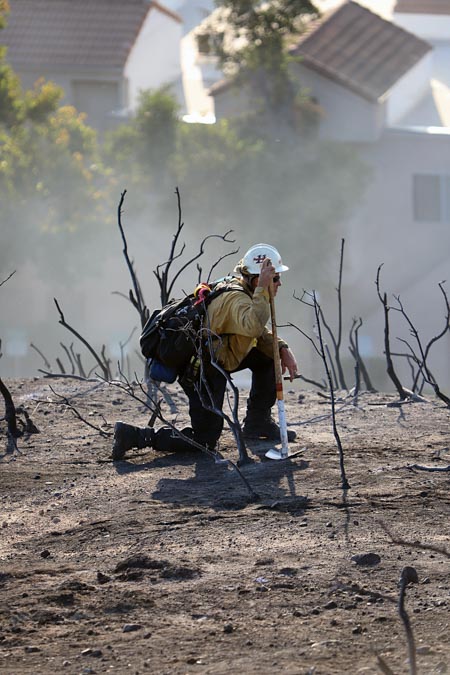
Photos of firefighters at a brush fire in Newhall, California

Above: A Los Angeles County Fire Department Captain collects hose so that he can move it further up the hill.
Fire photographer Jeff Zimmerman shot these photos July 30 at a vegetation fire in Newhall, California. Here is what he wrote in an email:
A 10-acre brush fire damaged two apartment buildings yesterday in Newhall along Valle Del Oro and Alder that were above a steep canyon. In sweltering heat firefighters knocked down the blaze in just over an hour. Trying to battle traffic in 100-degree heat, the fire was contained on my arrival so I decided to take to the burnt hillside and grab some portraits of people at the fire. My favorite is a young girl trying to stay cool near the fire hydrant along Valle Del Oro.

United States asking Australian firefighters for help
The Australian ABC News Service reports the US is asking for 188 specialist firefighters
Continue readingCarr Fire: threat to Lewiston increases, Redding area improves
The fire has destroyed 1,018 residences near Redding, California
Continue readingFirefighters on the Mendocino Complex battle to protect structures around Clear Lake

The fires are threatening 10,200 structures near Upper Lake and Lakeport, California
Continue readingMilitary RC-26 reconnaissance aircraft deployed to assist firefighters
Warning: Trying to access array offset on value of type bool in /home/customer/www/wildfiretoday.com/public_html/wp-content/themes/jupiterx/lib/api/image/functions.php on line 61
Deprecated: ltrim(): Passing null to parameter #1 ($string) of type string is deprecated in /home/customer/www/wildfiretoday.com/public_html/wp-content/themes/jupiterx/lib/api/utilities/functions.php on line 206
Deprecated: preg_replace(): Passing null to parameter #3 ($subject) of type array|string is deprecated in /home/customer/www/wildfiretoday.com/public_html/wp-content/themes/jupiterx/lib/api/image/class-image-editor.php on line 177
Warning: Undefined array key "extension" in /home/customer/www/wildfiretoday.com/public_html/wp-content/themes/jupiterx/lib/api/image/class-image-editor.php on line 179
Deprecated: preg_match(): Passing null to parameter #2 ($subject) of type string is deprecated in /home/customer/www/wildfiretoday.com/public_html/wp-includes/functions.php on line 3089
Deprecated: is_file(): Passing null to parameter #1 ($filename) of type string is deprecated in /home/customer/www/wildfiretoday.com/public_html/wp-includes/class-wp-image-editor-gd.php on line 95
Deprecated: preg_match(): Passing null to parameter #2 ($subject) of type string is deprecated in /home/customer/www/wildfiretoday.com/public_html/wp-includes/class-wp-image-editor-gd.php on line 95
The aircraft can detect new fires, map them, and stream real time video
Continue readingFirefighter killed on Ferguson Fire identified
The National Park Service has identified the firefighter who was killed Sunday morning July 29 while battling the Ferguson Fire on the Sierra National Forest in California west of Yosemite National Park. It was Captain Brian Hughes of the Arrowhead Hotshots.
The incident occurred just before 9:30 a.m. Captain Hughes and his crew were engaged in a tactical firing operation on the east side of the fire. In an area with a large amount of tree mortality, he was struck by a falling tree. Captain Hughes was treated at the scene, but passed away before he could be transported to a hospital.

Mendocino Complex of Fires grows closer to communities around Clear Lake
The two large fires are threatening Lakeport and Upper Lake, California
Continue readingAre we experiencing a “new normal” of wildland fire behavior?
In the last 16 days four fighters and at least three civilians have been killed on two fires in California, the Ferguson and Carr Fires.
These two fatal fires that are still spreading have over 7,100 personnel working to put them out. Today, nationally, 24,641 are assigned to wildland fires according to the July 29 National Situation Report, including 584 hand crews and 1,689 fire engines. These are very high numbers that have not been reached very often.
There are risks associated with wildland fires, and the more people taking those risks, almost 25,000 today, the more likely it is that fatalities will occur. Struggling to knock down huge weather and fuel-driven fires, or having people assigned for months to a fire that is being managed with a less than full suppression strategy, exacerbates the situation, exposing more firefighters for longer periods of time.
Firefighters on the Carr Fire near Redding, an area very familiar with wildland fire, are saying that during the current drought and extreme heat, the fire has been spreading without regard to what’s in front of it.
Below is an excerpt from an article at KTVU about the Carr Fire:
“We’re not fighting a fire,” said Jonathan Cox, battalion chief with Cal Fire. “We’re trying to move people out of the path of it because it is now deadly, and it is now moving at speeds and in ways we have not seen before in this area.”
From Fox26Medford:
Carr Fire Unified Incident Commander Chief Brett Gouvea said, “This fire is extremely dangerous and moving with no regard to what’s in its path.” Homes, businesses and tens-of-thousands of acres reduced to rubble and ash.
Mark Brunton with CAL FIRE said, “We’ve seen rates of spread, which means the movement of the fire, that are unprecedented. They’re record-breaking.” And continuing to force families to evacuate.
It is too early to say if what we are seeing on fires this year and this decade is the new normal. But maybe it is time to step back and see how the current climate affects the management practices we are using. Are the long term decisions made 10 years ago still viable today? Are we suppressing or managing every fire the best way? At the rate we are using let burn (or less than full suppression) strategies, will we ever treat enough land to make a difference in the long run? Do we have enough funding and firefighters for let burn fires which can linger on for months? Oddly, the National Situation Report does not include any meaningful data about these less than full suppression fires (how I hate that term!), only that there are 39 of them on July 29.