
The blaze is in Lake Havasu City, Arizona
Continue readingSpring Hill Fire spreads across 10,000 acres in New Jersey
The fire is just north of the Penn State Forest
Continue readingFirst place winner in student design competition of large air tanker
Awarded to CAL Poly, Pomona
Continue readingSecond place winner in student design competition of large air tanker
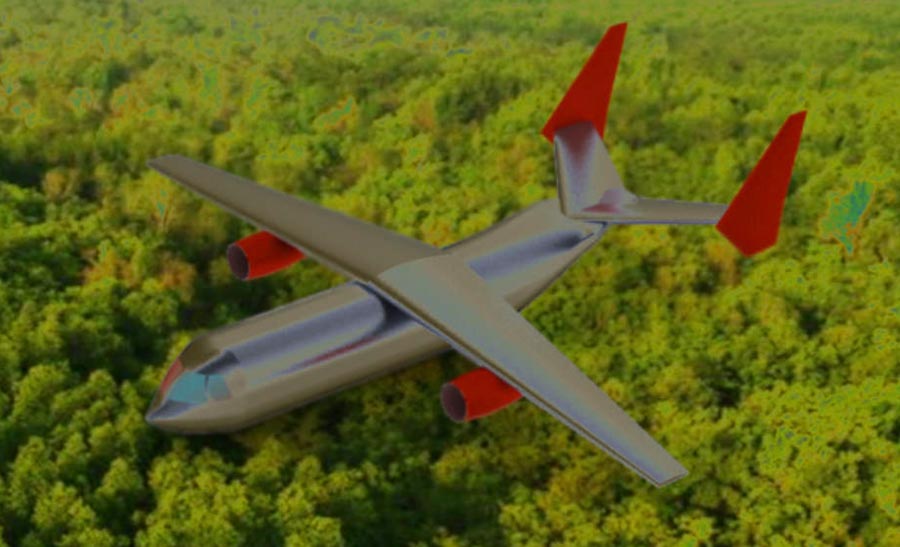 Second place winner in 2015-2016 AIAA student air tanker student design competition, Sharif University, Anahita.
In 2015 the American Institute of Aeronautics and Astronautics (AIAA) Foundation held a Graduate Team Aircraft Design Competition open to undergraduate AIAA branches or at-large Student Members. They competed for prizes ranging from $500 for first place to $125 for third.
In October, 2016 the AIAA announced the three winners. The team that finished second represented Sharif University in Tehran, Iran, for their Anahita aircraft. On March 26 we wrote about the third place winning team. In a later article we will cover the team that took first place, but here we will describe the Sharif University entry in the competition.
The task from the AIAA was to design from the ground up a purpose-built large air tanker. Specifications for the aircraft included a crew of two pilots, 5,000 gallon retardant capacity, 2,500 nm ferry range, dash speed of 300 knots, and powered by turbofan or turboprop engines. Other criteria was a drop speed below 150 kt, stall speed of 90 kt, and takeoff from a Balanced Field Length of 5,000 ft. with an assumption of +35°F standard atmosphere at an altitude of 5,000 ft. above mean sea-level. In addition, fatigue stresses should be strongly considered.
Not being fluent in Persian, I looked up “Anahita”, the name the team gave their project, and found that it refers to an Iranian goddess associated with fertility, healing and wisdom.
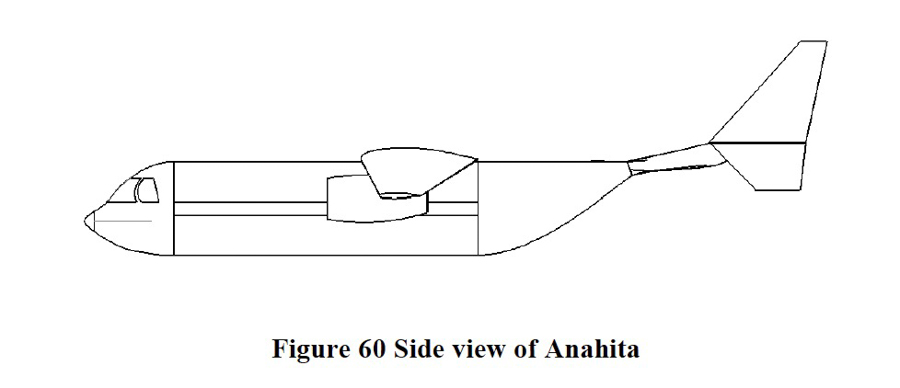 Second place winner in 2015-2016 AIAA student air tanker student design competition, Sharif University, Anahita.
Curiously, there was a fairly lengthy section in the team’s proposal discussing the feasibility of converting a 737 into an air tanker. The proposal was written in 2016, and in May, 2017 Coulson announced that they had purchased six 737-300s to convert them into 4,000-gallon “Fireliner” air tankers. Britt Coulson said they saw an opportunity when Southwest Airlines made a decision to replace their 737-300’s with the new 737-Max.
The students designed an aircraft with a high wing, “H” tail, and two turbofan engines under the wings. It would carry enough fuel for two sorties of three drops each.
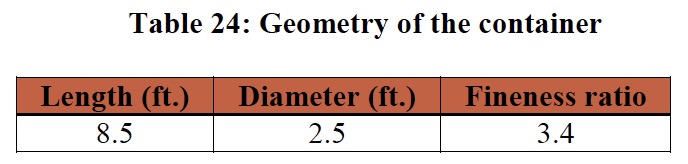 Size of the retardant tank as described in the proposal.
The retardant tank would be cylindrical, 8.5 feet long with a diameter of 2.5 feet. My calculations determined it would only hold 312 gallons, far short of the 5,000 gallon requirement.
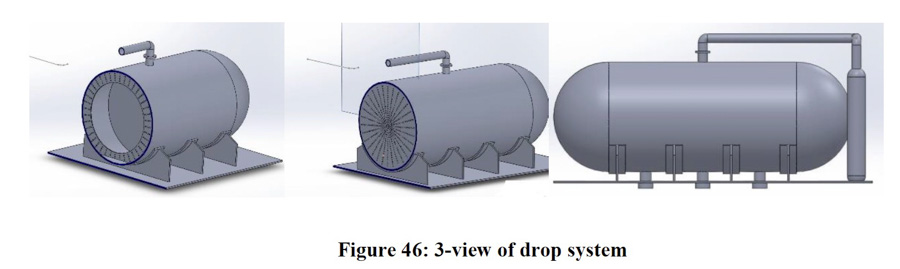
The students specified that the tank would be pressurized, “…so the drop operation will be more precise and there will be no splashing.” But there was no description of how that would be accomplished — with an onboard air compressor, a ground-based compressor, or another method.
The proposal mentioned that the aircraft could also carry cargo, and in another section, that the tank could be removed in minutes. There were no other details about cargo; presumably the tank would be removed to make it multi-role capable. The document described the cargo door in a 737 but there was no mention of one in their purpose-built air tanker design.
The aircraft will have two pilots, and since it must be able to drop on its own without the need for a lead plane, the designers determined that an observer would be on board to monitor the fire. Extra windows cannot be installed in the cockpit because it would greatly increase structural fatigue. So for the observer to have an effective view of the fire area, five cameras will be embedded in the skin providing imagery to a Virtual Reality (VR) helmet worn by the observer, similar to the helmet worn by F-35 pilots. Two cameras would be in the nose, one in the middle, and two in the rear.
In order to determine the location of the drop, two infrared cameras would map the fire and, the students wrote, “…with the help of the geological data of the terrain and wind speed and direction, the fire behavior can be predicted by a computer and the optimal location of drop can be realized.”
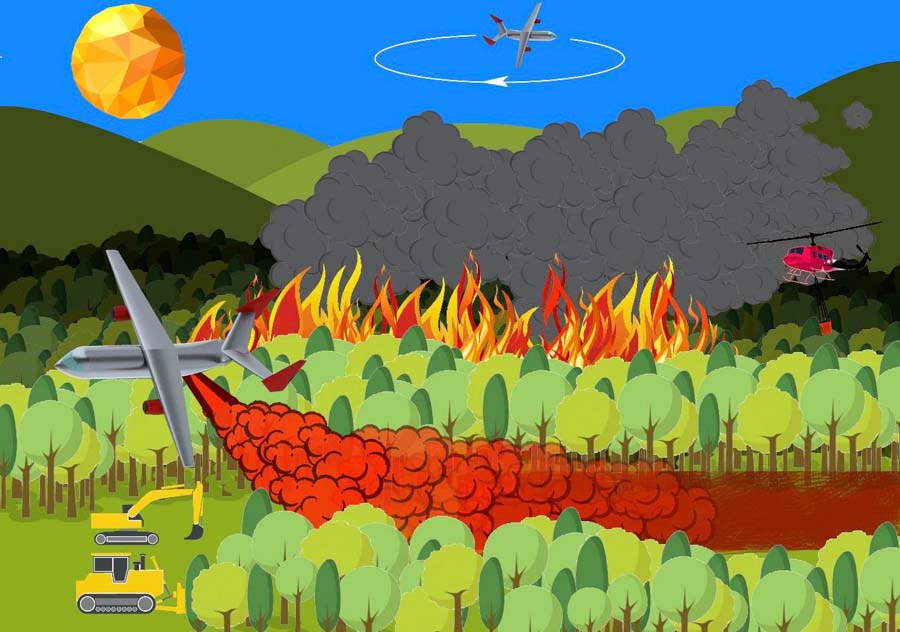 Second place winner in 2015-2016 AIAA student air tanker student design competition, Sharif University, Anahita.
Cost
They found an air tanker study that recommended an optimal number of 28 federal large air tankers. Based on production of 28, the unit cost would be approximately $279M. If 120 units were manufactured for worldwide use, the cost per unit would drop to $126M.
From the Conclusion section of the proposal
“It was realized that the 160-day contracts do not result in economical solutions to the LCC of Anahita, therefore, additional capability of performing alternate missions was considered. The 160 contracts per year were predicted to reach 208 by 2100, this indicates that the firefighting operation hours will increase in the future. Increase in the fleet was recommended in order to lower the unit cost, this was justified based on the increasing number of fires and 37 international agreements on forest fires between US and other countries, it was then indicated money for every player is guaranteed by Export Credit Loan, so foreign contractors could also be involved.”
You can download a copy of their proposal.
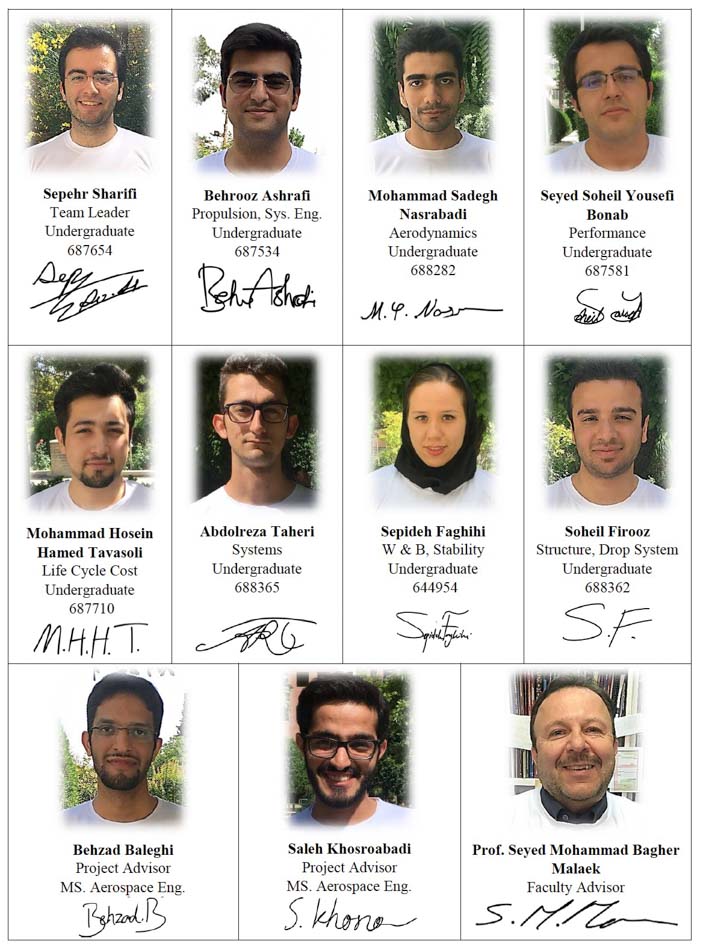
The designers:
Firefighter in Texas killed in helicopter crash
(This article was first published on FireAviation.com)
(UPDATED at 2:16 p.m. MDT March 28, 2019)
The firefighter that died in the Texas helicopter crash on March 27 has been identified by the U.S. Forest Service as Daniel Laird, a Captain on the Tahoe Helitack crew in California. He leaves behind a wife and young daughter.
One source tells us that the other passenger was also a USFS firefighter who was sitting in the front seat when the aircraft went down, but reportedly walked away and was treated and released from a hospital.

The pilot was also transported to a hospital in stable condition, according to the information reported yesterday by Sergeant Erik Burse with the Texas Department of Public Safety.
Below is a letter from the USFS Regional Forester in California:
“You may have already heard from Secretary Perdue and Chief Christiansen that we lost one of our own, Daniel Laird, yesterday, in a helicopter accident while conducting a prescribed burn with our Region 8 partners on the Sam Houston National Forest in Texas. Daniel was 41 years old and leaves behind his wife Heather and daughter Evain.
“Daniel started as a seasonal firefighter on the Tahoe [National Forest] and worked his way up to Helitack Captain. His passion was in aviation, but he was also known for his ability to lead a strike team of engines or a task force of hand crews and heavy equipment. He was a true leader in every sense. He was dedicated to being an instructor and a believer in the apprentice program, where he helped grow people just like himself. Daniel was originally from Graeagle, CA, and committed his working life to the Forest Service. He was extremely knowledgeable about his craft and loved his job. He had an infectious smile, natural physical talent, and his greatest love of all was his family.
“Our Forest Service family is hurting over this tremendous loss. It is an emotional time and Daniel’s loss can impact even the strongest among us. We grieve with Daniel’s immediate family, friends, and community. Please keep them all in your thoughts and prayers. The Region is providing support to the Tahoe and all who need it as they digest this sad news. I will pass more details on arrangements once they become available.
“Please continue to look out for one another and take care of one another.”
Randy Moore
Regional Forester
USFS R5
(UPDATED at 9 a.m. CDT March 28, 2019)
The deceased firefighter was a U.S. Forest Service employee who, along with the other firefighter and the pilot, were on an aerial ignition mission. Their equipment was dropping plastic spheres that burst into flame after hitting the ground, helping to ignite the prescribed fire. No names have been released.
(Originally published at 7:20 p.m. CDT March 27, 2019)
One firefighter was killed in the crash of a helicopter today while working on a prescribed fire in the Sam Houston National Forest about 30 miles southeast of College Station, Texas south of Highway 149.
Sergeant Erik Burse with the Texas Department of Public Safety said the Eurocopter AS350 went down at about 2 p.m. with three people on board, a pilot and two firefighters. One of the firefighters was deceased on scene. The pilot and a second firefighter were transported to a hospital in stable condition.
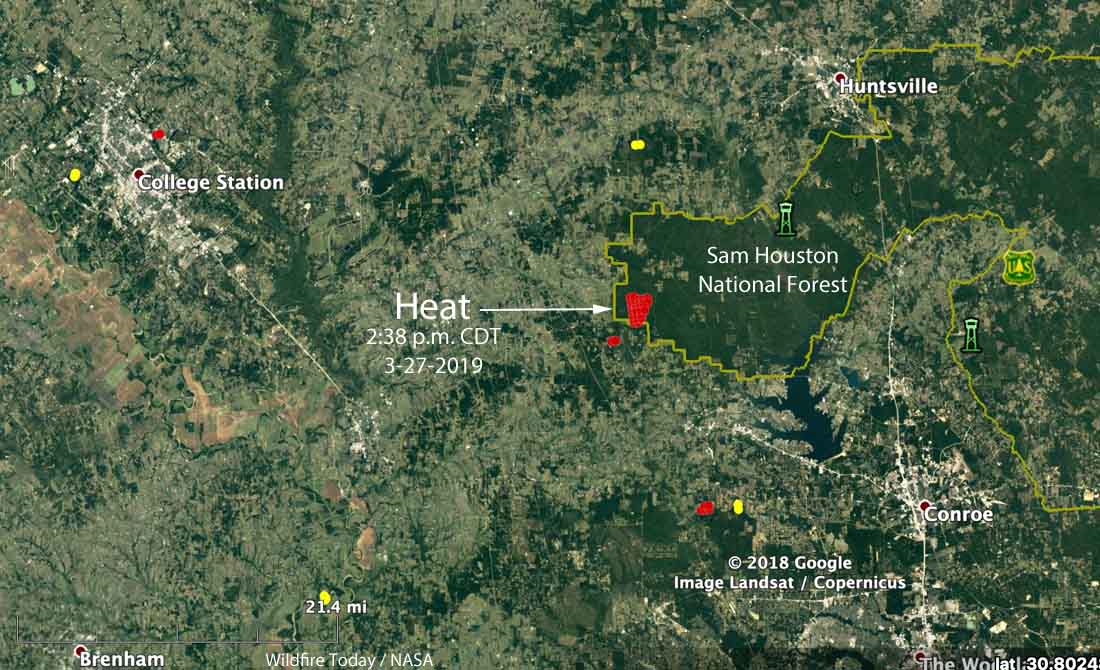 Map showing heat in the Sam Houston National Forest detected by a satellite at 2:38 p.m. CDT March 27, 2019. There is a possibility the heat could have been produced by a prescribed fire.
Our sincere condolences go out to the family, friends, and coworkers of the firefighter, and we hope for a speedy recovery of the injured personnel.
Thanks and a tip of the hat go out to Perry. Typos or errors, report them HERE.
Firefighter killed in Texas helicopter crash
(UPDATED at 2:16 p.m. MDT March 28, 2019)
The firefighter that died in the Texas helicopter crash on March 27 has been identified by the U.S. Forest Service as Daniel Laird, a Captain on the Tahoe Helitack crew in California. He leaves behind a wife and young daughter.
One source tells us that the other passenger was also a USFS firefighter who was sitting in the front seat when the aircraft went down, but reportedly walked away and was treated and released from a hospital.
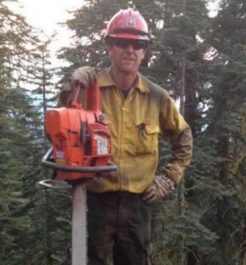 Daniel J. Laird. Tahoe National Forest photo.
The pilot was also transported to a hospital in stable condition, according to the information reported yesterday by Sergeant Erik Burse with the Texas Department of Public Safety.
Below is a letter from the USFS Regional Forester in California:
“You may have already heard from Secretary Perdue and Chief Christiansen that we lost one of our own, Daniel Laird, yesterday, in a helicopter accident while conducting a prescribed burn with our Region 8 partners on the Sam Houston National Forest in Texas. Daniel was 41 years old and leaves behind his wife Heather and daughter Evain.
“Daniel started as a seasonal firefighter on the Tahoe [National Forest] and worked his way up to Helitack Captain. His passion was in aviation, but he was also known for his ability to lead a strike team of engines or a task force of hand crews and heavy equipment. He was a true leader in every sense. He was dedicated to being an instructor and a believer in the apprentice program, where he helped grow people just like himself. Daniel was originally from Graeagle, CA, and committed his working life to the Forest Service. He was extremely knowledgeable about his craft and loved his job. He had an infectious smile, natural physical talent, and his greatest love of all was his family.
“Our Forest Service family is hurting over this tremendous loss. It is an emotional time and Daniel’s loss can impact even the strongest among us. We grieve with Daniel’s immediate family, friends, and community. Please keep them all in your thoughts and prayers. The Region is providing support to the Tahoe and all who need it as they digest this sad news. I will pass more details on arrangements once they become available.
“Please continue to look out for one another and take care of one another.”
Randy Moore
Regional Forester
USFS R5
(UPDATED at 9:07 a.m. CDT March 28, 2019)
The deceased firefighter was a U.S. Forest Service employee who, along with the other firefighter and the pilot, were on an aerial ignition mission. Their equipment was dropping plastic spheres that burst into flame after hitting the ground, helping to ignite the prescribed fire. No names have been released.
(Originally published at 7:17 p.m. CDT March 27, 2019)
One firefighter was killed in the crash of a helicopter today while working on a prescribed fire in the Sam Houston National Forest about 30 miles southeast of College Station, Texas south of Highway 149.
Sergeant Erik Burse with the Texas Department of Public Safety said the Eurocopter AS350 went down at about 2 p.m. with three people on board, a pilot and two firefighters. One of the firefighters was deceased on scene. The pilot and a second firefighter were transported to a hospital in stable condition after rescuers extracted them from the wreckage using jaws and air bags.
Map showing heat in the Sam Houston National Forest detected by a satellite at 2:38 p.m. CDT March 27, 2019. There is a possibility the heat could have been produced by a prescribed fire.Our sincere condolences go out to the family, friends, and coworkers of the firefighter, and we hope for a speedy recovery of the injured personnel.
Thanks and a tip of the hat go out to Perry. Typos or errors, report them HERE.
Establishment of firefighter cancer registry is progressing
The next step is to collect input from firefighters and stakeholders on an approach to the Registry including potential enrollment methods
Continue readingWildland fire research funding opportunities
The Great Basin Fire Exchange has accomplished a good deed for the wildland fire research community. They took a painful-to-read announcement about opportunities for research funding from the Joint Fire Science Program and distilled it into a short and uncomplicated notice.
(The links in the image below don’t work, since it’s a screen shot, but they both go to HERE.)
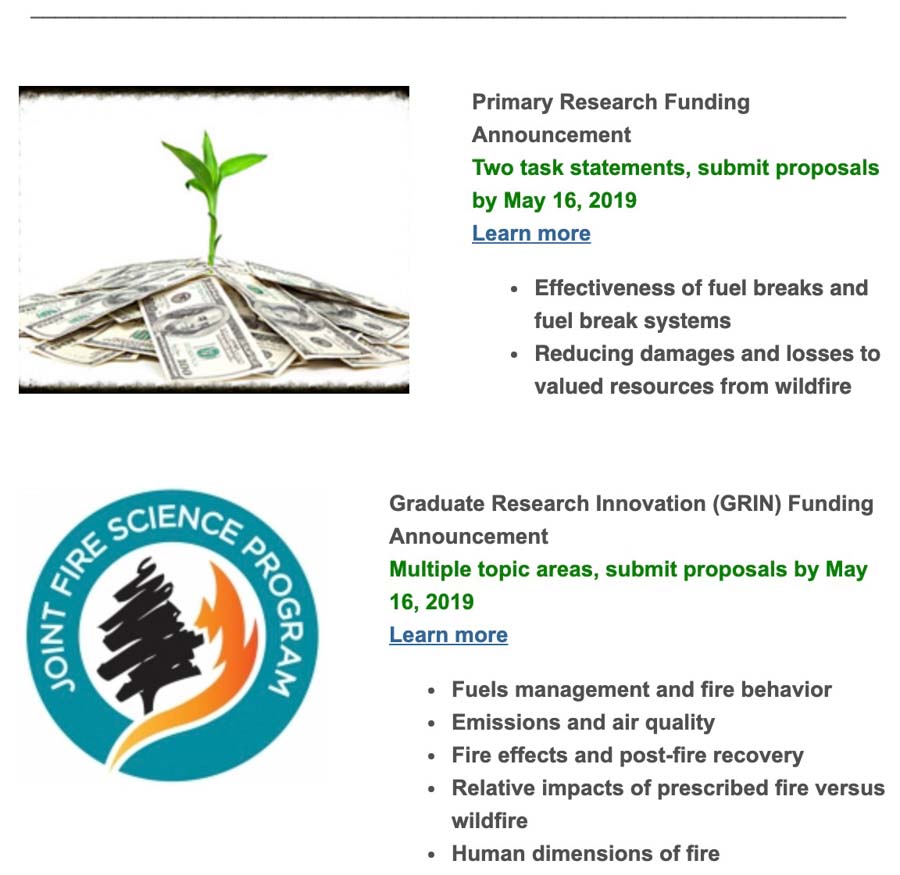
A researcher considering applying for funding will still need to go to the JFSP site to get the details. Proposals are due by May 16, 2019.
In FY 2017, 16 of the 22 approved projects were various ways of studying vegetation. Back then we wrote:
It would be refreshing to see more funds put toward projects that would enhance the science, safety, and effectiveness of firefighting.
Judging from the descriptions of the current funding opportunities it appears that the JFSP is moving away from awarding 72 percent of the awards to vegetation studies.
Third place winner in student design competition for a large air tanker
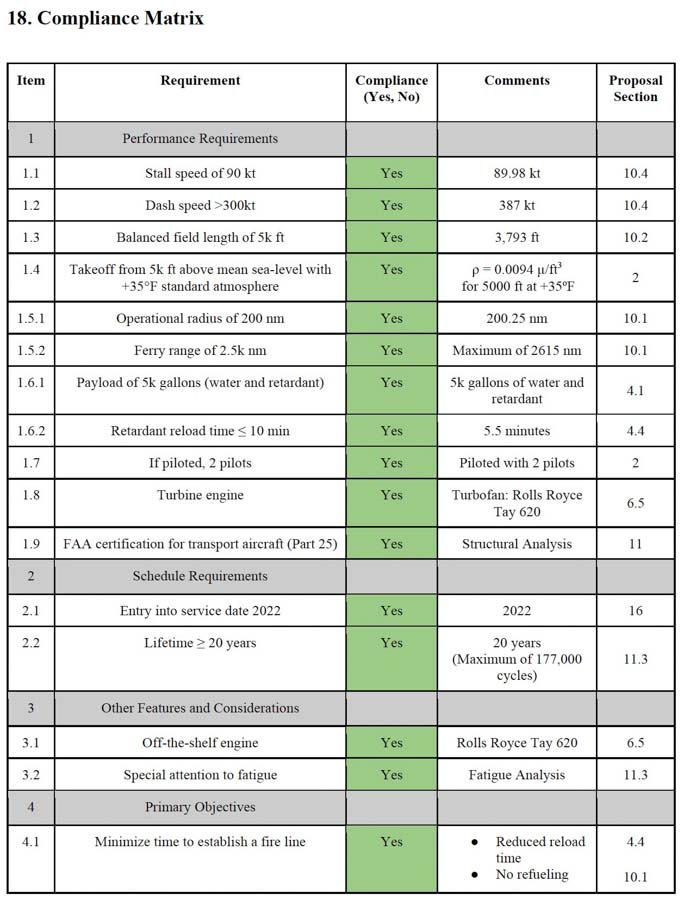
In 2015 the American Institute of Aeronautics and Astronautics (AIAA) Foundation held a Graduate Team Aircraft Design Competition open to undergraduate AIAA branches or at-large Student Members. They competed for prizes ranging from $500 for first place to $125 for third. The task was to design from the ground up a purpose-built large air tanker. Specifications for the aircraft included a crew of two pilots, 5,000 gallon retardant capacity, 2,500 nm ferry range, dash speed of 300 knots, and powered by turbofan or turboprop engines. Other criteria was a drop speed below 150 kt, stall speed of 90 kt, and takeoff from a Balanced Field Length of 5,000 ft. with an assumption of +35°F standard atmosphere at an altitude of 5,000 ft. above mean sea-level. In addition, fatigue stresses should be strongly considered.
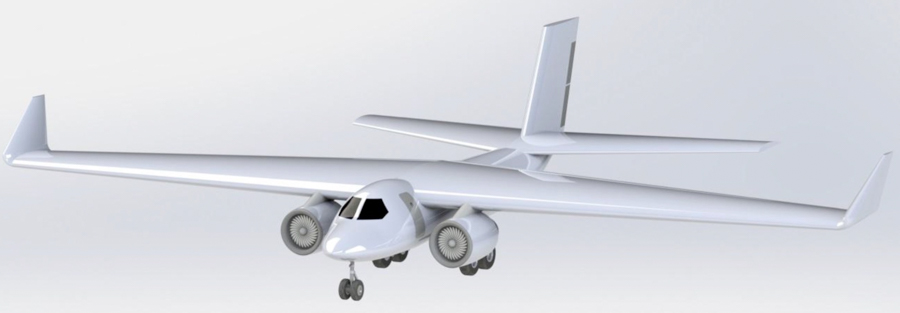 Third place winner in 2015-2016 AIAA student air tanker student design competition, CAL Poly Pomona, AeroTactic Company.
In October, 2016 the AIAA announced the three winners. Today we are writing about the third place contestant — in subsequent days we will cover the second and first place winners. Yes, even though we covered the initial announcement of the competition, we are a little late to the party to write about how it turned out. (No sense in rushing into these things.)
Receiving the award for third place was a 10-person group from California State Polytechnic University, Pomona, who called themselves the AeroTactic Company Team. You can download their very, very technical 65-page proposal.
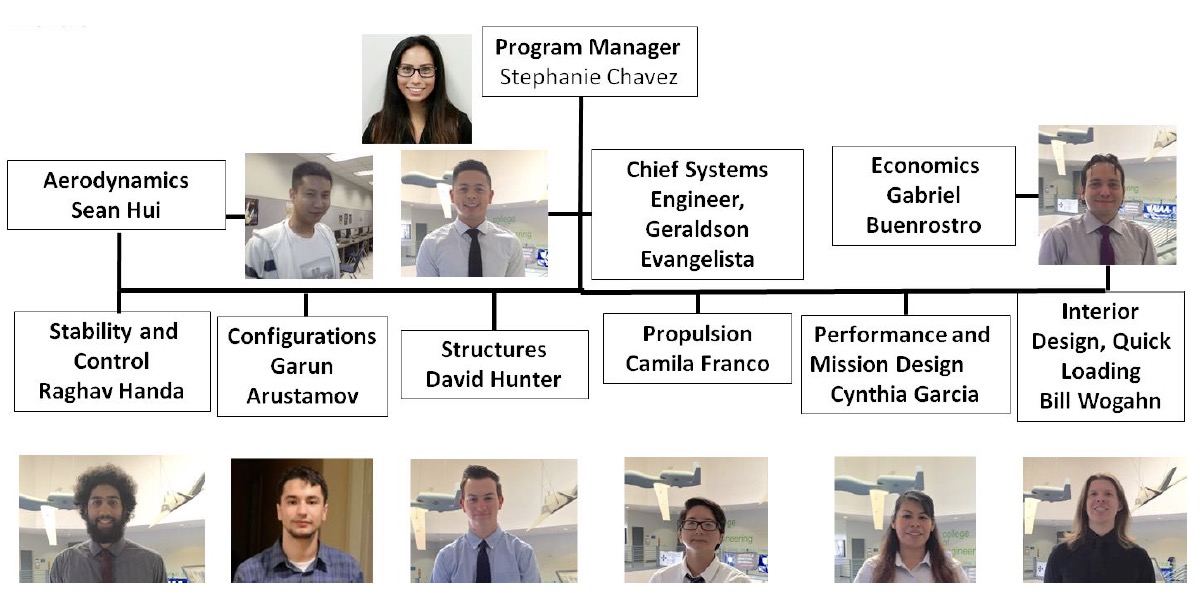 California State Polytechnic University, Pomona. AeroTactic Company Team. Image from the team’s proposal.
The team’s FF-1 Rainbird aircraft design features an integrated retardant tank with a gravity-fed dispersal system. It is powered by two Rolls Royce Tay turbofan engines underneath the wings. Winglets increased the Rainbird’s lift to drag ratio by 5%, consequently increasing its fuel efficiency.
Their rational for choosing to have it piloted rather than unmanned, was, “A piloted aircraft is more flexible to changing scenarios compared to a UAV. In addition, an unpiloted aircraft would cost more to maintain and to build due to the additional sensors, hardware, and software required.”
The high density payload combined with the low stall speed requirement drove the design of the aircraft to contain large wings and a small fuselage.
The two engines are attached to the wing’s leading edge, protruding past the wing in order to balance the aircraft for all loading configurations. It is capable of carrying enough fuel for four sorties and can reload the retardant within ten minutes.
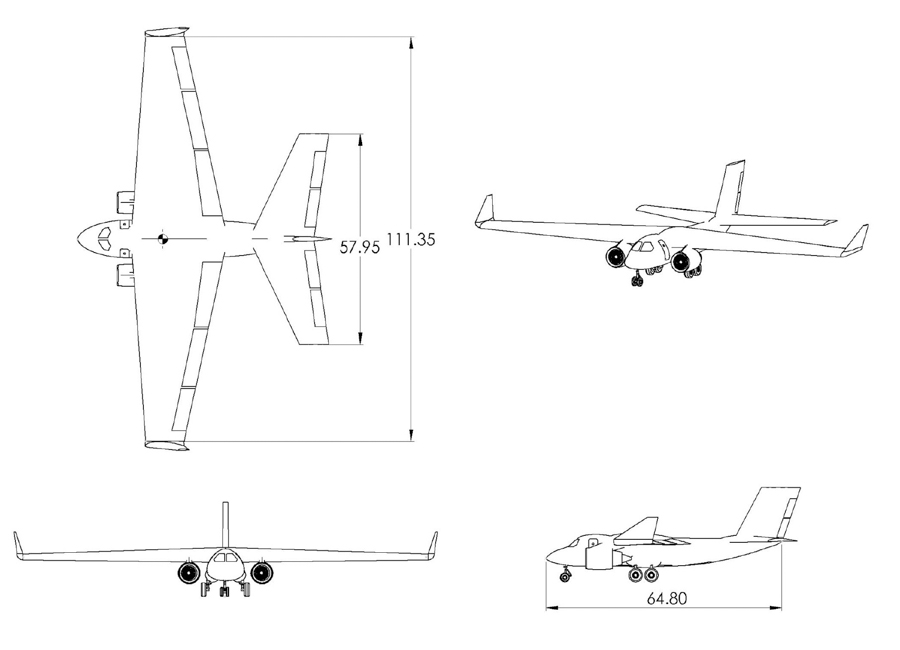 Third place winner in 2015-2016 AIAA student air tanker student design competition, CAL Poly, AeroTactic Company. Measurements are in feet.
The 5,000-gallon tank is located at the center of gravity of the aircraft, limiting CG shift while releasing its load. Their goal was for the fuselage to be as small as possible while still being long enough to maintain aircraft stability, hence the larger length of the tank relative to its other dimensions. The tank can be refilled from three fill ports simultaneously.
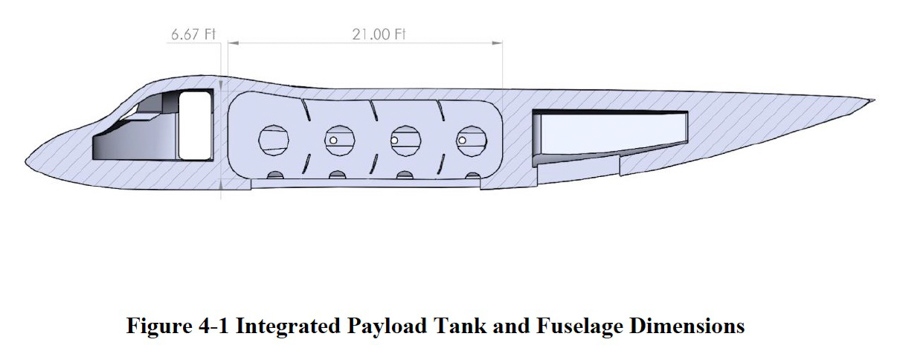
The group determined that for the aircraft to reach a fire 200 nm away in the least amount of time, 54 minutes, it should cruise at 20,000 feet at 245 kt.
The cockpit, but not the entire aircraft, would be pressurized and air conditioned. (Not all three of the student entries have pressurization.)
The aircraft will have two infrared cameras, priced at $4,200 each.
Cost
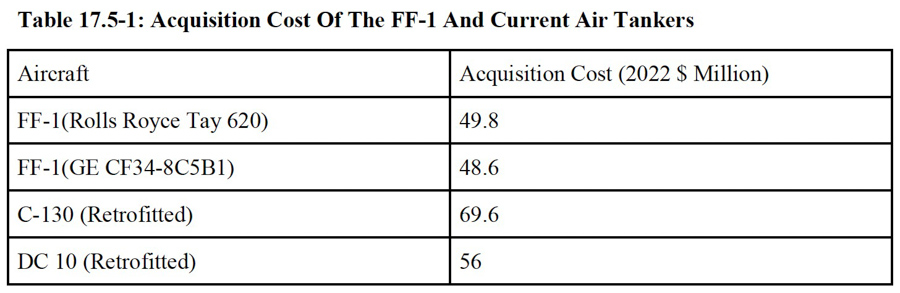
The graduate students assumed 200 units would be produced over the next 80 years with combined 20-year life spans covering 100 years. They estimated the research and development would cost $1.89 billion, including building and testing three aircraft. Total cost of production would be $89 billion, inflated to 2022 dollars (when delivery would begin). The flyaway cost for each unit was estimated at $45.3 million in 2022 dollars, including 10% profit. At 131 units, the program would break even in costs and begin to generate profit.
Below is an excerpt from the proposal:
“The cost comparison between the [students’] FF-1 and the C-130 and DC 10 was obtained through the analysis of depreciation, the costs associated with retrofitting an existing aircraft into an air tanker, and the limited life of the aircraft in the year 2022. The cost of retrofitting an air tanker was approximated to be $23.71 million, not to mention the installation of a retardant delivery system which is another $6.38 million. The cost for the both the C-130 and DC-10 were obtained from Military Aircraft. Table 17.5-1 exhibits the costs of the FF-1 configurations and the retrofitted competing aircraft.”
The table below shows how the design met the required specifications.
Five emotional and social intelligence skills of outstanding Incident Commanders
Results of a study
Continue reading