
The Alaska Fire was 450 acres at 1 p.m. Wednesday, July 31, 2019
Continue readingNumerous scoopers seen in action in France
 Five scooping air tankers get water from a lake in France. Screenshot from the video below.
I lost count of how many scooping air tankers can be seen in this video of the aircraft getting water at a lake in France.
An S-2 air tanker is ready to fight fire in Kansas
 Bill Garrison’s S-2 air tanker. Screenshot from the KWCH video below.
The owner of a crop dusting service in Kansas has acquired an S-2 air tanker formerly operated by the California Department of Forestry and Fire Protection (CAL FIRE).
Bill Garrison, owner of Ag Air Service out of Nikerson, Kansas, said that after he used his crop dusters in 2017 to aid firefighters by dropping water on wildfires, he decided he wanted a bigger airplane.
KWCH reported that the Kansas Forest Service has a call when needed agreement to use the plane on fires for $4,000 an hour.
The aircraft was constructed as an S-2A, according to aerialvisuals.ca, with the BuNo 136508. CAL FIRE operated it as Tanker 81 and 93 with registration number N477DF. At some point the tanker number changed to 95, the number still used today, and was owned by Yesterday’s Flyers and later, Cactus Air Force, both in Nevada. The current registration number is N508JR under the ownership of Mr. Garrison, with a certificate issue date of February 14, 2019.
The aircraft can carry up to 800 gallons and still has the radial engines, unlike the S-2s operated by CAL FIRE today that have been converted to turbine engines.
Mr. Garrison said he used one of the company’s planes in 2017 to drop 20,000 gallons of water on the Highlands Fire in Reno County, chipping in to help when the Kansas National Guard Blackhawk helicopter pilots ran out of duty time. Below is an excerpt from Hutch News published March 12, 2017:
Because of the high winds he was forced to fly into – the same winds whipping the fire out of control – he had to fly as close to the ground as possible, or the wind would blow the water off the fire, he said. “At times, I had fire above the aircraft,” Garrison said. “We were pushing the upper limits with the wind Monday night.”
Click here to see the CAL FIRE air tanker that today has the T-95 designator.
(UPDATED at 2:05 p.m PDT July 31, 2019)
After we posted this article, JD Davis sent us the two photos below of CAL FIRE air tankers with registration number N477DF. Thanks JD!
 CAL Fire Air Tanker N477DF at Hemet, CA June 10, 1979. JD Davis Photos.
 CAL Fire Air Tanker N477DF at Hemet, CA October 23, 2003. JD Davis Photos.
Thanks and a tip of the hat go out to Matt. Typos or errors, report them HERE.
Opinion: Diversity helps fight wildfires

David M. J. S. Bowman and Cathelijne Stoof wrote the following letter to the journal Nature (571, 478 [2019]), dated July 23, 2019:
Diversity helps fight wildfires
As professionals who study the control and prevention of wildfires, we argue that reducing the resulting loss of life and property calls for the involvement of socially diverse local communities.
People from different cultural backgrounds respond differently to wildfire risk, as do men and women (C. Eriksen; Gender and Wildfire: Landscapes of Uncertainty; Routledge, 2013). This presents practical and policy challenges for firefighting agencies. For instance, fire prevention and emergency warning must be tailored to specific groups. And engagement with local communities could be an awkward fit with wildland firefighting institutions, which are strongly hierarchical and have a masculine culture (A. M. S. Smith and E. K. Strand Fire 1, 45; 2018).
Fire-prevention strategies should include public education and real-time mass communication (see also A. M. S. Smith et al. Bioscience 66, 130–146; 2016). Communities need advice on managing fire risk. This requires devolution of political power from centralized bureaucracies to local organizations, and promotion of disciplinary, sectoral and social diversity among fire scientists, policymakers and wildfire managers.

Record-setting day at Helena Air Tanker Base
Twelve firefighting aircraft worked out of the base supporting the North Hills Fire
Continue readingHow a dust devil forms
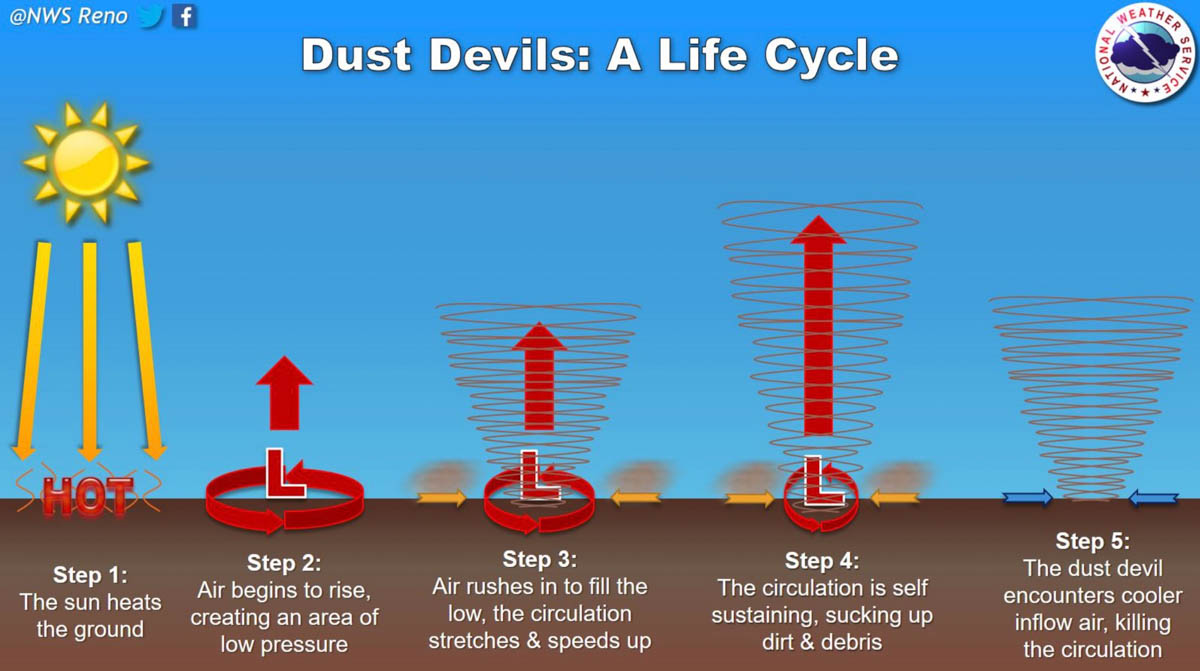
Dust devils are always interesting to watch, especially if they are over a wildfire and grow larger becoming fire whirls, or the very rarely seen fire tornado.
The Reno office of the National Weather Service distributed this graphic of how a dust devil forms.
–
GPS guided paracargo for firefighters
This autonomous paracargo system could come in handy for resupplying firefighters at night or during during smoky conditions.
From the BLM:
Thousands of pounds of supplies are delivered to firefighters each season. JPAD or Joint Position Air Drop allows smokejumpers to drop GPS-guided paracargo in low-visibility conditions.
This system is a fully autonomous GPS-guided military airdrop, using steerable parachutes and an onboard computer to steer paracargo to a precise location. Video courtesy of AFS fire personnel.
New film reveals the untold story of fire in a swamp
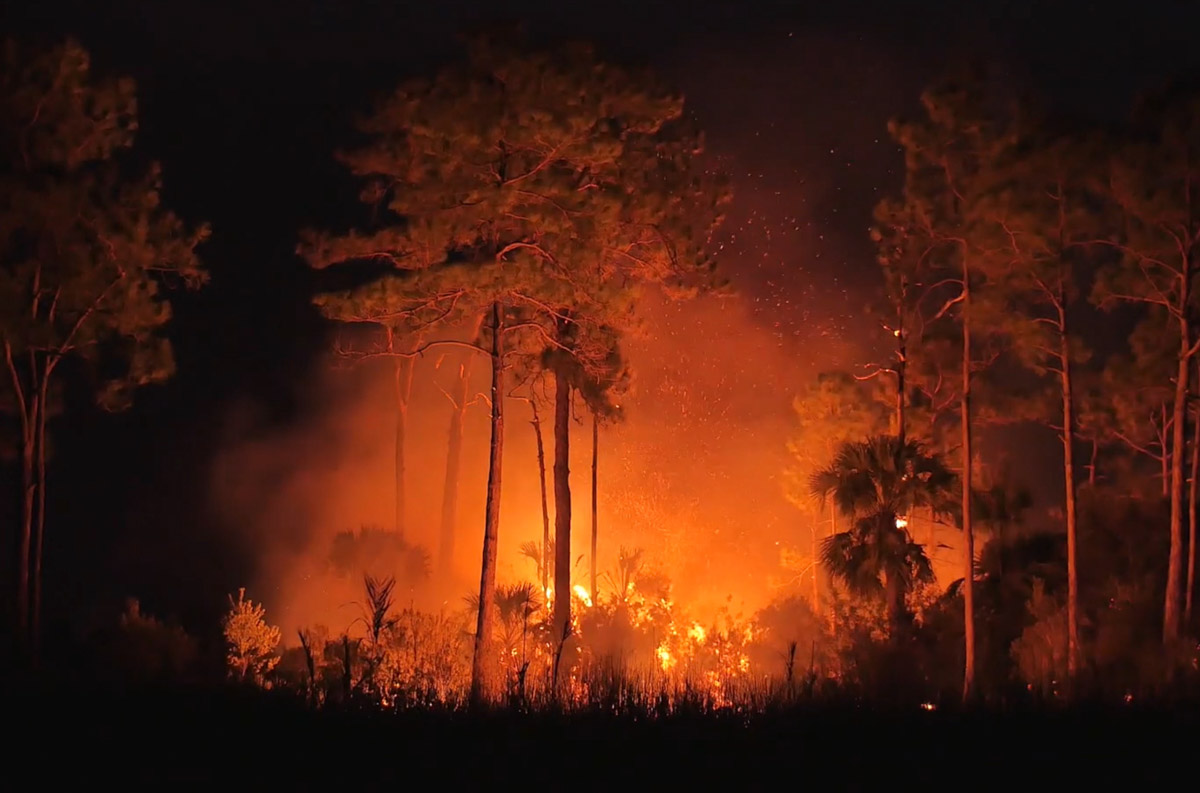
Much of Big Cypress National Preserve in south Florida is swampland. And like most areas with native vegetation it evolved with fire as a major component of the ecosystem.
Today the Preserve released a new film, “Fire Swamp,” that explains the relationship. Here is how they describe it:
‘Fire Swamp’ reveals the untold story of how fire burns in a swamp. Get a front row seat to fire flowing through our interwoven ecosystem of high and dry pinelands to cypress swamps with two National Park Service professionals who manage this dynamic ecosystem. Down here in the Big Cypress, the borders between fire, water, people, limestone, plants, and animals creates an exquisite mosaic of beauty.
Jen Brown, and recently with Rick Anderson, has been making films about fire in South Florida since at least 2012. Their company, IntoNatureFilms, has helped the land management agencies in the area interpret for the general public the value of public lands and inform them about how they are managed. More agencies around the country could learn from this approach.
The 2018 Woolsey Fire set back the reintroduction of an endangered frog
Three of the four reintroduction sites for the largest native frog in the western U.S. were wiped out by debris flows after the wildfire
Continue readingHundreds of homes evacuated due to wildfire north of Helena
The North Hills Fire has burned 4,225 acres 10 miles north of downtown Helena, Montana
Continue reading