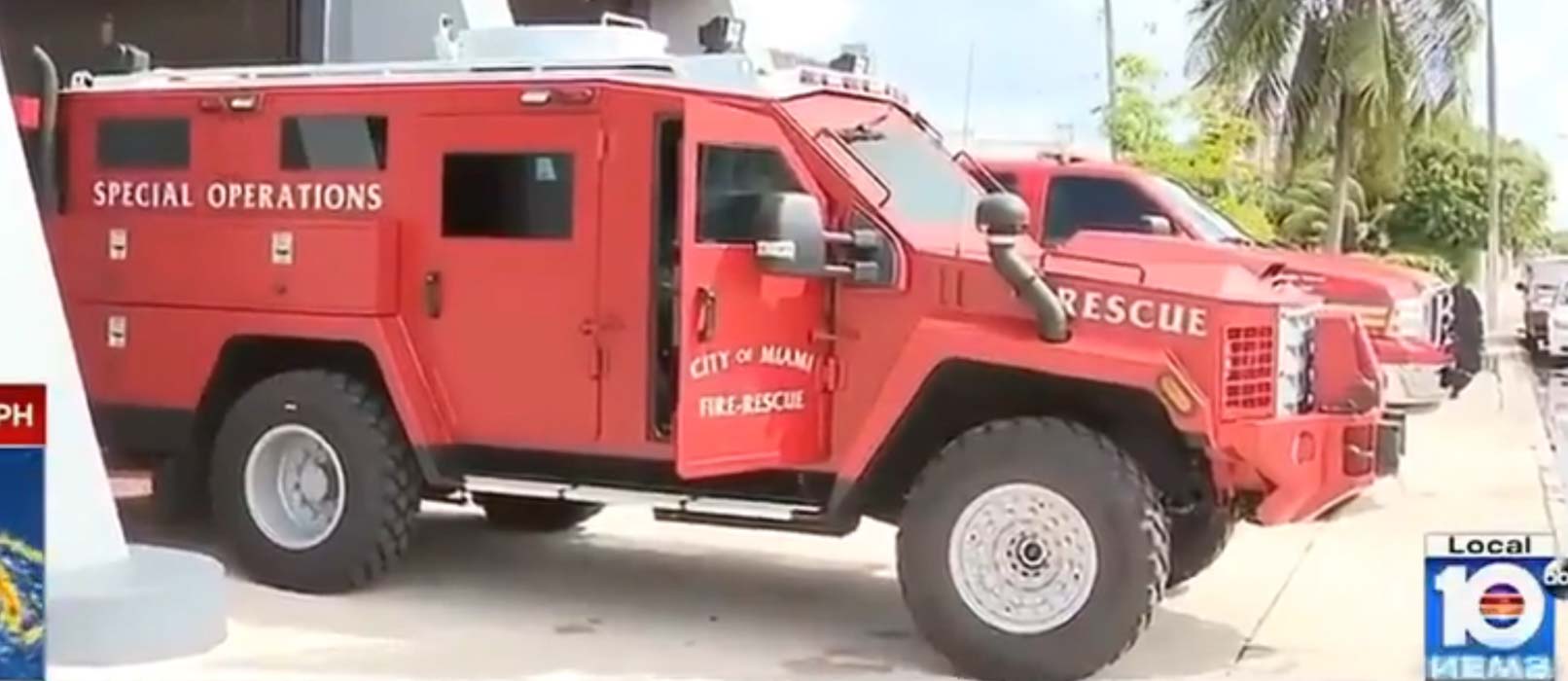
Miami Fire Department’s armored truck. From ABC 10 video.
The Miami Fire Department has acquired an armored truck that can be used for incidents involving high winds, high water, and active shooters. Since we are seeing more of these types of emergencies it might be very useful.
The video lays out the details, including the body armor labeled “FIRE”.
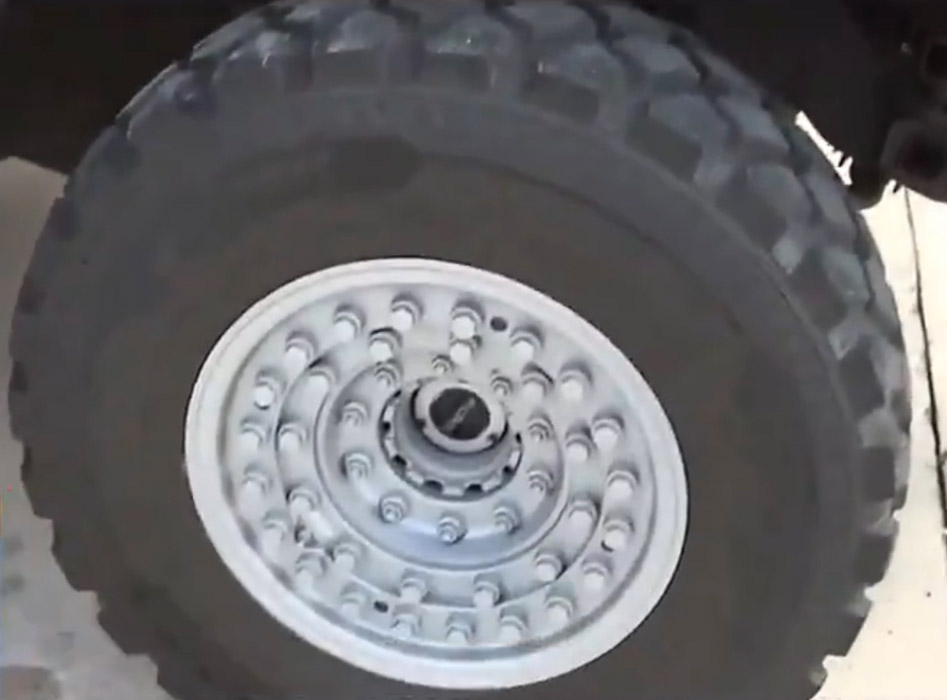
Body armor for firefighters in the armored truck.Miami Fire Department’s armored truck. From ABC 10 video. Changing a tire appears to be complicated.Miami Fire Department’s armored truck. From ABC 10 video.
This is video shot August 29 from the Single Engine Air Tanker (SEAT) piloted by Jim Watson on the R-1 Ranch Fire 13 miles northeast of Susanville, California. He was working out of the Air Tanker Base at Chester, California. You may notice that the aircraft is following another SEAT that makes a drop ahead of him.
Before the USSR collapsed, the government was designing the “Rescuer” which could carry 200 tons of water. This is the unfinished project at the Central Design Bureau. Alekseeva.
Before the USSR collapsed, their government was attempting to develop an aircraft that could carry 500 to 700 tons of cargo or serve as a water-scooping air tanker carrying 50,000 gallons of water.
It is not clear if it is a ground effect vehicle that would be restricted to flying 10 to 20 feet above a surface, or if it could also fly high enough to drop water on wildfires. It is a little difficult to determine the details based on the very crudely machine-translated article from Aviation of Russia, which is below:
“The Central Design Bureau (TsKB) for hydrofoil ships named after Alekseev (Nizhny Novgorod) has good groundwork on heavy ekranoplans, which could be used to extinguish large forest fires with greater efficiency than airplanes, reported Chairman of the Board of Directors – General Designer of the Central Design Bureau Georgy Antsev.
“ ‘Speaking of fires, we have serious work on the development of the Spasatel ekranoplan, where we go into tonnages from 500 to 700 tons. We have a series of proposals for the construction of ekranoplanes, where we can already talk about the tasks of fire fighting,’ Antsev said.
“According to him, such an ekranoplan could take about 200 tons of water as a load and dump it in the same time that IL-76 aircraft dump only 40 tons. Antsev emphasized that the advantage of ekranoplanes is that water does not need to be pumped at airfields from fire tanks, as is now happening with the IL-76. It takes a lot of time and is technically difficult. WIG can take water in large rivers or large bodies of water.
“Such characteristics of an ekranoplan, such as excess weight, characteristic of high-strength machines, designed for good performance in conditions of frequent water hammer, are compensated by the economy when flying in screen mode. In addition, the ekranoplanes are unpretentious to the places of basing – they can stand on the water or go ashore with a slight slope (up to 5%).
“Antsev added that he does not consider the ekranoplanes a panacea for extinguishing forest fires, but noted their effectiveness in the fight against large foci.
” ‘In a disaster, there is no one means. For something you still have to get and put out by plane and helicopter, you have to get somewhere on foot. In high-intensity fires and the battle over the area, the ekranoplan gives a significant gain in the amount of water discharged by unit area in a shorter time. If we talk about intense fires, it helps to ‘crush’ the source,’ said the general designer.
“Wing Rescuer is the second instance of the project 903, the first was an impact Wing-rocket carrier ‘Lun’. The ‘rescue’ was also pledged as a missile carrier, but the collapse of the USSR led to the cessation of financing and the conservation of the vessel at the 95% readiness stage.”
Thanks and a tip of the hat go out to Isaac. Typos or errors, report them HERE.
Earlier this year the National Wildfire Coordinating Group announced the recipients of the 2018 Wildfire Emergency Medical Service Awards. The annual awards program sponsored by the National Wildfire Coordinating Group’s Incident Emergency Medical Subcommittee (IEMS), recognizes and honors individuals and/or organizations who have demonstrated outstanding work, actions, or programs in emergency medical service for our Nation’s wildland firefighters.
“The mission of IEMS is to identify the need for and establish national emergency medical and occupational health standards and procedures and provide information, updates, and guidance to support the health and safety of workers on wildland fire incidents”, said Kaili McCray, Wildland Firefighter Medical Standards Program Manager and current Chair of the IEMS Awards Selection Committee. “The efforts of the awardees for 2018 stood out to the selection committee as particularly significant contributions. They join an elite group who have received these prestigious National Wildfire EMS Awards and we’re proud of them”.
The purpose of the Wildfire Emergency Medical Service Awards is to recognize the unselfish acts and actions of individuals and/or organizations for going above and beyond their normal duties in rendering emergency medical service care and training for member agency incidents and programs.
Heather Wonenberg, Helitack Lead at Yosemite National Park, California. Outstanding Wildfire EMS Individual of the Year Award.
Ally Young, Airtanker Base Staff and Jeff Miller, Airtanker Base Manager at Hill Airtanker Base, Uinta-Wasatch Cache National Forest, South Jordan, Utah. Excellence in Wildfire EMS/Rescue Award.
Dr. Jon Jui, M.D., Regional Medical Director of Incident Medical Specialist Program, Pacific Northwest Region (Region 6), Portland, Oregon. Outstanding Wildfire EMS Distinguished Service of the Year Award.
Steve Otoupalik, Incident Medical Specialist/Manager, Willamette National Forest, McKenzie Bridge, Oregon. Janette Peterson Lifetime Achievement in Wildfire Emergency Medical Service Award.
In Ipswich, Massachusetts yesterday, a dog escaped from his leash, discovered a fire, then like Lassie, barked at his 13-year old master and led him to the fire.
Like a scene out of “Lassie,” Robert Lane, 13, followed his barking dog yesterday to a brush fire burning in the woods behind the family’s home, then ran to a vernal pool to soak his T-shirt in water to try to put out the 10-foot circle of flames.
“I just wanted to get it out as fast as possible,” Robert said.
Discovering the fire was bigger than he thought, Robert ran home to tell his mother, who called the Fire Department at 12:30 p.m. If not detected early by Robert and the family dog, Max, who had escaped its leash, the brush fire could have easily spread and damaged the home and construction business located on their property at 285 High St., David Lane said.
“It could’ve been 10 times worse,” David Lane said by phone last night. “If it wasn’t for the dog getting off the leash, we wouldn’t have a house.”
Firefighters from six communities were able to contain the fire to a 400-by-800 foot area of woods, about three-quarters of an acre, on property across from the Dow Brook Reservoir, said Ipswich firefighter Lee Prentiss. Lane’s antique horse-drawn manure spreader was destroyed, but an estimated 30 to 40 pieces of his equipment were not damaged.
From the Salem News. Photo courtesy of the Daily News.
I am always interested in how wildfires are fought in other countries. I don’t speak Dutch, but still found this video interesting that shows helicopters in the Netherlands demonstrating their water dropping capabilities.