
Nine miles south of Cordes Lakes, AZ
Continue readingAbundant lightning in the western United States last 48 hours
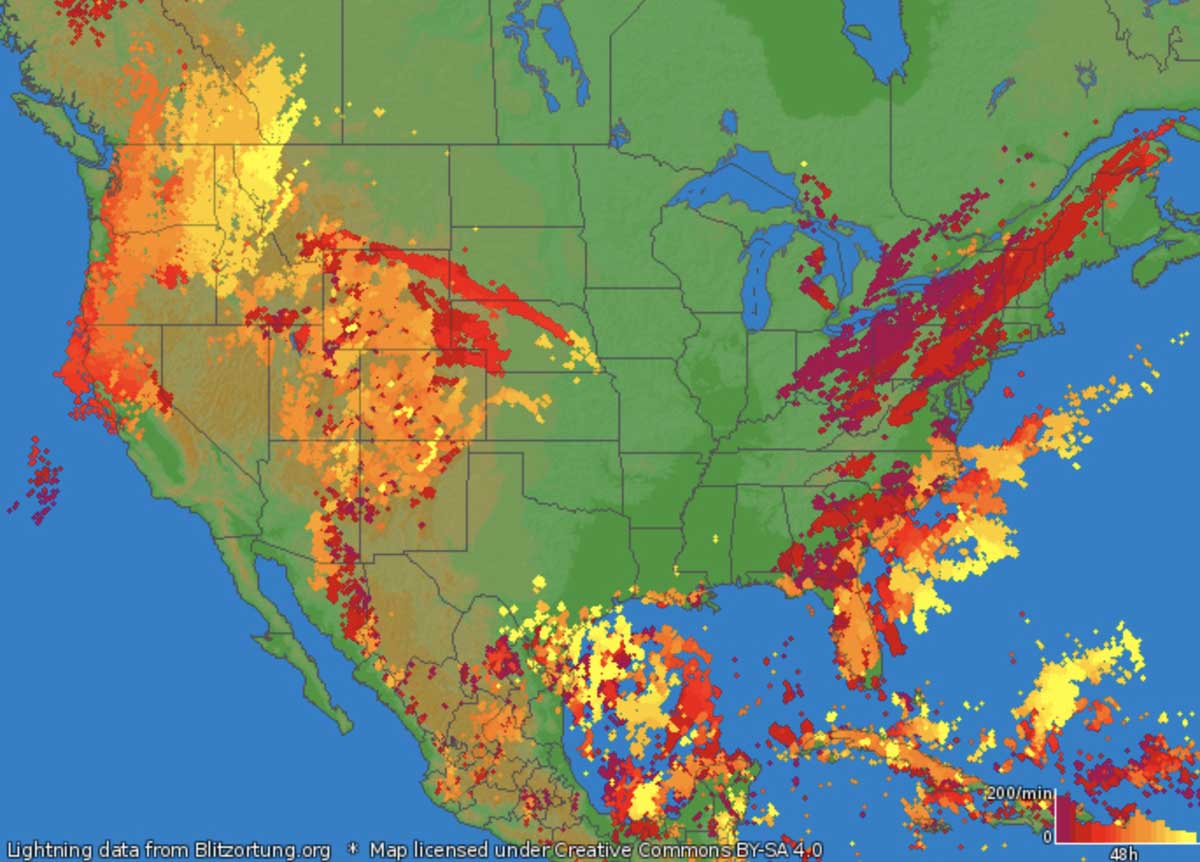
There has been a great deal of lightning in the western U.S. in the last 48 hours.
Below is the precipitation recorded over the last 48 hours.
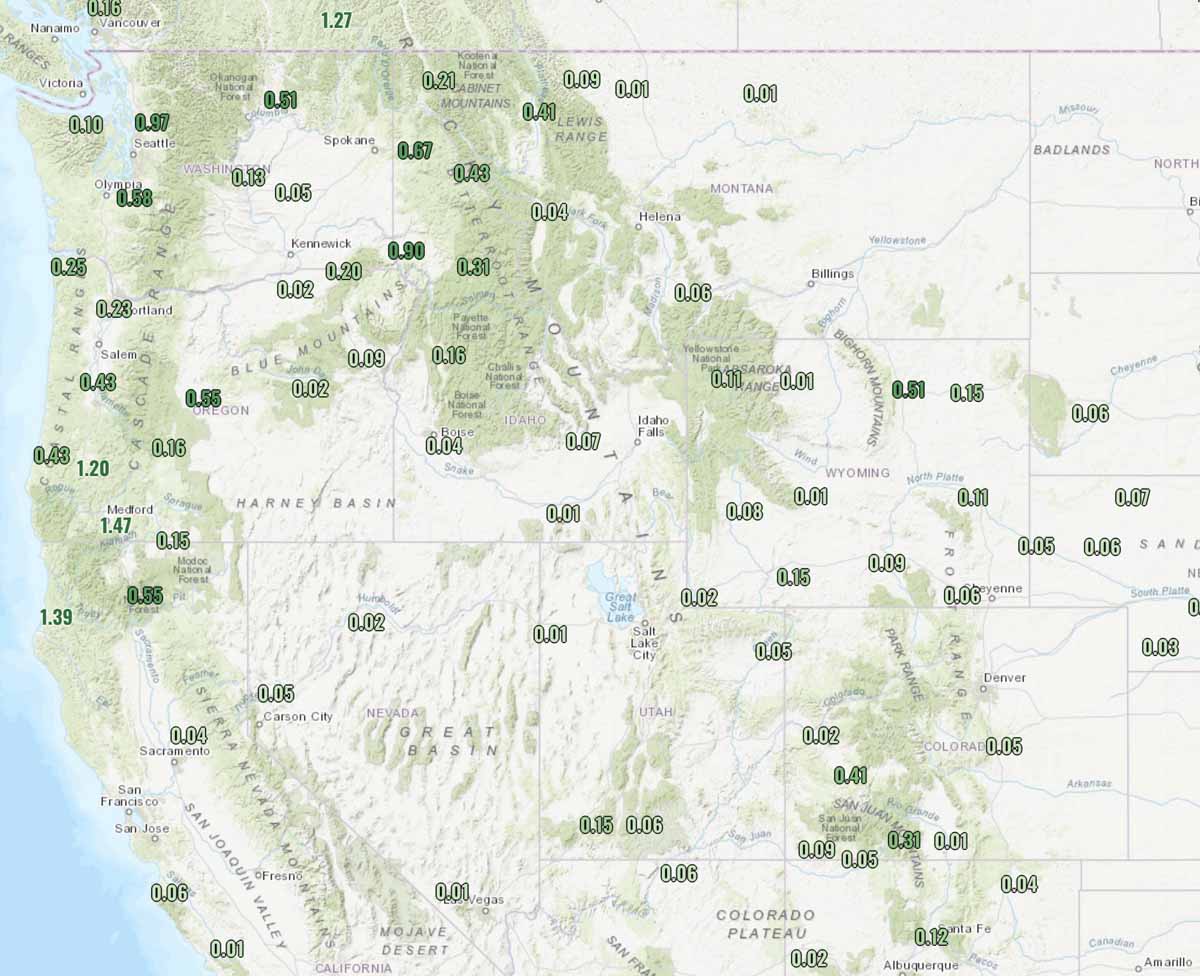
It will be interesting to see how many wildfires are ignited.
Sawtooth Fire, another wildfire in the Phoenix area, burns hundreds of acres east of Gold Canyon
One flank of the fire has spread into the footprint of the huge Woodbury Fire that blackened over 96,000 acres in June, 2019
Continue readingTwo CWN large airtankers to be activated
An MD-87 and a 737
Continue readingEvacuations ordered for the Ocotillo Fire near Cave Creek, AZ
10 miles northeast of the greater Phoenix area
Continue readingMore details about the 36 firefighting helicopters awarded 90-day contracts
 Ground and taxi test at the Medford airport October 21, 2019 for an Erickson Air-Crane purchased by the Korea Forest Service. Photo by Tim Crippin.
More details are trickling out about the 36 Type 1 and Type 2 helicopters that were awarded 90-day Exclusive Use (EU) contracts by the U.S. Forest Service in May, 2020. The agency is not releasing any information about the contracting of firefighting aircraft this Spring, but Fire Aviation has acquired documents that shed some light on the issue. Forest Service fire aviation contracts spend hundreds of millions of taxpayer dollars.
Below is the list that contains all 36 helicopter awards in one place.
 Helicopters that received from the US Forest Service in May, 2020 guaranteed EU 90-day contracts — 24 Type 1 and 12 Type 2 helicopters. Information from the USFS.
The EU contracts for 24 Type 1 helicopters and 12 Type 2 helicopters are guaranteed for 90 days. These aircraft, based on the national Call When Needed agreement, are considered national aviation resources to be used for initial attack and large fire support. It will be possible to extend the contract period beyond 90 days depending on the national situation. The plan was for the helicopters to begin their Mandatory Availability Periods on June 1 or June 15.
In an internal memo, the Forest Service said the reason for the 90-day guaranteed contracts “…is part of an enhanced national response due to COVID-19 for the 2020 fire season.” But no doubt another reason has to be the fact that the previous four-year contract for Type 1 helicopters expired April 30, 2020. The new contract has been protested and it may not be adjudicated by the Government Accountability Office until September 8, 2020.
When the multi-year EU contracts for Type 1 helicopters were awarded earlier this month neither Erickson or Coulson appeared on the list. But on this 90-day contract, Coulson has six ships and Erickson has two. This could lead a person to believe that the Forest Service considers them to be officially classified as small businesses.
Protests for new helicopter and air tanker contracts may not be decided until July or September
Four companies filed protests with the GAO
Continue readingOne of the four Alaska Department of Forestry employees hospitalized after airplane crash has been released
 The wreckage of an Alaska Division of Forestry aircraft that crashed on takeoff at the Aniak, Alaska airport, May 28, 2020. Photo by David Mattson.
(This is updated information from the Alaska Department of Forestry about the aircraft crash that we earlier reported covered on May 28 and May 29.)
Three of the four Division of Forestry employees injured in a plane crash in the Western Alaska village of Aniak on Thursday are recovering in Anchorage hospitals today while the fourth has been treated and released.
The three individuals still hospitalized suffered serious but non-life threatening injuries and are in stable condition.
The pilot was identified as Mark Jordan, of Eagle River. The three emergency firefighters on board were identified as Albert Simon, of Hooper Bay; Craig Friday, of Hooper Bay; and Kelly Kehlenbach, of Aniak. The plane was en route from Aniak to McGrath, where the firefighters were to be outfitted for an assignment to support initial attack responses at the Kenai/Kodiak Area forestry station in Soldotna.
The National Transportation Safety Board is investigating the crash, which occurred shortly after the plane took off from the Aniak airport at approximately 4 p.m. The plane, a state-owned Aero Commander 500 Shrike, crashed into a pond in a gravel pit.
 The wreckage of an Alaska Division of Forestry aircraft that crashed on takeoff at the Aniak, Alaska airport, May 28, 2020. Photo by David Mattson.
Some of the rescuers at the Alaska Department of Forestry plane crash were teenagers
All four victims had serious but not life-threatening injuries
Continue readingBLM intends to take shortcuts to begin cutting timber after a fire

The Bureau of Land Management will open a 30-day period during which it will accept public comments on their plans to remove some steps that are required before cutting timber following a fire.
The agency intends to no longer require Environmental Impact Statements or Environmental Assessments on what they call “salvage” operations of less than 5,000 acres — cutting dead or dying trees which can result from insects or wildfires. They would use a Categorial Exemption (CX) to skip some environmental review steps that are usually required.
The BLM’s press release about their plans did not include information about how the public could comment, just that, “[A] a public comment period on the proposed CX closes 30 days after the proposal publishes in the Federal Register. The BLM will provide additional information about when and how to comment when the proposed rule is published. ”
Their press release saw no issues with their planned accelerated timber cutting operations:
The BLM has completed a review of scientific literature and previously analyzed and implemented actions and found no evidence that salvage harvest at the levels proposed would have a negative effect on forest health. To the contrary, removing dead and dying trees can accelerate forest succession and benefit native wildlife species that rely on successional habitat, while reducing the potential for catastrophic wildfires.
An opposing point of view is in a paper written by D.B. Lindenmayer and R.F. Noss, titled “Salvage Logging, Ecosystem Processes, and Biodiversity Conservation.” It was in Conservation Biology, Volume 20, No. 4, August, 2006.
Here is an excerpt:
“Discussion
“Some of the impacts we have outlined may be different from or additional to the effects of traditional forms of logging that are not preceded by large, natural disturbance events. This is because the conditions preceding, during, and after salvage logging may differ from those in areas subject to traditional logging. Moreover, the ecological benefits derived from large-scale disturbances (such as the creation of charred trees and coarse woody debris) can be lost or severely diminished by salvage operations for decades and even centuries (Lindenmayer & Ough 2006). These problems have often been overlooked or poorly understood by conservation biologists, foresters, and other natural resource managers. In some cases salvage impacts may have been so substantial that past interpretations of ecosystem responses to natural disturbance may need to be reexamined. That is, ecosystem processes and biotic responses may have been more influenced by salvage logging than by the initial natural disturbance event. This may be true for hydrological regimes in the northeastern United States following the 1938 hurricane (Foster et al. 1997), aquatic macroinvertebrates in the western United States (Minshall 2003), and arboreal marsupials in the forests of Victoria, Australia, after the 1939 and 1983 wildfires (Lindenmayer et al. 1997).
“Whereas most documented effects of salvage logging are negative from an ecological standpoint, others can be neutral or positive, depending on the response variables measured. Effects are likely to vary over time and among and within vegetation types in response to the type, intensity, and periodicity of natural disturbance and disturbance by salvage logging. Therefore, there can be no generic recipes for salvage logging that can be uncritically applied in all landscapes.
“Perhaps one of the problems associated with the lack of appreciation of the impacts of salvage logging lies in the terminology itself. Dictionary definitions of the term salvage associate it with “recover or save” or “saving of anything from loss or danger” (e.g., Delbridge & Bernard 1989). Although salvage logging removes wood from burned areas, such practices generally do not help regenerate or save ecosystems, communities, or species (but see Radeloff et al. 2000) and often have the opposite effect. Hence, in many respects, the term salvage is inappropriate and misleading from ecological and conservation perspectives. An alternative term might be postdisturbance logging.”