
Certain type of air cleaners and masks can be helpful
Continue readingLabor Day fires of 2020 burned more of the Oregon Cascades than had burned in the previous 36 years combined
An analysis of the Labor Day 2020 wildfires in Oregon determined that the combination of high temperatures, unusually dry fuels, and strong winds occurring at the same time was unprecedented in the area.

That flammable combination led to an unprecedented number of acres burned in the Oregon Cascades, about 11 percent of the mountain range, and more than the previous 36 years combined.
Below is a summary of research published last month titled, “Compound Extremes Drive the Western Oregon Wildfires of September 2020,” by John T. Abatzoglou, David E. Rupp, Larry W. O’Neill, and Mojtaba Sadegh.
“Several very large fires in western Oregon spread rapidly during an unusually strong offshore wind event that commenced on Labor Day in 2020. The Labor Day fires burned more area of the Oregon Cascades than had burned in the previous 36 years combined and very likely exceeded the area burned in any single year for at least the past 120 years. The fires damaged over 4,000 structures, led to several fatalities, placed over 10% of the state’s residents under some level of evacuation advisory, and contributed to the hazardous air quality across the Northwestern United States.
“A compound set of weather-related factors leading up to and during the fires facilitated these extreme fires. Unusually warm conditions with limited precipitation in the 60-days leading up to the fires allowed for fuels to become particularly dry and combustible by early September. Downslope offshore winds materialized during September 7–9, 2020 across the Oregon Cascades bringing exceptionally strong winds and dry air that drove rapid rates of fire spread. While neither of these individual factors was unprecedented, the concurrence of these drivers created conditions unmatched in the observational record.”
The authors called that the “Plain Language Summary.” To drill down even more into Plain Language, the conditions in Oregon were hot, dry, and windy.
The Hot-Dry-Windy Index (HDWI) is a new tool for firefighters to predict weather conditions which can affect the spread of wildfires.
It is described as being very simple and only considers the atmospheric factors of heat, moisture, and wind. To be more precise, it is a multiplication of the maximum wind speed and maximum vapor pressure deficit (VPD) in the lowest 50 or so millibars in the atmosphere. It does not consider fuel moisture.
In preliminary data that had not been peer reviewed when we wrote about it February 20, 2019, the HDWI was far more useful than the Haines Index in predicting the growth of the Chetco Bar Fire which burned over 191,000 acres in Southwest Oregon in July, 2017.
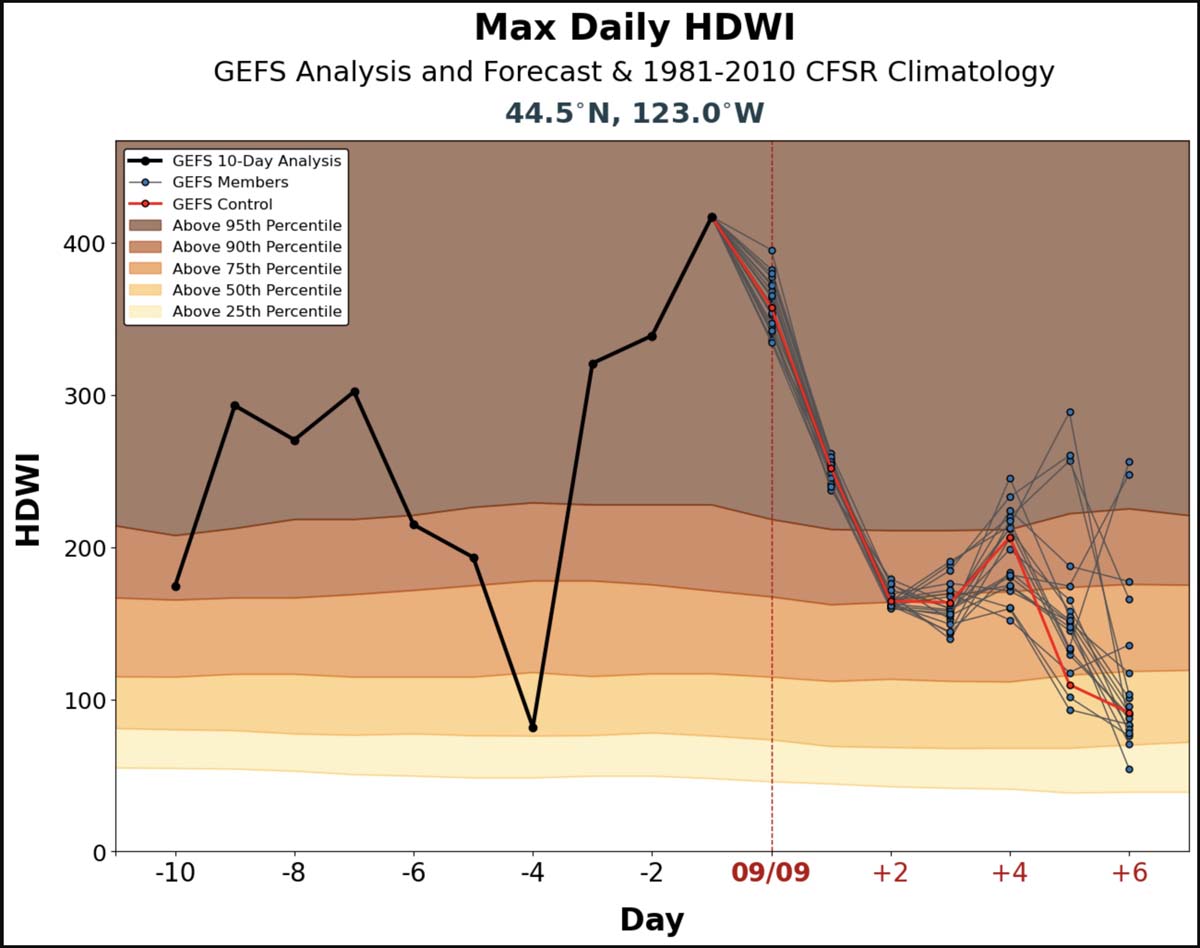
The HDWI for Oregon’s Willamette Valley was far above the 95th percentile September 6-9, 2020. During the 10 days prior to September 9 it was above the 90th percentile on nine days. The strong winds occurred September 7-9, and most of the growth of the Labor Day fires was during that period.

Thanks and a tip of the hat go out to Bob.
The Dog Fire in Guadalupe Mountains National Park has burned more than 1,800 acres
In Western Texas
Continue readingUS Forest Service firefighter dies in off-duty accident in Mississippi
The Associated Press is reporting that a wildland firefighter died Wednesday night in Mississippi.
Evan Batson, 34, worked for the U.S. Forest Service in Colorado on the San Juan National Forest’s Columbine Wildland Fire Module. The crew was on an assignment in Mississippi assisting with prescribed fires.
Mr. Batson and his co-workers had gone to dinner in Natchez. They were walking to a casino when he jumped a fence to take a shortcut from the top of a bluff to a grassy area, but he jumped too far. Natchez Police Department Cmdr. Scott Frye said the drop was about 100 feet down.
His co-workers, some of whom are EMTs, administered first aid along with the Natchez Fire Department.
“There was no motor vehicle access where he was,” Police Chief Joseph Daughtry said.
Later Mr. Batson was pronounced dead.
“His death occurred outside of work hours and is still under investigation,” said Lawrence Lujan, a spokesman for the US Forest Service. “Evan worked on the Payette, Medicine Bow-Routt, Manti La Sal, and San Juan National Forests as a career wildland firefighter during his tenure. We share this profound loss with Evan’s family, friends, and crew members and hold them in our thoughts and prayers during this difficult time.”
From the USFS website:
“The Columbine Wildland Fire Module (WFM) is a ten-person crew based out of the Columbine Ranger District of the San Juan National Forest. Columbine WFM is a resource that responds to fires locally, regionally, and nationally, and provides self-sufficient, highly skilled fire professionals to assist with wildland and prescribed fire operations, fire behavior and fire effects monitoring, hazard fuels reduction, and a range of other fire and resource related missions. Columbine has existed as an “initial attack” module since the early 2000s. With support from Forest Leadership working to expand the San Juan National Forest’s managed and prescribed fire programs, Columbine was reborn as a Wildland Fire Module in 2013.”

Our sincere condolences go out to Mr. Batson’s family, friends, and co-workers.
Thanks and a tip of the hat go out to Mike and Scott.
Fire on Mt. Wilson spreads into Wilson Creek drainage in Nevada

10 a.m. MDT May 29, 2021
The Wilson Creek Fire in Eastern Nevada had burned about 700 acres when it was mapped Friday, but the fire was very active that evening and into the night, growing substantially. Judging from the heat detected by satellites Saturday morning it may be two to three times larger.
It was started by lightning and was reported at 10:30 a.m. May 20.

The fire is east of Highway 93, 21 miles north of Pioche, Nevada, 44 miles north of Caliente, Nevada, and 17 miles west of the Nevada/Utah border.
Below is a Friday night update from the Incident Management Team:
“The lightning-ignited fire on Mt. Wilson is burning in timber, pinyon-pine, brush, and grass. There is no immediate threat to structures or private property. Public and firefighter safety is the top priority.
“The fire today moved down and out of the rocky terrain that has been largely inaccessible to firefighters, burning through some heavy fuels and making a run into the Wilson Creek drainage.

“Ground resources suppressing the fire are one Type 1 hand crew, one Type 2 Initial Attack hand crew, and eight smokejumpers. Two additional Type 1 hand crews are en route. Also en route are two engines to support the one engine onsite, and a bulldozer. Current aerial resources are one Type 1 helicopter and one Type 2 helicopter with a Type 3 helicopter available as needed. Aerial resources earlier today included three large air tankers and five Single Engine Air Tankers, or SEATs.
“Smoke will be visible to residents and recreationists in eastern Nevada and western Utah. Motorists are encouraged to be aware of increased fire vehicle traffic in the area. The fire is 50-percent contained with full containment expected Saturday evening, June 5. It was first reported Thursday morning, May 20.”

Forest Service smokejumper injured on a wildfire in New Mexico
Was parachuting into a fire 9 miles north of the Mexico border
Continue readingSmokejumper seriously injured while parachuting into a fire in New Mexico
He was evacuated to a hospital in El Paso, Texas
Continue readingFour killed in Blackhawk helicopter crash in Florida
FAA reports they were conducting fire water drop exercises
Continue readingFirefighter pay and fuels treatments were discussed in Senate hearing today
Senator Dianne Feinstein was adamant that the pay structure for federal wildland firefighters is not adequate in today’s job market
Continue readingBlackhawk helicopter crashes in Florida
No survivors found
Continue reading