
Researchers performed calculations to determine how many drones would be needed for attacking a wildfire
Continue readingBLM firefighters compete in physical fitness challenge
 Billings Veterans Fire Crew. (BLM photo by Cody Phillips)
By Karly DeMars, BLM State Fire Planner; and Chris Barth, BLM State Fire Mitigation and Education Specialist
Physical fitness is essential to firefighter performance, mental health, and safety. For example, fatigue has been found to be a contributing factor in many firefighter accidents. To encourage physical fitness, the National Interagency Fire Center (NIFC) sponsors the annual BLM Fire Operations Fitness Challenge. The voluntary fitness challenge provides a common system by which BLM firefighters can measure current fitness, establish fitness goals, track fitness improvement, and receive recognition for their efforts.
Recently, several BLM Montana/Dakotas wildland firefighters participated in the annual BLM Fire Operations Fitness Challenge. The highest scoring male and female participants in Montana/Dakotas were recognized for their achievements. Both are firefighters from the North Central Montana District and work at the Zortman Fire Station. First-year seasonal firefighter, Jessica Race, was the top female participant and third-year seasonal firefighter, Kevin Henry, was the top male participant. Those participants scoring a Level 4 (300 points) were also recognized for their achievements.
 Left: Kevin Henry, a third-year firefighter from North Central Montana District/Zortman Fire Station, displays his award for being the highest achieving male participant in Montana/Dakotas in the 2021 BLM Fire Operations Fitness Challenge. (Photo by Karly DeMars). Right:Jessica Race, a first-year firefighter from North Central Montana District/Zortman Fire Station, carries a chainsaw after completing project work this summer. Jess is the highest achieving female participant in Montana/Dakotas in the 2021 BLM Fire Operations Fitness Challenge. (BLM photo by Jessica Race)
“Firefighter fitness and well-being are the foundation to maintaining a healthy and resilient workforce to meet the demands of the job. BLM Montana/Dakotas encourages all our firefighting staff and partners to participate in high-quality training and fitness activities for the challenges they face,” said Aaron Thompson, BLM Montana/Dakotas State Fire Management Officer. “While the BLM Fire Operations Fitness Challenge is voluntary, Montana/Dakotas firefighters consistently participate in this annual activity, and we are proud of both Kevin and Jessica for their accomplishments.”
The BLM Fire Operations Fitness Challenge tests participants in four basic exercises — push-ups, pull-ups, sit-ups, and a timed run of either 1.5 or 3.0 miles. Participants are evaluated using a point system for each exercise category. Achievement is categorized in level increments where Level 1 is the minimum and Level 5 the maximum fitness level.
Congratulations to all 2021 BLM Fire Operations Fitness Challenge participants!
For more information on BLM’s Fire Operations Fitness Challenge, visit: www.nifc.gov/about-us/our-partners/blm/training/fitness-challenge.
Researchers performed calculations to determine how many drones would be needed for attacking a wildfire
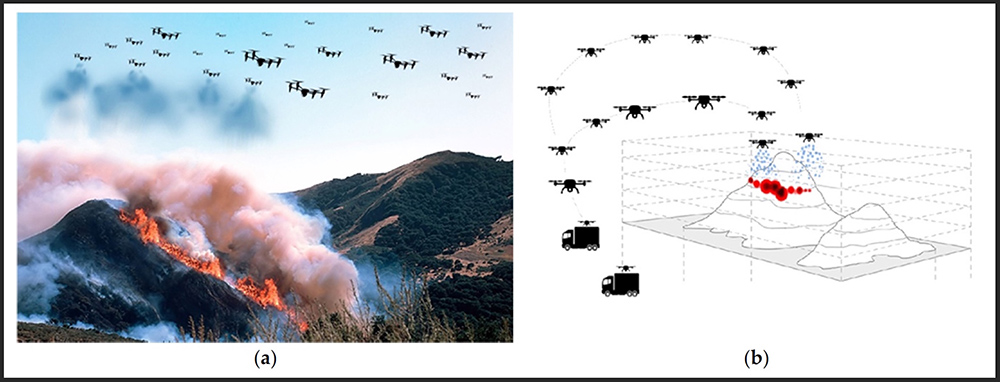 Figure 1. (a,b) Representations of the proposed firefighting system based on the use of a swarm of collaborative UAVs. (From the research)
The person who was awarded a patent in 2017 for describing a system of drones that could be used to drop liquids on wildfires wrote a paper earlier this year with two other authors that claims to have determined how many drones would be needed for suppressing a small section of a fire.
The patent, #WO2017208272A1, awarded to Marco Ghio, is quite vague and does not supply any technical details. It says that instead of applying fire retardant or water in a conventional manner, a “rain” concept would be used:
Dropping small quantities of firefighting liquid or drizzling it over the fire, and its subsequent spreading on a large area instead of in a concentrated manner. This method, both theoretically and experimentally, is acknowledged as being particularly effective, whereas, on a practical level, it is effectively used in domestic and/or industrial firefighting systems.
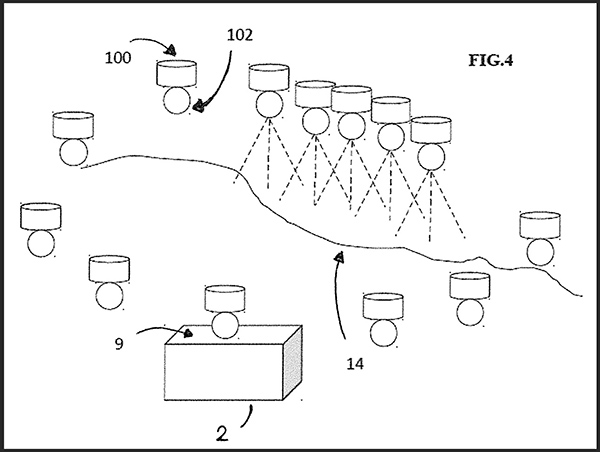 Diagram from the patent
In the United States fire retardant dropped from an approved air tanker is applied at coverage levels ranging from 1 to 9 gallons per 100 square feet, depending on the situation. It is not clear what coverage level “rain” would produce.
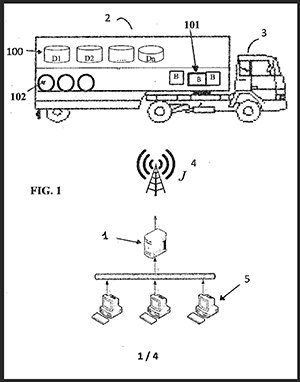 Drawing from the patent
The patent specifies that drones would transport the liquid in removable containers. Upon returning empty to the mobile base the containers would be autonomously replaced with full containers, along with a charged battery if needed.
The drones and the other equipment would be transported in standard metal shipping containers which would be strategically positioned. The system would include “a control unit for the coordination of missions, the flight paths to be followed, and the selection of the ideal drop points optimized according to the environmental conditions.”
Details about how all of this would be accomplished are not specified.
The patent and the research paper written by Mr. Ghio, Elena Ausonio, and Patrizia Bagnerini assumes that the cargo capacity of the drones would be 5 to 50 liters (1 to 13 gallons), much less than currently carried by helicopters (up to 3,000 gallons) and fixed wing aircraft (up to 17,500 gallons) that routinely fight wildfires.
Their analysis (below) takes into account wind speed, flame length, the length of fire line to be suppressed, and the dead fuel moisture. It indicates that about 75 linear meters (246 feet) of the fire’s edge could be extinguished with 120 drones each carrying 20 liters (5 gallons) or 80 drones carrying 30 liters (8 gallons). The vegetation is assumed to be grass or brush, but not timber. The example below assumes that the wind speed is 20 km/hour (12 mph) and the dead fuel moisture is 18 percent. A moisture content of 18 percent for 1-hour and 10-hour time lag fuels is quite high for a very active wildfire. It should not be very difficult to suppress a fire under those fuel conditions.
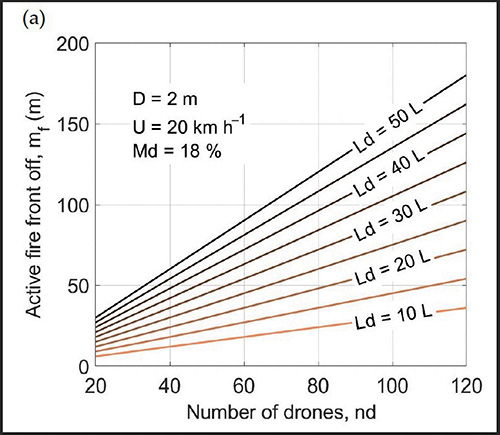 Figure 4a shows the linear meters of fire that can be arrested by using the firefighting system. For example, approximately 70–75 linear meters of active front can be extinguished with 120 drones each carrying 20 L or with 80 drones carrying 30 L. Assumptions are that the wind speed is 20 km/hour and the dead fuel moisture is 18 percent. (from the research)
Our take
In my opinion the most difficult part of using drones to assist firefighters would be applying the retardant or water at the exact location where it can be useful. That is difficult enough when you have good communication with ground personnel, adequate aerial supervision, and experienced highly qualified air crews in helicopters or air tankers.
I don’t think the principle of “rain” in the application of retardant or water from dozens or hundreds of drones is a thing, at least when you’re talking about drones that can just carry a few gallons of water and must have the batteries replaced every 20 minutes. The suppressant still has to be delivered in a timely manner in a quantity and at the location where it can be useful. Maybe when drones are carrying 50 to 100 gallons of water, and the technology improves for placing the retardant on target, it might be useful in very remote areas when the fire is very small, less than 1/10 of an acre, and the wind speed does not exceed 5 mph.
Rain Industries is working on an Unmanned Aerial System (UAS) that could carry up to 400 pounds of cargo, or 50 gallons of water.
Drone Amplified, the developer of the IGNIS prescribed fire system currently being used for aerial ignition, and Parallel Flight Technologies, have received a $650,000 grant from the US Department of Agriculture to support further development of a large-scale Unmanned Aerial System (UAS) for prescribed fire. Parallel says their hybrid gas/electric UAS can carry 100 pounds for up to two hours, numbers that are much larger than battery operated drones. When paired with the upgraded aerial ignition payload under development which will hold and dispense 3,500 incendiary spheres, it will have eight times the payload carrying capacity of drones being used today, and ten times the flight duration.
The paper was published by MDPI, which is food for thought.
Interpretive exhibit about forests and fire opens in Truckee, California December 10, 2021
Forest ecology and its relationship with Fire
Continue readingAircraft formerly known as the SuperTanker spotted in Hawaii
And, photos of a wildfire in Hawaii
Continue readingWildfire north of Honolulu threatened structures
And, the aircraft formerly known as the SuperTanker was spotted in Hawaii
Continue readingC-130 designated for CAL FIRE stops by McClellan, stripped of paint
Coast Guard number 1714
Continue readingWind gusts over 60 mph lead to preemptive power shutoffs in Southern California on Thanksgiving
Red Flag warnings in effect
Continue readingOrganizing for night-flying firefighting operations, U.S. and Australia
What guidelines are in place?
Continue readingAerial firefighting program on PBS

A program that aired on the Rocky Mountain Public Broadcasting System looked at fire aviation in the Western US. It featured the California Department of Forestry and Fire Protection, Los Angeles County, Interra (which manages fire data and intelligence), and United Rotorcraft which converts Blackhawks helicopters into water-dropping Firehawks. Most of the 27 minutes is spent talking about helicopters, and they mention that the state of Colorado is going to purchase a Firehawk.
This episode of Wings Over the Rockies is dedicated to Marc “Thor” Olson, the pilot with CO Fire Aviation who was killed November 17 while on a night-flying mission over the Kruger Rock Fire near Estes Park, Colorado. We see him explaining the use of night vision goggles and fighting fire from the air at night.
Thanks and a tip of the hat go out to Tom.