
UH-1Hs are used on wildfires in the Western United States
Continue readingData shows building codes can reduce vulnerability of homes in wildfires
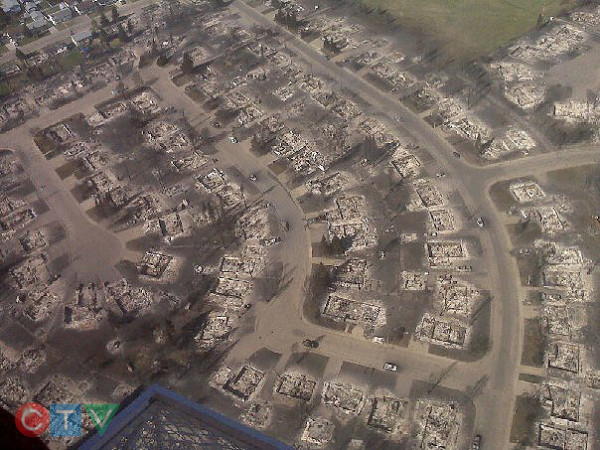 Burned homes in Slave Lake. May 16, 2011. Alberta, Canada. CTV.
Researchers have found that building codes based on lessons learned during the deadly 1991 Tunnel Fire in the Oakland Hills of California can reduce the vulnerability of homes to wildfires.
In a paper titled Mandatory vs. voluntary adaptation to natural disasters: the case of U.S. Wildfires, authors Patrick W. Baylis and Judson Boomhower describe how they scoured property and wildfire records to identify which homes were constructed under building codes requiring enhanced resistance to wildfires.
Chapter 7A of the California Building Code which went into effect in 2008 requires certain fire resistance measures, including exterior construction materials used for roof coverings, vents, exterior walls, and decks. It applies to new construction of residential and commercial buildings in designated fire hazard severity zones.
The researchers discovered that a 2008 or newer home is about 16 percentage points (40%) less likely to be destroyed than a 1990 home experiencing an identical wildfire exposure. There is strong evidence, they concluded, that these effects are due to state and local building code changes – first after the deadly 1991 Oakland Firestorm, and again with the strengthening of wildfire codes in 2008. The observed vintage effects are highly nonlinear, appearing immediately for homes built after building code changes. There are no similar effects in areas of California not subject to these codes or in other states that lack wildfire codes.
Their findings are similar to those in a paper published October 4, 2021 in which researchers analyzed the structures that were destroyed and those that survived the Camp Fire that ran through the city of Paradise, California in 2018. They considered at least four primary characteristics of structures:
- Were they built before or after the adoption in 2008 of Chapter 7A of the California Building Code.
- Distance to nearest destroyed structure.
- Number of structures destroyed within 100 meters.
- Pre-fire overstory tree canopy within 100 meters
They found that the last three criteria were the strongest predictors of survival. Homes more than 18 meters (59 feet) from a destroyed structure and with less than 53 percent pre-fire overstory canopy within 30 to 100 meters (98 to 328 feet) survived at a substantially higher rate than homes in closer proximity to a destroyed structure or in areas with higher pre-fire overstory canopy. Most fire damage to surviving homes appeared to result from radiant heat from nearby burning structures or flame impingement from the ignition of near-home combustible materials. The researchers concluded that building and vegetation modifications are possible that would substantially improve outcomes. Among those include improvements to windows and siding in closest proximity to neighboring structures, treatment of wildland fuels, and eliminating near-home combustibles, especially within 1.5 meters of the structure.
(The video below was shot December 31, 2021, the day after the Marshall Fire destroyed more than 1,000 homes in Boulder County, Colorado. Notice that most of the surviving homes seen in the video had fewer homes in close proximity.)
The authors noted that while Chapter 7a includes requirements not found in many building codes, a few other codes are more complete incorporating multiple construction classes based on anticipated radiant heat, flame, and ember exposure levels. For example Chapter 7A does not consider the interaction between components such as siding, window, and the under-eave area on an exterior wall.
California is embarking on a pilot project in which owners of vulnerable homes in lower income neighborhoods will be given grants up to $40,000 to retrofit the structures, making them more resistant to wildfires.
Home Ignition Zone
This data helps to illustrate that the condition and characteristics of the Home Ignition Zone should be an extremely high priority in preventing structures from burning as a wildfire approaches.
There is an opportunity for much needed improvement in both current building codes and how we live in wildfire prone WUI areas.
Thanks and a tip of the hat go out to Gerald.
Pilot program will provide up to $40,000 to make a home more resistant to wildfire
The state of California is beginning the initiative in rural San Diego County
Continue readingSometimes they just need a hug
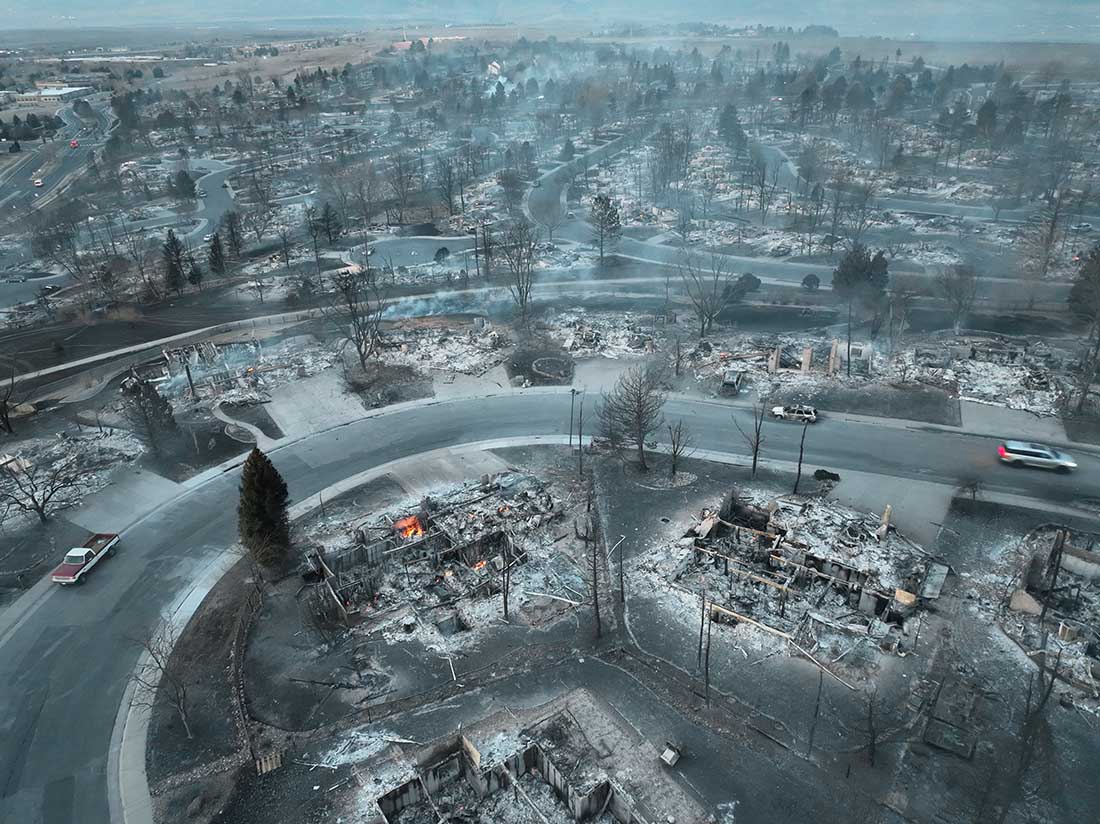 Marshall Fire, Louisville, Colorado. Photo by WxChasing/Brandon Clement, Dec. 31, 2021.
By Pete Baston
When you have been impacted by a disaster of any kind you are frightened, scared, often very angry and the last thing you need is to fill out forms and answer numerous questions from strangers clamoring to HELP you. So why is it that the majority of our disaster assistance and recovery programs at all levels fail to understand that emotional issues can seldom be resolved by analytical processes?
At a hazards mitigation conference I once attended, one subject kept coming up (albeit often in side conversations): how can we do better with natural hazards preparedness and mitigation? At all levels of government and private industry, the fact that billions of dollars are being spent annually often with very little result is becoming a major concern. That the largest risk companies now estimate that the cost of hazards damage is starting to become incalculable is scaring even the wealthiest countries. The big elephant in the room was the fundamental question of whether it is even possible to understand a subject with massive emotional dynamics through analytical means.
Should this be approached in a very different way? Any victim of a disaster in which their world has imploded in 5 minutes is naturally frightened, upset, and scared. To introduce a program of any kind, no matter how well-intentioned, that does not explicitly recognize this adds additional trauma, leading to complex issues lasting for years.
Two of the presenters at the conference made a huge impact: elders from the Chitimacha Tribe of Louisiana; and Sallie Clark, a Commissioner for El Paso County, Colorado. Their messages were different, but interconnected. In sum, they both stressed the importance of knowing your community and reacting in both a human and efficient systems way, or as Sallie stated so eloquently “Yes, indeed we need to be efficient in our response to a disaster — but let’s not forget that sometimes they just need a hug.”
The Chitimacha (Sitimaxa, “people of the many waters”) are famous because when the FEMA team got to their reservation three weeks after hurricane Katrina, they had already taken care of most of the damage. Communication in the tribe took place mostly by word of mouth, with CB radio assistance. Within 24 hours after the storm had passed, all 1,100 members of the tribe had been contacted by a tribal council team and all needs, both physical and emotional, were being attended to. Rebuilding had started, and in many cases was complete. A major focus of the tribal council was on emotional support, and this ran consistently throughout everything they were doing.
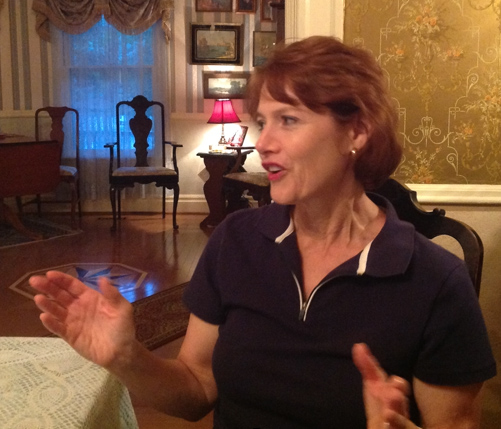 Sallie Clark, a Commissioner for El Paso County, Colorado
Sallie was doing something similar after the 2012 Waldo Canyon fire devastated her Colorado Springs community. That wildfire was one of the most destructive in Colorado history. It took two lives, destroyed 347 homes, forced tens of thousands to evacuate, and insurance claims topped $450M. Sallie’s response: identify everyone impacted, ensure they have a case officer attending their needs both physical and emotional, and simply make sure they have a shoulder to cry on. She personally drove to evacuation shelters and made sure this was being done and gave anyone a hug who needed it. A truly shining example of “WE CARE!”
Growing body of research points to reproductive health problems for female firefighters
One study showed 27 percent of pregnancies among female firefighters ended in miscarriage
Continue readingDepartment of Interior outlines changes enabled by Infrastructure Bill
The legislation provides a historic $4.5 billion for federal wildland fire management programs
Continue readingCoal underground may have been burning for 150 years near where the Marshall Fire started northwest of Denver
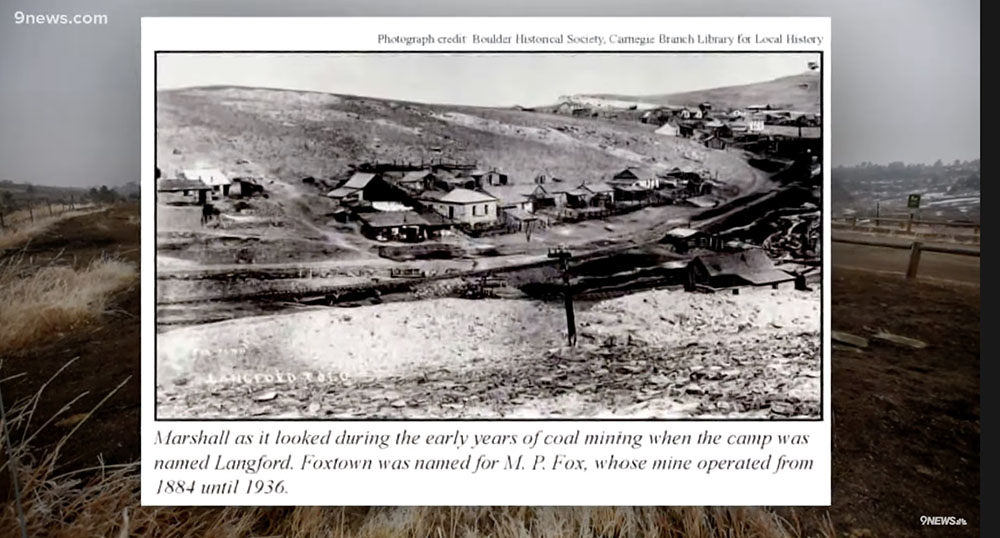 Coal mine at Marshall, Colorado, 1884 until 1936. 9News
A television station in Denver, 9News, has found that in the general area where investigators are narrowing down the origin and cause of the Marshall Fire northwest of Denver an underground coal seam has been burning since the 1870s.
In December, 2005 after a portion of the burning seam emerged on the surface and started a vegetation fire the Office of Surface Mining advised the City of Boulder, which owns the land, “It would be prudent for the City of Boulder to remove any vegetation from surface cracks, as well as begin a long term maintenance and monitoring program for the area.” In 2005 the spread of the fire was stopped quickly.
The City hauled in 275 tons of gravel with the intention of least insulating the fire from the surface. But these underground fires have a habit of creeping their way back up and too often ignite fires. They are next to impossible to extinguish.
9News reported that the M. P. Fox mine in the area operated from 1884 until 1936.
Pushed by winds gusting at 60 to 100 mph, the Marshall Fire spread rapidly as it destroyed more than 1,000 homes. Most were in the city of Louisville and the town of Superior.
The 9News video below has more details.
On a different topic, but related to the Marshall Fire, we learn in the next video that 17 of the houses that were in the burned area but survived have been sold.
Thanks and a tip of the hat go out to Gerald.
Photo series — mitigating fuels from tornado damage, Black Hills National Forest
Prescribed fire
Continue readingOfficials are investigating smoldering coal mine as cause of Marshall Fire
The rapidly spreading blaze destroyed more than 1,000 homes northwest of Denver December 30
Continue readingStudy finds that short-term exposure to smoke from 2016 Fort McMurray wildfires in Alberta affected lung function
Equipment more sensitive than a conventional spirometer was able to detect lung damage
Continue reading