
It was the only Antonov An-225 built
Continue readingForest Service completes long-overdue report about 10-year aircraft contracts but will not release it right away
March 1, 2022
 Tanker 12, a BAe-146, dropping on the northwest side of the Alisal Fire near Santa Barbara, California, Oct. 13, 2021. Photo by Santa Barbara County FD.
Thirteen members of Congress signed a letter February 2, 2022 asking the Secretaries of the Interior and Agriculture about a long-overdue report regarding shifting from 1-year to 10-year contracts for firefighting aircraft.
Many of the contracts for firefighting aircraft issued by the Forest Service in recent years have been for only one guaranteed year with a few more years possible on a year by year approval basis. Some air tanker vendors have found it challenging to develop the aircraft and then hire, train, and retain employees with nothing guaranteed beyond one year.
The Consolidated Appropriation Act of 2021 which became law December 27, 2020 required that the report about 10-year contracts be submitted no later than March 27, 2021. When the letter (below) was written, the document still had not been submitted, and was more than 300 days overdue.
On Tuesday March 1, a spokesperson for the US Forest Service, Stanton Florea, told Fire Aviation that the agency sent the report to the Committee on Appropriations, Subcommittee on Interior, Environment, and Related Agencies, on February 8. In compliance with Public Law 111–88, Mr. Florea said, after 45 days it will be posted to the Forest Service website at: www.fs.fed.us/about-agency/
When we asked for a copy of a letter that would have been in response to the February 2 inquiry from the 13 members of Congress, Mr. Florea said it is”currently going through clearance and is not yet available.”
Elizabeth Daniels is the Communications Director for the Congressional Western Caucus which posted the letter to the USFS on the Caucus’ website. The Caucus, rather than individual Representatives’ offices, are the lead on issues like this, we were told by Amanda Fitzmorris, the Press Secretary for Rep. Dan Newhouse, the Chair of the Caucus.
The Congressional Western Caucus lists 85 members on its website, many of which are from surprising locations considering the name of the organization — Louisiana, Pennsylvania, North Carolina, New York, Puerto Rico, and American Samoa. Most, however, are from states west of the Mississippi River.
Ms. Daniels confirmed that the Caucus has the report from the USFS about the 10-year contracts, but she could not send us a copy.
“We’ve got a lot of different cooks in the kitchen on this one…I’m trying to get the information out as soon as possible,” Ms. Daniels said. “Hopefully we’ll be able to turn some of the recommendations and things that they’ve put into the report into some legislative items. So while you may not get the actual physical report, you’ll kind of get the gist of what they said through our actions.”
She later said if the report is approved for release, she could then distribute it.
In testimony April 15, 2021 before the House Appropriations Subcommittee on Interior, Environment, and Related Agencies, U.S. Forest Service Chief Vicki Christiansen was asked about the report, which at the time was about 19 days late.
“Relative to your question about air tankers, the contracting air tanker community has really come on line, they are meeting our needs of contemporary air tanker capacity for wildland fire in the U.S,” Chief Christiansen said. “We are studying the question about going to a 10-year contract, what the pros and cons are. We’re nearly complete with that report. It will be going through clearance in a matter of a few days and it will be getting to the committee here shortly. So we’d be glad to discuss more about air tankers. But we think we are really on the right track with our air tankers. And thank you for being such a help and an advocate for getting us get the right resources.”
We have written about 1-year and 10-year contracts several times. Here is an excerpt from an article published December 17, 2021, titled, Forest Service says there’s not enough time to issue new helicopter contracts for 2022.
Our take
Less than three months after Forest Service Chief Christiansen said the agency was going to release a report “shortly” about the feasibility of moving to 10-year contracts, they issued a presolicitation for helicopter contracts that guaranteed one year. (Fire Aviation requested a copy of the report at the time, but it was not provided.)
In December, 2017 the US Forest Service canceled a five-year exclusive use (EU) contract it had issued the previous year for two CL-415 water scooping air tankers. So a one-year contract with each additional option year at the discretion of the agency with unreliable congressional funding is not a concept that makes potential vendors feel all warm and fuzzy.
That year the FS also reduced the number of Type 1 helicopters on EU contract from 34 to 28 and canceled a solicitation for up to seven large air tankers, citing a lack of funding.
In 2018 when the Forest Service began issuing one-year contracts for air tankers we wrote:
Few if any vendors can simply write a check to purchase and convert an air tanker, so they have to convince a lender to give them large sums of money usually even before they have a contract with the USFS. With this new one-year contract policy, obtaining those funds could be even more difficult.
Below is an excerpt from the Missoulian:
“They’re only offering a one-year contract,” said Ron Hooper, president of Missoula-based Neptune Aviation. “We can’t go to the bank with a one-year contract to finance airplanes. They just laugh at us.”
Even if a vendor received a guaranteed five-year contract it can be difficult to establish and implement a long-term business plan that would make sense to their banker and the solvency of the company.
These one-year firefighting aircraft contracts need to be converted to 10-year contracts, and the number of Type 1 helicopters must be restored to at least the 34 we had for years.
Below is the letter sent by the 13 members of Congress dated February 2, 2022.
[pdf-embedder url=”https://fireaviation.com/wp-content/uploads/2022/02/Congressional-letter-10-year-contracts.pdf” title=”Congressional letter, 10-year contracts”]
Thanks and a tip of the hat go out to Gerald.
Report: some firefighters in Colorado do not have adequate personal protective equipment
Recent legislation could help provide the gear
Continue readingThree universities receive $20 million to make fuel management data more usable for managers
Will also evaluate outcomes to see what works
Continue readingGreece to have 15 more firefighting aircraft than last year
 At least 9 Erickson Air-Cranes photographed together for the first time. October, 2021 in Greece. Photo by Dimitris Klagos. (According to a report from Erickson, there may have been 10 Air-Cranes at the site.)
Greece will strengthen its ability to fight wildfires by having 15 more aircraft than last year, after the government paid an old debt that accumulated over a six-year period.
Because of internal problems, some say corruption, instead of contracting for firefighting aircraft within their own government, between 2011 and 2016 Greece leased air tankers and helicopters through NATO’s Security and Procurement Agency (NSPA). However, according to Athens News, during that period a €8.4 million debt accumulated and NSPA stopped providing the aircraft to Greece. It recently got to the point where according to NSPA regulations, the other NATO countries were going to have to pay the debt. But in January Greece paid what was owed and the NSPA issued a tender for 76 million euros on behalf of Greece’s Hellenic Fire Service. Applications closed February 21.
This year the Hellenic Fire Service expects to have twenty Air Tractor single engine air tankers (up from six last year) and eight Bell helicopters (up from six last year) which have an integrated water tank and can also carry personnel. This year they will once again lease two large Air-Crane helicopters, an ATR 42-500 fixed wing transport aircraft, and a Russian Beriev Be-200 amphibious scooping air tanker (as it did last year).
These aircraft will add to the twenty helicopters (twelve medium and eight heavy) already leased by NSPA under a previous ongoing tender, as well as to the “permanent” fleet of aircraft and helicopters in the country. Thus, the total number of aerial firefighting aircraft this year will increase to 93 from 78 in 2021 (+15).
In 2021 Greece experienced devastating fires beginning in early August, burning 309,000 acres which approached the sum of the burned areas of the previous eight years (2013 – 2020).
Below is a report about the blazes posted by the New York Times August 9, 2021.
Thanks and a tip of the hat go out to Tom.
BC Wildfire Service moves to a year-round workforce
The agency employs approximately 1,000 wildland firefighters
Continue readingResearchers find the current Western drought is worst in 1,200 years
It is intensified by climate change
Continue readingHelicopter crashes in Hawaii, killing four
An S-61N operated by Croman was transporting an external load for the military
Continue readingExtreme wildfires may increase 14 percent by 2030, United Nations warns
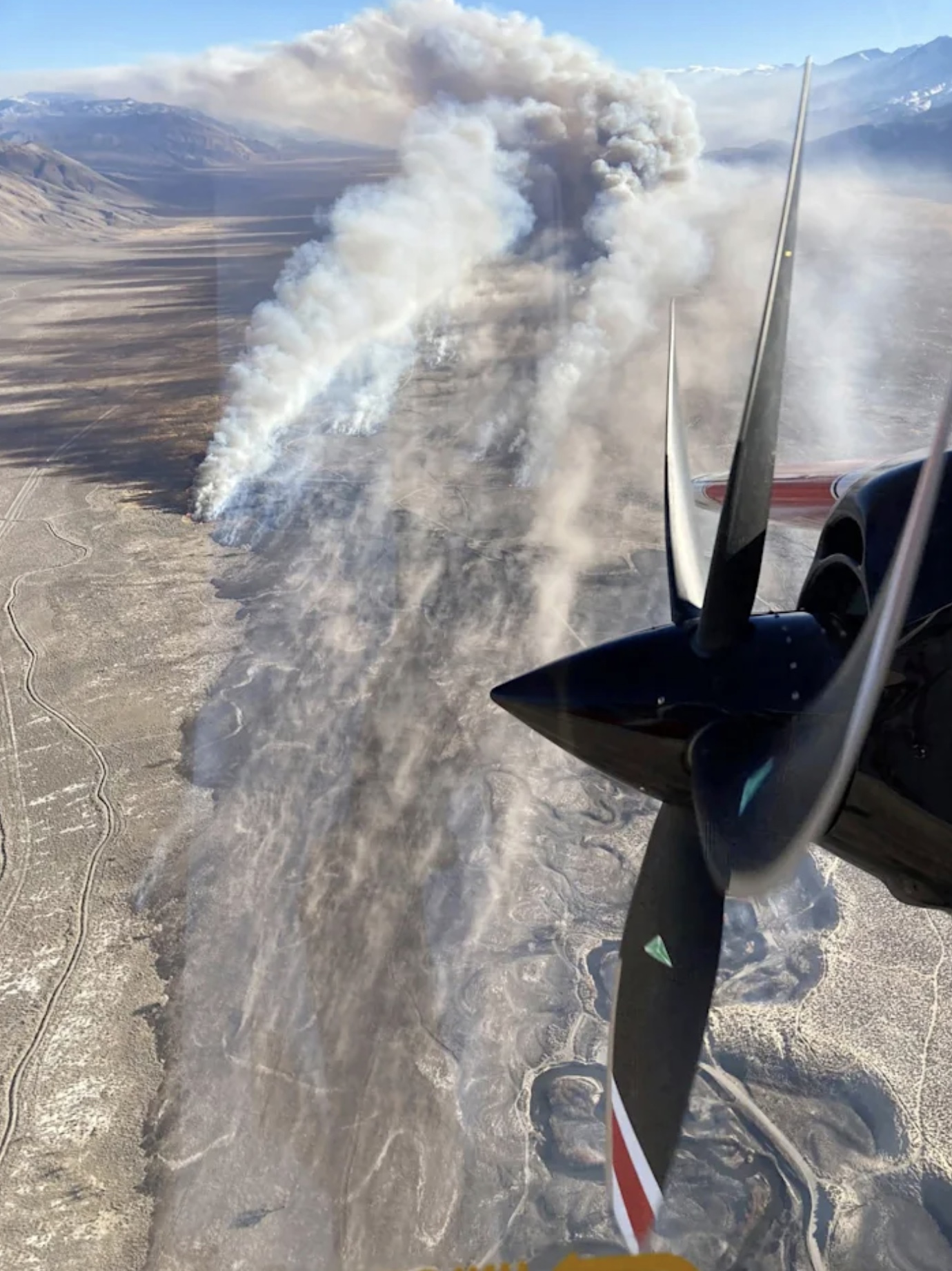 Airport Fire near Bishop, California Feb. 16, 2022. CAL FIRE photo.
Climate change and land-use change are projected to make wildfires more frequent and intense, with a global increase of extreme fires of up to 14 percent by 2030, 30 percent by the end of 2050, and 50 percent by the end of the century, according to a new report by the United Nations Environment Program (UNEP) and GRID-Arendal.
The study calls for a radical change in government spending on wildfires, shifting their investments from reaction and response to prevention and preparedness.
In the report, wildfire is defined as “an unusual or extraordinary free-burning vegetation fire which may be started maliciously, accidently, or through natural means, that negatively influences social, economic, or environmental values”.
The study, Spreading like Wildfire: The Rising Threat of Extraordinary Landscape Fires (117 MB), finds an elevated risk even for the Arctic and other regions previously unaffected by wildfires in recent centuries. The publication calls on governments to adopt a new “Fire Ready Formula”, with two-thirds of spending devoted to planning, prevention, preparedness, and recovery, with one third left for response. Currently, direct responses to wildfires typically receive over half of related expenditures, while planning receives less than one per cent.
To prevent fires, the authors call for a combination of data and science-based monitoring systems with indigenous knowledge and for a stronger regional and international cooperation.
“Current government responses to wildfires are often putting money in the wrong place. Those emergency service workers and firefighters on the frontlines who are risking their lives to fight forest wildfires need to be supported”, said Inger Andersen, UNEP Executive Director. “We have to minimize the risk of extreme wildfires by being better prepared: invest more in fire risk reduction, work with local communities, and strengthen global commitment to fight climate change”.
Wildfires disproportionately affect the world’s poorest nations. With an impact that extends for days, weeks and even years after the flames subside:
· People’s health is directly affected by inhaling wildfire smoke, causing respiratory and cardiovascular impacts and increased health effects for the most vulnerable;
· The economic costs of rebuilding after areas are struck by wildfires can be beyond the means of low-income countries;
· Watersheds are degraded by wildfires’ pollutants; they also can lead to soil erosion causing more problems for waterways;
· Wastes left behind are often highly contaminated and require appropriate disposal.
Wildfires and climate change are mutually exacerbating. Wildfires are made worse by climate change through increased drought, high air temperatures, low relative humidity, lightning, and strong winds, which causes hotter, drier, and longer fire seasons. At the same time, climate change is made worse by wildfires, mostly by ravaging sensitive and carbon-rich ecosystems like peatlands and rainforests. This turns landscapes into tinderboxes, making it harder to halt rising temperatures.
Wildlife and its natural habitats are rarely spared from wildfires, pushing some animal and plant species closer to extinction. A recent example is the Australian 2020 bushfires, which are estimated to have wiped out billions of domesticated and wild animals.
The report said the restoration of ecosystems is an important avenue to mitigate the risk of wildfires before they occur and to build back better in their aftermath. Wetlands restoration and the reintroduction of species such as beavers, peatlands restoration, building at a distance from vegetation, and preserving open space buffers are some examples of the essential investments into prevention, preparedness and recovery.
 Wildfire smoke contains fine particulate matter and potentially toxic combustion products (the latter can be particularly harmful at the wildlandurban interface where waste and rubbish, materials used in buildings and vehicles are often burnt; Hallema et al. 2019). From the report.
The report concludes with a call for stronger international standards for the safety and health of firefighters and for minimizing the risks that they face before, during and after operations. This includes raising awareness of the risks of smoke inhalation, minimising the potential for life-threatening entrapments, and providing firefighters with access to adequate hydration, nutrition, rest, and recovery between shifts. Women firefighters face various challenges ranging from gender discrimination and sexual harassment to ill-designed equipment and protective clothing that puts them at greater risk of injury.
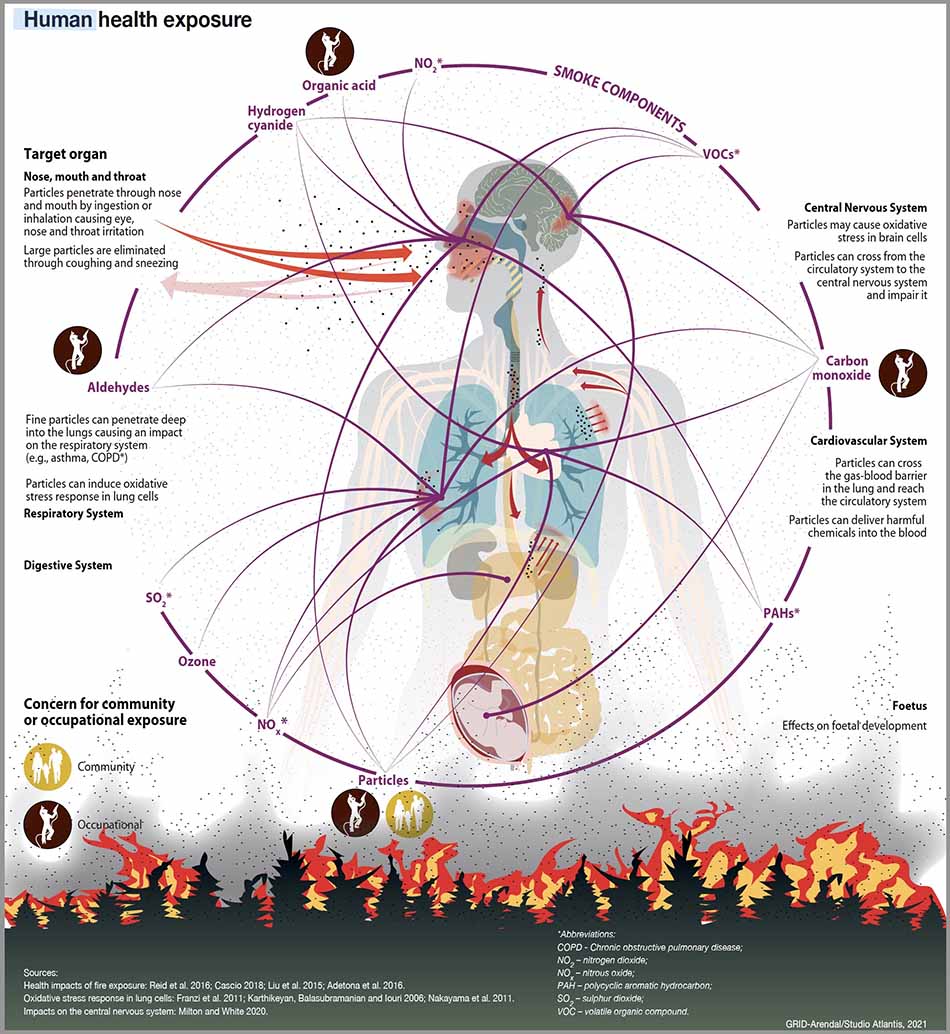 Smoke particulate exposure pathways and impacts. Smoke exposure is most commonly measured from land-based air pollutant monitors, followed by satellite-based imagery models, with fewer studies measuring personal exposure to smoke (Liu et al. 2015). From the report.
Smoke associated with deforestation fires in the Brazilian Amazon has been found to be responsible for the premature death of almost 3,000 people annually (95 percent percentile confidence interval: 1,065–4,714), demonstrating the regional scale of fire impacts (Reddington et al. 2015).
Our take
The report predicts a global increase of extreme fires of up to 14 percent by 2030 and 30 percent by the end of 2050. The statistics for the United States from the National Interagency Fire Center since the 1980s indicates that the total acres burned and the average size of wildfires has been far exceeding those rates of increase. The data, which does not include Alaska since those fires are managed far differently from the rest of the US, shows during the forty-year period approximately a 400 percent increase in the average size by decade, and more than a 300 percent growth in the total acres burned each year. The statistics for the US are for all fires, not just those that “negatively influence social, economic, or environmental values.”

Another factor that may influence the size of fires in the US is that some wildfires are not totally suppressed and can be herded around to attempt to protect private land, structures, and certain resources. They may burn for months, and occasionally grow far beyond what was expected. The use of a limited suppression strategy can be to allow fire to be reintroduced to replicate natural conditions and reduce fuels. Or in recent years it could be due to extreme fire activity in the Western US and a shortage of firefighting resources as a result of difficulties in hiring, retention and recruitment.

Thanks and a tip of the hat go out to Rick and Tom.
Two Blackhawk helicopters go down near Utah ski area
There were no reports of serious injuries
Continue reading