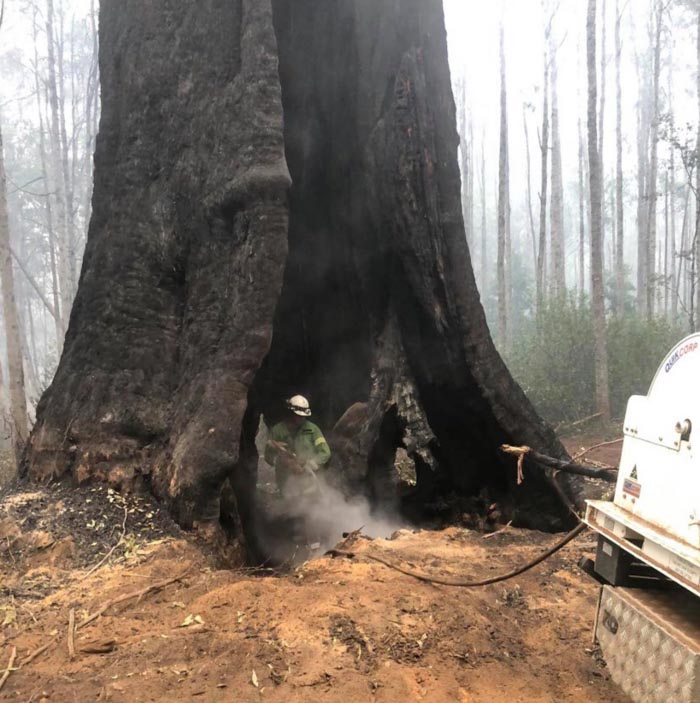
Firefighters work to save a Messmate in Victoria, Australia. Photo by Forest Fire Management Victoria.
The presumptive disease program passed last year by Victoria’s Parliament went into effect September 14, 2022.
It extends the program to wildland firefighters and includes “surge firefighters” who are government employees normally in other roles, but who perform firefighting duties during the fire season as part of their agency’s surge capacity as needed.
The presumptive disease program ensures that if a firefighter is diagnosed with any of the 12 listed cancers, they will not have to prove that it was caused by their employment, and it will be considered an on the job injury.
The cancers covered are brain, bladder, kidney, non-Hodgkins lymphoma, leukemia, breast, testicular, multiple myeloma, prostate, ureter, colorectal, and esophageal.
The compensation applies to forest firefighters who:
have been diagnosed since 1 June 2016 with one of the 12 specified types of cancer;
have served in active firefighting roles for a specified number of years, depending on the cancer type;
are diagnosed during their service or within 10 years after they’ve finished their service.
A partial year of service is counted as a full year of service to recognize seasonal workers. Previous service as a volunteer or career firefighter and equivalent interstate service count toward the qualifying period.
Senate Energy and Natural Resources Committee. Sept. 29, 2022.
During a hearing today before the Senate Energy and Natural Resources Committee a number of issues important to federal wildland firefighters were discussed. The two witnesses from the agencies were John Crockett, Associate Deputy Chief, State and Private Forestry, Forest Service, and Jeff Rupert, Director of the Office of Wildland Fire for the Department of the Interior.
We don’t have time to get into the details, but here are the points at which some key topics were covered in the video above, which shows the entire hearing:
45:19. Three-day break in service which can result in a firefighter (FF) losing eligibility for FF retirement.
49:50. Forest Service counting the same acres of fuel treatments multiple times.
54:47. FF mental health.
1:00:00. Protecting Giant Sequoias from fire during their 3,000-year life span.
1:06:30. How many firefighting aircraft do the agencies have?
1:22:20. FF pay, and a long term solution.
1:27:50 and again at 1:37:30. A possible new requirement for air tankers to have pressurized cabins.
1:33:45. Why have the agencies not accomplished more acres of fuel treatments?
The Grassroots Wildland Firefighters clipped portions of the hearing, as you’ll see in the short videos below.
Senator Murkowski asks the USFS and DOI about long-term pay for Federal Wildland Firefighters:
Senator Heinrich asks the DOI what they are doing for Firefighter Mental Health:
Forest Service and DOI Respond to Three-Day Break In Service Issue for Wildland Firefighters:
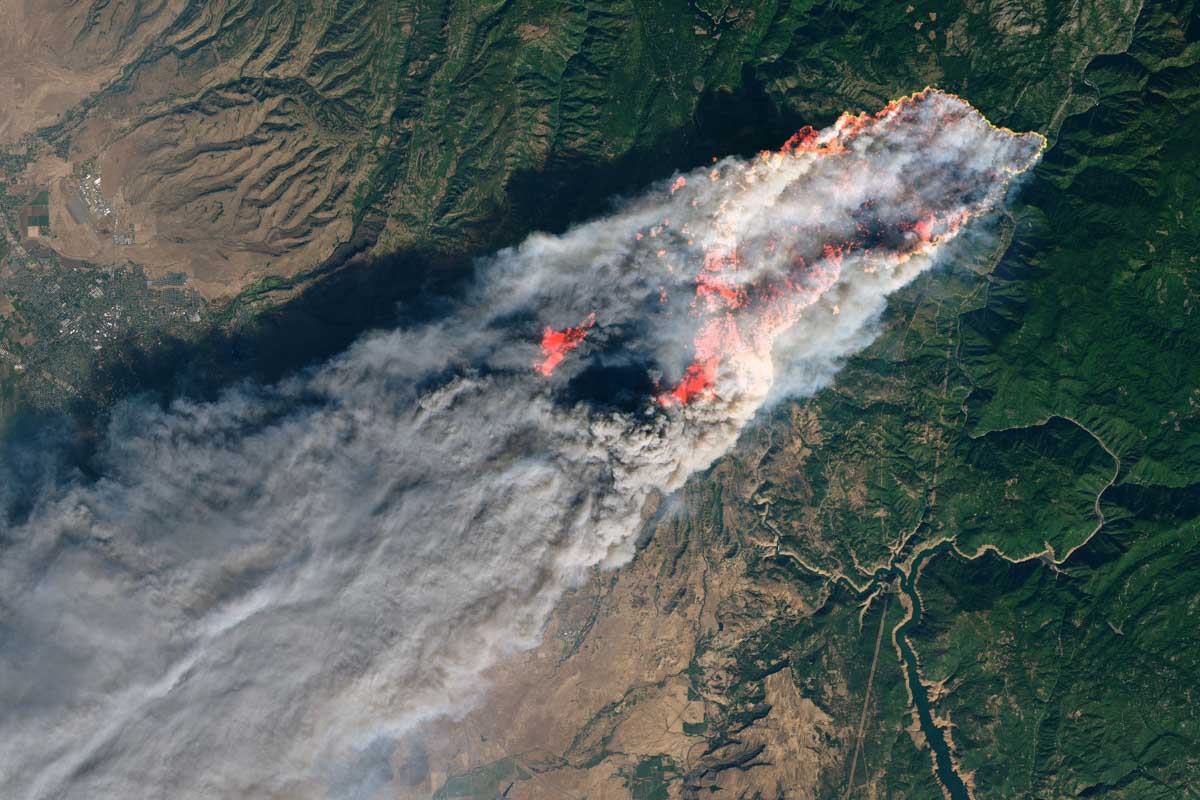
The Camp Fire, November 8, 2018. NASA (Joshua Stevens) – NASA Landsat 8.
When most people think of the Federal Emergency Management Agency (FEMA) what comes to mind is the assistance the agency provides before and after hurricanes, tornadoes, and floods. Part of their mission and the ways in which the assistance is supplied has been specified by the 1988 Stafford Act and before that, the Disaster Relief Act of 1974.
FEMA’s current procedures and requirements don’t always work for post-wildfire recovery needs, and a bill passed unanimously by the Senate Wednesday will help close some of those gaps. The FEMA Improvement, Reform, and Efficiency (FIRE) Act, S.3092, would help ensure that FEMA’s disaster preparedness and response efforts fully address the unique nature of wildfires and their impacts on communities.
If the bill is passed by the House of Representatives and signed by the President, FEMA would be able to pre-deploy resources during red flag warnings – periods of high fire danger, when catastrophic wildfires are most likely to start – just like they already do in advance of hurricane warnings.
The bill would also help ensure relocation assistance is accessible for public infrastructure in fire prone areas. It would improve FEMA’s response to wildfire-specific damage, such as repairing and mitigating contamination from damaged infrastructure.
If passed, it would have FEMA provide culturally-competent crisis counselors and case managers to ensure that underserved and disadvantaged communities receive equitable treatment when accessing federal disaster assistance. Tribal governments would be able to access financial assistance to upgrade their emergency operation centers, putting them on an equal standing with state and local governments.
The American Institute of Aeronautics and Astronautics (AIAA) Foundation has announced the winners of a Team Aircraft Design Competition open to undergraduate AIAA branches or at-large Student Members. The task was to design from the ground up a purpose-built large air tanker.
Specifications for the aircraft included 4,000 to 8,000 gallon retardant capacity, 2,000 to 3,000 nm ferry range, it would use existing available engines, and have a dash speed of 300 to 400 knots. Other criteria included a drop speed of 125 to 150 knots and takeoff from a Balanced Field Length of 5,000 to 8,000 ft. with an assumption of +35°F standard atmosphere at an altitude of 5,000 ft. above mean sea-level.
The design teams awarded first, second, and third places all chose 8,000-gallon gravity-powered retardant tanks. The estimated prices of the aircraft are based on a manufacturing run of dozens of each aircraft. The teams’ complete proposals are at the links below.
First Place
The “Fireflighter” designed by a team from Nanyang Technological University in Singapore took first place. (See image above). It is powered by four turboprop engines and has a dash speed of 410 knots. The students estimate it would cost $75 million.
Fireflighter retardant tank
Second Place
Second place, Valkyrie, by team Njord.
Team Njord, from the University of Illinois at Urbana-Champaign designed the “Valkyrie,” powered by two jet engines. Its dash speed is 300 knots and would use two removable RADS-XXL retardant tanks, enabling it to carry 20,000 pounds of cargo at the aircraft’s ferry range of 3,000 nm. It would sell for approximately $186 million.
Falkyrie retardant tank
Third Place
Third place, Firehawk, by team Albatross.
The Albatross team, also from the University of Illinois at Urbana-Champaign, designed the “Firehawk” powered by two jet engines. It would have a dash speed of 380 knots and sell for about $91 million.
Fire weather outlook Sept. 28, 2022. NOAA Storm Prediction Center.
The counter-clockwise rotation of winds around Hurricane Ian has brought north winds and low humidity to portions of Louisiana, Mississippi, Alabama, Georgia, and the panhandle of Florida. The combination of a strong surface high to the north and the strong pressure gradient around the hurricane will drive moderately strong northerly winds across much of the Southeast on Wednesday.
The forecast is for humidity in the teens and 20s with wind gusts of 20 to 35 mph Wednesday afternoon.
Wind forecast for 2 p.m. CDT Sept. 28, 2022. Windy.com. The colors represent wind speed in knots. See legend at lower-right.
In the wind forecast above for 2 p.m. CDT Wednesday, Hurricane Ian is predicted to make landfall near Cape Coral, Florida.
The National Weather Service’s Red Flag Warning map was a little more conservative than the Storm Prediction Center’s designations of elevated and critical fire weather.
Red Flag Warnings at 8:45 a.m. Sept. 28, 2022. NWS.
The Storm Prediction Center’s forecast for Thursday is for elevated fire weather only in southern Alabama and the Florida panhandle.
Caldor Fire map showing the location of Grizzly Flats. The white line was the perimeter at 8:20 p.m. August 18, 2021. The red areas represent heat detected by an aircraft at 6:44 p.m. PDT Aug. 19, 2021. The fire continued spreading east, coming very close to South Lake Tahoe.
National Public Radio is publishing a series of at least two short audio stories about treating fuels to reduce the chance of large fires spreading into populated areas.
The first episode, only four minutes long, examined what the US Forest Service promised the residents of Grizzly Flats the agency would do to treat the fuels close to the community. But last year the Caldor Fire destroyed about two-thirds of the town’s structures as it burned to the edge of South Lake Tahoe.
Randy Moore, Chief of the US Forest Service, was asked in the episode if the Forest Service had any responsibility for the outcome in Grizzly Flats.
“Well, I mean, I don’t know what kind of question that is,” he replied. “I mean, you know, do anybody bear any responsibility for not having the budget to do the work that we need to do?”
In the next episode, a local Southern California Burn Boss explains some of the challenges she faces in scheduling a prescribed fire.
The reporter says the San Bernardino National Forest refused to disclose its budget after months of “multiple asks and a Freedom of Information Act request.” The Burn Boss, however, gives a hint.
They also talked with a local resident who evacuated from the Radford Fire near Big Bear earlier this month.
Update Sept. 28, 2022. Cap Radio, which may have collaborated with NPR on the above segments, has a detailed article published August 16 about the proposed fuel reduction project the US Forest Service proposed to lessen the risk to the Grizzly Flats community. It walks us through the ambitious project from conception to completing only 14 percent of the planned work before the Caldor Fire wiped out the town. One of many stumbling blocks were complaints from Chad Hanson, co-founder of the John Muir Project, a nonprofit that aims to protect biodiversity in national forests and fiercely opposes tree removal. One of Hanson’s primary concerns was the California spotted owl, which is designated as a “sensitive species” by the Forest Service.
Our take.
We’re not sure how often this has occurred in Washington over the last 20 years, but Chief Moore’s predecessor in April 2021 squandered a softball opportunity to tell the House Appropriations Subcommittee on Interior, Environment, and Related Agencies that the Forest Service needed more funding in two very important inadequately budgeted areas, fuels treatment and aerial firefighting. In a June 9, 2022 Congressional hearing Chief Moore squandered a similar opportunity, giving an incoherent response when basically asked, “Do you have enough firefighting aircraft?”
Helicopter 729 drops on a fire near El Cajon, CA May 13, 2022. Ryan Grothe.
The US Forest Service recently released new requirements for firefighting helicopters on their Multiple Award Task Order Contract (MATOC). It requires real-time communications, automatic flight following, and ATU bucket drop data, together with cockpit audio recording and Flight Data Monitoring (FDM).
Three companies have combined their expertise to build a system that meets the requirements without overburdening aircraft and budgets, according to a press release issued by GPMS, Blue Sky Network, and Flightcell.
Below are excerpts:
Today, GPMS International, Flightcell, and Blue Sky Network jointly announced a combined solution featuring their industry-leading technologies that creates a fully compliant, lightweight, cost-efficient option for operators looking to bid on the recently released U.S. Forest Service Multiple Award Task Order Contract (MATOC) firefighting contract.
Executives from the companies explained that many operators are having difficulty finding workable solutions to satisfy the new requirements in the USFS contract. By pairing Flightcell’s and Blue Sky Network’s enabled communications, flight following, Additional Telemetry Unit (ATU), and cockpit audio recording with GPMS’s advanced Health and Usage Monitoring System, the combined package meets new USFS requirements including the “modern aircraft” specification for HUMS.
“After many discussions during the HAI Firefighting and Aerial Firefighting shows, operators told us that they are looking for a solution to meet the new USFS requirements without overburdening their aircraft with additional weight or complexity or stacking single system costs onto their budgets,” said Todd Powers, GPMS VP of Sales. “What we have created here with Flightcell and Blue Sky Network is a lightweight, economically efficient solution to bring aircraft into compliance and allow operators to compete for this new contract.”
It puts Flightcell’s DZMx Plus and Smarthub cockpit audio visual recording onboard and, using Blue Sky Network’s connectivity service and SkyRouter™ fleet management platform, data is ported via a dual Satellite/LTE modem, where operators get comms, ATU data, and flight following in real-time together with downloadable audio/video recording.
Completing the solution, GPMS’s Foresight MX system provides the in-depth flight and machine monitoring that are part of the MATOC’s modern aircraft requirements for HUMS. Foresight provides engine and airframe vibration monitoring, engine performance monitoring and cycle counting, flight data monitoring with exceedance alerting, as well as rotor track and balance monitoring and adjustment solutions.