At Brown Field near San Diego, Nov. 22, 2022.
Continue readingNavy helicopter collides with firefighting helicopter, both land safely
At Brown Field near San Diego, Nov. 22, 2022.
Continue readingAircraft from Erickson Aircraft Collection featured in movie “Devotion” opening today
F4U-7 Corsair
Continue readingForest Service examines 10 years of incidents and fatalities to develop Metareview
After a fire or other incident occurs that had an unfavorable outcome, Wildland fire organizations typically conduct an investigation or review to cipher out lessons that can be learned. That of course can be extremely helpful and can reduce the number of similar accidents down the road. But looking at multiple incidents can uncover trends or themes that could be even more valuable.
The US Forest Service recently completed a “Metareview” of accidents and incidents, including fatality incidents in the agency over a 10-year period (2007-2016).
Five themes emerged:
- Fatalities and injuries: Why are they continuing to occur?
- Fiscal incentives: How does the current pay structure affect operational strategies and risk management?
- Society: How do social and political pressures play into the wildland fire system?
- Ecological soundness: How do ecological health and land management factors currently play into wildland fire decision making and strategy planning processes?
- Communication/work environment: What do current successes and failures look like in the context of communication and the wildland fire work environment?
The seven-minute video below is an introduction to the effort.
The entire Metareview document can be downloaded as a .pdf, or you can peruse the individual chapters below.
- Chapter 1: Introduction
- Chapter 2: Learning from the Past
- Chapter 3: Conducting this Wildland Fire Metareview
- Chapter 4: Clear, Stable, Long-Term Vision
- Chapter 5: Does Our Communication Lead to Trust?
- Chapter 6: Telling Our Story – Consistently Inconsistent
- Chapter 7: Socio-Political Pressures: Real and Perceived
- Chapter 8: Cost or Investment?
- Chapter 9: Is “Safety First” a Myth?”
- Chapter 10: Mental Health and Suicide – A Call to Action
- Chapter 11: The Quest for 1,000 Hours of Overtime – Money as an Incentive to Risk
- Chapter 12: An Exercise in Envisioning
- Chapter 13: What’s Next? Continuing the Learning
- Chapter 14: Final Learning Challenge
One person who has reviewed much of the document described their impressions to Wildfire Today:
Basically the USFS is actually identifying a lot of their shortfalls and explains the policy issues they are having with conducting prescribed fires; describes that employee pay structures are unethical; describes why the current system by design is causing bad outcomes for employees both mentally and physically, and a lot more. Perhaps the most interesting part about this report is that there aren’t really any solutions offered.
The Forest Service views this metareview as one important step in their learning journey. This tool should be viewed in combination with other interagency wildfire safety products, such as the annual interagency National Wildfire Coordinating Group’s safety gram and the Lessons Learned Center’s annual “Incident Review Summary.”
This fall and winter, the Forest Service’s learning team will host webinars for the fire community to introduce the content and demonstrate how this learning tool can be used to transition from singular incident learning to ongoing, multi-format, iterative, shared learning.
Air Force to develop plan to train pilots to fly special ops tail-dragger
A modified single engine air tanker
Continue readingBill passes to allow injured firefighters to remain in enhanced retirement system
 Lightning near the King Fire, Yosemite NP, June 30, 2022. Photo by Jessica Lane @wilderjess_views.
Late Thursday night just before beginning their state work period the Senate passed a bill that will allow injured or disabled federal firefighters to remain in a 6C enhanced retirement position. They will continue receiving federal retirement benefits in the same manner as though they had not been disabled.
H.R.521, the First Responder Fair RETIRE Act, had already been passed by the House so its next step is the desk of the President.
Currently, federal law enforcement officers, firefighters, nuclear material couriers, and others are enrolled in and pay into a system whereby they may retire at the age of 57 or after 20 years of service. After all, “These are by definition high risk jobs,” said Rep. Carolyn Maloney (D-N.Y.).
Connolly, a former county supervisor, explained that federal first responders are qualified under the law creating enhanced retirement system for an annuity after serving 20 years, but their annuity amount is calculated at a higher rate than other federal employees, recognizing the risks they take. “Unfortunately, not all federal first responders can complete those 20 years of service,” she added.
On the House floor during a short debate, Connolly described the experience of a smokejumper who parachuted out of a plane in 1985 and landed in a tree, was dropped 80 feet and broke his back in five places: “He died twice before he could be revived and evacuated,” Connolly noted. Ten years into his career, the firefighter chose to work in another position “but the reward for his bravery and his injury and service was his removal from the retirement system.”
Short documentary about a group of firefighters during a firestorm in Australia
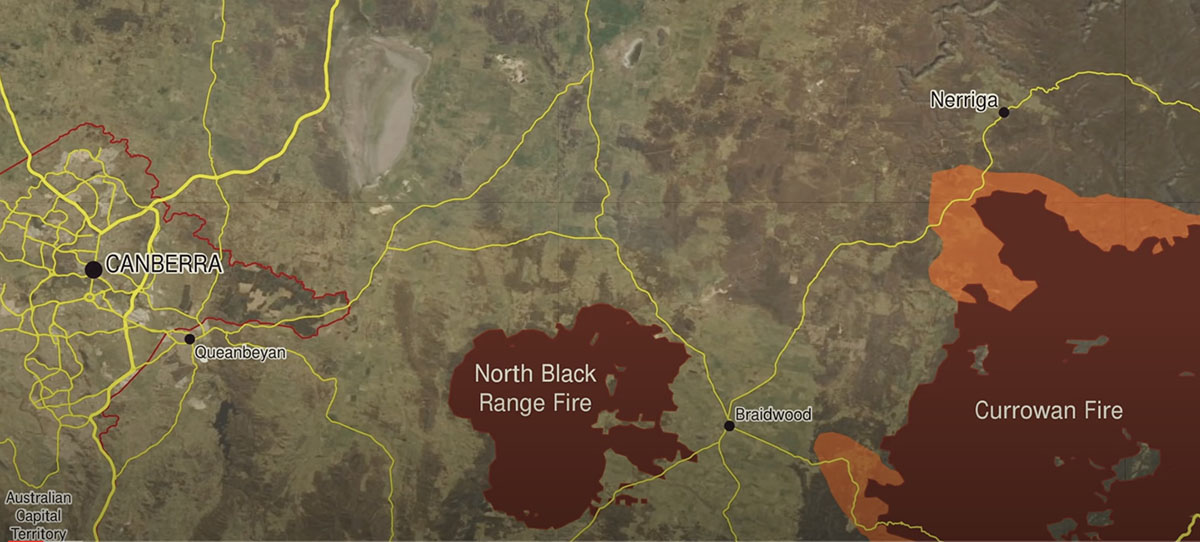 Currowan Fire, and the town of Nerriga in Australia. December 21, 2019. Image from the film
Martin Greenwood sent us information about a short documentary he has released about a group of firefighters responding to a firestorm at the small town of Nerriga, New South Wales Australia December 21, 2019. It uses a great deal of excellent video footage shot by the firefighters and cameras on the engines, as well as interviews with the personnel who were there.
GAO reports on barriers to recruitment and retention of federal wildland firefighters
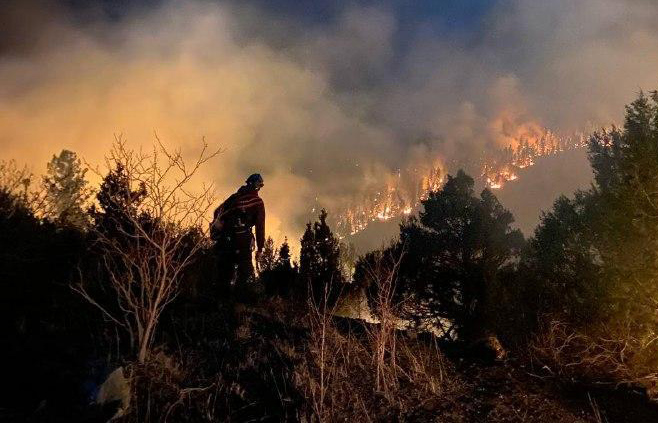 Silver City Hotshots conduct firing operations along Hwy 518 west of Holman during night shift for the Calf Canyon Fire in New Mexico, 2022. Photo by Santa Fe National Forest.
Today the Government Accountability Office released a report about the difficulties the federal agencies are having recruiting and retaining wildland firefighters.
Congress requested the report, but apparently did not ask for recommendations. The 41-page document identifies numerous issues that adversely affect recruitment and retention, most of which are already well known to the five agencies that employ wildland firefighters — Forest Service, Bureau of Land Management, National Park Service, Fish and Wildlife Service, and Bureau of Indian Affairs.
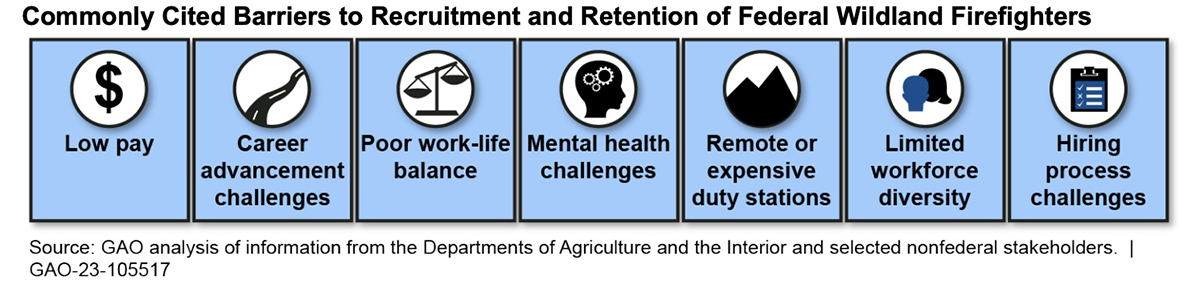 From the November 17, 2022 GAO report.
The report goes into detail about each of the major challenges, after receiving input from officials in the five agencies and a sample of 16 nonfederal stakeholders—including nongovernmental organizations representing active and retired federal firefighters and other organizations involved in firefighting issues, such as the National Association of State Foresters and the Western Governors’ Association.
Low pay was the most commonly cited barrier to recruiting and retaining federal wildland firefighters. Officials and all 16 stakeholders stated that the pay, which starts at $15 per hour for entry-level positions, is low. Officials and eight stakeholders also noted that the pay does not reflect the risk or physical demands of the work. Moreover, officials and stakeholders said that in some cases, firefighters can earn more at nonfederal firefighting entities or for less dangerous work in other fields, such as food service.
Some of the efforts being taken to improve hiring and retention are mentioned, including addressing pay, and offering slightly more time at home between fire assignments.
But much remains to be done, especially towards pay and a new Wildland Firefighter job series, which the five agencies have made very little progress developing.
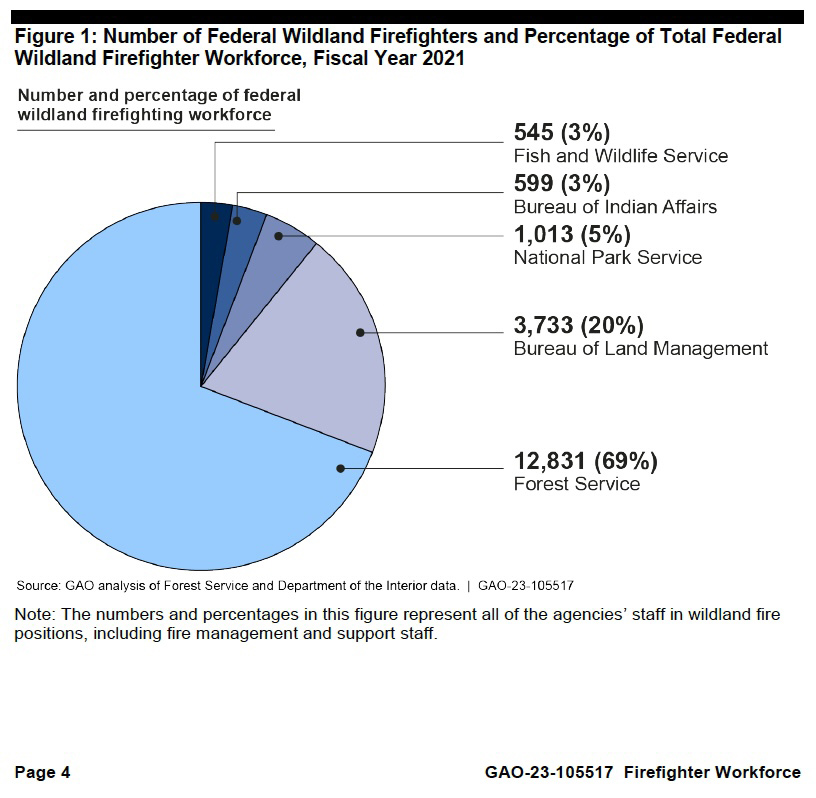 Number of federal wildland firefighters by agency, from Nov. 17, 2022 GAO report.
Download the 41-page GAO report.
Pilot of helicopter that started a fire with a landing light tells inquiry he did not see long grass before landing
 File photo of Australian Army soldiers of the 3rd Battalion, Royal Australian Regiment deplane from a 5th Aviation Regiment MRH-90 Taipan during Exercise Hamel 2014 at the Tolga Turf Club near Atherton, Queensland. (Photo: Australian Army)
As we reported in February, 2020 and later in December, 2020, a helicopter operated by Australia’s Army inadvertently started a bushfire January 27, 2020 in Namadgi National Park south of Canberra, in the Australian Capital Territory (ACT). It was caused by heat from the landing light on an MRH-90 Helicopter as it set down in the remote Orroral Valley for a crew break.
 Sentintel-2 satellite imagery of the bushfire in Namadgi National Park south of Canberra, Australia. February 4, 2020.
More information is coming into focus during an ongoing Coroner’s Court, including why the flight crew did not report the fire until after it landed 45 minutes later at an airport.
From the Australian Broadcasting Corporation:
Dramatic accounts of how an army helicopter codenamed Angel 21 started a fire in the Orroral valley in January 2020 during a toilet stop, have emerged from the first day of evidence in the coronial into the disaster.
The fire burned nearly 90,000 hectares (222,000 acres) of the ACT, also burning into the Clear Range in New South Wales, laying waste to farmland along the way.
Counsel Assisting the Coroner Kylie Nomchong told the court the fire started about 1:30pm on January 27 and by 2:25pm it had burned 20 hectares.
She said by later that afternoon, it had burned more than 1,000 hectares and was out of control, and by soon after 6pm, it had burned 18,000 hectares.
It was not put out for five weeks.
On Monday, the court listened to recordings of the crew of the helicopter Angel 21 in the lead-up to the landing and immediately afterwards.
One of the pilots described what he saw as he lifted off the ground.
“The downwash basically worked like a blow torch,” he said.
‘Come up, come up. We’ve started a fire’
The crew of the chopper had been part of Operation Bushfire Assist, in which the Commonwealth was providing resources for the ACT to monitor for fires during the tinder dry conditions in the 2019-2020 summer.
The court heard Angel 21 had been in the air for about two hours checking on the condition of helicopter landing pads, which might be needed if there was a fire, when there was an exchange between the crew members.
“What are the chances of a whiz break?” one of the crew can be heard asking in the recording.
The Coroner’s Court heard it was the decision of another officer to land, but that the pilot flying that day, who gave evidence on Monday, had done a risk assessment and found it to be safe.
But moments later on the ground, a voice is heard saying:
Come up, come up. We’ve started a fire. We’ve started a fire. Turn the search light out.
When asked about the long grass, the pilot said he had not seen it.
The army has admitted it was a light on the helicopter that sparked the fire in the extreme weather conditions that day, and it was revealed some time ago that the unscheduled stop was for a crew break.
The pilot told the court that he knew the searchlight was hot, but was unaware that it could get to 550 degrees Celsius.
Two pilots who gave evidence on Monday said they had been using the searchlight to make sure other aircraft could see them in the smoky hazy conditions that summer.
The court also heard a recording of communications from a fire spotter in a tower nearby, who reported the fire almost immediately.
In his first call he described a column of smoke, and in a later call described it as grey and a bit orange.
Soon afterwards, the ACT’s Emergency Services Agency (ESA) was receiving reports of smoke from residents on Canberra’s southern fringe.
The fire was in an inaccessible area, but local authorities quickly dispatched 19 appliances and 13 aircraft, including water bombers.
It was to no avail.
Chopper couldn’t communicate with ESA, court hears
The question before the inquiry is about communications, particularly between the army and the local ESA.
“There is a live issue in this inquiry as to when, if ever, the army told the ESA Angel 21 had ignited the fire,” Ms Nomchong said.
She also said that included the manner in which the fire started and the coordinates of the fire.
The pilot was questioned on Monday about who could be contacted from the aircraft.
He told the court he did have contacts for the ESA officers and the communication systems on board did not provide for contacting them.
Ms Nomchong: “No one on Angel 21 could communicate with the liaison officers at ESA?”.
Pilot: “Correct.”
Ms Nomchong played several recordings of communications between the second pilot and air traffic controllers on the way back to Canberra in which he never mentioned the fire.
She asked him why he didn’t say anything about how the helicopter had started a fire, or give the coordinates.
“My mind was on the safety of the crew and passengers,” he said.
The pilot said he’d been concerned the helicopter had also caught fire and was damaged.
“I was contemplating what was going to happen on landing,” he said. “It was a life and death situation.”
The coronial began in controversial circumstances.
Chief Minister Andrew Barr was against an inquiry, saying he didn’t want a witch hunt.
On Monday Coroner Lorraine Walker opened the hearings saying the object was not to crucify anyone, but rather to make things safer for everyone.
The inquiry is expected to hear from 11 witnesses in total, including from some NSW residents.
Nine NSW residents had previously been excluded from the inquiry because Coroner Lorraine Walker believed her jurisdiction did not cover their interests across the border.
The was overturned by the Supreme Court earlier this year.
Editor’s note 15/11/2022: The coronial inquiry has been put off until 2023, due to unforeseen circumstances which meant Chief Coroner Lorraine Walker was unavailable. The hearing was supposed to run for a week. A new date has yet to be set.
Section of Hwy 41 designated as the Gary Helming Memorial Highway
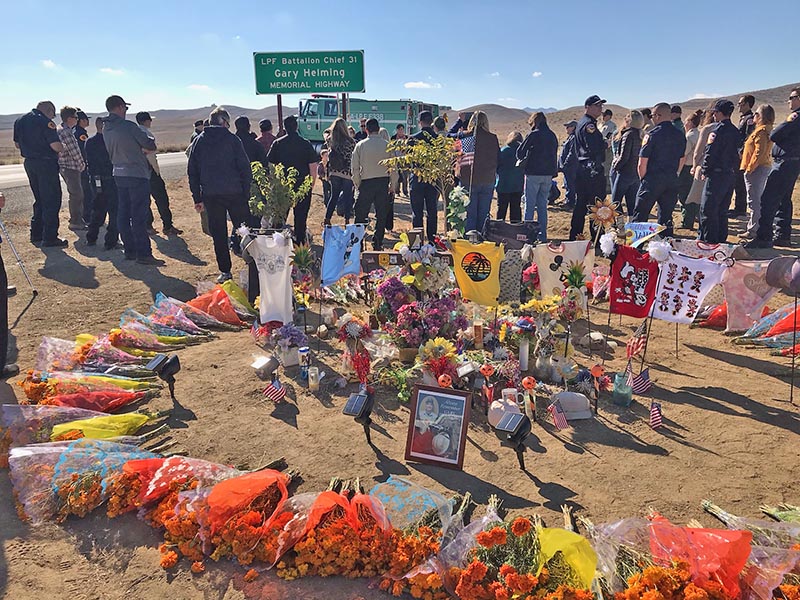 On November 13 a section of Highway 41 in California was designated as the Gary Helming Memorial Highway. USFS photo.
On November 13 a section of Highway 41 in California was designated as the Gary Helming Memorial Highway. The Santa Barbara County Fire Department, CAL FIRE, and Los Padres National Forest Service were among those who attended the dedication Sunday along with a group of family, friends, and co-workers.
The Battalion Chief with the Los Padres National Forest was killed August 31, 2017 in a vehicle accident on the highway. He was returning from a wildfire on the Sierra National Forest.
According to the U.S. Fire Administration a Ford F-350 traveling in the opposite direction suffered a tire failure, crossed the middle of the road and struck Chief Helming’s vehicle head-on.
The accident occurred on Highway 41 just south of state Route 33 in Kings County, California.
In the video below, a CAL FIRE OV-10 lead plane honors Battalion Chief Gary Helming as the section of Highway 41 was renamed November 13, 2022. Video by Joel Lane.
After the accident an unofficial memorial appeared at the site.
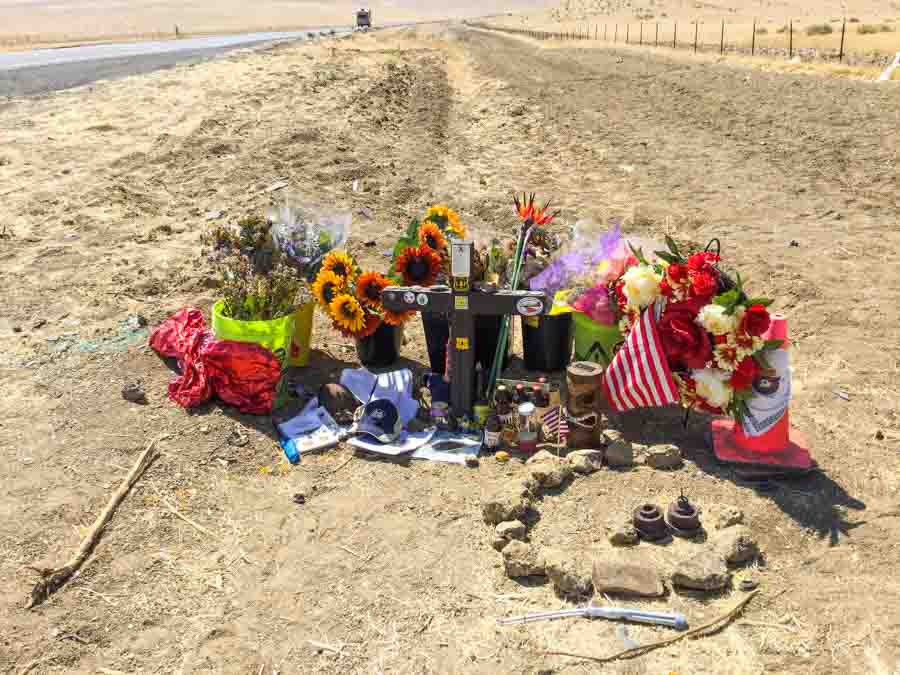 Roadside memorial for Chief Gary Helming who was killed in a vehicle accident at this location August 31, 2017. Photo by John Szalay, September 17, 2017.
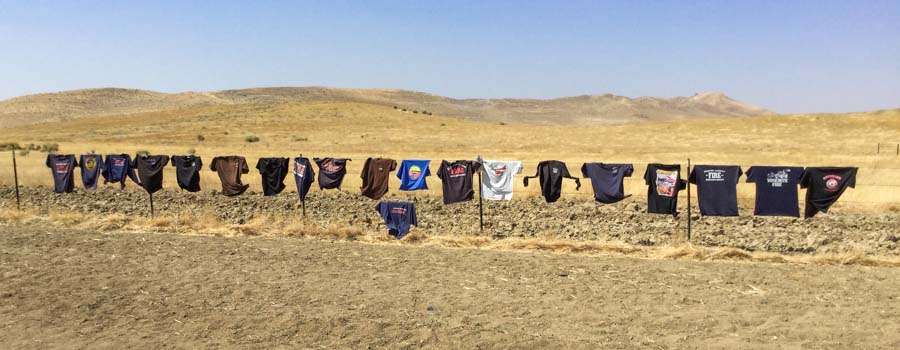 Roadside memorial for Chief Gary Helming who was killed in a vehicle accident at this location August 31, 2017. Photo by John Szalay, September 17, 2017.
Chief Helming started out as a seasonal firefighter and spent 22 years with the U.S. Forest Service. During his career, he also worked with the Bureau of Land Management and the National Park Service but returned to the USFS in 2013. He was stationed in Santa Maria as Battalion Chief with the Los Padres National Forest. His wife, Andrea, has served as Air Tanker Base Manager for the agency at Santa Maria. They have three children.
On January 21, 2015 Chief Helming was honored by the Santa Maria Elks Lodge as Outstanding Firefighter of the Year for Los Padres National Forest’s Santa Lucia Ranger District.