Bambi Buckets hit 40!

The very first Bambi Bucket was introduced back in 1982, and since then it’s become well-known in aerial firefighting operations around the world. Mark Tayler — general manager at manufacturer SEI Industries — says the bucket’s popularity is thanks to the company’s innovation. “It’s been a process of continuous evolution,” he told Vertical magazine.

The giant flexible bucket made from SEI’s iconic orange material was the breakthrough product in early development of helicopter-slung water loads. “The early tanks were bulky and rigid,” said Tayler, “and had to be either moved to the site of the fire by road, or flown there under the helicopter, and they weren’t reliable.” He said what they needed was a way that the tank could be transported to the site inside the helicopter, and then used to drop water reliably.

SEI's Bambi Bucket hits 40-year mark. SEI photo.
SEI’s Bambi Bucket hits 40-year mark. SEI photo.

In 1978 Canadian inventor Don Arney and his partner Mark McCooey started a company named after their founding principles: science, engineering, and innovation. While testing underwater airbags by suspending them filled with water, Arney wondered if something similar might be used as a firefighting bucket. Arney built a prototype in his garage and repeatedly tested it — there’s even an archive photo of him testing the damage resistance of the original design by whacking a filled and suspended bucket with a woodcutting axe. While still rigorous, the SEI’s testing methods are now somewhat more sophisticated.

Firefighting customers can choose from numerous custom options when purchasing Bambi Buckets. They range in size from 72 to 2,590 gallons (270 to 9,800 liters), which at the top end is just under ten tons of water, about as much as some airport fire trucks. Then there are options to add pumps that allow the bucket to be filled without submerging it, fire suppressing foam injection systems, and even floatation devices in case the bucket must be jettisoned in the water.

Since its entry into production 40 years ago, the Bambi Bucket has been used in over 100 countries and slung under a wide variety of aircraft, from light helicopters to the heavy Chinooks. Congratulations to SEI for hitting its 40th anniversary!

Judge dismisses lawsuit over Oregon’s new heat and smoke rules

When local residents who aren’t firefighters see summertime haze or clouds on the horizon, they often guess it’s smoke. Mid-summer they often think it’s wildfire smoke, and in the fall they suspect it’s a prescribed burn. This is a “common experience” with wildfire smoke, according to attorneys with Oregon OSHA, who successfully argued last week that it’s fairly easy to determine when the air is smoky and affecting air quality.

On Tuesday, according to the Salem Statesman Journal, a federal magistrate dismissed a lawsuit against Oregon OSHA in which plaintiffs claimed the state agency’s new heat and smoke rules somehow violated the 14th amendment of the U.S. Constitution and were unenforceable. Lawyers for Oregon Manufacturers and Commerce, Associated Oregon Loggers, and Oregon Forest Industries Council claimed that air quality fluctuations are caused by many factors, and not just wildfire smoke.

“Most times, it’s not obvious,” attorney James Anderson declared. “There’s no method to determine that air quality is due to wildfire smoke, or prescribed burn smoke, or other things that make up particulates.”

Magistrate Mark D. Clarke was not persuaded. “Why is it that complicated?” he asked. He said Oregonians are quite familiar with wildfire smoke. “I’m not sure any of us have any trouble knowing when wildfire smoke rolls in. I’m having trouble with that, factually.”

The lawsuit also claimed that OSHA’s rules to protect workers against extreme heat and smoke were too vague to be enforced. The new rules, as KGW-TV reported last July, took effect after recent heat waves in Oregon resulted in medical problems and deaths, prompting new requirements for employers to protect employees from heat-related illnesses. The new OSHA rules require, when the heat index hits or exceeds 80 °F, that employers provide shaded areas for workers to rest, more break time, and access to plenty of water. When temperatures exceed 90 then breaks must be longer, communication must be more frequent, and workers must be monitored more closely.

Dangerous heat exposure is risky especially for farm workers, according to Ira Cuello Martinez, policy director for Pineros y Campesinos Unidos del Noroeste (PCUN), Oregon’s farm worker union. “You’re constantly moving and doing repetitive motions, having to bend down, and there aren’t many shaded structures when it comes to the field or doing work in agriculture,” he said.

First flight of teleoperated helicopter aims for agile and safer fire operations

Helitack and on-the-ground firefighters learn to keep eye contact with a helicopter pilot. So it’s unnerving to look into the cockpit of this Robinson R22 and not see a pilot’s helmet as it lifts into a hover. But this is the point – this is a video of the first test flight of an uncrewed, teleoperated helicopter focused on fire missions. And it takes just a moment to spot a focused face in the control van behind the hovering helicopter – the pilot, holding a cautious yet quite committed in-ground hover.

First teleoperated flight of Robinson helicopter with Rotor Technologies
First teleoperated flight of Robinson helicopter with Rotor Technologies. The pilot is in the control van on the right.

On December 2, 2022, Rotor Technologies’ teleoperation tools demonstrated the first and key technical challenge of moving the pilot out of the helicopter. The first three-minute flight of “Birdy McBirdface” (named in honor of  “Boaty McBoatface,” a pioneering British uncrewed submersible) demonstrated the initial flight operations with their CloudPilot system and began testing and refining the remote piloting process.

To get to this launch, company co-founders Dr. Hector Xu and Greg McMillan studied the opportunities for improving aviation with technology. Their research showed that “firefighting came across as a very urgent need,” Xu said after the first series of test flights. “It’s a growing need in terms of the climate crisis. And people don’t have the tools to fight fires.”

After a year and half of programming and prototypes, they’ve launched their CloudPilot teleoperations system that relies on low earth orbit satellites to integrate accurate, real-time location-sharing and communications between the pilot and the helicopter.

While others are developing larger payload aircraft with autonomous piloting, Rotor is focused on light helicopters with real-time but remote piloting. By removing the pilot from the light helicopter, the payload increases from 170 pounds to 400, with a three-hour flight time. Even with that gain, Xu acknowledges that “in suppression operations, we will always be a little payload limited when compared with the competition.”

The advantages of a remote pilot become more apparent in precise and interactive operations, both high risk and more routine, “when flying low and slow in the deadman’s curve, such as ignitions, and providing logistics, food, water, tools. The case that is exciting is working on the fringes of the day. To build technology that is able to fly beyond visual flight restrictions, that improves situational awareness of remote pilots beyond the physical cockpit. The technology we’re building will improve situational awareness in low-visibility situations,” both to avoid inadvertent entry into instrument meteorology conditions (IMC) and to ensure safe flying in IMC. With CloudPilot technologies, even night operations become possible – think of the potential of aerial night ignitions.

Yet what adds the most value to a light helicopter with remote piloting? As Xu notes, “People have been building uncrewed rotorcraft for awhile … trying to build fully autonomous systems. We’re very clear this is teleoperations. A pilot is operating this remotely. Not a lot of people are building this technology, particularly in the civilian operations.”

And it is this clear relationship – between pilot and helicopter, and with fire operations on the ground and in the air – that Xu holds is unique in their approach, which will help build trust in new technologies that will in turn support safer mission operations overall.

Beyond wildland firefighting, use scenarios include disaster response, emergency management and eventually passenger certification.

With their success in the first flights, Rotor Technologies is planning for simulated firefighting scenarios in field tests this summer for their two prototype helicopters.

For more, see Rotor’s Medium post at https://medium.com/@rotor_ceo/first-flight-for-uncrewed-firefighting-helicopter-db5deb15a101.

Got your six here

09. December, 2022 — Readers of FireAviation and WildfireToday have probably noticed that we have lately featured fewer-than-usual posts here by Bill Gabbert.

“That’s because I have developed an incurable disease,” says Mr. Gabbert. “I have pancreatic cancer. The symptoms started about September, and the diagnosis came in October. Basically there will be no major changes to either of these websites, but there will be a bit of a transition period that may take us a little while.”

BILL GABBERT
Bill Gabbert and the poster for ONLY THE BRAVE, photo by Wendee Pettis

The WildfireToday site was launched in January 2008 and FireAviation  followed four years later in 2012. “I have long had a passion for wildland fire,” says Mr. Gabbert, “and it requires continuous learning. I’ve always been a student of wildfire, and I wanted to create a venue for the fire community that encouraged students of wildfire. I am certain that I don’t want that venue squandered. I therefore have decided to give all rights to both websites to the International Association of Wildland Fire. The IAWF shares my values, and my commitment to preserving these two websites and 15 years of collected data, knowledge, and experience gathered from thousands of people who share our passion for wildland fire.”

REGARDING ADVERTISERS: Bill Gabbert wants you to know that we all appreciate your support for the last 15 years. “We couldn’t have done this without the advertisers,” he says. “We value your support over the years and someone with IAWF will be in touch in the near future about our upcoming plans. The intention is that both websites will continue on mostly without interruption. Our goal is that the knowledge accumulated over the years on these two sites will not be abandoned.”

“Things progressed a lot faster medically here than what was projected,” added Bill, “but we’re doing the best we can.”

REGARDING OUR READERS: Bill Gabbert and the IAWF are committed to maintaining the continuity and quality of both sites and the news and commentary that have made both WildfireToday and FireAviation trusted sources of wildland fire journalism for years.

Bill interviewed at the Washington Monument
Bill is interviewed about the Washington DC weather after he had interviewed retiring F&AM director Tom Harbour.

FROM THE IAWF:
Since 2008 Bill Gabbert has developed and published WildfireToday; his journalism and commentary expanded in 2012 to include the FireAviation site.

In these publications we have learned of changes in wildland fire operations and policy and have tracked how wildland fires affect our lives and communities.

Bill was often the first to tell us of fire tragedies and new developments in the field. It is the community he gathered — the experts and sources he knew and depended on and the readers and businesses who supported both sites — that makes these sites what they are.

Bill Gabbert photo by Kari Greer
Bill Gabbert enjoyed the photo exhibit at the Continuum Conference at Missoula in the spring of 2018 and Kari Greer made this portrait of Bill in the gallery.

Today the IAWF honors Bill as a key to both the history and the future of wildland fire in the U.S. and beyond.

As Bill moves on here, he has asked us to manage the future of these publications; it’s an honor and a  challenge to steward his legacy.


Mexico and U.S. working together on wildfire

This year the U.S. and Mexico celebrated their 200th year of diplomatic relations, and for almost 25 years now the two countries have worked together in information-sharing and wildfire management. The U.S. Forest Service and the National Forest Commission of Mexico (Comisión Nacional Forestal, or CONAFOR) work with similar wildland fire challenges and a shared approach in the Incident Command System.

CONAFORThis collaboration has its roots back in 1998, when Mexico suffered through its worst fire season on record and was mounting a massive response to try to contain environmental damage and community threat. According to a recent feature story by the Forest Service’s International Programs, smoke from the 1998 Mexico fires caused serious air quality deterioration across hundreds of miles from Veracruz north to the Gulf States along the U.S. border.
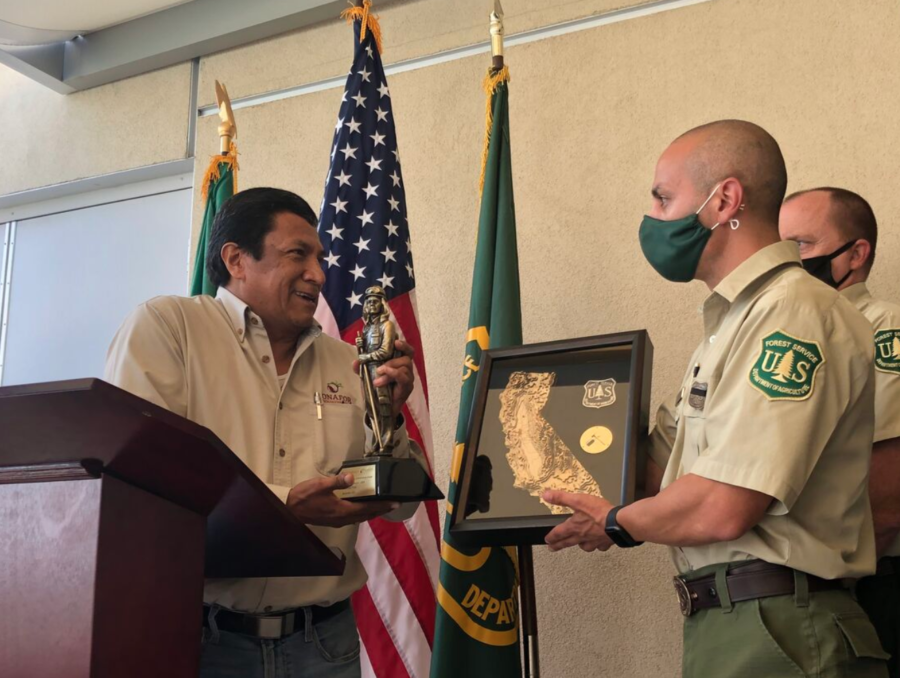
The USFS sent literally tons of equipment, personnel, and other resources to Mexico, initiating what’s become a longstanding knowledge-sharing exchange. U.S. firefighters began then to regularly travel to Mexico to teach ICS principles and operations and to share resources, and Mexican firefighters started traveling here to help fight fires and add skills alongside U.S. firefighters.

Eduardo Cruz with USFS fire people
Eduardo Cruz with USFS Region 5 fire people
photo courtesy CONAFOR

Eduardo Cruz traveled from Mexico to the Sequoia National Forest soon after the 1998 fires. He worked on a helitack crew in California and launched longtime international friendships; Cruz is now the fire management director of CONAFOR. During 2020’s brutal R5 season, he brought five crews of Mexican firefighters to California to work on fires — the first time that Mexico had sent an entire delegation of firefighters to support U.S. efforts.

CNN reported back in September 2020 that the Mexican crews brought to California by Eduardo Cruz worked on the Sequoia Complex, which at the time had burned more than 144,000 acres and was just 35 percent contained. “Fires do not have borders, fires do not have different languages and cultures,” Cruz told CNN. “In the end we all speak the same language when it comes to fighting fire.”

The Forest Service has a 2020 photo album online [HERE].

An archived story from WILDLAND FIREFIGHTER Magazine about the 1998 fires in Mexico is online [HERE]. (NOTE that it’s on the archive.org website and most of the old links on that page are no longer functional.)

Western Australia adds a C-130 and a 737

Adding two more large airtankers will boost firefighting capability for Western Australia as emergency services personnel prepare for a busy bushfire season. A C-130 Hercules from Coulson Aviation was added on December 5 and is expected to serve in Western Australia (WA) for four seasons. The WA Minister for Emergency Services’ office said the Coulson contract was secured with an $11 million investment to ensure there is a locally based airtanker in the state for the first time.

The Australian Rural & Regional News reported that a Commonwealth-funded Boeing 737 will arrive later this month and will also be based in WA. This arrangement has been secured from the Australasian Fire and Emergency Service Authorities Council National Resource Sharing Centre. Both airtankers can carry more than 15,000 litres — just under 4,000 gallons — of fire suppressant, and both will be based at Busselton-Margaret River Airport in the South-West.

Coulson C-130
Australia Aerial Firefighting C-130 Hercules Firetanker —
Coulson Aviation photo

Western Australia’s aerial fleet comprises 36 rotary and fixed-wing suppression and aerial intelligence aircraft, and for the second consecutive year will feature two Black Hawk helicopters.

Department of Defense joins NWCG board

The National Wildfire Coordinating Group (NWCG) has added the DoD as a primary member of its executive board.

“A key function of NWCG is the establishment of standards for the wildland fire community,” said Shane McDonald, NWCG Executive Board Chair. “With the addition of DoD to the Executive Board, they will now be a part of the process to help create the common operating framework for wildland fire resources.”

Across its 27 million acres of land used for training and testing, DoD manages about a million acres for wildland fire, according to a press release from the Homeland Security news. Including the DoD on the NWCG board acknowledges the cross-jurisdictional nature of wildfire and will contribute to the interagency approach of the federal agencies in charge of fire management.

NWCG provides national leadership to enable coordinated wildland fire operations among federal, state, local, tribal and territorial partners. Other primary members of NWCG include the Forest Service, Bureau of Indian Affairs, Bureau of Land Management, National Park Service, U.S. Fish and Wildlife Service, National Association of State Foresters, U.S. Fire Administration, Intertribal Timber Council, and the International Association of Fire Chiefs. Associate members include the U.S. Department of the Interior’s Office of Wildland Fire and the National Weather Service. The NWCG priorities include training, operations standards, qualifications, IT requirements, research, policy, and safety. More info is available on the NWCG website.

NWCG agencies

New study report says states do not adequately budget for wildfire

Increased spending on wildland fire suppression risks states’ fiscal stability, according to a recent report from The Pew Charitable Trusts. Over the last ten years, the five major federal fire agencies within the Department of the Interior and the Department of Agriculture have nearly doubled combined spending on wildland fire.

State governments, particularly those in the West, operate under differing budgetary constraints and organizational approaches to wildfire management, according to the report, but unlike the federal agencies, states are required to balance spending and revenue every budget cycle. After their extensive review of existing research and available data, the Pew researchers completed 18 semi-structured interviews between December 2021 and July 2022 with wildfire and budgeting experts in six states — Alaska, California, Florida, Nevada, Texas, and Washington. They also interviewed key fire officials with the DOI, the USFS and FEMA, and the National Association of State Foresters — which has information on all states’ wildfire management online.

Oregon Public Broadcasting reported that the Pew study looked at how states budget for wildfire costs, the challenges with those budgets, and what might be done for improvement. Each of the analyzed states primarily uses general fund appropriations to pay for wildfire costs upfront; revenue for the general fund comes from state taxes and fees and is used for general state operations.

“To the extent that more expensive and unpredictable wildfires are being pulled from that same pool of money, it’s a problem for state fiscal stability moving forward,” Colin Foard with the Pew Trusts told OPB. “As fires have grown, so has government spending on the costs associated with them.”

The report and other related studies are available online from  PewTrusts.org.