Flying smarter to manage wildfires

2023 begins as a year of fire aviation innovations.

Wildfire-focused aviation innovations for the first few weeks of 2023 hold promise for a year of improved aviation tools and techniques. Some of the more recent examples range from financial innovation to foam delivery.

FINANCING: The special purpose acquisition company (SPAC) of Jack Creek Investment Corp. collaborated with the long-time aerial firefighting delivery company, Bridger Aerospace Group Holdings, LLC (BAER/BAERW), moving onto Wall Street via the Nasdaq Global Market. Shares began trading on January 25 and dropped by a third on day three, with the company’s market capitalization at a robust $760.64 million. More on process and goals of this business combination at https://ir.bridgeraerospace.com/news-events/press-releases/detail/16/bridger-aerospace-and-jack-creek-announce-closing-of.

Eight scooping air tankers at Santa Fe airport
Eight scooping air tankers at Santa Fe airport, May 6, 2022, operated by Bridger Aerospace and Aero-Flite. The Calf Canyon and Hermit Peak Fires were nearby. Photo by Jerry Messinger.

Bridger provides a “fleet of firefighting aircraft, which includes ‘Super Scoopers’ (CL-415EAF), air attack and logistical support aircraft .. and UAVs (Unmanned Aerial Vehicles). Bridger also offers FireTRAC (https://firetrac.com), an innovative, proprietary data gathering, aerial surveillance and reporting platform that complements its fleet of firefighting assets.”

AERIAL FOAM: Aerial X Equipment continues to develop and deploy a range of aerial foam engines. As described on their website, “Aerial X Equipment’s Striker Airborne Fire Engine™ is the first airborne platform that produces homogeneous high expansion class A foam. This enables it to become the first aerial wildland fire suppression force multiplier with unique capabilities and a range of capacities.” This foam engine floating in the sky beneath a range of helicopter platforms is claimed to have longer-residency foam due to the use of compressed air (CAFS) – with Aerial X stating residency of 30-90 minutes compared to 1-10 minutes for traditional low-expansion foam. More at https://aerialxequipment.com.

TELEOPERATED FLIGHT: Our prior coverage of Rotor Technologies will continue to be updated, and Fire Aviation articles on other innovations are in progress.

But not all the updates hold such promise or good news.

CRASH SETTLEMENT. A family of a helicopter pilot, Heath Coleman, who died while fighting wildfires in Alberta, Canada, in 2021 due to a faulty rotor pin, has received a $10 million settlement, per a report in AviationPros. At the time, the fatality inspection report led to temporary grounding and rotor-pin inspections of more than 500 Bell 212 helicopters.

K-MAX, GOODBYE. The venerable twin-rotored K-Max will cease production. Over 60 rolled off Kaman’s production lines over 30 years, but limited demand and low profitability led to Kaman’s decision.

K-MAX Comet Fire
A K-MAX helicopter (N314) drops water on the Comet Fire north of Salmon, Idaho July 28, 2016.

The company has committed to support those helicopters already in service. https://www.ainonline.com/aviation-news/business-aviation/2023-01-19/kaman-ending-production-k-max-heavy-lift-helicopter.

PRODUCTION NOTE: Lest we take the pace and utility of tech innovation for granted — the research, writing and posting of today’s article was thanks to satellite connectivity on a cross-country flight which also featured some monitoring of prescribed burns in Louisiana and surveying the snowpack in New Mexico, Arizona and southern California.

Surveying the snowpack en route to LAX. Photo: Ron Steffens.


The story of Higgins Ridge

Smokejumpers who survived a 1961 wildfire on Higgins Ridge in Idaho will recount their harrowing experience in a film on Monday on Montana PBS. The Daily Inter Lake in Kalispell reported that “Higgins Ridge,” named for the location of the fire in Idaho’s Selway Bitterroot Wilderness, will air January 30 at 8 p.m. Mountain Time.

The U.S. Forest Service sent 20 smokejumpers to what looked like a routine fire from the air, but an afternoon cold front blew the blaze to an inferno on the Nez Perce National Forest. The jumpers, 8 from Grangeville and 12 out of Missoula — many of them rookies — shifted from fighting the fire to fighting for their lives. They instinctively wanted to run to safety, but they remembered the fate of 13 firefighters who had tried to outrun a fire in Montana’s Mann Gulch 12 years before.

With that tragedy in mind, they decided to hold up. As the wind increased to 50 mph the supervisors of the two squads, Dave Perry and Fred “Fritz” Wolfrum, instructed the firefighters to remain calm and to clear an area for themselves in the black.

In the film, 12 of the 20 men who jumped the fire on August 4, 1961, share the story of how the fire surrounded them, showered them with embers, and forced them to shelter in place. After about three hours, helicopter pilot Rod Snider managed to land his Bell 47B-3 on Higgins Ridge, about 83 miles southwest of Missoula, despite heavy smoke and wind, and he shuttled the jumpers to safety. Snider, then a pilot with Johnson Flying Service who is now 92 years old, is featured in the documentary along with many of his original photos from 1961.

Bell 47 helicopter, USFS photo.
A Bell 47G helicopter, USFS photo.

“This is a story that, for 60 years, never was shared beyond a few smokejumper circles,” producer Breanna McCabe said. “I didn’t believe it when I first heard it. But when a dozen men who were there all corroborate the same series of unbelievable events, I knew it was time for the public to hear it.”

Many of the interviews were collected in 2019 as part of the National Museum of Forest Service History’s Higgins Ridge Oral History Project. The museum partnered with Montana PBS producer Breanna McCabe for technical assistance recording the interviews, and McCabe collected additional interviews and materials to weave the stories into one captivating hourlong film.

Details and a 1-minute trailer are posted at higginsridge.org and viewers can stream the show at watch.montanapbs.org/livestream or from the Montana PBS Facebook page.

Bill Gabbert wrote a detailed story on this fire three years ago.

About the producer: Montana PBS producer Breanna McCabe draws from 16 years of video storytelling throughout the West and beyond. She is eager to bring “Higgins Ridge” to audiences in 2023, a historical story that’s grounded at the Missoula Smokejumper Base in McCabe’s hometown. She remembers watching smokejumpers practice landing on the hill behind her childhood home, and today she enjoys hearing “silk stories” from her brother-in-law, an Alaska smokejumper. As a producer at Montana PBS, McCabe contributes stories to the program “Backroads of Montana.” Her last documentary, “Ghost Forests,” took viewers into high elevations to examine the threats facing whitebark pine. McCabe graduated from the University of Montana School of Journalism in 2009, and returned to earn her master’s degree in environmental science and natural resource journalism in 2020. In between, she worked as a broadcast news reporter for CBS News affiliates KPAX-TV in Missoula and KREM 2 News in Spokane. When she’s not asking senior smokejumpers to see their slide collections, she enjoys exploring trails, rivers and shores with her husband and their two pint-sized, high-spirited rescue dogs.

Manslaughter charge continues against couple in El Dorado Fire

The case against a couple accused of starting the 2020 El Dorado Fire with a gender-reveal device will move forward after one of four felony counts was dropped by a Superior Court judge in San Bernardino, California.

As reported by Brian Rokos of the Southern California News Group, one of four property-damage felony charges against Refugio Manuel Jimenez Jr. and wife Angelina Renee Jimenez was dismissed; a felony involuntary manslaughter charge remains along with three felony counts of recklessly causing a fire with great bodily injury and and three felony counts of recklessly causing a fire to an inhabited structure.

El Dorado Fire
El Dorado Fire, photo by Jeff Zimmerman Sept. 5, 2020.

Attorneys for the Jimenezes argued that the fire was accidentally ignited by the smoky gender-reveal device and sought dismissal of the manslaughter charge. Rokos reported that the deputy county attorney argued that “the Jimenezes should have known better than to set off the smoky device on a 103-degree day with low humidity in a park containing extremely dry brush.”

If convicted of involuntary manslaughter, the Jimenezes could be sentenced to four years in prison. They are currently on leave from their jobs as California correctional officers.

Prior coverage in Wildfire Today of the “Narrative” and related reports on the fatality of a squad leader on the Big Bear Interagency Hotshot Crew highlighted the increasing risks and complicated processes in a comprehensive analyses. Charles ‘Charlie’ Morton died as he was scouting the fire alone on September 17, 2020 when it overran his location.

Excerpts from the reports included:

“In his September 24, 2020 testimony before Congress, John Phipps, the Forest Service’s Deputy Chief of State and Private Forestry, stated “the system is not designed for this,” to illustrate the misalignment between the design of the wildland fire system and the reality that wildland fire responders routinely experience.”

“We continue to ask our wildland fire responders to save communities that are becoming increasingly unsavable. At what point do we declare communities without any semblance of defensible space not worth the risk of trying to save under extreme fire behavior conditions?”

As Bill Gabbert wrote about the reports on their release, they were notable for their in-depth compilation of lessons as well as the suggestion “that perhaps firefighters (or forestry technicians) should be called ‘fire responders’ so they don’t ‘view fire as an enemy.’ Other than that many of their conclusions are very reasonable, even though most of them have been previously identified in various forms. But having so many of them listed in one fatality report is unique, and could be useful. Unless it just disappears into files like so many others.”

One lesson is being applied – to streamline Type 1 and Type 2 team classifications. Other lessons – such as identifying the risk of scouting and implementing tracking devices and drones – are not moving ahead as quickly.

Firefighter health and workplace initiatives featured Jan. 26

Finding time and priority for our health is key for firefighters and fire managers. This week, we offer four activities for you to pick and choose or preferably quadruple-up, starting with two online meetings on Jan. 26 that will highlight initiatives to improve firefighter working conditions.

(1) On Thursday Jan. 26, 1 pm EST, Fire Engineering and Vector Solutions will host a webinar with Chief Todd LeDuc (Ret.), Chief Strategy Officer for Life Scan Wellness Centers, and Frank Leeb, Deputy Assistant Chief with FDNY, on “The Impact of Occupational Cancer: How to Reduce Exposure & the Role of Early Detection.”

The announcement notes that “The International Agency for Research on Cancer (IARC) recently updated its classification of the firefighting occupation to Group 1, ‘carcinogenic to humans,’ after conducting a new international study that found sufficient evidence linking cancer risk to the occupation. The danger is real, but there are strategies and resources that can reduce risk, enhance survival, and support firefighters.”

(2) Later on Thursday (and on Pacific Time), the Grassroots Wildland Firefighters offer their quarterly update starting at 5:30 pm PST. Register here or find out more at their home page at www.grwff.com. This quarter’s updates will likely discuss recent legislation concerning preemptive cancer coverage in the Federal Firefighters Fairness Act and other Grassroots WFF initiatives, as well as the announcement by outgoing president Kelly Martin of the incoming board, which features Luke Mayfield – President, Riva Duncan – Vice President, Bobbie Scopa – Secretary, and Jami Egland – Treasurer. Kudos to Martin’s work with GRWFF and wishing for continued success to the new board.

(3) In related health news, this past week the U.S. Fire Administration announced the pending opening of the National Firefighter Registry. https://www.usfa.fema.gov/blog/ci-011723.html.

As the USFA notes, “By adding your information to the National Firefighter Registry (NFR), you can help researchers better understand how your work affects the risk of getting cancer and how to lower this risk. According to National Institute for Occupational Safety and Health (NIOSH) research, cancer is a leading cause of death among firefighters, and research suggests firefighters are at higher risk for certain types of cancers when compared to the general population.”

A direct link to the NIOSH NFR website is at https://www.cdc.gov/niosh/firefighters/registry.html. Initially the Registry was anticipated to open this past fall; it’s now scheduled to open this winter for confidential sharing of cancer diagnoses and work histories. As the NFR notes, “The more firefighters who sign up for the registry through its secure web portal, the more information researchers will have to learn about cancer in the fire service and how to protect firefighters from developing cancer in the line of duty.”

(4) Finally, a reminder –- there’s an opportunity to learn more of cancer and PTSD risks while adding a cancer/health donation. See our article Share a few hours for cancer awareness (and help fund our profession’s response) for more – and if you need an extra incentive, remember that the Vector-Solutions sponsored donation deadline is Jan. 31.

What a wet West Coast winter foretells for fire season 2023

The above-normal winter precipitation in California and over parts of the American West has already raised the question — even before the floodwaters have receded — of how this winter precip might either dampen the fuel beds or spawn a monster crop of fine fuels come spring and summer of 2023.

There’s a lot of winter and spring to come, and the first-of-the-month fire outlooks are 10 days out, but many are sensing that fire season in wetter locales will begin later. This delay is more likely in California, which is coping with a walloping by deep and repeated atmospheric rivers, resulting in near-record snowpack and flooding that may be familiar historically but not during the most recent drought decades.

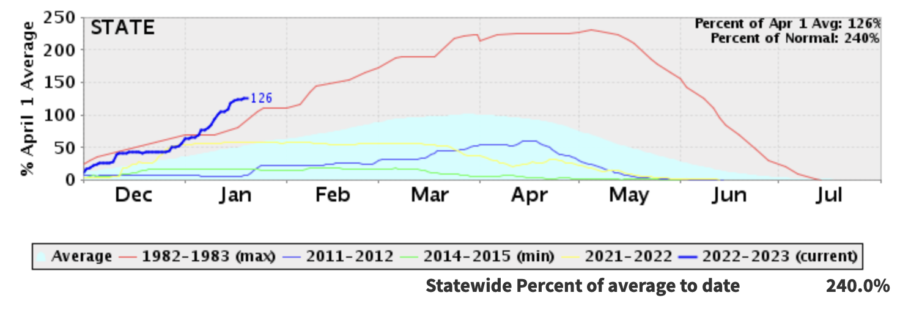
Consider the California snowpack as of Jan. 20, 2023. Whether by graph or map, the message is clear: the snowpack is significant and snowmelt periods will likely be extended. Statewide the snowpack is at 126% of the April 1 normal, but 240% for the current water year-to-date.

Calif Statewide Snowpack years 2023-01-20
California Statewide Snowpack as of Jan. 20, 2023. https://cdec.water.ca.gov/snowapp/swcchart.action

With a focus on California’s rapid switch from drought to flood, it’s clearly a banner water year to analyze — which is too painfully clear to the many who are working through a long recovery from flood damages estimated to exceed $1 billion. As CNN reported, at one point an estimated 90% of California’s population was under some form of flood watch, which equates to 10% of the US population.

Per California Water Watch, the state is at 167% of average precipitation for this date, but storms aren’t a universal event. While the map for accumulated water year precipitation beginning Oct. 1 shows higher departure from average over most of the state, the most-intense  “purple” is being collected in the higher elevations in the central and northern mountains, and sopping the lower coastal regions that were hit full-force by the atmospheric rivers.

See California WaterWatch for regular updates.
See California WaterWatch for regular updates: https://cww.water.ca.gov

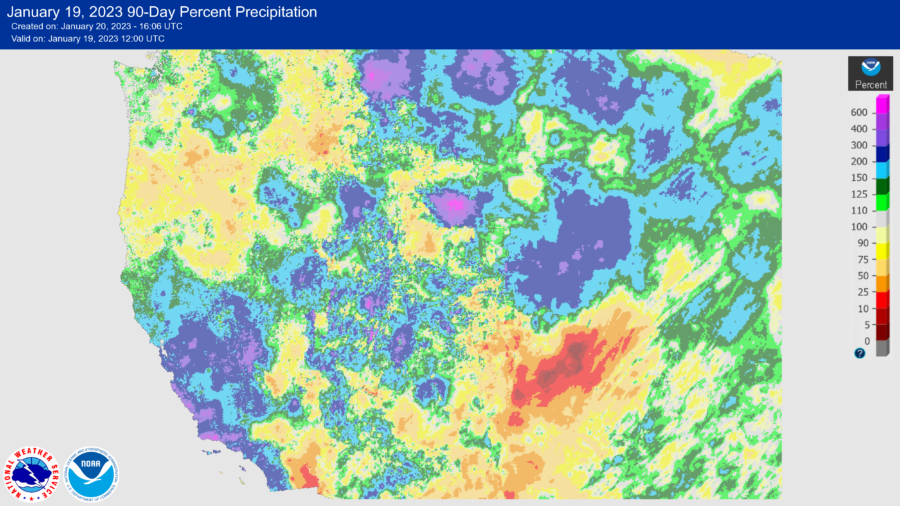
As damaging as the storms have been for so many communities, much of the West continues to feel the effects of long-term drought. A broader west-wide map of  precipitation of the past three months shows the patchiness of these bomb cyclones.

January 19, 2023 90-Day Percent Precipitation
Precipitation for the past 3 months.

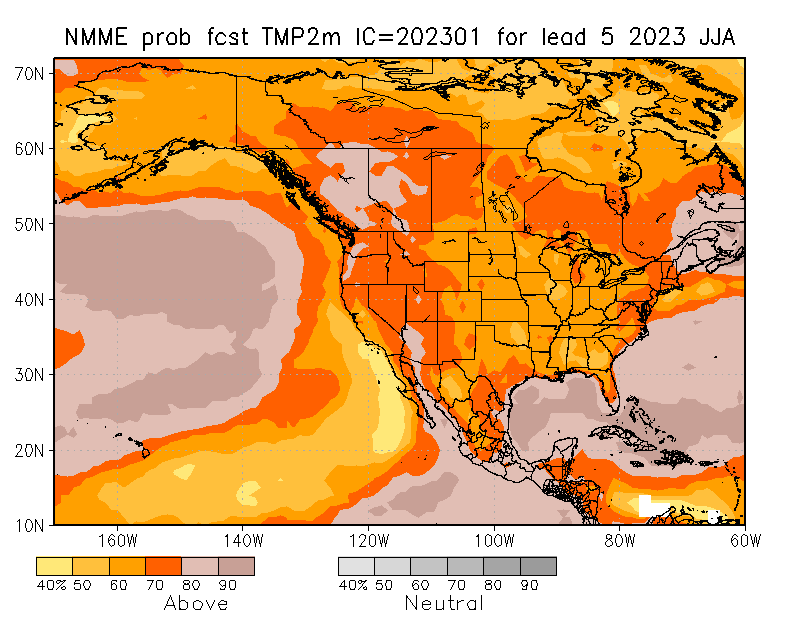
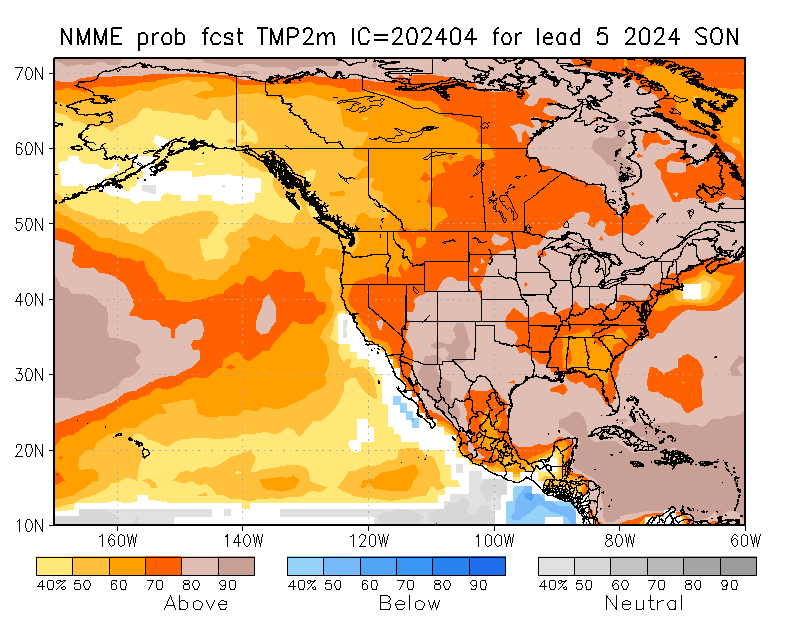
Looking ahead, a range of analysis tools foretell the potential of a warm summer and the likely impacts of long-term drought returning. The five-month lead for June-July-August (JJA), from the North American Multi-Modal Ensemble (or NMME), paints a warm picture for North America, with most of the U.S. West at 70% or higher likelihood for warmer than normal temps. Which will in turn elevate the evaporation potential during growing (and curing) season.

NMME ensemble temperature forecast for JJA 2023.
NMME ensemble temperature forecast for JJA 2023. https://www.cpc.ncep.noaa.gov/products/NMME/prob/images/prob_ensemble_tmp2m_us_season5.png

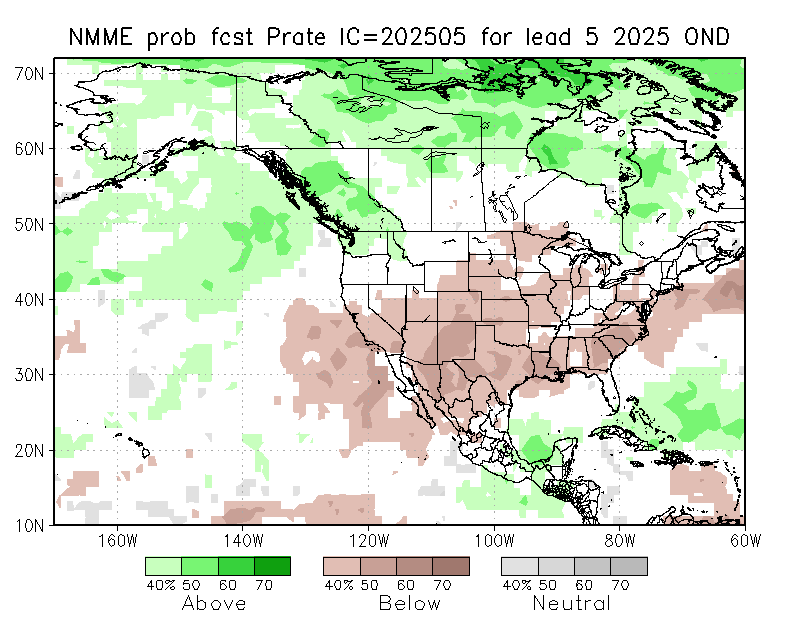
The same JJA outlook indicates a potential for most of North America to receive normal summer precip (though normal is often quite dry for much of the Western regions), with wetter likelihood for Alaska and drier than normal for western and northern Canada, the Pacific Northwest, the lower Mississippi Valley into Texas and south to Mexico and Central America.

NMME ensemble precipitation for JJA 2023. https://www.cpc.ncep.noaa.gov/products/NMME/prob/images/prob_ensemble_prate_us_season5.png

How these ensemble outlooks play out will depend in part on a projected switch from La Niña to neutral or potentially El Niño conditions. And the impact of the winter’s snowpack will depend on how early and warm the spring temperatures rise. More on that potential when we look at the February outlooks.

Thanks to the Analysts … Many of these resources are digested from the outlooks and links prepared and shared by National and Geographic Area analysts. So a thanks for the work these folks do, season in and season out. This update owes much to the analysts who produced the January outlooks for Northern California and Southern California.

Two California counties sue PG&E over Mosquito Fire

A lawsuit was filed January 18 against Pacific Gas & Electric Co. by El Dorado County and Placer County seeking damages related to the 2022 Mosquito Fire, which burned almost 77,000 acres over 50 days in the Sierra Nevada foothills. The two counties, along with the El Dorado Water Agency, Georgetown Divide Public Utilities District, and Georgetown Divide Fire Protection District, filed the lawsuit in San Francisco Superior Court. The fire burned mostly on the Tahoe and El Dorado National Forests and caused evacuations of more than 11,000 people.

Mosquito Fire 09-13-22
An airtanker makes a retardant run over the Mosquito Fire after it jumped the American River and headed north toward Foresthill, California.   09-13-22 Inciweb photo.

The suit alleges that PG&E’s equipment caused the fire, which started on September 6 near the community of Foresthill, according to a report by CBS News.

“The lawsuit seeks to hold PG&E accountable and to help our community rebuild after this devastating fire,” said El Dorado County counsel David Livingston. The Mosquito Fire started near the Oxbow Reservoir at the Middle Fork American River, according to the Sacramento Bee, and it destroyed 78 structures, including dozens of homes in the Placer County community of Michigan Bluff and the El Dorado County town of Volcanoville. It was not contained till October 27.

Mosquito Fire Day #2
Extreme fire behavior on the second day produces a large column of smoke visible from Foresthill, California.
09-08-22 Inciweb photo

The county filed the lawsuit one day before PG&E officials were scheduled to appear in Shasta County Superior Court for a criminal case related to the 2020 Zogg Fire, which killed four people and which Cal Fire investigators have blamed on PG&E equipment. Shasta County prosecutors charged PG&E with four counts of involuntary manslaughter; the utility company in June pleaded not guilty.

The Mosquito Fire lawsuit follows a legal settlement earlier this week in which 10 public entities agreed to $24 million from PG&E for damages caused by the 2021 Dixie Fire, which started July 13 and burned over 963,300 acres across Plumas, Lassen, Butte, Shasta, and Tehama counties. Plaintiffs include the five counties, along with the City of Susanville, Plumas District Hospital, Chester Public Utility District, Honey Lake Valley Recreation Authority, and Herlong Public Utility District.

“Local government across the five affected counties came together to recover these significant funds to reimburse public and natural resources lost in the fire,” Gretchen Stuhr with Plumas County told The Plumas News. “The allocated portion of the settlement proceeds will in no way make the entities whole following the devastation caused by the Dixie and Fly Fires but will assist the County in its recovery.”


Bill Gabbert’s death announced by his family

We are saddened to share that Bill Gabbert, founder of Wildfire Today/Fire Aviation and a friend and colleague to so many in our profession, passed away last night. His family shared that Bill  died peacefully in his sleep yesterday evening in Senatobia, Miss.

Our thoughts are with Bill’s family. We will share more on Bill’s life in the days ahead.

Share a few hours for cancer awareness (and help fund our profession’s response)

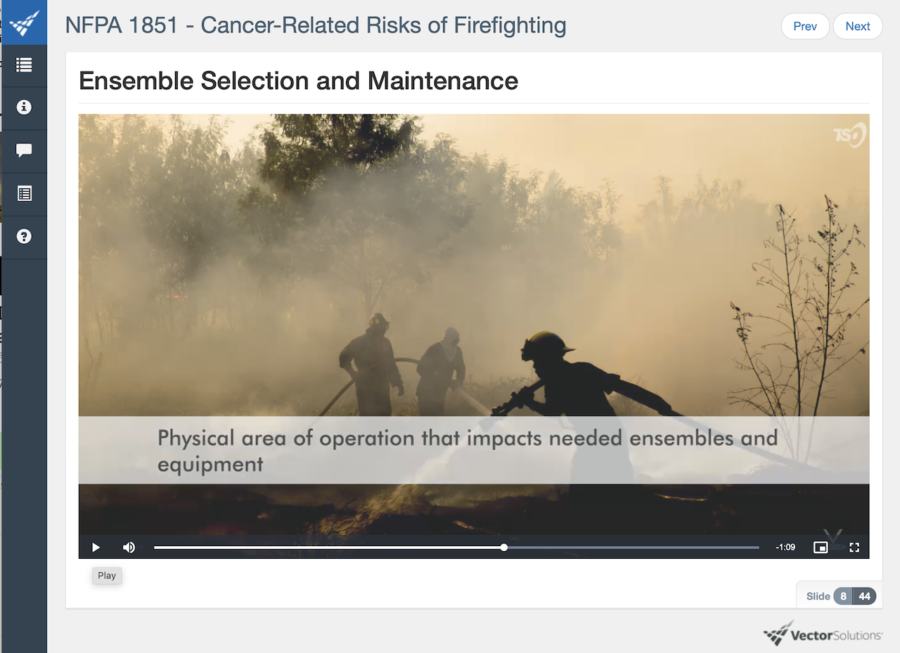
NFPA1851 training, Vector video. Areas of operation include wildland firefighting.
Screenshot of NFPA 1851 training video by Vector Solutions, focused on areas of operation where carcinogens can impact PPE and increase firefighter exposure.

For the past day or so I’ve been dropping into a cancer awareness training video hosted by Vector Solutions. I was recruited in part by Vector’s pledge to donate to the Firefighter Cancer Support Network for every completed course. About halfway through the two-hour course, guided by NFPA 1851’s “Cancer-Related Risks of Firefighting,” I paused the screen, as I have many times, this time at the list of cancers linked to firefighting … and typed out the systemic locations and types of cancers … genitourinary, kidney, testicular, brain, head and neck, non-Hodgkins lymphoma, thyroid, and — as the narrator notes — “skin cancer, especially in wildland firefighters.”

After that I stopped taking breaks, following the chapters that explored the risks and protective actions we can take against them — all the time noting that while fire is fire, NFPA 1851 is by definition a standard focused on “Selection, Care, and Maintenance of Protective Ensembles for Structural Fire Fighting and Proximity Fire Fighting.” While many in the field are cross-qualified in structure and wildland firefighting, of equal concern — whether we’re responding in turnouts or wildland PPE — is that many key cancer risks are shared across the structural and wildland communities.

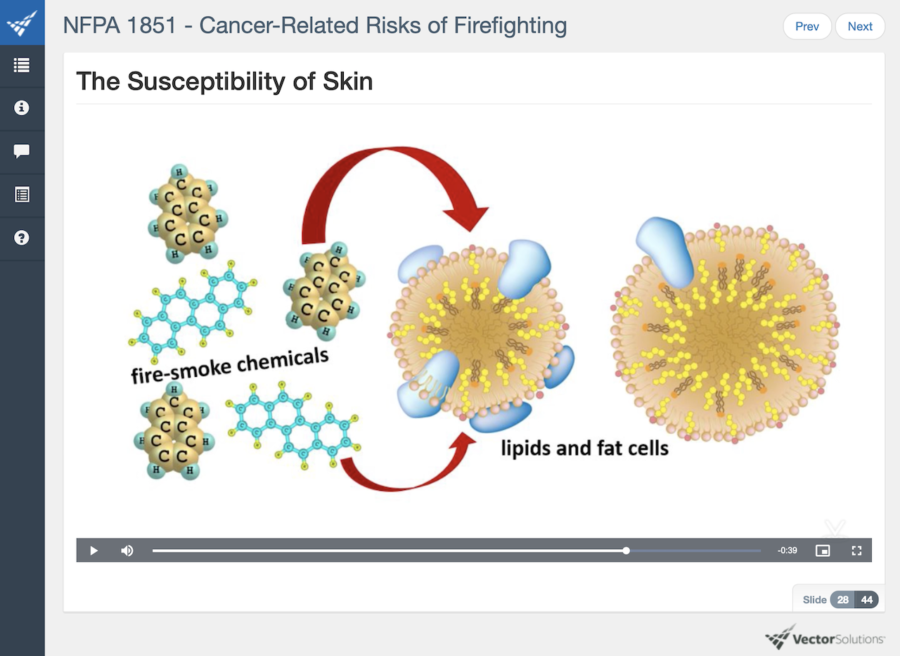
For instance, there is the caution in this training against skin exposure. While those in wildland fire are so often cautioned to protect our airways, the skin exposure to airborne carcinogens and char can be significant in wildland firefighting. The training notes the formidable cocktail of chemicals released in structural fire suppression — and though the vectors and hazards are different, take a moment to compare the protective components of turnouts and SCBAs to wildland Nomex and bandanas. And as the training notes, “For every 5 degrees F increase in skin temperature, there is a 400% increase in the absorption capability of our skin.” And exposed skin is a conduit for carcinogens to bioaccumulate in fat cells and lipids.

Skin exposed to carcinogens can lead to bioaccumulation in fat cells. Screenshot: NFPA 1851 Section training.

To explore the connections between cancer and firefighting, Vector Solutions connected us with Chief Todd LeDuc (@ToddJLeDuc), retired from Broward County Fire Rescue, board member for the International Association of Fire Chief’s (IAFC) Safety Health & Survival Section, and editor of “Surviving the Fire Service.” We’ll have more from our conversation with Chief LeDuc in upcoming posts, but what’s key for now is the importance of awareness noted by LeDuc. Firefighters — structural and wildland — face increased cancer risk, and we should prioritize early detection and treatment while integrating immediate risk reduction. Leduc’s core advice for structural and wildland firefighters?”Get the carcinogen off the body as soon as we can.” He shared the concept to “Shower within an hour” after exposure to clean carcinogens from skin exposed to smoke — or more immediately (and more timely and feasible in wildfire work) is to use wet wipes to clean off during a break.

Another shared yet often hidden fire-service carcinogen is diesel exhaust, a Group 1 carcinogen (as is benzene). As the training notes, the state of California states that “diesel exhaust provides the highest cancer risk of any contaminate.” And as the narrator notes, diesel exhaust is “A real threat that is by and largely preventable, but for the cost” — the cost being that of pollution-trapping entrainment systems or finding alternative fuels and procedures for heavy-engines and generators.

And don’t forget to think of the impacts of 24-hour shift work has on our overall health, including an increased risk of cancer.

We will share additional posts during Firefighter Cancer Awareness Month, but in the meantime you might put aside two hours for the training. Complete the test (I passed at 80%) and “$1 will be donated [by Vector Solutions] to the American Cancer Society and Firefighter Cancer Support Network for each completed course.” Complete the PTSD course for another donation — and consider a matching donation to support firefighter safety in 2023.

LINKS

County commissioner in Glenwood Springs wants “climate” removed from wildfire agreement

Garfield County in west-central Colorado signed off this week on the new multi-agency Roaring Fork Wildfire Collaborative, but not without a little creative editing. The Post Independent reported that county commissioners signed a memorandum of understanding (MOU) joining 17 other local governments, fire districts, and state and federal agencies in the formation of the wildfire collaborative.

“The Roaring Fork Valley presents especially complex boundaries with the sheer number of agencies involved,” said Larry Sandoval with the BLM’s Colorado River Valley Field Office. He said the completion of this MOU is a major step toward effective collaboration in fire prevention and management.

The request for edits to the MOU originated with Garfield County Commissioner Tom Jankovsky. “A lot of the emphasis is coming from Pitkin and Eagle counties and the Forest Service to do more forest management,” he said, “which from my perspective is more than just prescribed burns.” Jankovsky wanted the MOU to include equal mention of logging, thinning, and other “more aggressive” forest management methods. “I find it ironic that this group talks about climate change, yet they look at forest management as burning the forest, which has the same effect as if we have a forest fire, just to a much smaller degree,” Jankovsky explained.

A third-generation native Coloradan, Jankovsky is serving his third term as Garfield County Commissioner. He is the public lands planning lead for the Board of County Commissioners and the former general manager of Sunlight Mountain Resort in Glenwood Springs. He asked that the word “climate” be removed from one sentence in the MOU where it stated that active management “… includes the use of the best available climate science that will help stakeholders understand how a changing climate will impact our landscapes and ecosystems, while also looking for opportunities to improve understanding through local research.” Jankovsky wanted the line to read “best available science” and not “best available climate science.”

Fire photo by Colorado State Forest Service

Because fires have no boundaries and don’t recognize jurisdiction lines, the valley-wide collaborative is meant to have everyone on the same page. The 18 local, county, state, and federal agencies involved in wildfire management formalized their working relationship through the Roaring Fork Valley Wildfire Collaborative; the Gunnison Times reported that talk of the collaborative started early 2022, when residents in the Roaring Fork River drainage discussed their interest in better fuels treatment. With several big fires in recent memory — the 2018 Lake Christine Fire, the 2020 Grizzly Creek Fire, and the 2021 Sylvan Lake Fire — valley stakeholders began discussing solutions. The collaborative’s goals include improving communication and identifying critical areas of fuels reduction and vegetation treatment.

Signatories to the MOU are Aspen, Snowmass Village, Basalt, Carbondale, Glenwood Springs, and Marble. County signatories are Pitkin, Eagle, Garfield, and Gunnison counties. Additional collaborators include Aspen Fire, Roaring Fork Fire and Rescue, Carbondale Fire, Glenwood Springs Fire, the U.S. Forest Service, and the BLM.

The 2002 Hayman Fire was the largest wildfire in Colorado state history for nearly 20 years, until the Pine Gulch Fire surpassed it in August 2020. The Cameron Peak Fire became the largest wildfire in Colorado history seven weeks later at 206,667 acres. With multiple record-breaking fires, the 2020 Colorado wildfire season became the largest in state history after burning 665,454 acres.

Large-scale wildfires are becoming increasingly common in the U.S. as climate change accelerates; since 2000 an annual average of 70,072 wildfires have burned an annual average of 7 million acres across the country. According to research by the College of Natural Resources at North Carolina State University, that’s more than double the annual average of 3.3 million acres burned in the 1990s, when a greater number of fires occurred annually. A 2016 study found that climate change had doubled the number of large fires between 1984 and 2015 in the western U.S., and a 2021 study supported by NOAA concluded that climate change has been the main driver of the increase in fire weather each season.