On a windy Sunday on the west side of County Cork, Ireland, satellite hotspots were highlighting what firefighters were facing in person, with reports of nearly 100 fires breaking out in gorse and related fuels, beginning February 26 and burning into the next morning.
Burning gorse in Cashelfean, County Cork, Ireland. Photo: Cork County Council.
Significant nighttime fire growth in highly flammable gorse brush threatened a radar and aviation-control installation and involved six West Cork fire brigades and other resources, including the Irish Aviation Centre firefighters on Mount Gabriel.
Heat detection and burned area mapping from the Global Wildfire Information System highlights widespread fire ignitions on the West Cork peninsulas from Feb. 26-27, 2023.
The burning of vegetation from March 1 through August 31 is a violation of the Wildlife Acts, but a spokesperson for Cork County Council warned that intentionally set fires during last weekend’s winds threatened houses, a radar installation, livestock and wildlife, not to mention the risk to firefighters and the drawdown of resources for other emergencies.
Twitter correspondents also captured the flames.
Firefighters have been praised for saving a critical aviation radar installation from a massive wildfire last night.
The Mount Gabriel blaze was one of 20 wildfires on the Mizen & Beara peninsulas to stretch firefighting resources this weekend. #Corkhttps://t.co/AybkSQqn3Z
West Cork gorse fires came close to knocking out air traffic control radar on Mount Gabriel: Several homes were also endangered by the wildfires https://t.co/yMrZzaqp84
A decade ago, the late Bill Gabbert began writing here about the “Holy Grail of Wildland Fire Safety” – the tools, best practices and system for advanced firefighter and fire tracking – and he returned to it often.
As their letter to the President observes, “Whereas we have a national commitment ensuring that our warfighters are not sent into harm’s way without the best of American science and technology at their disposal, no similar organizational framework exists to protect and empower wildland firefighters.”
Their five recommendations lead off with this problem and an urgent push:
“Recommendation 1: Given the vulnerabilities and shortfalls in wildland firefighter communications, connectivity, and technology interoperability, immediately assess, adapt, and field currently available technologies.”
To support this, their next recommendation calls for cabinet-directed executive authority to “Reverse the current trend of rapidly growing wildfire suppression costs by establishing a joint-agency executive office (hereafter Joint Office) that can accelerate enterprise-level development and deployment of new technologies that enhance situational awareness and initial attack capabilities.”
The recommendation continues that “This Joint Office would serve to advance coordination, streamline authorities, and drive progress in enabling technology adoption across the numerous federal agencies with equities for wildland firefighting science and technology (S&T) within NIFC [National Interagency Fire Center]. It is imperative that the Joint Office leader have Cabinet-delegated decision-making authorities as well as the mandate and budget needed to develop and execute a unified technology roadmap.”
Recommendations 3, 4 and 5 would be led by the proposed Joint Office and serve to unify and expedite the “full operational sequence of wildland firefighting” with current and new technology, with inputs from NIFC, the land management agencies of DOI and USDA, and NOAA, NASA, and the Department of Defense.
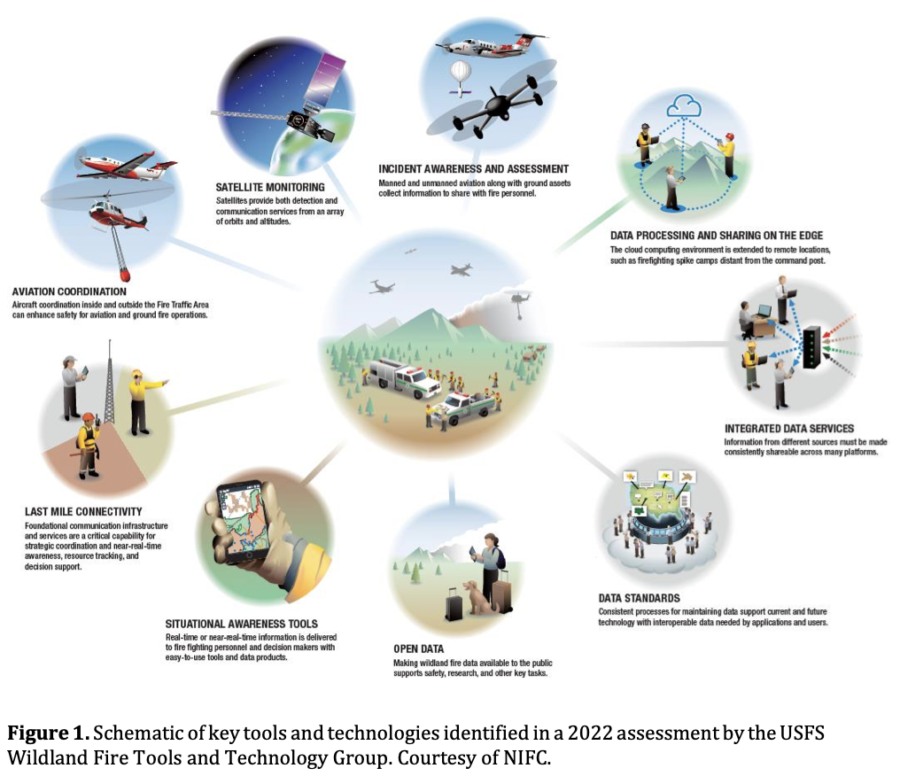
While the goals are straightforward the implementation is complex, as indicated in this graphic from the report.
At the NIFC website, a search for the word “safety” produced 641 results. Hits for “technology” totaled 206, “intelligence” 121. “Location-based” yielded 24 results, though most were variations of “allocation.” The most concrete reference is to the 2023 Red Book, where there’s a reference to “Location Systems,” on page 42 of the BLM section:
“The LBS [Location-Based System] Program combines current Global Positioning System (GPS) technologies with BLM fire and aviation preparedness to provide a situational awareness tool by tracking equipment. LBS is incorporated into dispatch and other operating procedures to enhance situational awareness and accountability of WCF 600-class fire equipment. This program meets the intent of S.47 – John D. Dingell, Jr. Conservation, Management, and Recreation Act, SEC. 1114. (d) 12 Location Systems for Wildland Firefighters.”
With wholehearted respect for the BLM’s LBS program and the efforts to date, the federal location systems in their entirety seem a far (and hard to track) distance from meeting the intent of the 2019 Dingell act.
This week’s PCAST recommendations seeks to correct the “vulnerabilities and pitfalls” of our current processes and accelerate the urgency toward this decade-long search for the “Holy Grail” of location systems. It’s a race we need to win.
James Taiclet, CEO of Lockheed Martin, says “21st Century Security” means that large defense contractors can quickly deliver mission-focused defense capabilities to complex problems outside the traditional defense sphere. Taiclet is focusing on wildland fire, addressing the tough challenges recently highlighted by the President’s Council of Advisors on Science and Technology.
Lockheed Martin has considerable expertise as an integrator of complex technologies, but the company is oriented toward selling big things to a small number of big federal customers. Lockheed’s now shifting to focus on developing systems for big markets like F-35 Lightning II fighter jets or naval combat systems, while firefighting represents the civil component of the 21st Century Security initiative. But as Forbes recently reported, the wildfire marketplace offers no simple route to a big sale.
“Wildfire is one of the toughest national challenges in America,” wrote Craig Hooper, senior contributor at Forbes. “Chronically underfunded, subjected to brutal operating conditions and operating under the constant specter of death, wildfire fighters have little time for gimmicks, ineffective gear, and wasted funds. It is a no-nonsense business, with buyers scattered throughout local, state, and federal governments. If something doesn’t work or is too costly, America’s wildland firefighters won’t buy it.”
On February 13 wildfiretoday.com detailed the federal Wildland Fire Commission’s first report to Congress, which focused on the aviation sector after the federal legislation creating the commission prioritized aerial firefighting as key.
San Diego Fire Rescue’s Firehawk at HAI 2020, January 2020 photo by Bill Gabbert.
“We’re sitting at a point now where we can actually predict where fires might start, and start moving assets there,” said Taiclet. In a joint project with NVIDIA, Lockheed is working with the USFS and the Colorado Division of Fire to use artificial intelligence (AI) to predict and simulate fire behavior. Lockheed’s Cognitive Mission Manager system will integrate a range of sensor- and AI-informed inputs to recommend courses of action. Ultimately, says Taiclet, these would feed into “things that we make that actually do fight fires today.” Those things include the Sikorsky FIREHAWK® helicopter and C-130 airtankers.
“The Department of Defense is only beginning to engage America’s wildfire fighting community,” wrote Hooper for Forbes. “Lockheed has sufficient access to Pentagon decision-makers that the company could, essentially, write up the Defense Department’s strategy for supporting civil authorities during wildfire season, setting the foundation for a national-level NORAD-like early wildfire detection and response capability.”
There’s yet another dumb hiker in the news for starting a wildfire to signal rescuers after he got lost. Philip Powers, a resident of Tempe, Arizona, argued in court that the fire he set in 2018 was necessary to save his life. But a federal court found that he was so unprepared that he created his own emergency.
Backpacker Magazine reported that the 37-year-old hiker in the rugged Sycamore Canyon Wilderness northwest of Sedona, in late May 2018, had barely slept and had muscle cramps in his legs. He’d also found a rattlesnake in the sheepherder shack where he’d overnighted. It was 14 miles back to his car, he was out of food and water, and he had no cell signal. Powers later told a USFS law enforcement officer that he feared he was “done.”
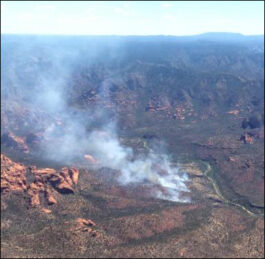
2018 Sycamore Fire in Arizona, looking north. USFS photo.
He’d tried the night before to start a signal fire, but it quickly burned out. He tried again, piling dry foliage around the base of a snag and firing it up with his Bic lighter. He hoped that the dead tree would go up in flames, and someone would see it and come to his rescue. But the fire got away, tripled in size in one day, and quickly grew to 230 acres; the Sycamore Fire took over a week to contain. A federal district court recently convicted him for his actions in 2018, and Powers now owes the feds almost $300,000 in restitution — and a year of probation.
Fronteras Desk reported that Judge Camille Bibles didn’t buy the hiker’s excuses. “Had Powers engaged in adequate preparation in planning and carried adequate water, food and gear, he would not have found himself in his circumstances,” she wrote. “Thus, the court finds that Powers’ necessity defense fails, as he created the conditions necessitating the commission of the fires, and his subsequent rescue.”
Powers faced 3½ years in prison for the seven misdemeanors he was charged with. Judge Bibles sentenced him to seven concurrent one-year probation periods instead. He also owes the Forest Service more than $293,000 in restitution, which he will make in $200 monthly payments.
In addition, the judge ordered Powers to complete a hiking safety course.
According to 12News in Arizona, he’s already filed an appeal of his conviction.
The launch of the United Aerial Firefighters Association adds a unified industry voice to help shape changes in fire aviation practices, policies and funding.
As noted in their launch release on February 16, the UAFA was founded in “an effort to respond to the ever-growing wildfire challenge” and unites “leading aerial firefighting companies … to form a powerful industry association that will serve to foster safety and standardization in the aerial firefighting community.”
The UAFA identifies as “the only association dedicated to aerial firefighting and is a unified voice advocating for safety and standardization on the local, state, and federal levels.” Membership is open to those who own, operate or lease wildland firefighting aviation assets, and companies supporting the aerial firefighting industry. Additionally, free memberships will be available to nonprofits and state and national agencies engaged in the wildfire community.
“We’ve seen tremendous change occur in wildland fire aviation over the last twenty years,” says John Gould, President and CEO of 10 Tanker Air Carrier, who is one of the founding members as well as the UAFA’s first president. “As we look ahead, these challenges will only become more significant. While individual organizations within the industry will always be competitive, we believe the collective expertise represented within UAFA membership will help to ensure our industry continues to grow with the innovation, safety, and standardization necessary to deliver the best service possible to our customers.”
The UAFA’s entry into policy and planning occurs at an opportune moment. With the initial report on fire aviation released this week by the Wildland Fire Mitigation and Management Commission, the need and value of a focused industry-expert voice becomes more apparent. Though the phrase “private aviation” only occurred three times in the commission’s report, some variation of “contract,” “contracting” or “contractor” appeared 132 times, including in the second recommendation: “Efforts should be made to include contractor perspectives in any future strategy development given that, at this time, the majority of aviation resources in the federal fleet are owned and operated by contractors.”
And in the third recommendation: ”A national strategy should consider all ownership models, including contracting and government ownership of aviation resources.”
Recommendations 5, 6 and 7 focus specifically on the contracting and financing of fire aviation, all seeking to resolve an interconnected set of concerns summarized in Finding 4: “Agencies’ current budget structures and contracting constraints have incentivized the use of contracts that are seasonal, shorter term, and, while incorporating best value considerations, ultimately favor short-term budget expediency over long-term value.”
As Gould observed in an interview with Wildfire Today/Fire Aviation, the initiative for founding the UAFA preceded the Wildland Fire Commission – so board members were able to meet with the commission and “were gratified to see that some of the points we discussed made it in to the report,” even though the UAFA was still in its founding phase.
“It’s the right time, right place” for the industry to come together, Gould said. While many of the members have met individually in the past with members of Congress and the US Forest Service and related agencies to share their perspectives, they were often asked “what does the industry think? We see the advantages of speaking as a single voice, a unified voice. We realized that within our individual companies we have an expertise and experience yet there’s nobody that really speaks for our industry, to get the messages to our customers and to the Hill.”
UAFA has opened an office in Washington, D.C., and is planning to hire an executive director this spring. One of their first charges will be “to discuss what our organization can do. The breadth of experience you find in UAFA reaches back into into 20, 30 years of experience and innovation. And innovation comes in a lot of forms, so the challenge is how do you integrate it into fire … with the association, we bring experience across all aspects of innovation, safety and standards.”
When Ed Pommerening died last Christmas Eve in Kellogg, Idaho he left a forestry legacy that is unmatched in Idaho history. I grew up in Kellogg and knew Ed mostly by reputation. We last talked by phone in 1996. I was in the middle manuscripts for an Evergreen edition featuring forests and forestry in Idaho and I wanted to include a short story about the miraculous rebirth of forests on the barren hills of my youth.
Ed is the reason Idaho’s Silver Valley between Smelterville and Big Creek is covered with countless thousands of conifers, many of them 50 feet tall. It is a stunning tribute to the dogged determination of a young man who once told me that the Kellogg he saw for the first time in 1972 reminded him of the godawful agent orange devastation he’d seen while serving with the 101st Airborne Rangers in South Vietnam.
That young man was Ed Pommerening. He was coming to Kellogg then to begin work as the Bunker Hill Company’s first forester. “Uncle Bunker” was by far Idaho’s largest industrial employer, the Union Pacific Railroad’s largest customer by tonnage, and the largest power consumer in the entire Washington Water Power system. At one time, Bunker Hill was the largest mining and smelting company in North America. It supplied most the lead we threw at the Germans and Japanese during the Second World War.
I worked my way through college in company stopes a mile beneath the streets of Kellogg. It was dangerous as hell — but great fun. I have no idea what convinced Ed that he could turn the Silver Valley’s barren hills green again — or how he convinced the company to invest in the crazy idea that he could grow countless thousands of seedlings 3,000 feet down in the mine, but in August 1975 company carpenters built Ed’s first 40-foot long underground greenhouse. One of my late father’s plumbing crews ran the water lines.
The scale of Ed’s thinking was breathtaking but the idea was not new. Many miners grew vegetables in pots in pitch black drifts with only the illumination of a single lightbulb. The air temperature was a constant 72 degrees, so all you had to add was some soil, water from a nearby drill line, a little light, and voila! It certainly helped that Ed had earned two forestry degrees from the University of Idaho. His connections would prove invaluable after his first seedlings died soon after they were transplanted on treeless hills by high school kids and civic groups.
The same thing had happened to seedlings my Cub Scout pack planted in Vergobbi Gulch in the 1950s. We never knew why, but soil scientists at the University of Idaho figured out that sulfur dioxide gas released from stacks at the Bunker smelter had polluted the soil. Acid was killing the seedlings. The solution: plant them deeper and add a dash of neutralizing potash for good measure. The beautiful result graces both sides of Interstate 90 between Smelterville and Big Creek: Ponderosa, Scotch and Austrian pine, Douglas-fir, western larch, western white pine, blue spruce, willow, and poplar.
The homesteader’s apple orchard behind our home on Mission Avenue has given way to a sea of green that turns to gold in the fall. Words seem inadequate.
A very good case can be made for the fact that the Silver Mountain Resort and Ski Area and its legendary gondola are prospering today because of Ed Pommerening’s modesty and quiet determination. Small wonder that his forestry consulting business, Riverview Timber Services, thrived for decades.
The Kellogg where I grew up is long gone: the smelter whistles that announced shift changes, the friends I made underground, Al Laramie at the piano on Friday nights at the old Sunshine Inn, and the vibrancy of Kellogg’s booming economy. We thought Bunker would go on forever. For better or worse, it didn’t. The end came in 1981. Labor strife and unattainable federal air and water quality standards were the main reasons. But Ed’s vision provided the catalyst for Kellogg’s rebirth.
The power of forestry turned the barren hills of my youth green again and my hometown has a future. There is a bronze statue of a miner at the corner of Main and McKinley Avenue in uptown Kellogg. There needs to be one of Ed standing beside him.
WATCH THE VIDEO: The Reforestation of Silver Valley is a fascinating story told by Ed Pommerening and others about an industry that took the initiative to solve a major environmental problem in northern Idaho. The video was funded by the Kootenai-Shoshone County Farm Bureau and Idaho Farm Bureau and was produced by Matthew Bane. Watch it [HERE].
The largest wildfires in the West — often called mega-fires — have increased in both size and number in recent years. The fire season — in both length and severity — increases nearly annually. Severe wildfire — classed in various ways but often as fire that kills most of the trees in its path — has by some reports increased eightfold in 30 years.
Fire science and experience over decades of research and field practice have settled on a major prevention tool: fuels reduction. This term includes both thinning (mechanical removal of shrubs and mostly small trees) and prescribed burning (intentional introduction of fire under favorable conditions).
A recent issue of High Country News features a report by Emily Shepherd, a freelance writer who worked in wildlife conservation for eight years, followed by two years as a U.S. Forest Service hotshot. She explains that wildfire ecologists almost universally support fuels reduction, especially in forests that had previously flourished under frequent ground fires — such as the ponderosa pine forests of Arizona and the Southwest.
While there’s no serious cohort of scientific dissent, forest managers still struggle to put their fuels reduction knowledge and goals into practice. “Forest thinning” is the target of prolific misinformation from groups ranging from the simply uninformed to the nationally well-funded (and well lawyered up), while locals in the area where prescribed fire is planned often see rxfires as just a nuisance or annoyance. To its opponents, thinning is a form of “silviculture by stealth,” as wildfire historian Stephen Pyne puts it; he says thinning is more like “woody weeding.” Logging harvests large, mature trees over large areas, he explains, while thinning mostly removes small trees. Logging makes money; thinning almost always costs money.
Thinning should be followed by prescribed fire. “If you don’t follow it up with the right fire, then it’s worthless,” says Pyne, “and in many cases may have made it worse.” Thinning and prescribed burning are the one-two punch that can knock out severe wildfires. Like everything, prescribed fires do have drawbacks: They are complicated to plan and execute, they dump unwanted smoke on nearby communities, they’re subject to litigation, and in rare instances they can ignite destructive burns or even get agency staff arrested.
“We conduct an average of 4,500 prescribed fire projects annually,” said USFS Chief Randy Moore in the spring of 2022, “and 99.84 percent go according to plan. That equals slightly more than one escape per every 1,000 prescribed fires, or about six escapes per year.”
As long as terms like “thinning” are used and abused by non-scientific groups with a bias, though, there will always be conflict. A report by Oregon Public Broadcasting not long ago was headlined “A southern Oregon conservationist’s wishlist for better collaboration with the BLM” in which Roman Battaglia, a reporter with Ashland-based Jefferson Public Radio, interviewed Luke Ruediger, executive director of Applegate Siskiyou Alliance, about the Medford area BLM’s latest forest management plan, known as the Integrated Vegetation Management Plan. “A lot of the problem that we see is that increasingly the federal government and federal land managers are not making that effort to communicate and collaborate or even to share basic information on federal land management projects with the public,” said Ruediger. “And that’s leading to a lot of issues surrounding trust.”
“It’s also creating a lot of situations where, essentially, the BLM is operating in secret and refusing to provide information on the projects that they’re designing on federal lands to the public that those projects would affect,” claimed Ruediger.
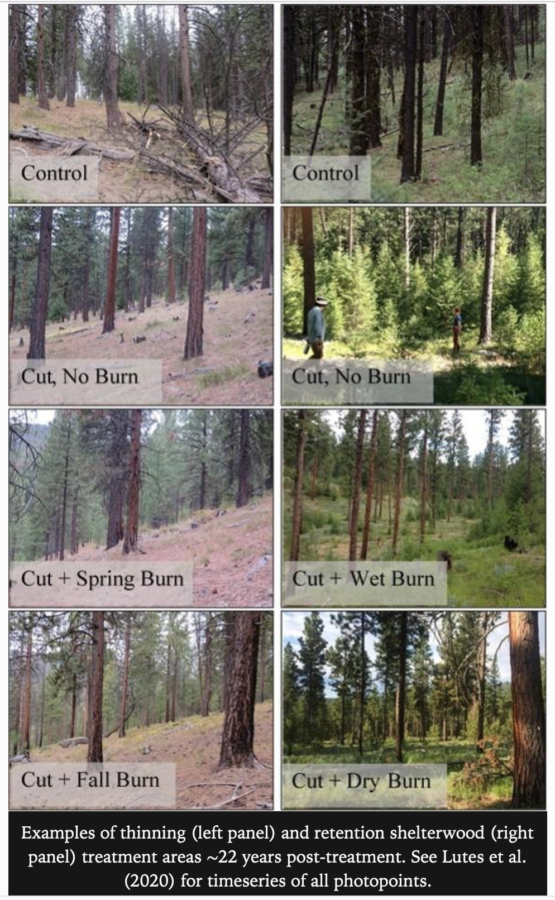
Opponents of thinning and other fuels treatment methods really need to take a look at the history of Lick Creek in Montana. The Lick Creek Demonstration – Research Forest studies were established back in 1991 in western Montana to evaluate tradeoffs among alternative cutting and burning strategies aimed at reducing fuels and moderating forest fire behavior while restoring historical stand structures and species compositions.
Firefighters and numerous studies over many years credit intensive forest thinning projects with helping save communities like those recently threatened near Lake Tahoe in California and Nevada, but dissent from some environmental advocacy groups still roils the scientific/environmental community. An Associated Press story out of Sacramento in October of 2021 noted that environmental advocates say data from recent gigantic wildfires support their long-running assertion that efforts to slow wildfires have instead accelerated their spread. “Not only did tens of thousands of acres of recent thinning, fuel breaks, and other forest management fail to stop or slow the fire’s rapid spread, but … the fire often moved fastest through such areas,” Los Padres ForestWatch, a California-based nonprofit, said in an analysis joined by the John Muir Project and Wild Heritage advocacy groups.
But James Johnston, a researcher with Oregon State University’s College of Forestry, called the groups’ conclusions “pretty misleading,” “irresponsible” and “self-contradicting.”
“Claims that modern fuel-reduction thinning makes fire worse are not credible,” Johnston said.
Chad Hanson is an ecologist with the John Muir Project and the author of Smokescreen: Debunking Wildfire Myths to Save Our Forests and Our Climate. “Wildfires can always turn tragic,” says Hanson, “but the greater tragedy in Greenville and Paradise, which was largely destroyed during the 2018 Camp Fire, and other towns is that they put their faith in logging operations miles away rather than proven, community-based fire prevention measures. Forest thinning is gaining more media attention and is heavily promoted by some land management agencies and logging interests, but science suggests the technique more often makes fires burn hotter and faster. The idea of felling trees and hauling them to lumber mills in the name of fire prevention has many deceptive names: fuel reduction, forest health, ecological restoration, thinning, and even reforestation.”
KGW-8 News reported on Johnston’s work with OSU, writing that the forestry sciences community forecasts massive wildfires like the ones that burned in Oregon last year will only get bigger and more severe. However, new research suggests that thinning the forests can go a long way toward preventing severe fires. [ related: video ]
“This study shows that fuel reduction thinning to moderate fire behavior … works,” said Johnston. His research focused on a ponderosa forest in northeast Oregon, where his team compared thinned stands of trees with un-thinned control stands and then used computer modeling to predict the behavior of future fires. “Most fuel reduction projects in eastern Oregon thin from below and cut down the smaller trees and leave the old large fire-resistant trees,” Johnston said. “That leaves behind a forest that’s less dense, and our studies show it has a less far less fuel to burn in future fires.”
Johnston said the result is even better when prescribed burning is added. “The only way to fight fire is with more fire,” he said.
It’s easy to see why the influenceable public can become confused, with a wide range of communications and opinions about complex forest and fire management topics. But two rural Josephine County communities are working with federal fire managers, according to a report by KDRV-TV, to improve wildfire resilience in southern Oregon. The BLM recently issued its “decision to promote safe wildfire response, develop fire-resilient lands, and create habitat for special status species” for a project near the communities of Murphy and Williams, both south of Grants Pass.
The BLM project is called Late Mungers Integrated Vegetation Management Project. It includes prescribed fire, fuels thinning and selective harvest phases; over the next 10 years the BLM expects fuels reduction work on about 7,500 acres under this project.
Fire managers plan to start at strategic locations where firefighters have the best chance to catch and contain wildfires. The project also includes 830 acres of proposed harvests split into two timber sales: Late Mungers and Penn Butte. “By using selection harvest methods, these treatments will increase the diversity of the forest stands,” according to the BLM. “This more complex habitat is important for the northern spotted owl, the marbled murrelet and Pacific marten (federally listed as threatened under the Endangered Species Act), as well as other special-status species.”
During the project’s public comment period, the BLM collected more than 100 comments, and the project team hosted a field trip to the project area and held a public webinar to collect further input about the project. The final document, including BLM’s response to comments, is online at eplanning.blm.gov/eplanning-ui/project/2018484/510 and there’s a detailed PDF map online [HERE].
“Forests in Southwest Oregon are in dire need of active management to maintain and improve forest health,” said BLM District Manager Elizabeth Burghard in Medford. “The Late Mungers project is an important step toward promoting and developing complex forest habitats for the northern spotted owl and other sensitive species. This project will make the landscape, including legacy trees, more resilient to wildfire by addressing hazardous wildfire fuels near local communities.”
(UPDATE February 14, 2023: To clarify — the rationale for releasing a report on Aerial Equipment first was a component of the guiding legislation that specified, in the “Duties of Commission,” that a “Report on Aerial Wildland Firefighting Equipment Strategy and Inventory Assessment” would be submitted per a prioritized schedule – an initial surplus inventory within 45 days of the commission’s first meeting, and a report to Congress 90 days after the inventory. See the statute at https://www.usda.gov/sites/default/files/documents/title-two-wildfire-mitigation.pdf. Thanks to a commission member for the helpful reminder to always confirm with the guiding legislation.)
To choose aviation for the first report from the Wildland Fire Mitigation and Management Commission might be seen as harvesting the lowest hanging fruit, or cornering the largest elephant in the room. In actuality, the guiding legislation created specific timelines that prioritized fire aviation as a key and initial priority. Whatever the colloquial phrase, the Commission’s swift creation of the Aerial Equipment Strategy Report offers a challenging and potentially quite fruitful focus.
The report, released on February 13, 2023, frames the status of fire and aviation today in eight findings, which in turn aims us to 19 recommendations. Both the framing and the aiming may raise familiar notes — but in this case there is a universal urgency that reflects the accelerating fire challenge as well as the timeframe for the Commission, which has a year from their first meeting on September 14-15, 2022 to submit recommendations to Congress.
The Commission’s mandate and 50-person membership resulted from the 2021 Bipartisan Infrastructure Law (BIL) (https://www.whitehouse.gov/build/), which features a focused timeline and inclusion of a wide range of wildland fire experts and stakeholders – more than half representing non-federal entities (and more than 2/3rds, if you include alternates). The BIL included $8.7 billion for wildfire management under the umbrella of resilience, with the greatest proportion of funding tagged to “the Department of Agriculture’s Forest Service ($3.37 billion) and the Department of the Interior ($1.46 billion) for wildfire risk reduction.”
As the report notes, the time for this strategy is overdue when considering the commission’s legislative charge to develop “a strategy for meeting aerial equipment needs through the year 2030” (a mere seven years from now) – which may be why the recommendations aim a trajectory into future decades for aviation and fire management in general.
The Commission’s first report operates within a framework that places aviation as a component of an overall strategy for a changing fire environment:
“In developing these recommendations, the Commission also sought to address several key themes: the need to develop an overarching, forward-looking aviation strategy that drives procurement, rather than letting aviation approaches become constrained by current practices; the need to invest in both technology and people to build an aviation fleet that meets long-term demand; and the need to take an inclusive approach to the range of functions aerial resources can serve and the range of entities that must be included in development of a truly national – rather than federal – aviation strategy.”
The topics, as organized by the commission, are grouped by aviation strategy, military-sharing opportunities and challenges, contracting, staffing, aviation use for beneficial fire (beyond suppression), and uncrewed aerial systems.
This first report of recommendations merits a full read – but in support of its urgency, consider this summary of Findings and Recommendations as a streamlined tally sheet for tracking the tasks ahead.
FINDING
RECOMMENDATION
Aviation Strategy
1) Fire Year
2) Aviation not sole solution
3) National strategy to define needs
R 1: Regional Standards of Cover.
R 2: Include contractor perspectives.
R 3: Consider national strategy for all ownership models of aviation.
R 4: Compare costs of Dept .of Defense (DoD), government and private aviation assets.
Contracting and Appropriations
4) Budgets favor short-term over long-term
R 5: Improve effectiveness, efficiency of contracting.
R 6: Contracts meet national strategy.
R 7: Funding for increased fire seasons.
Staffing
5) Lack of qualified personnel a bottleneck
R 8: Congressional funding for aviation training, staffing at all levels.
R 9: Explore private contractors as NWCG staff.
R 10: Explore technology to increase effectiveness, reduce staff.
Military Interoperability
R 11: Uniform training for DoD and land management for interoperability.
R 12: National aviation strategy to consider needs outside continental U.S.
R 13: Continue DoD for surge after other aviation assets utilized.
Military Surplus
6) Surplus adoption has risks, costs
7) Benefit to surplus parts
R 14: DoD surplus for all wildland fire community.
R 15: Wildland fire community to develop annual list of surplus needs.
R 16: Evaluate purpose-built or modified aircraft for wildland fire.
AerialResourcesandBeneficialFire
8) Beneficial fire use limited by aviation capacity
R 17: Aviation resources for risk mitigation, prescribed fire.
UncrewedAerialSystems
R 18: Improve UAS technology in wildland fire.
R 19: Develop national UAS strategy for wildland fire.
Topics still open for comments include …
Comments due by February 22: Science, Data, and Technology
Public Health and Infrastructure
Comments accepted March 1-22: Appropriations
Workforce
Two survivors of a wildfire that destroyed much of Lytton, B.C. in the summer of 2021 say their lawsuit should be certified as a class action. The chief justice of the B.C. Supreme Court will decide whether the case, initially filed in October of 2021 by two residents who lost their homes, has a broader scope.
CBC News reported that on the hottest day of 2021, a fire in the Fraser Canyon burned more than 800 square kilometers, killed two people, and destroyed much of the village. Investigators found no evidence that a passing train caused the fire, but the lawsuit claims the fire was started by either a Canadian National or Canadian Pacific train on its way through the village. According to the Calgary Sun, lawyers for Christopher O’Connor and Jordan Spinks, the two representative plaintiffs in the case, argued in court that the fire was ignited as a result of a coal train owned by Canadian Pacific Railway passing through the village on June 30, 2021. Spinks is a member of the Kanaka Bar Indian Band and has said that he witnessed smoke and flames on CN Rail’s right of way, at or near CN Rail’s bridge that crosses the Fraser River. He had just finished his shift as a care aide at an assisted-living facility and lost his job as a result of the fire. O’Connor, a resident of Lytton, lost his home in the fire and had his vehicle damaged.
The railway companies deny any responsibility for the fire and cite a report by the Transportation Safety Board of Canada that concludes there was no link between train operations and the fire. But Tony Vecchio, a lawyer for the plaintiffs, said the report was deficient in a number of respects and should not be relied upon.
“They didn’t have any basis to make this finding at all, on their own evidence,” Vecchio told B.C. Supreme Chief Justice Christopher Hinkson. He pointed out errors in the report, including the number of railway cars on the train, and said investigators failed to interview a number of witnesses.
The British Columbia Wildfire Service said that in 2021 between April 1 and September 30, 1,610 wildfires had burned 868,203 hectares (2.145 million acres) across British Columbia. Moody’s RMS reported those numbers were in stark contrast to 2019 and 2020 when the total area burned in the province was less than 25,000 hectares (61,776 acres) per season.
On Sunday, June 27, the temperature in Lytton reached 46.6°C (116°F). On Monday it reached 47.7°C (118°F). And then on Tuesday, June 29, Lytton recorded the highest-ever temperature in Canada: 49.4°C (121°F). Extended drought conditions held through April and into June, meaning many areas were already on extreme fire hazard ratings when on June 29, 2021, the small town of Lytton made it into the record books for the third time in three days.
The Guardian has a photo essay of the Lytton fire online.
Two pilots walked away from an airtanker crash on Monday while fighting bushfires in Western Australia. Initial reports indicate that Coulson’s 737 took off from Busselton about 3:25 p.m. and went down about 4:40 p.m. in Fitzgerald River National Park, about 460 kilometres southeast of Perth. According to news.com.au the Australian Maritime Safety Authority (AMSA) detected an emergency beacon activation from the airtanker approximately 185 kilometres west of Esperance. The agency issued a statement saying there were no other crew aboard the airtanker when it crashed. Both pilots were transported by helicopter to Ravensthorpe Health Service, and ABC.net.au news reported that the pilots were not seriously injured. The Western Australia Department of Fire and Emergency Services (DFES) and the Australian Transport Safety Bureau (ATSB) are conducting separate investigations into the crash.
The Alberni Valley News (in British Columbia, where Coulson is based) reported the investigators will interview pilots and then examine the wreck. “Initially, investigators will interview the pilots and witnesses to understand the circumstances of the accident, and determine the accessibility of the accident site with the aim of conducting an on-site examination of the aircraft wreckage,” said the ATSB in a statement.
This is the second incident for Coulson Aviation during firefighting operations in Australia, after a C-130 heavy airtanker crashed in 2020, killing all three on board.
Tanker 139 — the 737 — had just been awarded a contract last month. This flight was the airtanker’s third drop of the day.
737 flight path, FlightRadar24 image.
A news report by aerotime.aero said the 737 flew for more than 40 minutes before it crashed in the Fitzgerald River National Park. According to flightradar24.com, its last recorded altitude was 675 feet (205.7 meters) at 4:13 local time (UTC +8). A report by samchui.com indicated the ATSB was assembling a team from its Perth and Canberra offices with experience in aircraft operations and maintenance, human factors, and data recovery to conduct the evidence-collection phase of the investigation.
Coulson Flight Path: Twitter/ @flightradar24
This airtanker is a Coulson Flying Tankers 737-300 Fireliner registered as N619SW. The 737 was delivered new to Southwest Airlines in 1995 and was acquired by Coulson in 2019. It entered firefighting service in the U.S. after conversion in summer 2022, and it flew to Australia in December 2022.