Frank Carroll stirs up Lake Tahoe

“The Forest Service has no authority to let fires burn millions of acres — misappropriating tax dollars and recklessly destroying our natural resources. It’s an inverse condemnation of private property and wanton destruction of public resources, pure and simple.” ~ Frank Carroll

Agitator Frank Carroll, whom Dana Tibbitts with the Nevada Globe refers to as a “Chief Forester,” is an active part of this “discussion” in the Tahoe Basin and in New Mexico and other states, advising forest owners who hire him and assisting people in suing the Forest Service over losses resulting from escaped prescribed fires or managed fires that burned more acreage than Carroll thinks they should have. In her report, Tibbitts quotes anonymous sources to claim that FS Chief Randy Moore’s “Burn Back Better” letter (the annual fire-related “letter of intent”) has “caused a firestorm among firefighters and Forest Service veterans nationwide.”

Some of Tibbitts’ anonymous sources are associated with the “National Wildfire Institute,” founded by Bruce Courtright (retired FS Deputy Chief for Management Improvement) and Michael Rains — who at one time directed the USFS Forest Products Lab. Char Miller in the Los Angeles Times refers to the group as “a suppression-friendly bloc of retired Forest Service officials,” but they don’t seem to have a website or any publicly visible managers or founders besides Rains and Courtright.

Some other more widely respected retired fire experts disagree, and they’ve written here before on this topic, citing the founder of the U.S. Forest Service Gifford Pinchot. “The debate within the agency defies permanent resolution,” writes Char Miller,”not least because deference to political exigencies is baked into the Forest Service’s DNA. For that, we can thank, or blame, Pinchot.”

Miller is a senior fellow of the Pinchot Institute for Conservation, and a fellow with the Forest History Society. “In an 1899 article in National Geographic,” he explains, “Pinchot clearly detailed wildfire’s essential role in regenerating forests in the South and mountainous West. But despite this robust ecological evidence, it would be fire’s bad optics that drove his pitch for establishing the Forest Service.” As per the agency’s first manual: “Probably the greatest single benefit derived by the community and the nation from forest reserves is insurance against destruction of property, timber resources, and water supply by fire.”

Carroll and his cohorts, though, claim that the USFS “just gave firefighters license to burn millions of acres of forest and rangelands with zero commitment to putting the fires out.”

Tahoe-Douglas Fire Chief and head of the Northern Nevada Fire Chiefs Association Scott Lindgren said, “The latest forecast and guidance from the Chief is so unhinged from firefighting realities on the ground as to defy rational analysis or practical guidance.”

“It’s caused a firestorm among firefighters and Forest Service veterans nationwide.”  ~ Dana Tibbitts
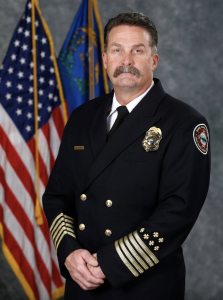
Fire Chief Scott Lindgren, Tahoe Douglas Fire Protection District

According to Tibbitts and the Nevada Globe, USFS Regional Foresters are supposedly enacting a new policy now, calling for all fires in the Tahoe Basin to be risk-assessed and monitored by those same Regional Foresters, “who alone would determine the appropriate response to new fire ignitions.”

Chief Lindgren says allowing fires to burn is criminal and claims that allowing fires to burn means the USFS can count those acres as “treated” in burn quotas ordained by administrators in Washington DC. “These are not treated acres,” he says, “they are destroyed acres!”

Frank Carroll says USFS fire commanders and administrators are using firefighter safety as a false flag to justify wildfire use, even at the expense of civilian lives and devastated communities.

“Firefighter safety is an excuse that is neither safe nor supportable — a feature of the persistent failure to build informed consent and to analyze environmental impacts before letting wildfires burn and then expand them on purpose,” Carroll said. “They’re unilaterally implementing giant prescribed wildfires — consequences be damned.”

According to the anti-managed-fire crowd, the Biden-Harris administration’s plan to Burn Back Better is detailed in Confronting the Wildfire Crisis and lays out a 10-year program to treat 20 million acres of National Forest System lands and 30 million acres of other federal, state, tribal, and private lands. Randy Moore Letter of Intent 04/24/24
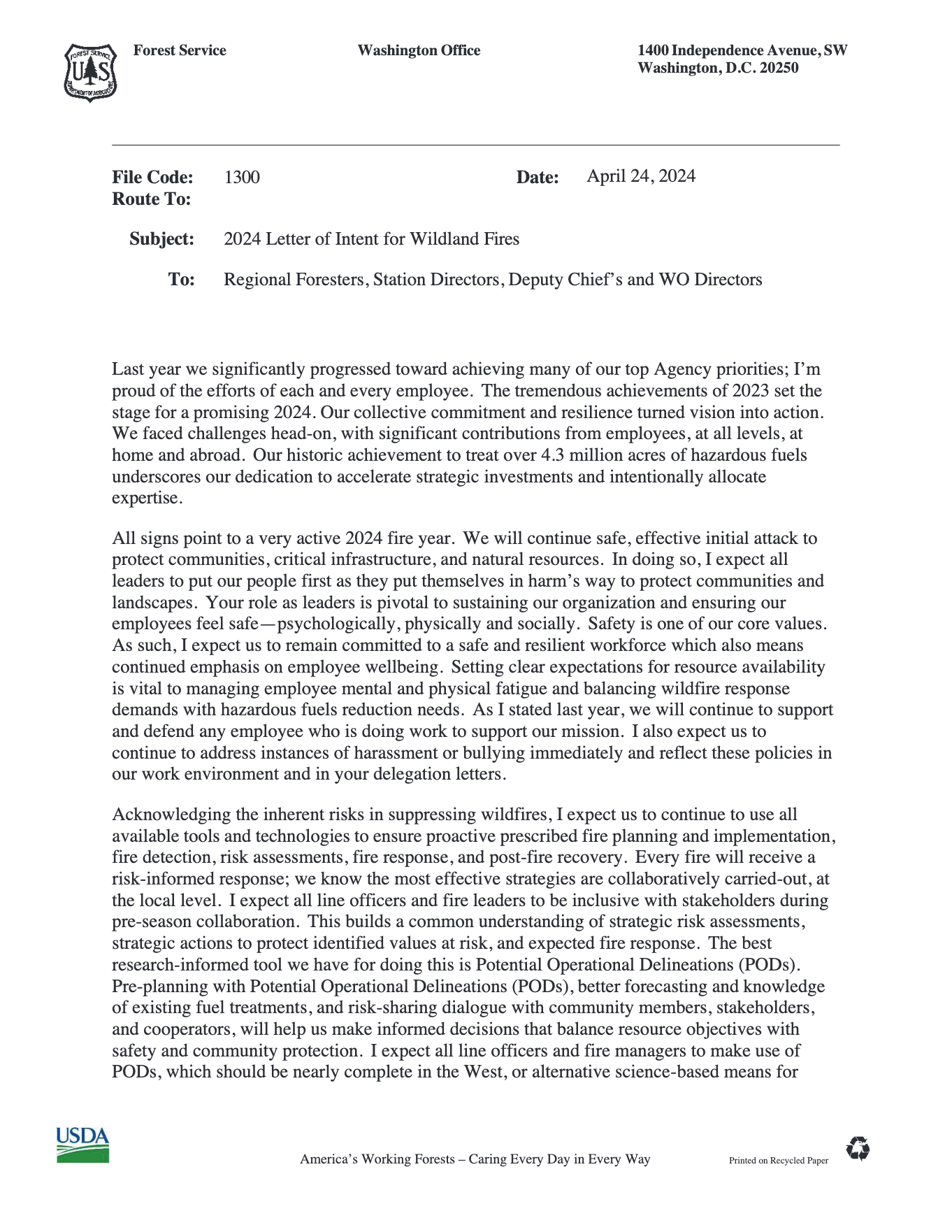
Randy Moore Letter of Intent 04/24/24 — click to read

British Columbia starts season with most applicants in a decade

More than 2,000 applicants wanted to be a part of the British Columbia Wildfire Service in 2024, the highest number of applicants the service has seen in the past decade. The agency told WildfireToday that the application boost was linked to feedback received from the Expert Task Force on Emergencies established last October by BC Premier David Eby after the province’s historic 2023 wildfire season. The task force issued 31 recommendations, some of which were enacted swiftly ahead of the 2024 wildfire season.

Fire management made numerous enhancements to the Service’s wildland firefighter recruitment and hiring process as a result of the recommendations. Upgrades included expanding First Nations boot camps, extending the hiring period for new recruits, and encouraging applicants to indicate their work location preference.

The Service directly attributed the improvements to their having a full staff of 162 Initial Attack Crews and 30 Unit Crews in 2024, compared with the 149 Initial Attack Crews and 30 Unit Crews in 2023. Approximately 1,300  fire crew positions are employed directly with the Service, including an additional 500 permanent staff and 300 seasonal positions; 250 new recruits were invited by the Service from its New Recruit Boot Camps and First Nations Boot Camps this spring. The provincial 2024 budget provided $38 million to support stable, year-round staffing, including fire crew leaders and frontline staff who work in structure protection, prevention, risk reduction, and wildfire land-based recovery.

“People living in First Nations, along with rural and remote communities bear a disproportionate impact from the rising threat of wildfires,” said Wayne Schnitzler, task force member and executive director of First Nations’ Emergency Services Society. “I’m pleased to see the Province is boosting recruitment initiatives, including expanding First Nations boot camps as recommended by the Premier’s expert task force on emergencies. These initiatives break down barriers and pave the way for increased participation of Indigenous peoples as wildland firefighters.”

Apart from hiring, the Service said it will continue to implement numerous task force recommendations through 2024, including:

        • Launching a wildfire training and education center at Thompson Rivers University
        • Increasing new technology use to predict wildfire movement and growth
        • Increasing community evacuee support funding
        • Increasing the volunteer pool to support evacuees
        • Boosting wildland firefighting fleet and equipment
        • Enhancing wildfire recruitment tactics

BC Wildfire Service airtankers, meanwhile, are conducting practice flights from Kamloops and Penticton airports in the afternoons. The BCWS said airtankers out of Kamloops are flying the east side of Adams Lake, and  the Penticton aircraft will conduct practice about 40 nautical miles east of Penticton.

CastanetKamloops.net reported that BCWS noted the exact location and timing of tanker practices are subject to change depending on weather and other conditions; the practices don’t involve active fire. After six days with no flying activity, practices are run to make sure aviation teams are ready to respond. “It is important for air attack officers and pilots to practice, as it allows them to remain proficient and prepared to respond to active wildfires,” BCWS said. “Practices also ensure the aircraft are mechanically sound and ready to respond.”

White Mountains fire in New Mexico closes wilderness trails

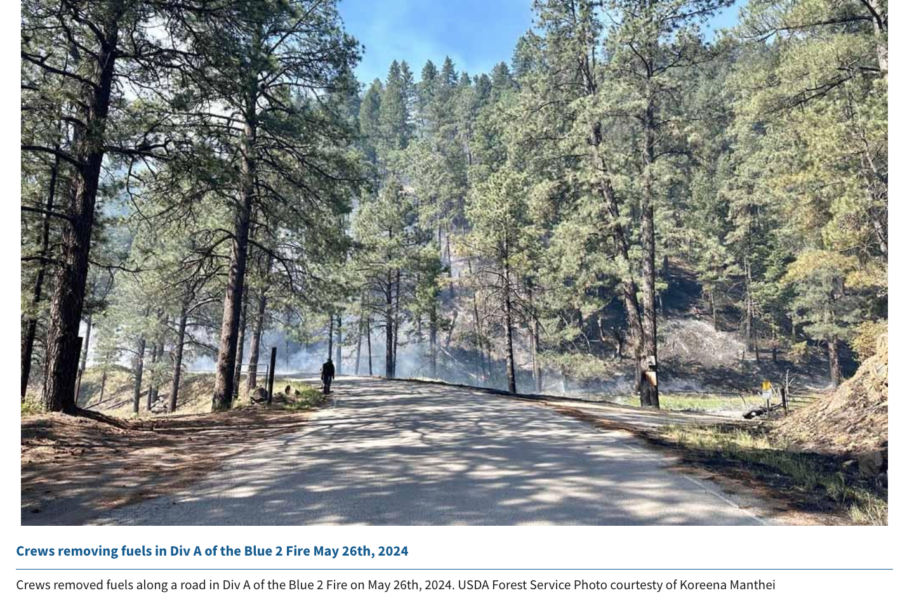
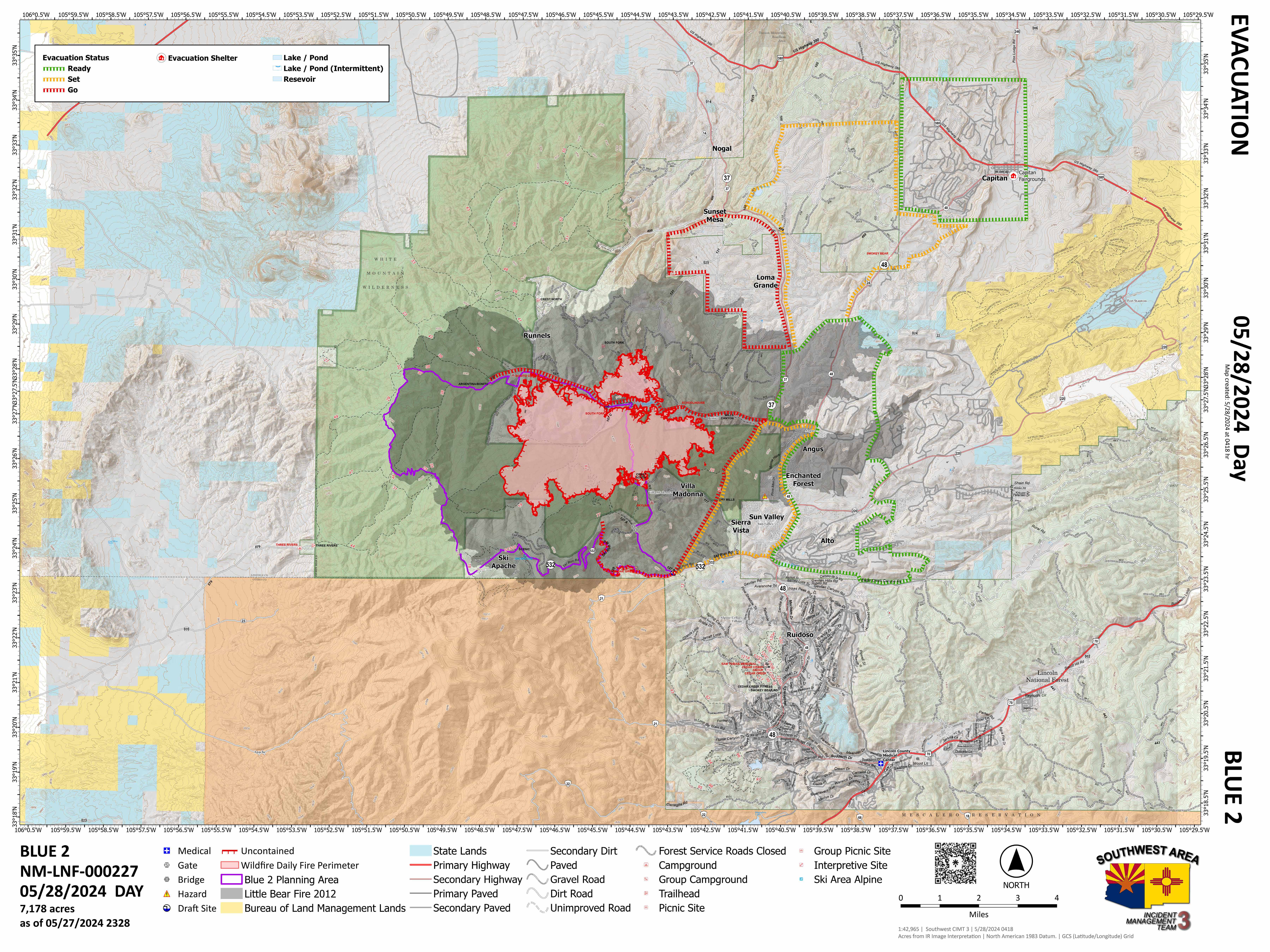
The Lincoln National Forest has issued closure orders for several trails within the White Mountain Wilderness Area on the Smokey Bear Ranger District, and air resources are actively working the 7,200-acre Blue 2 Fire today. The fire has produced more smoke and is still active, even at night, because of high temperatures and dry conditions.

Blue 2 Fire
Blue 2 Fire

The western boundary of the restricted area is at the junction of Forest Service Road 107 and Big Bonito trail #36 and the order is intended to protect firefighters and the public on the Blue 2 Fire. The lightning-caused fire’s just a few miles north of Ruidoso and is still at zero containment, burning in timber and understory with 10 crews and 32 engines assigned. Other resources include 6 helicopters, 6 dozers, and 5 watertenders.

smoke map Ruidoso

According to Ruidoso News, crews are using direct tactics to build line, while aircraft are dropping water and retardant along the firelines. Fire managers are using a feller-buncher in the Ski Run Road area and crews are setting up sprinklers and hoses around local homes for structure protection.

Blue 2 Fire map
Blue 2 Fire map — click for larger version

Updates are available on the inciweb site, and Lincoln County also has updates online.

Flash from the past

Marc Anderson’s got a priceless collection of aviator photos on his facebook page, quite a few of which are Jerry Ogawa photos, including a few below. THANKS Marc and Jerry both!

1992 McCall smokejumpers photo © Jerry Ogawa
1991 McCall smokejumpers photo © Jerry Ogawa
1986 McCall smokejumpers photo © Jerry Ogawa
1984 McCall smokejumpers photo © Jerry Ogawa

Dauntless expands fleet of SEAT scoopers

Dauntless Air has announced a fleet expansion amid increasing demand for its single-engine water-scooping aircraft. The company’s added five more Fire Bosses to its fleet of water-scooping SEATs. In the U.S. a record number of new Fire Boss solicitations were issued during this past off-season.

“The Fire Boss is a game-changer in wildfire suppression,” said Brett L’Esperance, CEO of Dauntless Air.

As far back as 2012, the RAND Corporation recommended an increased focus on scoopers in the U.S. aerial firefighting strategy — amid numerous other airtanker studies. “It’s been a long time coming, but it’s clear that single-engine scooper initial attack is gaining ground around the world,” added L’Esperance.

As climate change and other factors exacerbate the frequency and intensity of wildfires, more states and federal agencies are considering increased focus on scoopers.

A total of 29 OAS-compliant Fire Bosses now operate across 24 exclusive-use and 10 CWN contracts, up from 15 EU and 7 CWN contracts from last year. Dauntless Air holds most of these contracts, many of which were issued by states that have never before offered a SEAT scooper contract.

Internationally, fire agencies have now ordered dozens of Fire Bosses to add to their firefighting fleets. Officials in Greece have ordered a record-setting 31 Fire Bosses in the last two years, and Turkey and Slovenia secured manufacturer contracts — for 15 and four aircraft, respectively.


David Dow’s Fire Boss photos were featured by General Aviation News; photos he captured of pilots conducting training flights at Heber Springs Municipal Airport (KHBZ) in Arkansas; they were operating out of Greers Ferry Lake just north of Little Rock.


BC Wildfire Service looks back at tragic, historic 2023 fire season

Over 7 million acres burned, hundreds of homes destroyed, and tens of thousands of people forced to evacuate. British Columbia’s 2023 season was the most destructive in recorded history. The fires stressed local economies, infrastructure, and local ecology, but also had an unquantifiable impact on the province’s firefighting force, partly caused by the deaths of six wildland firefighters.

“The season has been emotionally challenging and will always be remembered for the tragic loss of six members of B.C.’s wildland firefighting community,” the BC Wildfire Service recently told WildfireToday. “These individuals exhibited remarkable courage, dedication, and selflessness, and their memory will continue to be honoured. Thank you, Devyn Gale, Zak Muise, Kenneth Patrick, Jaxon Billyboy, Blain Sonnenberg, and Damian Dyson for serving and protecting the lands and people of British Columbia.”

The Service said it’s difficult to zero in on one wildfire as the season’s “most memorable” because of the historic nature of the season. The Service, instead, singled out two instances: the lightning-caused Donnie Creek Fire, and the wildfires that burned between August 15 and 18.

The Donnie Creek Fire was discovered on May 12 near Fort Nelson and became B.C.’s largest fire in recorded history after burning 1.5 million acres. The fire exhibited aggressive growth, taking an 18-mile run just five days after receiving 1.6 inches of rain. The fire also resulted in the Service’s second death of  2023 when 25-year-old Zak Muise was killed after his utility terrain vehicle rolled over a sharp drop in a gravel road while responding to the fire.

PREVIOUS COVERAGE: Yet another Canadian firefighter dies … on the largest fire in British Columbia’s history

Extreme heat and strong winds caused numerous wildfires to exhibit intense fire behavior between August 15 and 18, according to the Service’s season summary page. More than 40 heat records were set during the period, and a following cold front brought strong gusting winds of 25 to 37 mph. Numerous wildfires spread exponentially during the extreme weather patterns, including:

        • The Kookipi Creek Fire near Boston Bar
        • The Downton Lake Fire near Gold Bridge
        • The Casper Creek Fire near Shalalth
        • The Crater Creek Fire near Keremeos
        • The McDougall Creek Fire adjacent to West Kelowna
        • The Bush Creek East and Lower East Adams Lake fires in the Shuswap merged as a result of the extreme weather
Kookipi Creek Fire
The Kookipi Creek Fire 16 kilometers northwest of Boston Bar and 7 kilometers east of Nahatlatch Lake. Elevated winds, following hot, dry conditions have resulted in extreme fire behaviour and further growth to north and east past the Nahatlatch and Fraser rivers. The fire crossed Highway 1, closing the highway in both directions. It is approximately 2000 hectares in size and is a highly vigorous surface and crown fire.

As the 2024 season kicks off, the Service has a single message to share with BC residents: prevention measures must be stepped up.

“The challenge of longer and more intense wildfire seasons in British Columbia cannot be met by one agency, organization, government, or individual acting alone,” the Service said. “This immense challenge requires a whole-of-society approach in which all people, governments, organizations, and others do their part in preventing and preparing for wildfires.”

Residents can take concrete actions to make their homes and community more resilient to wildfire threats, the Service said. Those actions include FireSmarting homes, preparing for potential evacuations, using fire safely on the landscape, and reporting any wildfires or dangerous activity that could cause wildfires.

The Service has undertaken more than 30 cultural and prescribed fire projects this spring and has treated 104,000 acres since 2018 to reduce fuels near communities and other values.

Coulson starts on newer 737

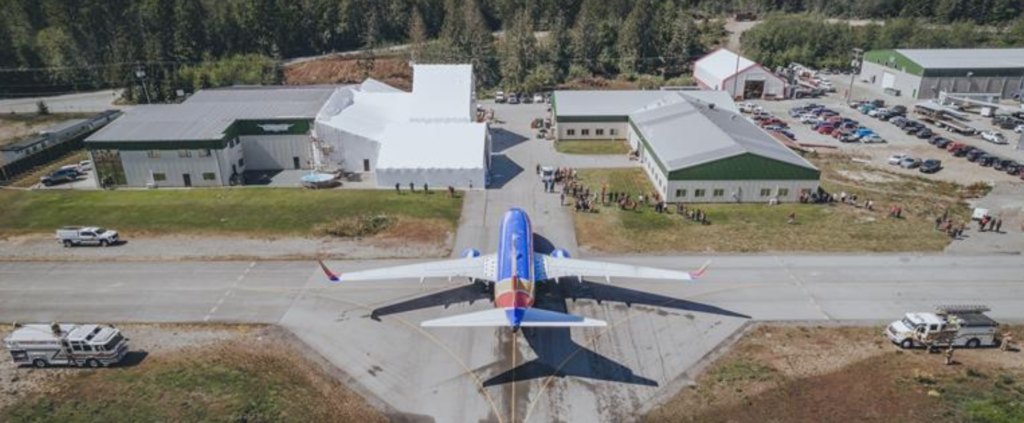
Coulson Aviation has its first Boeing 737-700 from Southwest Airlines and will convert it at its base in Port Alberni, British Columbia. According to FlightGlobal, the latest arrival (N7841A) is the first of up to 10 aircraft that will be converted under Coulson’s Next Gen Fireliner program. Earlier Fireliner conversions used older 737-300s that were also sourced from Southwest.

The MSN28015 aircraft was operated by Denmark’s Maersk Air before it landed with Southwest in 2016. It’s accumulated over 60,000 flight hours.

Britt Coulson, chief operating officer of Coulson Aviation, says the Fireliner is the go-to large airtanker for foreign governments’ purchase because of its multi-role capability — it can transport passengers when not deployed on a fire. It will carry 19K liters (a bit over 5000 gallons).

Coulson's Port Alberni base in British Columbia
Coulson’s Port Alberni base in British Columbia

New wildfire alert system cuts down warning times

Oklahoma is the testing ground for a new wildfire system that uses local National Weather Service (NWS) forecast offices to quicken alerts sent to nearby communities.

The alert system software, called “Wildfire Analyst,” was created by wildfire technology company Technosylva. Its promising results were backed up at a recent U.S. House of Representatives Committee on Science, Space and Technology hearing.

Oklahoma State Forester Mark Goeller explained the system to representatives while testifying at the hearing. He said the software, using NWS data and local emergency management warning systems, significantly reduces fire warning times by predicting a wildfire’s potential spread from the ignition point.

“The fire warning was issued in just six minutes on a recent wildfire occurring in a heavily populated wildland/urban interface area in the Oklahoma City metro,” Goeller said. “Oklahoma is the first state in the nation to use this system. Using our legacy process, it often required approximately 90 minutes to issue the fire warning.”

The Wildfire Analyst software has three core applications, according to Technosylva. The software’s “FireSim” application was the main tool Goeller referred to during the hearing. The application generates real-time fire spread predictions and supports wildfire planning through “what if” scenarios. The software’s other two applications, “FireRisk” and “FireSight,” predict wildfire risk days through forecasts and calculate risk reduction, respectively.

The state’s goal to overhaul its wildfire alert system started after its 2005-06 season when numerous fires burned in Texas and Oklahoma, Goeller said during the hearing. The fires resulted from prolonged drought and strong winds and killed 25 people and 5,000 head of cattle — and destroyed hundreds of homes, according to the Wildland Fire Lessons Learned Center.

Soon after that catastrophic season, the “Southern Great Plains Wildfire Outbreak Group” came together, including members of the Oklahoma Forestry Services, Texas Forest Service, and National Weather Service forecast offices. The partnership spawned from that group eventually led officials to look specifically at how weather dynamics did and could affect the states’ wildfire response.

“The things that I would emphasize as the lessons learned are for other states’ forestry agencies and local emergency management agencies to get to really working closely with their National Weather Service forecast offices,” Goeller said. “Look at the model we apply in Oklahoma, look at the process we went through … the research that went into what affects our weather systems would absolutely be employable in other places.”

Oklahoma is the testing ground for a new wildfire system that uses local National Weather Service (NWS) forecast offices to quicken alerts sent to nearby communities.

The alert system software, called “Wildfire Analyst,” was created by wildfire technology company Technosylva. Its promising results were backed up at a recent U.S. House of Representatives Committee on Science, Space and Technology hearing.

Neptune lands 2024 contract

Neptune’s entire fleet of nine BAe airtankers is now committed to exclusive-use contracts for the season.

Tanker 41 photo © Marty WolinNeptune’s Tanker 41 photo © Marty Wolin

The USFS has awarded Neptune Aviation Services a Multiple Award Task Order Contract (MATOC), with task orders for the three BAe 146 aircraft they still had available for the 2024 season. All three task orders are for exclusive use and include a base year with four 1-year options — along with 160-day guaranteed availability periods.

Neptune’s aircraft have a 99 percent dispatch availability rate.

Neptune BAe lineup
Neptune BAe lineup – photo courtesy Neptune Aviation

They’ll be under contract in states including California and Colorado, according to Jennifer Draughon, Neptune’s president. “We are grateful to everyone at Neptune for helping us secure this contract,” she said.

The BAe tankers have a capacity of 3,000 gallons of retardant or water, and they started their availability on May 21. More info is online at NeptuneAviation.com

now

Fire is a lost tradition in Missouri but this council is reigniting the practice

French Jesuit priest Louis Vivier in 1750 described what 70 years later became the state of Missouri, and in his writings he told of Native Americans there setting fires to the prairies. “The trees are almost as thinly scattered as in our public promenades,” he wrote, and “the Savages set fire to the prairies toward the end of the autumn, when the grass is dry; the fire spreads everywhere and destroys most of the young trees.”
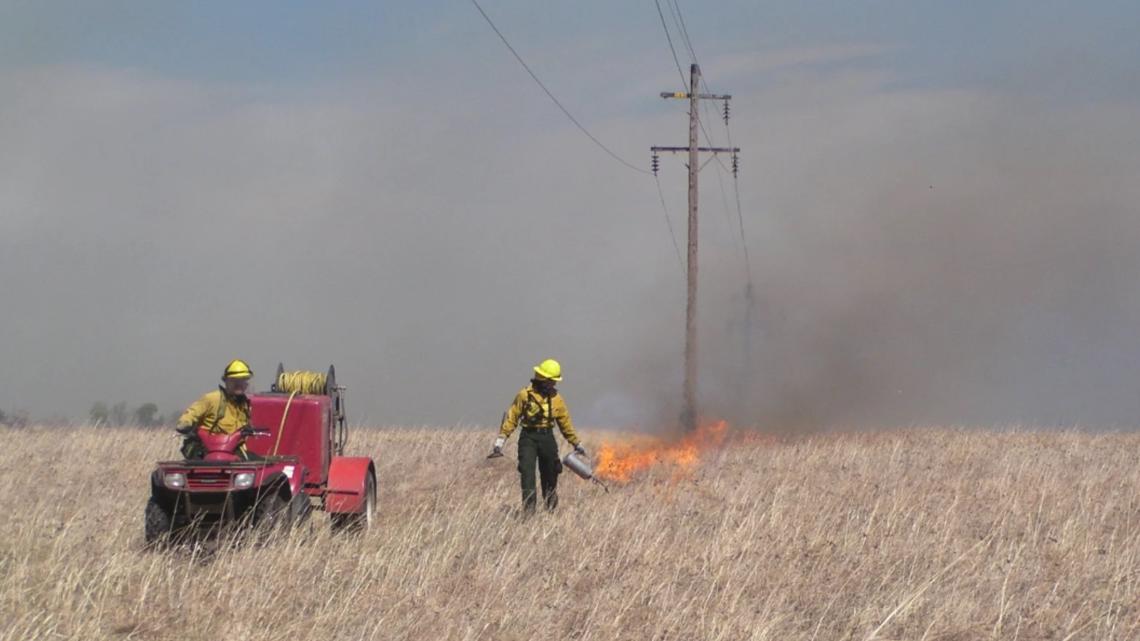
Vivier was right about fire being a frequent occurrence in Missouri, as reported in a feature story on KSDK.com. Midwest tribes had been purposely setting fire to the grasslands and prairies for centuries. They recognized the essential role fire played in the prairie ecosystem, and that knowledge, and the practice of managed burns, is being rekindled by the Missouri Prescribed Fire Council, a coalition of landowners and experts attempting to bring the state’s grasslands back to their once-thriving status.

These practices have been recorded nationwide as the philosophy of fire as medicine, according to the National Park Service.

European colonists’ response to the tradition of cultural burning was the implementation of a century-long fire suppression regime. Missouri’s disappearing prairies in part have the resultant lack of fire to blame. Unregulated tree growth, known as woody plant encroachment into tallgrass prairie environments, has progressed throughout the Midwest as areas of saplings develop without needed periodic fire.

Missouri’s Ozark region, for instance, has existed in the “not enough fire” category for much of recent history, causing a drop in biodiversity and the domination of the landscape by oak, hickory, and cedar trees, according to the University of Washington and others.

The Missouri Prescribed Fire Council, though, is trying to reverse that suppression regime and reintroduce managed burns back into the state for the health of its natural environment.

“Almost all of Missouri’s natural plant communities have adapted with fire,” said Wes Buchheit, councilmember and prescribed fire coordinator biologist with Pheasants Forever & Quail Forever. “Fire is a natural tool and prescribed fire is mimicking that natural process in a more controlled setting … you can benefit a lot of different species, plant and animal, with prescribed fire.”

About 93 percent of Missouri’s 44.6 million acres is privately owned, according to the Missouri Department of Conservation. The lack of public land means any substantive prescribed burning must come through community collaboration. In response to multiple recent historic wildfire seasons, a movement of Prescribed Burn Associations (PBAs) has grown nationwide. Many RxFire efforts are led by federal agencies, but these PBAs are instead a collaboration among landowners. The Missouri Prescribed Fire Council is part of that growing movement, and because wildfires haven’t been a prevalent issue for Missourians, private landowners in the state haven’t been as hesitant to participate in prescribed burning as other wildfire-prone states.

Prescribed fires have burned tens of thousands of acres in 95 of Missouri’s 114 counties between 2020 and 2022, council data showed. Of those, just over 1 percent have escaped control, and most burned just 0.1 acres or less, which is on par with national averages. “The only time that folks ever heard about prescribed fire is when there’s an ‘oops,'” says Council Chair Mark Howell. “They don’t hear about the other almost 99 percent of the time that things go perfectly well.”

Credit: Missouri Prescribed Fire Council