Australian fleet poised and ready, while waiting for late arrivals

Air-Crane Gypsy Lady arriving at Sydney

The Australian aerial firefighting fleet has been upgraded as an anticipated long, hot summer begins across the south, with most states expanding access to more aerial options in their local fleets.

Late season fires in the northern hemisphere have delayed the arrival of some the fleet. In Victoria, the announcement of the summer firefighting fleet of 54 aircraft was tempered by the statement that “2 Aircranes will also join the fleet once their service period ends in North America. Three additional aircraft will be on short-term contracts until the Aircranes arrive.”

Erickson Air-Cranes in Greece
Erickson Air-Cranes on northern hemisphere service, October 2021 in Greece. Photo by Dimitris Klagos.

The National Aerial Firefighting Centre (NAFC) has contracted 177 aircraft on behalf of Australian state and territory governments for the 2024-25 season. This fleet is supplemented by NAFC aircraft contracted as “call when needed”, and additional state owned and state contracted aircraft hired to meet peak demand across the country. In total more than 500 aircraft, provided by over 150 operators, are available as a shared resource for firefighting across Australia for season 2024-2025.

Amid regular calls at the political level for a national sovereign fleet that is less dependent on the variable end to the northern hemisphere fire season, NAFC figures show that 95 percent of the Australian firefighting fleet is already resident year-round in Australia, including 75 percent owned and operated by Australian companies.

The remaining 5 percent are predominantly the larger aircraft, both fixed wing and rotary, that follow the fire seasons around the globe. NAFC contracts these under partnerships between Australian and foreign companies. The aircraft fly on complementary contracts in the northern hemisphere and then are, ideally, packed up and returned in time for the Australian summer.

But that start of Australian summer has its own variable timing that contributes to the annual problem of overlapping seasons across the hemispheres: along the heavily populated east coast of the continent, bushfire season can begin as early as August into September, while New South Wales regularly has a highly active October and November. Further south, Victoria fires appear around December, with Tasmania seeing most activity from January onwards.

With the Australian fire season now well into its southward trajectory from the tropical north – currently in its Wet Season after an active Dry Season of bushfires – to a southern Australia with a year of below average rainfall, fire authorities are relying on their aerial resources for essential support to ground crews. The large grassland regions abutting the forests are particularly vulnerable this year, with several large outbreaks currently being dealt with in Victoria.

The Australian Government has funded NAFC with around $A100 million ($USD 63M) for this season and the next. Two Blackhawks and a Sikorsky S-61N have recently joined the fleet.

At the end of September 2024, the contracted national fleet comprises of:

  • 6 Large fixed wing air tankers
  • 16 Large rotary wing aircraft (Type 1)
  • 68 Medium and small rotary wing aircraft (Type 2 and 3)
  • 54 Fixed wing firebombers
  • 18 Light fixed wing

Coulson Aviation Australia has secured a long-term contract with Australia’s largest state-based fleet. The New South Wales Rural Fire Service announced in July this year that Coulson would manage the NSW fleet for the next 10 years, after managing it for the previous five.

The NSW RFS fleet of 11 aircraft includes a 737 large air tanker (the Marie Bashir, which has seen service in North America including a three-month stint in 2023), two Cessna Citations, six Bell-412 helicopters, a Chinook helicopter, and a Beechcraft Super King Air. Under the new contract, these aircraft will be overseen by primarily Australian crews, in a shift to bolster the local workforce and makes NSW more self-sufficient.

NSW RFS 737 fire tanker at NIFC.
The New South Wales Rural Fire Service 737 at the National Interagency Fire Centre in Boise, Idaho in 2023.

The fleet also supports other emergency services, such as the NSW State Emergency Service for rescues during floods, when they are not being used for firefighting duties.

Even the smaller states are increasing their capacities from the NAFC pool. Tasmania has received 15 dedicated aircraft from the NAFC fleet, to be managed locally by the Tasmania Fire Service. South Australia has retained its record high level of 31 aircraft from last year into this year, managed by the Country Fire Service, including five Blackhawk helicopters. Western Australia, immense in size but small in population, has found an extra $A10 million for its fleet, which includes four Blackhawks and a C130 Hercules.

Italian mafia linked to massive spike in wildfires, research finds

Italy has seen massive recent increases in both burned areas and the total number of fires, according to the European Forest Fire Information System (EFFIS).

The nation had abnormally high numbers throughout its 2023, 2021, 2017, and 2007 wildfire seasons, EFFIS’ annual statistics show. The vast majority of fires and burned area between 2002 and 2023 happened in Sicily, around 77% of which were arson, and new research has uncovered a likely cause: the mafia.

Italian officials in both 2021 and 2023 believed the wildfires were intentionally set, according to a new paper from the University of California, Berkeley, published in the Criminology & Criminal Justice scientific journal. The mayor of Polizzi Generosa said the region was “under attack” in 2021, while Palermo’s mayor said the increase in fires suggested “malicious acts…of absolute wickedness.”

The trend has roots in the history of Southern Italy, according to the paper.

“The setting of intentional wildfire, incendio doloso, in Southern Italy has been tied to vendettas, land disputes, and protests, but recently the mafia has operationalized fire as an accumulation strategy and for territorial control,” the paper said. “Non-governmental organizations (NGOs) have estimated that 80% of wildfires were concentrated in regions known to have a powerful mafia presence, while the Anti-Mafia Commission report completed in May 2022 concludes that the fires in Sicily show undeniably that the predatory actions of Sicily’s Cosa Nostra are a continued “condition of ‘power’ and ‘control’ in the territory which . . . go hand in hand with interests of an economic nature.”

The Sicilian Anti-Mafia Commission launched an investigation during 2021’s spike in fires, according to the paper. After 10 months of testimony from numerous officials, the commission concluded that the fires were often set for numerous profit-seeking reasons, including burning land owned by farmers who refused to sell their land to green energy projects.

Numerous fires were also reportedly set during heat waves in the same areas to overwhelm fire crews, who would be forced to choose which fires to put out and which would be left to burn. Another investigation was launched in the wake of 2023’s wildfires that burned on the hillsides surrounding Sicily’s capital city of Palermo, land considered desirable solar and wind installations, rather than rural, inland, and forested regions that were burned in 2021.

“The interviews, tours, conversations, and analysis cited in this work all point to something malicious afoot in the burned landscapes of Sicily,” the paper said. “While the perpetrators may never be caught, looking at Sicily’s perceived, conceived, and lived space—urban and rural—in history and today might help answer the question: What does setting land on fire offer to the power dynamics found in Sicily today, and does it point toward the next, future iteration of the Cosa Nostra?”

Click here to read the full paper.

Credit: EFFIS


Aerial firefighting company upgrades its US arsenal

An aerial firefighting company will soon introduce a new aircraft to the United States’ wildfire suppression arsenal as it begins upgrading a portion of its air tanker fleet.

Neptune Aviation Services, based in Missoula, Montana, recently announced it would begin partially transitioning its airtanker platform from BAe 146s to Airbus A319s. The transition is expected to be completed by 2027, with the company operating between 10 to 15 aircraft in its fleet, a mix of A319s and BAe 146s depending on the evolving aerial firefighting market.

The company is the first to convert A319 planes for aerial firefighting operations, the United States Forest Service (USFS) confirmed with WildfireToday. The aircraft can hold a minimum of 4,500 gallons of fire retardant, compared with the maximum 3,000 gallons that the BAe 146 could hold, along with a greater fuel capacity.

The A319’s retardant capacity rides the edge between large airtankers (LATs) and very large airtankers (VLATs) as characterized by USFS. LATs have historically only been able to deliver 2,000 to 4,000 gallons of retardant, while VLATs are capable of delivering over 8,000 gallons.

Credit: Julian Herzog via Wikimedia Commons

Airbus, the manufacturer of A319s, will reportedly provide comprehensive support for the lifecycle of the fleet to ensure long-term success. The company originally created the A319, part of the A320 aircraft family, in the mid-90s and paired it with the “fly-by-wire” (FBW) digital flying system, according to Airbus’ website. The then-revolutionary and now-standard system allowed a computer to control wing and tail functions to a pilot’s wishes.

A new and improved FBW system will reportedly accompany the converted planes entering Neptune’s fleet.

“The FBW system uses computers to process pilot inputs and then sends electrical signals to control the aircraft’s flight surfaces, ensuring the desired flight path,” the company said in a press release to WildfireToday.  “These capabilities enhance safety, reliability, and maneuverability, while reducing weight by eliminating traditional cables, pulleys, and rods.”

Light ’em up – “Ignition: Lighting Fires in a Burning World” book review

A book review by Brian Ballou

Ignition: Lighting Fires in a Burning World

By M.R. O’Connor

“You sing the country before you burn it,” an Aboriginal fire-lighter in Australia told the author. “In your mind, you see the fire, you know where it is going, and you know where it will stop. Only then do you light the fire.”

Ignition, book cover
Ignition: Lighting Fires in a Burning World, by MR O’Connor

Close your eyes the next time you are preparing to start a prescribed fire project and visualize its beginning and end. Where will you paint the ground with brushstrokes of fire? What is the wind saying? What tricks does Mother Fire have up her sleeve?

And, importantly, how will the day end? In calm twilight laced with thin smoke and the soft sound of dying, crackling fires? Or in a cacophony of bulldozers and bombers and the sight of your prescribed fire project racing over a far ridge?

“Ignition: Lighting Fires in a Burning World” chronicles author M.R. O’Connor’s deep dive into the world of prescribed fire, mostly in the United States but occasionally elsewhere. She embeds herself with state, federal and private crews as they conduct prescribed burns — taking the training, wearing the clothes, learning the terms and the lingo — and finds it deeply fascinating and occasionally quite frightening.

There is a rush these days to return fire to the land, a belated response to a few decades of staggeringly large wildfires that could have — should have — been tempered by prescribed fire. She talked with many firefighters and fire-lighters and “began to deduce how complex working with fire could be.”

Using fire as a tool is an art people are still grappling with. “Fire-lighters seemed to carry with them a dream of a place where fire was stripped of safety regulations, government qualifications, diesel fuel, and engines. In this pyro-Eden, fire was so benign that lighting one was like watering a garden.”

It’s dizzying to think that something as simple as returning fire to the land could, and likely would, avert highly aggressive wildfire behavior. Could pre-treatment have kept 2018’s Carr Fire from spawning a fire “burning so hot and generating such intense winds that a whirl of fire with winds of 143 miles per hour … slammed into Redding. It picked up a truck and threw it a quarter of a mile down the road, killing the firefighter inside. It was the equivalent of a category 3 tornado.”

Indeed, the fire environment had become so dangerous that firefighters had begun experiencing post-trauma health problems at an unprecedented level. One firefighter O’Connor discussed this with “made me consider that confronting a monster — what you saw out there, the feelings you experienced and things and people you lost — could exact a mental and spiritual cost.”

“I thought about the dragon-fighting analogy a lot,” wrote O’Connor, digesting what she had been told by firefighters coping with wildfire-induced PTSD. “It conveyed something of the monstrous qualities of the wildfires themselves and hinted at the quixotic nature of fighting them.”

After years of fighting wildfires, some “began to see suppression as a lost cause.” One said, “If a fire was close to any type of community, it never crossed my mind that we shouldn’t go put the thing out. [But] I was on a lot of fires way out in the wilderness where I thought, Well, if somebody gets hurt or killed out here, this is really dumb. This is kind of for nothing, this is a lightning fire. This area needs to burn.”

With so much land needing a fire, and wildfires increasingly getting larger and more dangerous, agencies have embraced programs like TREX, in which fire-lighting skills are taught and tested. However, actual prescribed fires have moved forward slowly due to the fear of losing control of the burn, destroying private land and homes, even though this has rarely occurred.

“Of the roughly forty-five hundred fires [the Forest Service] ignited each year,” writes O’Connor, “fewer than 1 percent of them escaped control. The ones that did, however, were often emblazoned in collective memory and cited for decades. People didn’t forget, let along forgive, when the government intentionally lit fires that ended up burning down homes.”

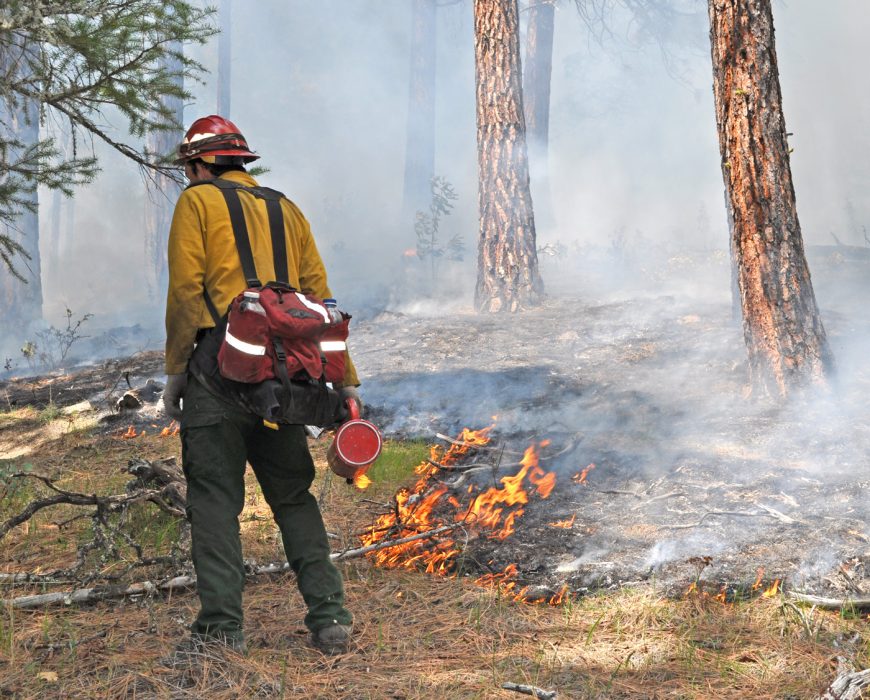
A 2012 prescribed burn in Ashland, Oregon
A 2012 prescribed burn in Ashland, Oregon: Brian Ballou.

Nearing the conclusion of her book, O’Connor highlights the Washburn Fire that burned in 2022 within Yosemite National Park. The news media homed in on whether the fire would consume the Mariposa Grove of giant sequoias. “The Washburn Fire and so many others became apocalypse clickbait.” The news media nearly completely ignored the fact that areas that had been treated with prescribed fire burned with much lower intensity, if at all.

“Ignition: Lighting Fires in a Burning World” is a fine read, and I find it particularly impressive that it was written by someone who knew next to nothing about prescribed fire. Perhaps that was best.

She asked wildland firefighters whether the current fire environment was too dangerous — an interesting question for people who sorta kinda really really like having a bit of danger in their day — and learned that maybe, yes, it was getting a bit too hairy out there.

O’Connor never provides a succinct message at the end of the book. I rather like that.  But the alignment of the various segments of the book make it clear: The time for prescribed fire is today, yesterday and tomorrow. No, it won’t always be pretty.

Brian Ballou retired from the Oregon Dept. of Forestry where he was a fire prevention specialist and public information officer. In the 1970s and ‘80s he was a firefighter with the US Forest Service. He lives in Medford, Oregon.

Ignition: Lighting Fires in a Burning World

By M.R. O’Connor

Bold Type Books

Copyright 2023

Nonfiction

Hardbound, 372 pages, $30 (also available from Amazon and Apple in ebook format)


Helping smokejumpers to predict wind turbulence

Wind turbulence is a well-known factor in the complex wildland fire environment.  Sometimes it is the wind shear over vegetation, buildings, or terrain, and other times it’s the buoyant forces from solar surface heating or thermal plume injections from the fire itself.

Smokejumpers approaching landing zone in 2011. Photo: Mike McMillan

For a smokejumper, parachuting from a low-flying aircraft in a remote and rugged landscape, turbulence near the ground at the atmospheric boundary layer (ABL) is of particular concern.

Scientists at the Rocky Mountain Research Station have published a study on how to better predict terrain-induced turbulence to assist smokejumper operations.

Smokejumpers are employed by the United States Department of Agriculture Forest Service and the Department of Interior Bureau of Land Management throughout the western US and Alaska. These smokejumpers use Ram-Air style parachutes, which require forward speed to maintain lift (USFS 2018). Small wind fluctuations can drastically impact parachute aerodynamics. Existing protocols to assess ABL turbulence during jump operations include the release of weighted streamers to visually assess the winds and turbulence. Numerous hard landings, serious accidents, and fatalities have been attributed to unexpected near-surface turbulence during training and operational jumps. Searching “Smokejumper Accident” on the Wildland Fire Lessons Learned Center’s website shows an average of four serious jump injuries per year between 2015–2023 in which turbulence potentially played a factor.

Wind flow over ridges can create large wake zones with increased turbulence that extend far downwind. This phenomenon likely contributed to the hard landing that resulted in a smokejumper fatality during a jump on the Eicks Fire in New Mexico in 2021 The research team used WindNinja, the high-resolution diagnostic wind model for wildland fire applications, to investigate surface winds and turbulence during the jump operation on the Eicks Fire. The findings indicate that the jump took place in the wake of a tall upwind ridge that created a large re-circulation zone with areas of turbulence.

WindNinja is routinely used by fire managers in the US and around the world and can drive operational fire spread models such as FlamMap and Prometheus. These uses take wind speed and direction predictions from WindNinja, however, the research notes that WindNinja can also generate information about the near-surface atmosphere, such as turbulence and shear. The researchers say these capabilities, to date, have not been made accessible to end users or formally assessed for accuracy by the development team. WindNinja has been evaluated in the field but not in the really rugged terrain where smokejumper operations often occur. Here, wind modeling is far more complex and challenging.

This study concluded that WindNinja’s lesser-known ability to simulate wind turbulence could be of use for assessing smokejumper operations under moderate to high wind conditions.

They also suggest that although this work focused on smoke jumping, real-time turbulence predictions from WindNinja could be useful for other near-surface firefighting aerial operations.

Predicting terrain-induced wind turbulence for smokejumper parachute operations is an open-access article in the International Journal of Wildland Fire.

More than 1.5 million people die annually from wildfire air pollution

Wildfire smoke is increasingly encroaching on urban and rural spaces throughout the world. Increasingly frequent wildfires in Siberia are projected to cause thousands of deaths and billions in costs for East Asia. Smoke temporarily covered all U.S. lakes between 2019 and 2021.

Researchers, however, know little about the global mortality burden related to smoke pollution. A new study published in The Lancet scientific journal sought to learn more about that burden.

Researchers found that 1.53 million deaths per year were attributable to wildfire-driven air pollution between 2000 and 2019, including 0.45 million deaths from cardiovascular issues and 0.22 million respiratory deaths. Particulate matter pollution contributed to 77.6% of deaths, while 22.4% of the deaths were attributed to surface ozone pollution.

Smoke Beaver Fire
Smoke at the Beaver Fire in Northern California. August 12, 2014. Photo by Bill Gabbert.

Researchers calculated particulate matter and surface ozone from wildfires across 59 countries between 2000 and 2019 and obtained relative risks for both the short-term and long-term impact of exposures to particulate matter and surface ozone on cardiovascular and respiratory mortality. The data was obtained from previously published meta-analyses on particulate matter and surface ozone and from the Global Burden of Diseases Study 2019 published by the Institute for Health Metrics and Evaluation.

Over 90% of all attributable deaths were in low-income and middle-income regions. Sub-Saharan Africa had 606,769 deaths from wildfire smoke pollution, southeast Asia had 206,817 deaths, south Asia had 170,762 deaths, and east Asia had 147,291 deaths. The five countries with the largest death totals were China, the Democratic Republic of the Congo, India, Indonesia, and Nigeria.

Deaths attributed to cardiovascular issues saw an annual increase of 1.67% per year between 2000 and 2019, the study said. Deaths attributed to respiratory issues did not have statistically significant trends. In 2019, the attributable mortality rates in low-income countries remained four times higher than those in high-income countries, though this had reduced from nine times in 2000.

Wildfire smoke directly increases dementia risk, study find

A study of more than 1.6 million people in California found a direct correlation between exposure to wildfire smoke and increased dementia risk.

The research, published in the JAMA Neurology scientific journal, used electronic health record data between January 2008 to December 2019 among members of the Kaiser Permanente Southern California system, which serves 4.7 million people in the state. The study focused on people aged 60 years old or older but excluded people who had a dementia diagnosis before cohort entry.

The study found that people exposed to fine particulate matter PM2.5 from wildfires had an 18% increase in the odds of a dementia diagnosis, compared with an only 1% increase in people exposed to non-wildfire PM2.5. The most at-risk subjects were less than 75 years old, were from racially minoritized subgroups, and those living in high-poverty census tracts.

“As the climate changes, interventions focused on reducing wildfire PM2.5 exposure may reduce dementia diagnoses and related inequities,” the researchers said.

s2t airtanker holy fire
An S-2T air tanker comes out of the smoke to drop retardant near the communication towers on Santiago Peak in Southern California August 8, 2018 as the Holy Fire approaches. HPWREN image.

It’s not the first time wildfire smoke has been linked to neurological hazards. University of New Mexico Health Sciences researchers published a study in 2021 that found people inhaled microscopic particles from woodsmoke which worked their way into the bloodstream and reached the brain. The particles put people at risk for neurological problems ranging from premature aging and various forms of dementia to depression and even psychosis.

READ MORE: Researchers find that wildfire smoke poses neurological hazards

“Past research has consistently identified an association between long-term PM2.5 exposure and incident dementia, with varying magnitudes of association depending on study context, outcome ascertainment, and exposure averaging period,” researchers from the JAMA study said. “These results align with prior research consistently demonstrating that individual-level and area-level social determinants compound the risk of adverse health outcomes associated with climate-driven environmental exposures.”

Examples of how socioeconomic inequalities can exacerbate health issues from wildfire smoke include lower-quality housing increasing smoke infiltration and lack of air filtration systems to improve air quality during extreme smoke events.

“Future studies may wish to explicitly study these factors as effect modifiers,” the researchers said.

A fire whirl was spotted at the Park Fire in the early evening hours of July 25, 2024. ~ AlertCalifornia camera
A fire whirl was spotted at the Park Fire in the early evening hours of July 25, 2024.
~ AlertCalifornia camera

Increasingly frequent and severe wildfires causing a firefighting aircraft boom

Extreme wildfire events are becoming more frequent and intense, satellite imagery has shown.

Six of the past seven years have been among the most extreme wildfire years on record, according to research from Australia’s University of Tasmania. The frequency of extreme wildfire events has also more than doubled between 2003 and 2023.

The research “provides concrete evidence of a worrying trend,” according to lead researcher Dr. Calum Cunningham.

A worrying trend for the world’s living beings is seemingly an economic opportunity for the global firefighting aircraft market, a new report from the Business Research Company said.

File photo of an Air Tractor 802 Fire Boss operated by Conair. Not necessarily the aircraft involved in the incident.
File photo of an Air Tractor 802 Fire Boss operated by Conair.

The market has “grown strongly” in recent years, with an increase from $8.77 billion in 2023 to $9.57 billion in 2024. The market is expected to grow to $13.42 by 2028 at a compound annual growth rate of 8.8%.

“The growth in the forecast period can be attributed to climate change impact on wildfires, development of next-generation fire retardants, increased focus on early detection, global expansion of wildland-urban interfaces, and government preparedness investments,” the report said. “Major trends in the forecast period include enhanced remote sensing technologies, integration of drone technology, advancements in aerial firefighting technologies, the growing importance of aerial firefighting services, and global collaboration for aerial firefighting resources.”

One of the major market trends identified in the report was the rise of autonomous aerial firefighting technology, including the autonomous MK2 developed by California-based company Rain. The autonomous helicopter is reportedly designed to transport around 30 gallons of payload to a fire and can perform all standard helicopter flight phases controlled by a remote operator.

A similar helicopter from Lockheed Martin was recently demonstrated to an audience of NASA, FEMA, and wildland firefighting officials. The company claimed the aircraft could be commanded solely on a tablet from 300 miles away and extinguish fires as small as 12 inches in diameter.

READ MORE: Self-driving aircraft may soon head to a wildfire near you

Credit: Lockheed Martin

Another market driver the report found is rising global urbanization. The World Bank reported around 56% of the world’s total population lives in urban areas as of 2023, and the global urban population is expected to reach 6 billion by 2045. This, coupled with the forecast surge in the number of wildfires, is expected to drive the growth of the firefighting aircraft market.

The region with the largest share of the firefighting aircraft market was reportedly Asia-Pacific, but North America is expected to be the fastest-growing region over the coming years.